Validated Researcher in the Loop Workflow for Systematic Reviews
Validated Researcher in the Loop Workflow for Systematic Reviews
AI can be trusted for deduplication, title/abstract screening, and structured data extraction in systematic reviews, provided a researcher stays in the loop with audit logs and validation checks. Recent work shows sensitivity near 100% and extraction accuracy around 98% under these conditions. Platforms like PaperSynapse now build that oversight directly into the workflow.
TL;DR:
- AI achieves near 100% sensitivity in screening and about 98% accuracy in data extraction when audit logs and validation checks are in place.
- Deduplication and abstract screening are the stages where AI provides the most significant time savings, often reducing review time from weeks to days.
- Validation involves retrospective tests, calibration on sample records, and comparison against source PDFs to ensure the AI’s reliability before full deployment.
- Proper documentation of AI tools, thresholds, override rules, and validation results must be integrated into a reproducible protocol for transparency.
- Most effective AI tools, like Papersynapse, include customizable fields, audit trails, and PRISMA-ready exports, but require thorough pilot testing and validation.
Table of Contents
- Where AI Fits in the Systematic Review Workflow
- What Does the Evidence Say About AI Accuracy in Reviews?
- How Do You Evaluate and Choose an AI Tool for Your Review?
- How Do You Integrate AI Into a PRISMA-Compliant Protocol?
- Papersynapse in Practice: What a Validated Workflow Looks Like
- What Should Researchers Actually Do With This Technology?
- Start a Pilot Review With Papersynapse
- Sources
Where AI Fits in the Systematic Review Workflow
AI does not replace a systematic review team. It replaces the repetitive parts of the job that eat months without demanding much judgment. Mapping AI onto the standard workflow makes clear where it earns its keep and where a human still has to make the call.
- Search and discovery: AI can expand search strings, suggest synonyms, and flag related records across databases, though final search strategy still needs a librarian or methodologist’s sign-off.
- Deduplication: this is where automation is most mature. Fuzzy matching across titles, authors, and DOIs catches near-duplicates that simple string matching misses.
- Title/abstract screening: AI models rank records by relevance, letting reviewers work through a prioritized queue instead of an alphabetical dump.
- Full-text triage: retrieval-augmented models can now scan full PDFs and flag likely inclusions, though this stage benefits most from human spot-checking.
- Structured data extraction: AI reads abstracts or full texts and populates fields like PICO elements, sample size, or outcome measures into a table.
- Risk-of-bias tagging: AI can pre-tag likely bias domains, but the final judgment call remains a human task.
- PRISMA reporting: some platforms auto-generate flow diagrams and counts for inclusion/exclusion at each stage.
The outputs researchers actually see vary in reliability. A deduplicated library or a prioritized screening list is usually solid straight out of the tool. A PICO extraction table needs a spot check. Deeper judgments, like whether a study’s randomization method introduced bias, still need a trained eye reading the actual source, not just an AI-generated excerpt.
What Does the Evidence Say About AI Accuracy in Reviews?
The numbers are better than most researchers expect, but they come with caveats worth understanding before you trust them blindly.
The data: A 2026 preprint reported AI-assisted screening sensitivity of 100% ± 0%, specificity of 90.8% ± 8.6%, and data-extraction accuracy of 98.0% ± 3.5% across the tested review sets.
A systematic review that excludes a relevant study by mistake is a far bigger problem than one that includes a few extra records for a human to reject later. Specificity sitting lower, around 91%, reflects that tradeoff directly: the model is calibrated to over-include rather than risk a false negative.
That calibration choice has a workload cost. Lower specificity means more records survive to full-text review than a perfectly tuned filter would allow, and that’s the deliberate tradeoff worth defending in your protocol.
Time savings tend to concentrate at specific stages rather than spreading evenly across the whole process:
- Deduplication and title/abstract screening see the largest gains, often cutting review time from weeks to days.
- One LLM-plus-retrieval-augmented-generation approach cut screening time by roughly 95.5%, dropping from 564.4 hours to 25.5 hours while maintaining a 0% false negative rate.
- Full-text extraction and risk-of-bias assessment remain slower, since these steps demand contextual judgment that current models handle less reliably.
Tools like Elicit demonstrate both the upside and the ceiling: added coverage across several SR stages, paired with documented limitations in repeatability compared to fully manual screening.
How Do You Evaluate and Choose an AI Tool for Your Review?
Not every AI tool sold for evidence synthesis deserves a spot in your protocol. A review of AI tools in educational psychology found only seven of 282 screened tools met basic inclusion criteria for rigorous evaluation. That ratio should temper enthusiasm for any tool’s marketing claims, including the ones in this article.
Before adopting a tool, run it through this checklist:
- Audit trail availability. Can you export a log showing every AI decision, timestamp, and any human override?
- Export formats. Does it produce PRISMA-compliant flow data and CSV or Excel exports your team can archive?
- Customizable extraction fields. Can you define your own PICO or outcome fields, rather than being locked into generic templates?
- Override capability. Can a reviewer flag and correct an AI decision without losing the record of what the AI originally said?
- Security and compliance. Where is data stored, and does the vendor meet your institution’s data-handling requirements?
- Documentation and support. Is there a published methodology, and can you reach a human when something breaks?
Checklists like this one line up closely with the systematic review quality criteria most methodologists already use to judge manual processes.
Beyond the checklist, run three concrete validation tests on your own data before trusting a tool with a live review:
- Build a retrospective known-included set: run the AI against a review you already completed manually and check whether it recovers your known included studies.
- Calibrate on a random sample of 200 to 500 records, comparing AI decisions against a human reviewer’s independent screening.
- Run an extraction reconciliation test on roughly 20 full texts, comparing AI-extracted fields line by line against the source PDF.
Set your acceptance threshold explicitly. Most methodologists target a false negative rate near 0% for screening decisions, since a missed study is far more costly than an extra hour spent excluding a false positive.
Pro Tip: Run your calibration sample before you touch a single record from the actual review. Testing on live data means you find the tool’s blind spots after they’ve already cost you time, not before.
How Do You Integrate AI Into a PRISMA-Compliant Protocol?
Bringing AI into a systematic review isn’t a plug-and-play swap. It requires protocol changes that keep the review reproducible and defensible to a peer reviewer who asks how, exactly, the screening happened.
Start with the protocol document itself:
- Document the AI tool and version used, including model name and screening thresholds.
- State your stopping rules in advance: what specificity or false negative rate triggers a manual re-screen of excluded records.
- Log every override a human reviewer makes to an AI decision, with a brief reason.
- Report the AI methodology in your final manuscript, matching the transparency standard expected in reproducible literature review methodology.
Piloting the workflow before full deployment saves headaches later:
- Select a small sample set, ideally one you’ve already screened manually, and run it through the AI tool.
- Apply the validation tests from the evaluation checklist and adjust thresholds based on results.
- Assign a specific team member to review every AI-included record before it advances to full-text screening.
- Build in a disagreement resolution step: when two reviewers or a reviewer and the AI disagree, a third person makes the final call.
- Verify a sample of extracted data fields against the original PDF before locking the extraction table.
Practical experience across teams doing this work suggests the biggest early wins come from deduplication and abstract screening, not full-text extraction. Treat the extraction stage with more skepticism until your team has built confidence through repeated calibration on abstract screening.
Papersynapse in Practice: What a Validated Workflow Looks Like
Papersynapse was built around the exact checklist above, not bolted onto it after the fact. Researchers import references directly from Scopus or Web of Science, define their own extraction fields instead of accepting a fixed template, and get a full audit trail of every AI decision alongside PRISMA-ready exports.
What that looks like operationally:
- Custom extraction fields mapped to your protocol’s PICO or outcome variables, not a generic one-size-fits-all table.
- Audit logs tracking every extraction decision, so a peer reviewer or co-author can trace exactly how a data point was generated.
- Collaboration tools letting a team split screening and extraction work while keeping one shared, versioned dataset.
Claimed throughput: Papersynapse reports processing up to 200 papers in under two minutes for structured extraction, a figure worth verifying against your own paper set during a pilot rather than taking at face value.
Run the same three validation tests here that you’d run on any candidate tool: a retrospective known-included check, a calibration sample, and an extraction reconciliation against source PDFs. The value isn’t the speed claim on its own. It’s whether that speed holds up once you’ve checked the outputs against your own manually screened baseline.
What Should Researchers Actually Do With This Technology?
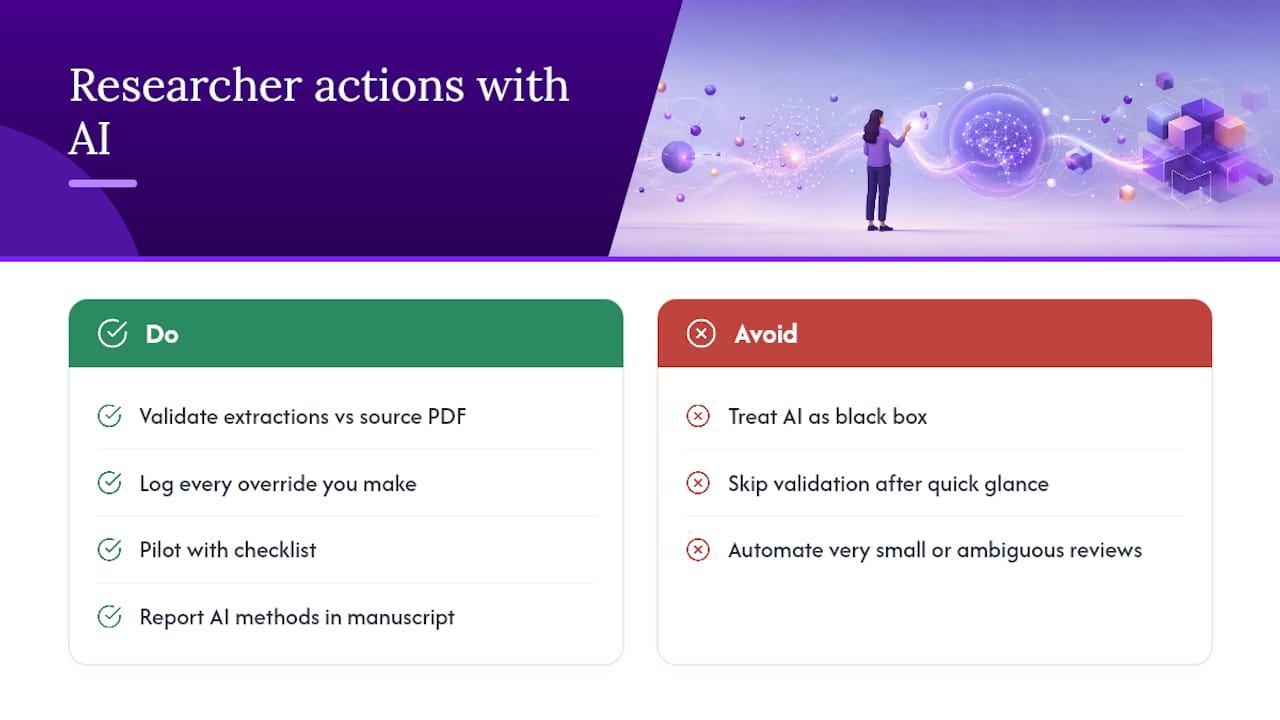
The biggest mistake I see isn’t over-trusting AI. It’s treating it as a black box and skipping the validation step entirely, because the tool “seemed to work” on a quick glance. Always check extractions against the source PDF, and log every override you make.
Skip automation entirely for very small evidence sets or reviews with ambiguous outcome definitions. AI calibration needs volume to mean anything. Pilot with the checklist above, then report your AI methods in the manuscript. Reviewers will ask.
*— Ubada
Start a Pilot Review With Papersynapse
Papersynapse gives you the audit trail, custom extraction fields, and PRISMA exports that the evaluation checklist above demands, without asking your team to stitch together three separate tools to get there.
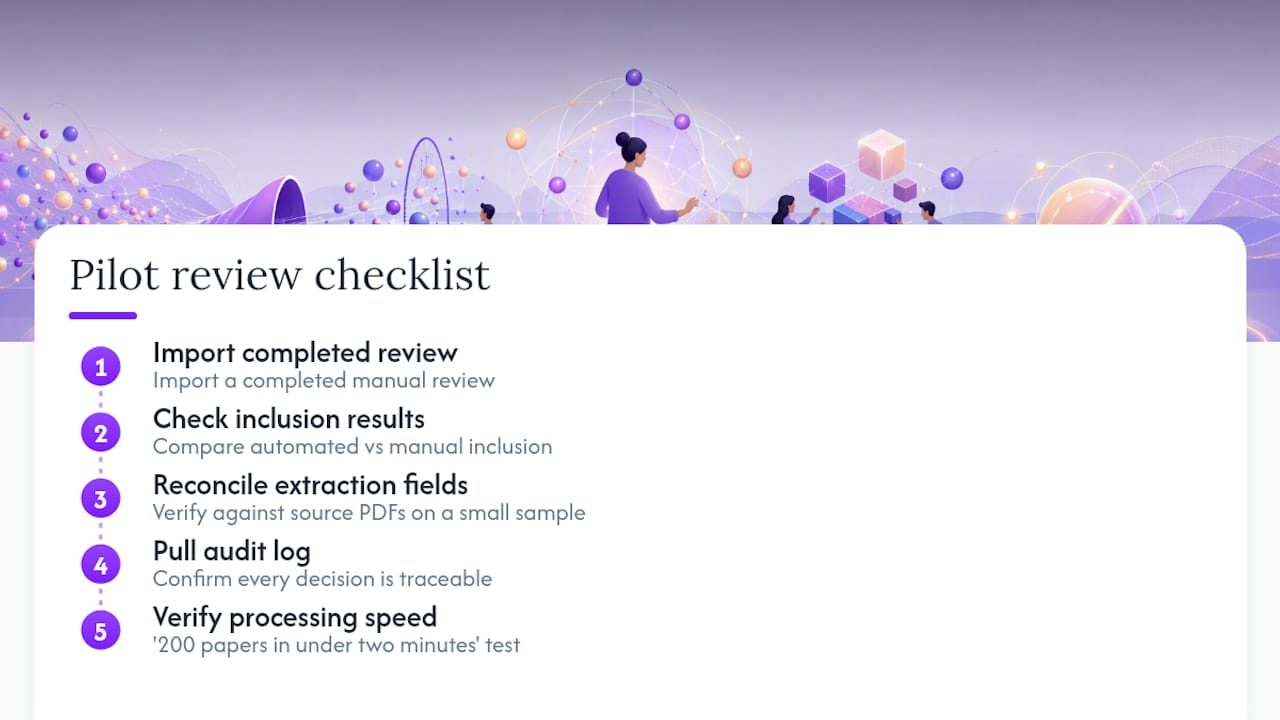
Before committing a full review to it, run the same pilot test suggested throughout this article: import a review you’ve already completed manually, check the retrospective inclusion results, reconcile extracted fields against source PDFs on a small sample, and pull the audit log to confirm every decision is traceable. That’s the honest test of whether the claimed processing speed, up to 200 papers in under two minutes, holds up on your actual dataset.
Visit the Papersynapse product page to start a trial, or reach out about a team pilot if you’re coordinating a multi-reviewer systematic review across a larger research group.
Sources
For deeper method guidance, consult the AHRQ white paper on machine learning tools, Cochrane’s methods guidance on AI, and the King’s College London library guide on AI in evidence synthesis. For lifecycle audit practices, see this AI audit checklist.
- Preprint (2026) — AI-assisted systematic review performance metrics
- Using artificial intelligence for systematic review: the example of Elicit