Systematic Reviews: Protocol First AI Label Mapping After 50 Studies
Systematic Reviews: Protocol First AI Label Mapping After 50 Studies
AI label mapping is the automated process of normalizing extracted study fields, outcome names, PICO elements, and study-design terms into a consistent, predefined vocabulary across a systematic review. The recommended approach follows PRISMA and Cochrane/MECIR piloting standards: build a versioned codebook first, let AI propose labels, and route ambiguous cases to human adjudication. Once a review passes roughly 50 studies or the source labels get messy, this workflow (the one Papersynapse runs natively) beats manual normalization on both speed and consistency.
TL;DR:
- Setting clear rules for field scope, granularity, and versioning in the codebook prevents re-tagging during the normalization process.
- Pilot runs with 20 to 30 studies help identify ambiguous terms and refine the codebook before processing larger datasets to avoid delays.
- Tracking label provenance, correction rates, and agreement statistics ensures the quality and reproducibility of AI-mapped data for peer review.
- Exported structured datasets must use dedicated label columns and version control to maintain consistency and facilitate software ingestion.
- Involving humans for ambiguous cases and iterating prompts on pilot batches improve accuracy and defendability of the normalized labels.
Table of Contents
- What Belongs on Your Pre-Mapping Checklist?
- How Does an AI Label Mapping Pipeline Actually Run?
- How Do You Build a Codebook That AI Can Actually Follow?
- [What Quality Checks Make AI-Mapped Labels Defensible?](#what-quality-checkshttpsabmiumcom-make-ai-mapped-labels-defensible)
- What Should You Report for PRISMA and MECIR Compliance?
- How Do You Move Off Spreadsheets Into Structured Exports?
- Practitioner Perspective: What Actually Breaks in Real Reviews
- Papersynapse: A Protocol-First Platform Built for This Exact Workflow
- Where to Read Deeper on Extraction Methods
- Sources
What Belongs on Your Pre-Mapping Checklist?
Before any AI touches your dataset, your team needs to lock in a handful of decisions. Skipping this step is the single fastest way to end up re-tagging 200 papers a second time.
- Field scope: decide exactly which fields get normalized, typically PICO elements, outcome names, and study-design terms, and leave free-text fields untouched.
- Granularity rules: set how fine-grained categories go (e.g., “randomized controlled trial” vs. “parallel-group RCT”) and make sure categories are mutually exclusive.
- Codebook versioning: draft a numbered, dated codebook before extraction starts, not after.
- AI role assignment: choose whether the model acts as a DirectLabeler (assigns final labels), an AssistantLabeler (suggests, human confirms), or a PseudoLabeler (generates draft labels for a separate model to refine), a taxonomy described in recent NLP literature.
- QC thresholds: fix your pilot sample size and the interrater agreement statistic you’ll report before you see a single result.
How Does an AI Label Mapping Pipeline Actually Run?
A working pipeline has clear stages, clear ownership, and a feedback loop between the model and your review team. Here is the sequence most protocol-first teams follow:
- Import references. Bring in citations as RIS or CSV exports from Scopus, Web of Science, or your reference manager. Abstracts remain the standard input for automated extraction, since full-text parsing introduces formatting noise that most models still struggle with, a pattern confirmed in recent living-review updates.
- Run AI extraction. The model reads each abstract and populates your structured fields: study design, sample size, outcome names, comparator arms.
- Apply label normalization. Extracted terms get mapped to your controlled vocabulary. This is where an AssistantLabeler flags “12-week walking program” and “structured aerobic intervention” as the same intervention category, rather than leaving them as two entries.
- Human review checkpoint. A reviewer spot-checks the pilot batch, confirms or overrides AI suggestions, and logs corrections.
- Adjudication. Disagreements between AI and human, or between two human coders on critical outcomes, go to a third reviewer.
- Export and lock. Once agreement stabilizes, the dataset exports with provenance tags intact for analysis.
Teams frequently underestimate how much stage 4 shapes everything downstream. A pilot run on 20 to 30 papers, standard practice under Cochrane/MECIR guidance, usually surfaces the ambiguous terms your codebook missed. Fix them there, and the remaining 170 papers move through in minutes rather than days. Papersynapse’s own benchmark, processing up to 200 papers in under two minutes once the codebook is set, only holds up if that pilot stage catches your edge cases first.
How Do You Build a Codebook That AI Can Actually Follow?
A codebook that works for AI mapping looks different from a codebook written purely for human coders. It needs to be explicit about edge cases, because a model won’t infer intent the way a trained research assistant will.
Start with a hierarchy: broad category first (e.g., “study design”), then mutually exclusive subcategories (RCT, cluster-RCT, quasi-experimental). Where a standard ontology exists, MeSH terms for clinical concepts, CONSORT extensions for trial types, link your labels to it rather than inventing new terminology from scratch.
- Write at least one worked example per category, including a tricky borderline case (“crossover RCT” filed under RCT, with a note explaining why).
- Encode synonym lists directly into your prompt template or a mapping table the model references at run time (e.g., “post-operative pain” = “surgical pain” = “acute pain, post-surgery”).
- Version every revision, and re-pilot a small comparative batch whenever a category definition changes, so earlier extractions stay auditable rather than silently inconsistent.
- Keep a “needs adjudication” bucket in the codebook itself, so ambiguous terms have a documented home instead of getting force-fit into the nearest category.
Skipping the worked examples is the most common shortcut, and it’s the one that costs the most time later, when three coders have quietly interpreted the same vague label three different ways.
What Quality Checks Make AI-Mapped Labels Defensible?
Reviewers and journal editors will ask how you know your labels are right, not just fast. The answer needs specifics, not a general assurance that the AI “worked well.”
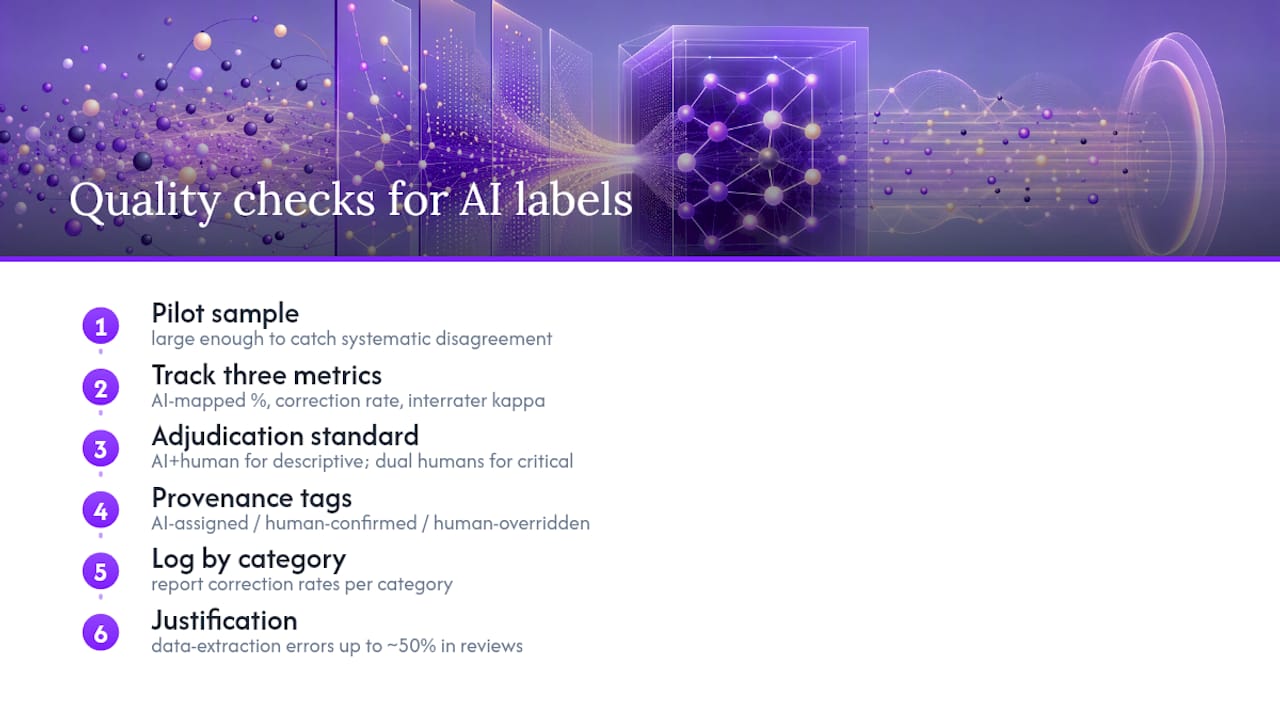
Start with a pilot sample large enough to catch systematic disagreement, then track three numbers: percent of labels the AI mapped without any human correction, the correction rate on the ones it didn’t, and an interrater agreement statistic (Cohen’s kappa or a percent-agreement figure with a stated partial-match tolerance) comparing AI output to a human-only pass.
For non-critical descriptive fields, an AI-plus-human-adjudication pattern is defensible. For critical outcomes, primary endpoints, adverse events, effect sizes, dual human extraction with the AI as a third check is the safer standard. This mirrors the logic behind conventional dual-extraction rules: extraction errors have been measured at rates high enough to shift pooled effect estimates in methodological reviews, and normalization errors carry the same risk.
Every label needs a provenance tag: AI-assigned, human-confirmed, or human-overridden. Without that trail, you can’t reconstruct which decisions were machine-driven when a peer reviewer asks.
Pro Tip: *Log the correction rate by category, not just overall.
Methodological reviews have found data-extraction error rates reaching roughly 50% in some studies, which is the exact justification Cochrane and MECIR use for mandating piloted, duplicate-checked extraction forms.
What Should You Report for PRISMA and MECIR Compliance?
Transparency here isn’t optional if you want your review taken seriously. Analysis of 152 Cochrane and non-Cochrane reviews found that reporting on how extraction forms were prepared and piloted is inconsistent across the field, which weakens confidence in results that depend on those forms.
Publish your codebook as a supplement, not a footnote. Include:
- The full label taxonomy with version history.
- Pilot batch size, correction rate, and agreement statistics.
- A plain statement of which AI role was used (DirectLabeler, AssistantLabeler, or PseudoLabeler) and at which pipeline stage.
- The percentage of labels that were auto-mapped without human correction, alongside the percentage that required adjudication.
A pilot on 20 to 30 studies, reported with its agreement statistic, gives reviewers a concrete basis for trusting the rest of your dataset. Vague language like “AI assisted with extraction” gives them nothing to evaluate.
How Do You Move Off Spreadsheets Into Structured Exports?
Free-text spreadsheets are where normalized labels quietly fall apart. One reviewer types “T2DM,” another types “type 2 diabetes,” and now your controlled vocabulary has a leak.
- Export as annotated CSV or RIS with dedicated label columns, not merged free-text cells.
- Keep a machine-readable change log alongside the dataset so every AI edit and human override has a timestamp.
- Use version control (even simple dated file naming) so a codebook revision doesn’t silently overwrite prior extractions.
- Structure exports so statistical software (R, Stata, RevMan) and visualization tools can ingest label columns directly, without a manual cleanup pass.
A shared, structured database beats a shared spreadsheet on exactly this point: it enforces the schema instead of hoping everyone remembers it.
Practitioner Perspective: What Actually Breaks in Real Reviews
The teams that get burned almost always skipped piloting to save a week, then lost three weeks to rework once inconsistent labels surfaced at analysis. A small upfront investment in a piloted codebook is cheap insurance against that.
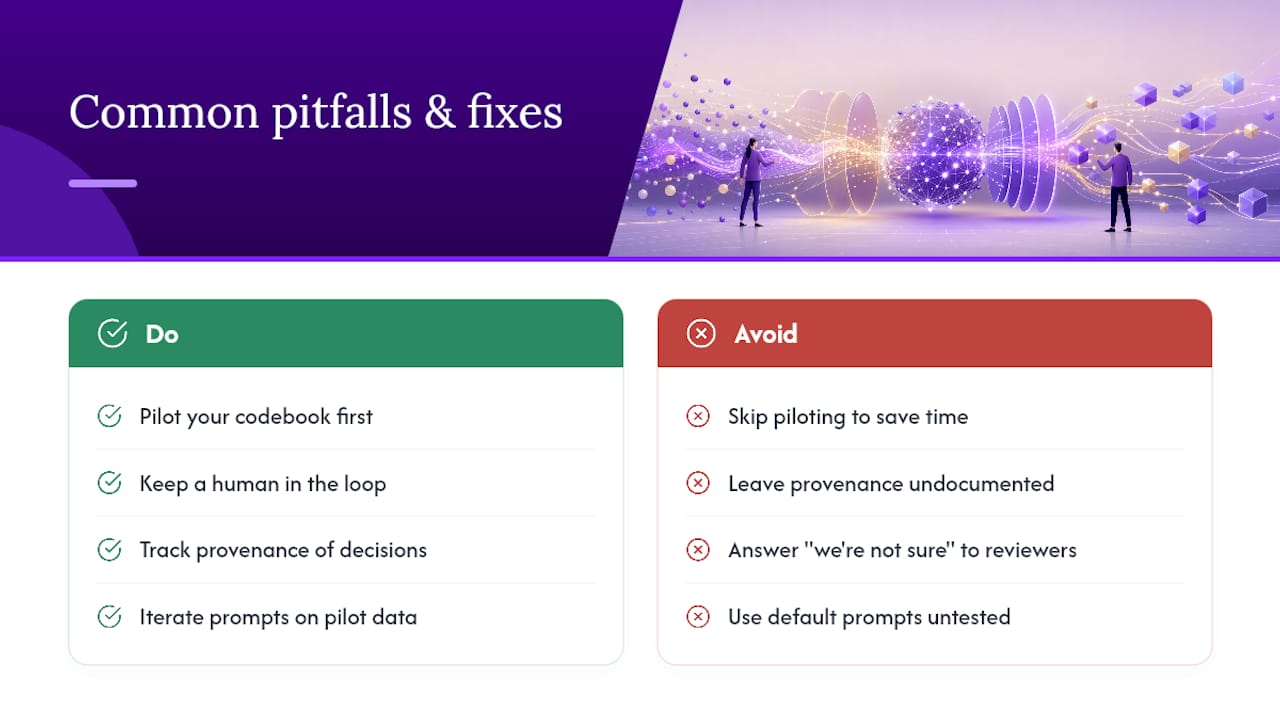
Keep a human in the loop for anything ambiguous. Provenance tracking matters more than most protocols acknowledge, because peer reviewers will ask which decisions were machine-made, and “we’re not sure” is not a defensible answer.
The other trap is trusting default prompts. Generic prompt templates work fine on generic vocabulary and fall apart on domain-specific outcome names. Iterate the prompt against your own pilot batch before trusting it on the full corpus.
— Ubada
Papersynapse: A Protocol-First Platform Built for This Exact Workflow
Papersynapse gives research teams the AI label mapping workflow described here without stitching together five separate tools. It’s built specifically for the systematic review pipeline, not adapted from generic data-labeling software.

Import references directly from Scopus or Web of Science as CSV or RIS, and the platform’s AI reads abstracts to populate structured fields automatically, the same DirectLabeler and AssistantLabeler pattern this guide describes, with normalization, provenance tagging, and PRISMA-ready screening built into one workflow instead of scattered across spreadsheets. Papersynapse’s benchmark of processing up to 200 papers in under two minutes reflects exactly the pipeline speed a piloted codebook makes possible. Teams use it to run their pilot batch, confirm agreement, then scale to the full corpus with an audit trail intact for peer review. If your review is heading past 50 studies with heterogeneous labels, start a project on Papersynapse and run your pilot batch this week.
Where to Read Deeper on Extraction Methods
For the methodological backbone behind this guide, see the Cochrane Handbook chapter on collecting data, the living review of extraction automation, and the literature review on LLM-based auto-labeling methods. Papersynapse’s own protocol-first extraction guide walks through applying these standards directly.