AI Paper Review for Systematic Literature Reviews
AI Paper Review for Systematic Literature Reviews
The fastest defensible way to run a large-scale systematic literature review is a hybrid human-in-the-loop workflow: AI handles abstract screening and structured extraction at scale, humans validate, adjudicate, and maintain the decision log. Start today by importing your RIS or CSV file, running AI-assisted screening on a pilot sample of at least 30 abstracts, and logging every inclusion/exclusion decision for PRISMA 2020 transparency.
Three things to do right now:
- Define your PICOs and a decision log template before touching any references. Every AI screening decision needs a rationale column, a confidence score, a human override field, and a timestamp.
- Import from Scopus, Web of Science, or PubMed as RIS or CSV, then run AI-assisted screening on a random 10% pilot sample (minimum 30 abstracts, ideally 100 for larger reviews).
- Validate recall before scaling. Papersynapse processes up to 200 papers in under two minutes, but speed only helps if your pilot confirms recall meets your threshold — typically 90% or higher for screening.
Table of Contents
- When does AI-assisted paper review actually help?
- How to run a hybrid AI-assisted SLR step by step
- How to design a pilot before you scale
- How to handle disagreements, missing data, and audit trails
- Extraction and normalization: what actually works
- How Papersynapse implements the hybrid workflow
- Implementation checklist and realistic timelines
- Risks, limitations, and ethical considerations
- Key Takeaways
- The case for keeping humans firmly in the loop
- Run your first AI-assisted SLR pilot with Papersynapse
- Useful sources and further reading
When does AI-assisted paper review actually help?
AI-driven systematic literature review works best when volume is the bottleneck. Large-scale abstract screening, title deduplication, initial structured extraction from abstracts, and rapid thematic clustering for scoping or living reviews are all strong fits. Empirical evidence shows workload reductions exceeding a large majority for some screening tasks when domain-specific prompts are well-tuned.
Where it breaks down:
- Novel measurement domains without standard terminology. AI models under-detect niche vocabulary and will miss relevant papers if your PICO uses field-specific jargon the model has not encountered at scale.
- Nuanced qualitative synthesis. Thematic interpretation, critical appraisal of study design, and judgment calls about methodological quality still require a human.
- Legal or ethical determinations. Inclusion decisions that turn on regulatory context or ethical classification are not appropriate for full automation.
- Single-manuscript peer review. Generating critique comments for one submitted paper is a different task entirely and outside the scope of AI-assisted SLRs.
Operationally, AI screening works on cleaned RIS/CSV imports. Messy metadata, inconsistent author names, and duplicate records degrade performance before the model even reads an abstract. Full-text extraction remains harder than abstract-level extraction and usually needs manual review for anything beyond surface-level fields.
Pro Tip: Run a short pilot on a stratified random sample before committing to full automation. Catching a recall gap at 50 abstracts costs an afternoon; catching it at 2,000 costs a month.

How to run a hybrid AI-assisted SLR step by step
A reproducible workflow has seven stages. Each one produces a documented artifact.
- Export — Generate relational CSVs (study-level, arm-level, outcome-level) or JSON for nested data. Link every export to the decision log snapshot and prompt version.
Decision log columns to capture:
| Column | What to record |
|---|---|
| Record ID | Unique identifier from your reference manager |
| AI decision | Include / Exclude / Uncertain |
| AI confidence score | 0–1 or percentage |
| Human decision | Final include/exclude with override flag |
| Rationale | Free-text reason, especially for overrides |
| Reviewer initials | For inter-rater tracking |
| Timestamp | Date and time of decision |
| Prompt version | Which prompt template was active |
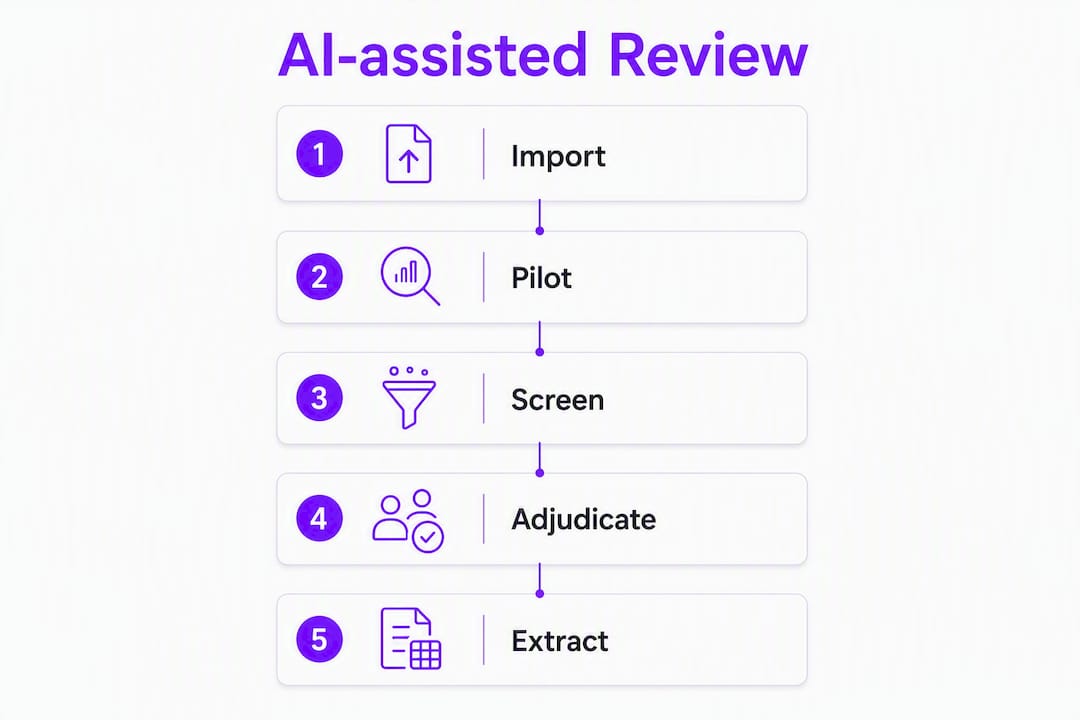
Timeline estimates under a hybrid workflow: small reviews typically take about one to two weeks; medium reviews take several weeks; large reviews require multiple weeks depending on team size and adjudication load.
How to design a pilot before you scale
A pilot is not optional. Methodologists warn that failure to document pilots, decision logs, and prompt versions makes reviews difficult to defend in peer review.
Pilot goals: estimate recall and precision, tune inclusion/exclusion prompts against your PICOs, and check extraction accuracy on your target fields before committing to full-scale processing.
Recommended sample sizes for pilots vary by review size.
| Review size | Pilot sample |
|---|---|
| Small reviews | 30–50 abstracts (random) |
| 500–2,000 papers | 50–100 abstracts (stratified random) |
| 2,000+ papers | 100+ abstracts with domain stratification |
Run the pilot in iterative cycles:
- Screen the pilot sample with your initial prompt.
- Compare AI decisions against independent human decisions.
- Calculate precision, recall, F1, and Cohen’s κ.
- Adjust prompts and re-evaluate on a fresh sample.
- Record every change in the decision log before scaling.
Target thresholds: recall ≥ 90% for screening is a widely cited minimum. LLM-based systems using GPT-4 have demonstrated high sensitivity and Cohen’s κ in clinical SLR pilots, but performance varies by domain — your pilot is the only reliable way to know where your review lands.
Pro Tip: Quantify inter-rater agreement during piloting and require re-piloting if Cohen’s κ falls below your pre-specified threshold. A κ below 0.6 on the pilot sample is a signal to revise your inclusion criteria, not just your prompts.
How to handle disagreements, missing data, and audit trails
PRISMA 2020 requires explicit transparency about how automation assisted each phase. That means your methods section must state which tool was used, which model version, what the pilot results were, and how disagreements were resolved.
Adjudication protocol:
- Independent dual extraction for all primary outcomes.
- Tie-breaker rule decided in advance (senior reviewer, consensus meeting, or third extractor).
- Every change to an extracted value gets a documented reason and timestamp.
Missing data handling:
- Contact authors for unreported outcomes when feasible.
- Accept reported ranges or confidence intervals when point estimates are missing.
- Code genuinely missing data as “missing” with a reason code, never leave cells blank.
Audit trail checklist:
- Decision log with AI confidence scores and human overrides
- Prompt versions linked to each screening or extraction run
- Timestamped edits to every data cell
- PRISMA flow diagram updated after each phase
- Pilot metrics (recall, precision, κ) included in the methods section
For teams managing multi-researcher reviews, assigning clear ownership of each adjudication step prevents silent overwrites and keeps the audit trail clean.
Extraction and normalization: what actually works
Methodological reviews consistently recommend customized extraction forms, detailed field instructions, and pilot testing. Manual extraction error rates can reach up to 50% in some reviews, often from misinterpreting statistics like SD versus SE. Structured field maps and controlled vocabularies cut that error rate substantially.
Core field categories:
- Citation metadata (authors, year, journal, DOI)
- PICO fields (population, intervention, comparator, outcome definitions)
- Effect sizes with units and variance measures
- Study design flags (RCT, cohort, cross-sectional)
- Outcome timing and follow-up periods
Normalization practices that matter:
- Map synonymous terms to a controlled vocabulary before extraction begins.
- Standardize units (mg/dL vs. mmol/L) and date formats at the field level.
- When a study reports multiple effect sizes, create one row per effect size, not one row per study.
For export, relational CSV tables (study-level, arm-level, outcome-level) handle nested data far better than flat spreadsheets. Experts recommend relational structures for reviews with nested effect sizes to avoid costly manual reconciliation later. JSON works well for programmatic downstream analysis.
Field-level piloting tip: test your extraction form on a stratified sample of 10–15 papers before scaling. Ambiguous fields surface fast when two reviewers extract the same record independently.
How Papersynapse implements the hybrid workflow
Papersynapse maps directly onto the hybrid workflow described above. The platform supports RIS and CSV import from Scopus, Web of Science, and reference managers, runs AI-assisted abstract screening with customizable extraction fields, and applies label normalization across extracted data. Decision logs, confidence scores, and prompt versioning are captured in-platform, and exports go out as enriched CSV or PNG for visualization.
| SLR need | Papersynapse capability |
|---|---|
| Reference import | RIS/CSV from Scopus, Web of Science, PubMed |
| Abstract screening | AI-assisted with confidence scores and decision log |
| Structured extraction | Customizable field maps with normalization |
| Audit trail | Decision log with timestamps and prompt versions |
| Exports | Relational CSV, PNG charts |
| Team collaboration | Multi-reviewer support with role-based access |
| Visualization | Custom tables and chart outputs |
Processing speed: Papersynapse processes up to 200 papers in under two minutes. Validate that throughput against your pilot recall metrics before treating speed as a proxy for quality.
Human-in-the-loop dashboards that surface recall, precision, and AI confidence let teams set conservative stopping rules and create an auditable trail. Papersynapse’s real-time Q&A over your literature dataset extends that capability into exploratory analysis once extraction is complete.
Implementation checklist and realistic timelines
Pre-launch checklist:
- Protocol finalized (PICOs, field definitions, extraction form)
- References imported and de-duplicated
- Pilot sample drawn (random, stratified)
- Pilot run completed and metrics recorded
- Thresholds set (recall, precision, κ)
- Full screening initiated with decision log active
- Extraction verified and adjudication complete
- Final exports linked to decision log snapshot
Timeline and effort by review size:
| Review size | Papers | Calendar time | Estimated people-hours |
|---|---|---|---|
| Small | Under 200 | 1–2 weeks | 20–40 hours |
| Medium | 200–2,000 | 3–6 weeks | 60–150 hours |
| Large | 2,000+ | 6–12 weeks | 150–400+ hours |
Subscription tier selection should follow paper volume. The free tier covers early piloting; Pro and Ultra tiers handle medium and large reviews. Time savings versus fully manual extraction are substantial, particularly for screening, where AI-assisted approaches can reduce workload by more than 90% on well-scoped tasks.
Pro Tip: Run a one-week pilot on a representative subset before committing the full team. It calibrates throughput, surfaces field ambiguities, and gives you the pilot metrics PRISMA requires.
Risks, limitations, and ethical considerations
AI augments judgment. It does not replace it. The biggest documented risk is hasty generalization from unvalidated automation: scaling a poorly tuned prompt to thousands of records before confirming recall.
Main risks:
- Hallucination on full texts. AI extraction from full PDFs is less reliable than abstract-level extraction. Prefer abstracts when possible; flag full-text extractions for human verification.
- Inconsistent prompt performance. A prompt that works well on RCTs may miss observational studies. Test across study types during piloting.
- Missing unpublished data. AI cannot retrieve grey literature or unpublished trials. Supplement with manual database searches and trial registries.
- Niche terminology gaps. Models under-detect specialized vocabulary in emerging fields. Domain-specific prompt tuning and sensitivity testing are required.
Ethical and legal considerations:
- Respect publisher copyright. Extract from abstracts when your license does not cover full-text processing.
- Disclose AI use in your methods section. PRISMA 2020 requires it.
- Do not treat AI confidence scores as ground truth. They are signals for human review, not verdicts.
- Keep prompt versions and model identifiers in your decision log so the review is reproducible if the model is updated.
For broader guidance on responsible AI use in academic contexts, practical AI frameworks for educators offer transferable principles around transparency and human oversight that apply directly to research workflows.
Key Takeaways
A defensible AI-assisted systematic literature review requires a hybrid human-in-the-loop workflow anchored in explicit PICOs, a pilot-validated recall threshold, and a PRISMA-compliant decision log maintained throughout every phase.
| Point | Details |
|---|---|
| Hybrid workflow is non-negotiable | AI screens and extracts; humans adjudicate, verify, and maintain the decision log. |
| Pilot before scaling | Test on 30–100 abstracts, target recall ≥ 90%, and record Cohen’s κ before full screening. |
| Relational exports over flat files | Use study-level, arm-level, and outcome-level CSV tables to avoid costly reconciliation. |
| PRISMA 2020 requires disclosure | Report AI tool, model version, pilot metrics, and how automation assisted each phase. |
| Papersynapse covers the full workflow | RIS/CSV import, AI screening, customizable extraction, decision logs, and relational CSV exports in one platform. |
The case for keeping humans firmly in the loop
The most common mistake teams make with AI-assisted SLRs is treating a high pilot recall score as permission to reduce human oversight. It is not. Recall measures how many relevant papers the AI caught on a sample. It says nothing about what the model does to edge cases at scale, how it handles ambiguous PICO matches, or whether its extraction of effect sizes is consistent across different reporting styles.
The decision log is not bureaucratic overhead. It is the mechanism that lets a peer reviewer or journal editor trace every inclusion decision back to a documented rationale. Without it, the review is not reproducible, regardless of how sophisticated the AI is. Papersynapse was built with that constraint in mind: the platform captures confidence scores, prompt versions, and human overrides together, so the audit trail is a byproduct of normal use rather than a separate documentation burden.
The researchers who get the most out of AI-assisted reviews are not the ones who automate the most. They are the ones who pilot carefully, set conservative thresholds, and treat the AI as a first-pass reviewer that always needs a second opinion on anything it is uncertain about.
Run your first AI-assisted SLR pilot with Papersynapse
Screening 2,000 abstracts manually takes weeks. With Papersynapse, the same volume moves through AI-assisted screening in minutes, with every decision logged and every confidence score captured for your PRISMA methods section.

The platform handles the full workflow: import your RIS or CSV from Scopus or Web of Science, define your extraction fields, run AI-assisted screening with customizable PICO prompts, and export relational CSVs ready for meta-analysis. The free tier is enough to run a complete pilot on a representative sample and capture the recall and precision metrics your review protocol requires.
Start your pilot at papersynapse.com and have your first extraction table ready before the end of the week.
Useful sources and further reading
Core methodology and reporting standards:
- PRISMA 2020 reporting guidance for automation in systematic reviews
- Development, testing, and use of data extraction forms in systematic reviews
- Frequency of data extraction errors and methods to increase data extraction quality
- Data extraction methods for systematic review semi-automation: living systematic review
AI-augmented SLR frameworks and evaluations:
- A hybrid framework for AI-augmented systematic literature reviews
- Enhancing systematic literature reviews with generative AI: development and performance evaluation
- Toward systematic review automation: a practical guide
- Streamlining systematic reviews with LLMs using prompt engineering and RAG
Relational data structures and step-by-step extraction:
- Data extraction and comparison for complex systematic reviews: a step-by-step guideline
- SR automation tools overview, University of Texas at San Antonio LibGuides