Why Standardized Coding Schemas Strengthen Your SLR
Why Standardized Coding Schemas Strengthen Your SLR
A standardized coding schema, also called a codebook or data extraction form, is the single most effective structural decision you can make for a systematic literature review. It reduces extraction drift, lifts inter-rater reliability, and produces a dataset that goes straight into analysis without a painful cleaning phase. PRISMA and the Cochrane Handbook both treat a piloted, versioned extraction form as a non-negotiable foundation, not an optional refinement.
Before you read further, three practices determine whether your schema actually delivers those benefits:
- Publish the codebook as a supplement with your review.
- Pilot on a representative sample before full extraction begins.
- Use independent, duplicate extraction with a documented disagreement resolution procedure.
Key Takeaways
A standardized coding schema reduces extraction drift, improves inter-rater reliability, and produces analysis-ready data — but only when it is piloted, versioned, and published as a supplement.
| Point | Details |
|---|---|
| Pilot before scaling | Test on 10–15 representative papers; stop when a second round produces no new disagreement types. |
| Publish the codebook | Only 7% of 152 reviewed studies published their extraction form; publishing yours is a reproducibility advantage. |
| Use relational structure | Link Study, Report, Arm, and Outcome tables with ID keys to prevent redundancy and simplify exports. |
| Validate automation | Log algorithmic decisions in the audit trail and retain manual verification for numeric outcome fields. |
| Papersynapse for scale | Import from Scopus or Web of Science, use customizable fields and inline editing, and export keyed CSVs for analysis. |
Table of Contents
- What are the benefits of standardized coding schemas for SLR quality?
- What concrete advantages does a standardized schema give your team?
- What minimum fields must your codebook include?
- How do you develop, pilot, and version a living codebook?
- Why do relational schemas outperform flat spreadsheets for complex reviews?
- When should you move beyond spreadsheets?
- What pitfalls should you watch for in schema design?
- How should you report and share your codebook?
- The codebook is a research asset, not a form to fill out
- Papersynapse fits naturally into the pilot-to-scale workflow
- Sources
What are the benefits of standardized coding schemas for SLR quality?
Extraction drift is what happens when two reviewers interpret the same variable differently, or when one reviewer’s interpretation shifts over a six-month extraction window. The result is a dataset that looks complete but contains systematic noise. A standardized coding schema defines exactly what is collected from each study, cutting that noise at the source and making the review reproducible.
The scale of the problem is documented. A sample of 152 reviews found that only about half reported using a standardized extraction form, a smaller portion reported piloting it, and very few published the form itself. That means the majority of published reviews cannot be fully audited or replicated, which is a direct threat to the credibility of any synthesis built on them.
| Common extraction error | How a standardized schema addresses it |
|---|---|
| Inconsistent outcome definitions | Controlled response options with defined units and timepoints |
| Double-counting multiple reports of one study | Mandatory report ID and study ID linkage fields |
| Reviewer-specific interpretation drift | Shared decision rules and real-time codebook annotations |
| Missing provenance | Required extractor, date, and version fields |
| Post-extraction data cleaning | Point-of-entry validation and closed-ended fields |
What concrete advantages does a standardized schema give your team?
Inter-rater reliability improves measurably when extractors work from the same controlled vocabulary. A synthesis of 25 guidance documents found that the most consistent recommendations across methodological guidance are: adapt a standardized form, provide detailed instructions, pilot it, and use at least two extractors with a formal disagreement procedure. Those four steps together address the largest sources of extraction noise.

Reusability is the less-discussed advantage. Normalized fields, meaning fields with consistent labels and controlled response options, allow a dataset to be shared, pooled with other reviews, or fed into automated analysis pipelines. Standardized terminology and classification systems are what make data interoperable across teams and tools. A codebook built with that goal in mind is an asset that outlasts the review it was built for.
Downstream cleaning time drops sharply when the schema enforces structure at the point of entry. Free-text fields generate heterogeneous strings that require manual harmonization before any quantitative synthesis. Closed-ended fields with defined options skip that step entirely.
51% of 152 reviewed studies reported using a standardized extraction form. Only 7% published it. Teams that publish their codebook occupy a reproducibility tier most published reviews have not reached.
What minimum fields must your codebook include?
A functional codebook covers five categories. Every field should specify its name, the permitted response options, and a one-sentence instruction for extractors.
- Study and report identifiers — unique study ID, report ID (one study can have multiple reports), bibliographic reference, and a field to link all reports to their parent study.
- Provenance fields — extractor name or ID, extraction date, codebook version number, and a rationale field for judgment calls.
- Study design and population — design type (controlled vocabulary: RCT, cohort, cross-sectional, etc.), setting, sample size, and PICO elements (Population, Intervention, Comparator, Outcome) with defined units.
- Outcome fields — outcome name, measurement instrument, unit of measurement, timepoint, and direction of effect. Each outcome field needs a defined timepoint; “post-intervention” is not specific enough.
- Response option guidance — every categorical field needs a closed list plus an “Other, specify” option. Free text is permitted only for fields where enumeration is genuinely impossible, such as verbatim quotes.
| Field name | Recommended response options | Extractor instruction |
|---|---|---|
| Study design | RCT / Cohort / Cross-sectional / Case-control / Other, specify | Select the design as reported by the authors |
| Primary outcome unit | Continuous / Dichotomous / Time-to-event / Other, specify | Match the unit used in the primary analysis |
| Extraction date | YYYY-MM-DD | Record the date this record was completed |
| Codebook version | Version number | Use the version active on the extraction date |
How do you develop, pilot, and version a living codebook?
The Cochrane Handbook recommends drafting the tables and figures you expect to produce before you build the electronic form. That sequence forces the team to decide what the analysis actually needs, rather than collecting everything that seems relevant and sorting it out later.
- Draft with the full team. Include domain experts, a statistician, and at least one extractor. Map each planned output table to the fields required to produce it.
- Pilot on 10–15 papers. Choose papers that represent the range of study designs and reporting quality in your corpus. Iterative piloting is where field-level agreement actually improves.
- Calibrate disagreements. Log every disagreement with the field name, both values, and the resolution. Update the codebook with the clarified rule. Record the change in the version log.
- Set a stability threshold. The codebook is ready to scale when a second pilot round on 5 new papers produces no new disagreement types. New disagreement types, not just new instances, are the signal.
- Version every change. Record the version number, date, and a one-line description of what changed. Retrain extractors on any rule that changed. If a changed rule affects already-extracted records, flag those records for re-extraction.
Pro Tip: Run your pilot on papers you expect to be difficult, not easy ones. If the codebook handles edge cases cleanly, it will handle the rest of the corpus without surprises.
Why do relational schemas outperform flat spreadsheets for complex reviews?
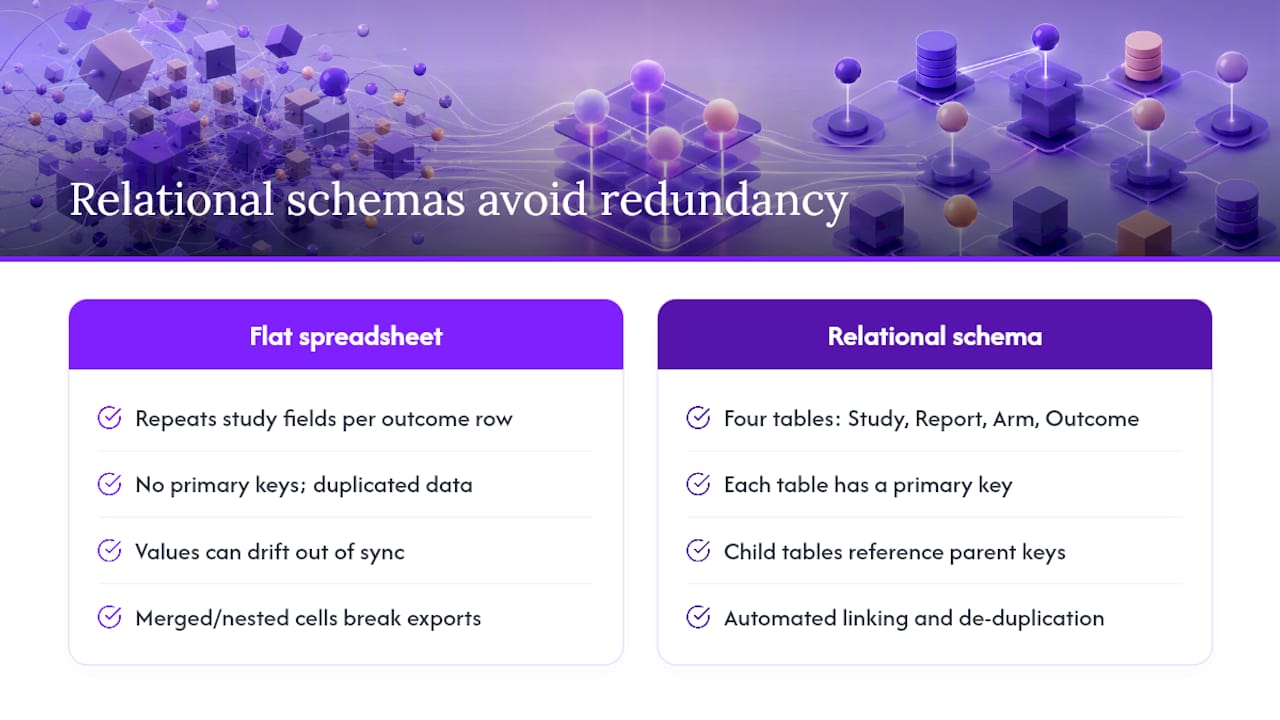
A flat spreadsheet forces you to repeat study-level information on every outcome row, which creates redundancy and makes it easy for values to drift out of sync. A minimal relational design uses four linked tables: Study, Report, Arm, and Outcome. Each table has a primary key, and child tables reference parent keys. One study can have three reports, two arms, and six outcomes without any duplication of the study-level fields.
Relational data structures reduce reconciliation overhead for linked entities, particularly when reviews include multi-arm trials or studies with multiple publications. The normalized design also makes automated linking and de-duplication straightforward: a query on the study ID returns all associated reports, arms, and outcomes in one pass.
For export, use CSV files with explicit ID columns (study_id, report_id, arm_id) rather than merged cells or nested formatting. JSON or NDJSON works well for nested structures when downstream tools support it. For meta-analysis software, flat exports keyed by study ID are compatible with RevMan, R (metafor), and Stata without manual reshaping.
Pro Tip: Before finalizing your schema, open a blank RevMan or metafor script and map each required input field to a column in your export. Mismatches are far cheaper to fix at the design stage than after extraction is complete.
When should you move beyond spreadsheets?
The case for a dedicated platform grows quickly with team size, study volume, and variable complexity. When more than two extractors are working simultaneously, a shared spreadsheet generates version conflicts. When the review includes more than 100 studies, manual audit trails become unmanageable.
Semi-automated and LLM-based extraction can reduce workload substantially, but they introduce variability in reporting quality and require careful validation. The practical rules are:
- Always validate automated outputs against the original source for numeric outcome fields.
- Log algorithmic decisions in the audit trail the same way you would log a human judgment call.
- Retain manual verification for critical result fields; automation is most reliable for bibliographic and design-level fields.
- Share your extraction code and datasets when publishing, so others can reproduce the automated steps.
Papersynapse supports this workflow directly. It accepts CSV and RIS imports from Scopus and Web of Science, provides customizable extraction fields that mirror a codebook’s structure, allows inline editing with a preserved audit trail, and exports enriched CSVs keyed for downstream analysis. The automation benefits are real, but the platform is designed to complement human verification, not replace it.
What pitfalls should you watch for in schema design?
Most extraction problems trace back to a small set of design errors.
“Vague variable definitions are the primary driver of inter-rater disagreement. When two extractors read the same field instruction and reach different conclusions, the problem is the instruction, not the extractors.” Tightening the definition resolves the disagreement at the source rather than through repeated adjudication.
The most common pitfalls and their fixes:
- Vague codes: Replace “intervention type” with a controlled list of specific intervention categories. Add an “Other, specify” option.
- Free-text reliance: Audit every free-text field. If the field will be used in any quantitative synthesis, convert it to a controlled list.
- Ignoring multiple reports: Add a report ID field and a procedure for linking reports to their parent study from day one.
- Skipping the pilot: A pilot on 10 papers typically surfaces 3–5 field-level ambiguities that would otherwise propagate across the full corpus.
- Missing provenance: If a record has no extractor ID or extraction date, you cannot audit it or resolve disputes after the fact.
A team that discovered mid-extraction that “follow-up period” had been interpreted as both the total study duration and the post-intervention measurement window resolved it by splitting the field into two: “total study duration” and “primary outcome timepoint.” Re-extraction on the affected records took two hours. Catching it during piloting would have taken twenty minutes.
How should you report and share your codebook?
Publishing the codebook as a supplement is the minimum standard for a reproducible review. Structured data sharing also makes your dataset reusable by other teams and discoverable in repositories.
A complete supplement includes:
- The full codebook with field names, response options, and extractor instructions.
- A data dictionary mapping each field to its type, unit, and permitted values.
- CSV or JSON exports with explicit ID keys for all relational tables.
- Provenance fields in every exported record (extractor, date, version).
- A change log documenting every codebook version with dates and descriptions.
- A pilot summary: number of papers piloted, inter-rater reliability metrics (Cohen’s kappa or percentage agreement), and the disagreement resolution procedure used.
Suitable repositories include institutional repositories, Zenodo, and the Open Science Framework (OSF). For journal submission, check whether the target journal requires a specific format; many now require PRISMA-compliant reporting with the extraction form attached. How structured schemas influence discoverability in AI-assisted search is an emerging consideration worth tracking as more researchers use AI tools to locate and synthesize prior work.
The codebook is a research asset, not a form to fill out
Most teams treat the codebook as administrative overhead, something to produce before extraction and forget. That framing is expensive. A well-maintained codebook is the reason a review can be updated in two weeks instead of six months when new studies are published. It is the reason a second team can replicate your synthesis without contacting you. It is the reason your dataset gets cited rather than ignored.
The return on investment shows up in concrete places: fewer re-extractions when a field definition turns out to be ambiguous, faster onboarding when a new team member joins mid-review, and a supplement that reviewers and editors can actually evaluate. Peer-reviewed extraction practices consistently show that the teams with the lowest error rates are the ones that treated the codebook as a living document from the first draft.
Start small. Run a 15-paper pilot, document one version change with a rationale, and measure whether disagreement rates drop in the second round. That single cycle is usually enough to demonstrate the value to skeptical collaborators.
Papersynapse fits naturally into the pilot-to-scale workflow
Once your codebook stabilizes after piloting, the bottleneck shifts from schema design to extraction throughput. That is where a platform built for structured extraction earns its keep.

Papersynapse imports directly from Scopus and Web of Science via CSV or RIS, maps your codebook fields to customizable extraction columns, and lets extractors edit inline while preserving a full audit trail. AI-assisted extraction pre-fills fields from abstracts, which cuts the time spent on bibliographic and design-level fields while leaving critical numeric outcomes for human verification. Exports are keyed CSVs ready for RevMan, R, or Stata without reshaping.
The workflow: pilot on 20–50 papers locally to stabilize your schema, then start your extraction on Papersynapse to scale without losing the provenance and version control your supplement will need.
Sources
- Data Extraction - Systematic Reviews - Subject Guides at Brigham Young University
- Chapter 5: Collecting data | Cochrane
- Development, testing and use of data extraction forms in systematic reviews: a review of methodological guidance - PMC