Best Reproducible Research Analysis Platforms for SLR Teams
Best Reproducible Research Analysis Platforms for SLR Teams
For research teams running systematic literature reviews, Papersynapse is the strongest starting point among reproducible research analysis platforms. It pulls references directly from Scopus or Web of Science, runs AI-assisted extraction into structured tables, supports PRISMA-compliant screening, and exports reproducible bundles, all inside one workflow. The platform processes up to 200 papers in under two minutes, which changes the math on what a small team can realistically review. If your work is SLR-focused and you need auditable, shareable outputs, start here.
Full computational workflow managers like Renku, Snakemake, DataJoint, and Whole Tale remain the right call for code-heavy pipelines or multi-publication reproducibility chains. But for most academic teams doing literature synthesis, that level of infrastructure is overkill.
Table of Contents
- Why a dedicated SLR platform beats ad-hoc scripts for reproducible research
- Which platform class fits your team’s actual needs?
- How to evaluate any reproducible analysis platform before you commit
- Running a reproducible SLR from import to publication: a realistic timeline
- How Papersynapse maps to what SLR teams actually need
- When should you skip Papersynapse and use a full workflow manager?
- Key Takeaways
- The shift that most teams are still underestimating
- Papersynapse gives your team a faster path to reproducible SLRs
- Useful sources
Why a dedicated SLR platform beats ad-hoc scripts for reproducible research
Spreadsheets and custom Python scripts get the job done until they don’t. The moment a second reviewer joins, or a journal asks for a reproducibility statement, the cracks show fast.
A purpose-built platform for reproducible data analysis gives you:
- Provenance tracking — every extraction is linked back to its source document and field
- Environment capture — the platform manages the runtime so your outputs replay without “works on my machine” failures
- Automated extraction — AI reads abstracts and fills structured fields, cutting manual entry time sharply
- PRISMA-compliant screening — inclusion/exclusion decisions are logged and exportable
- Team collaboration — shared research databases let multiple reviewers work on the same project without version conflicts
- Reproducible export bundles — data, code, and narrative travel together so the published record is re-runnable
Bundling these elements matters because hidden-state errors, where a result depends on a step nobody documented, are one of the most common reasons SLRs fail peer review or can’t be replicated. A platform that captures the full research object removes that risk by design.
Pro Tip: Before you migrate to a new platform, time how long one reviewer takes to screen and extract 20 papers manually. Run the same set through your new platform. That delta, multiplied across your full corpus, is your ROI number. Use the reproducible export as the evidence artifact for your manuscript’s reproducibility section.
Which platform class fits your team’s actual needs?
Not every research team needs the same tool. Three distinct classes of platform exist, and picking the wrong one costs weeks.
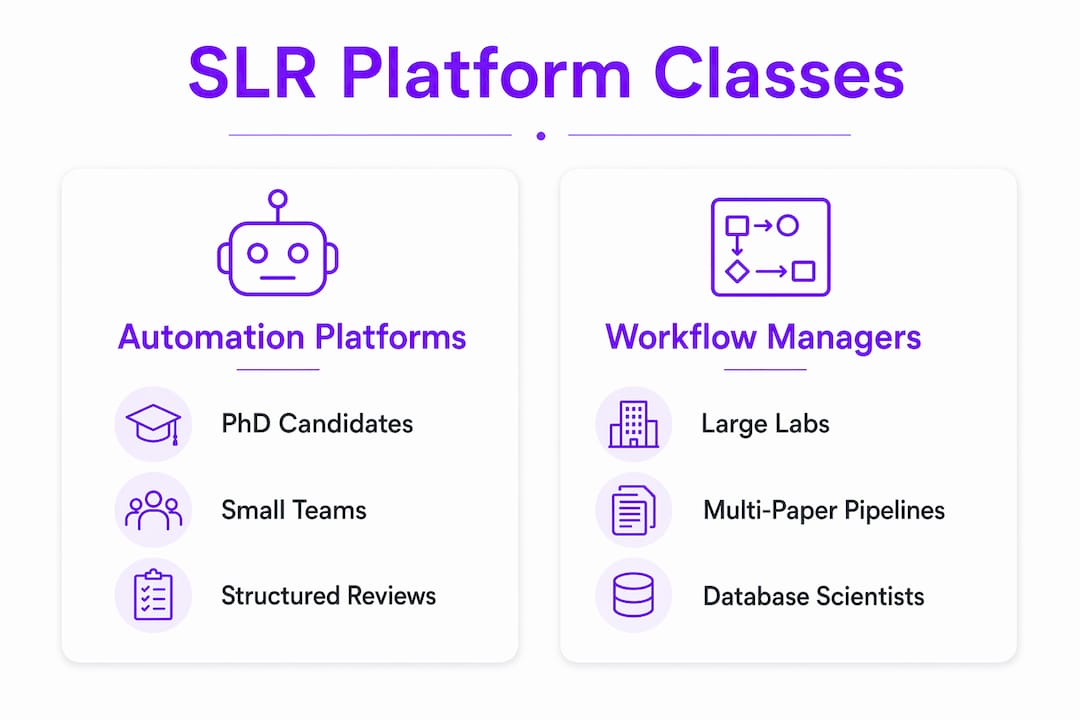
SLR automation platforms
Best for: PhD candidates, small-to-medium research teams, anyone whose primary output is a structured literature review rather than a custom computational pipeline. These platforms handle import, screening, extraction, and export without requiring any coding. Papersynapse sits in this class. The tradeoff is that customization beyond the extraction schema is limited, which is rarely a problem for SLR work.

Collaborative AI-native notebooks
Best for: data-science-adjacent researchers who need to write and share analysis code alongside their literature work. Tools like Deepnote offer multiplayer editing, scheduled runs, and built-in integrations that abstract away local environment setup. Marimo takes this further with a reactive execution model that eliminates the “run cells out of order” problem by automatically re-running dependent cells when inputs change. These tools are strong for analysis code but don’t offer PRISMA workflows or structured abstract extraction out of the box.
Full computational workflow managers and executable research-object platforms
Best for: large labs running multi-paper pipelines, experimental scientists with database-backed schemas, or teams whose reproducibility requirements span clinical trial linkages or downstream publications. Renku, Snakemake, DataJoint, and Whole Tale live here. Setup is heavier, but provenance guarantees and replayability across compute clusters are unmatched.
How to evaluate any reproducible analysis platform before you commit
Use this checklist when comparing options. The columns that matter most for SLR teams are starred.
| Criterion | What to look for | Why it matters |
|---|---|---|
| ★ Provenance tracking | Field-level links to source documents | Audit trail for every extracted data point |
| ★ Environment capture | Container images, lockfiles, or managed runtime | Guarantees outputs replay without dependency drift |
| ★ PRISMA compliance | Built-in inclusion/exclusion logging and export | Required for high-integrity SLR publication |
| ★ Import integrations | Scopus, Web of Science, RIS/CSV | Eliminates manual reference entry |
| ★ AI extraction accuracy | Structured field filling with audit log | Reduces subjective manual error |
| Collaboration | Shared DBs, role-based access | Scales to multi-reviewer teams |
| API / customization | Webhooks, plugins, custom fields | Extends the platform for niche workflows |
| Export formats | CSV, PNG, reproducible bundle | Covers both data reuse and publication needs |
| Scalability | Papers per minute, concurrent users | Matters at 500+ paper corpora |
| Pricing model | Per-paper tiers, free tier, self-hosted option | Aligns cost to actual usage |
| Security / compliance | Data residency, institutional SSO | Required for sensitive or funded research |
Questions worth asking any vendor directly: “How is the environment captured and replayed?” and “Can we export a fully replayable bundle that includes code, data, and environment?” If the answer is vague, the reproducibility claim is marketing, not engineering.
On pricing: most SLR-focused platforms tier by paper volume, which keeps costs predictable. Self-hosted workflow managers like Snakemake are free but carry hidden costs in DevOps time. Cloud notebooks typically charge by compute hours. Papersynapse uses a tiered subscription model with a free tier for early-stage projects, which lets teams validate ROI before committing.
Running a reproducible SLR from import to publication: a realistic timeline
The steps below apply to any platform in the SLR automation class. Timing estimates assume a single primary reviewer.
- Project setup and environment capture (1–2 hours): configure extraction fields, set reviewer roles, confirm institutional access to Scopus or Web of Science.
- Import references (15–30 minutes): pull RIS or CSV exports from your database; Papersynapse accepts both formats directly.
- Title and abstract screening (hours to days, depending on corpus size): apply PRISMA inclusion/exclusion criteria; the platform logs every decision.
- AI-assisted full-text extraction (minutes to 1–2 hours for most corpora): AI fills structured fields from abstracts; reviewers spot-check and edit inline.
- Normalization and versioning (1–3 hours): standardize labels, resolve conflicts between reviewers, lock the extraction version.
- Analysis and visualization (2–4 hours): generate charts, summary tables, and cross-tabulations inside the platform.
- Export and publish (30–60 minutes): export enriched CSV, PNG charts, and the reproducible bundle; attach PRISMA flow diagram.
For a corpus of under 100 papers, a single reviewer can complete steps 1–7 in under a week. Medium projects (100–500 papers) typically run two to three weeks with two reviewers. Large projects above 500 papers benefit most from the AI extraction speed and shared database features.
Pre-launch checklist: confirm institutional database access, have API keys ready if using direct Scopus/Web of Science connections, set storage quotas, and assign reviewer roles before importing references. After export, always replay the bundle on a second machine to validate reproducibility.
How Papersynapse maps to what SLR teams actually need
Papersynapse covers the starred checklist items above without requiring any infrastructure work from your team.
- Import: direct Scopus and Web of Science integration, plus RIS/CSV for any other reference manager
- AI extraction: reads abstracts and fills customizable structured tables; labels are normalized automatically
- PRISMA screening: built-in inclusion/exclusion workflow with logged decisions and exportable flow data
- Collaboration: shared research databases let multiple reviewers work on the same project in real time
- Export: enriched CSV, PNG charts, and reproducible bundles ready for manuscript appendices
- Visualization: cross-tabulations and summary charts generated inside the platform
The processing benchmark, up to 200 papers processed in under two minutes, means a 300-paper corpus that would take a reviewer days of manual reading clears the extraction stage in a single session. That speed compounds across the review cycle. For teams that want a deeper methodology reference, the reproducible literature review guide on the Papersynapse blog covers quality checks and validation steps in detail.
Institutions connecting analysis to publication metrics and downstream impact tracking, a growing expectation from funders and journals per Scopus product guidance, will find the CSV and reproducible bundle exports directly compatible with standard citation and impact workflows.
When should you skip Papersynapse and use a full workflow manager?
Papersynapse is the right tool for literature synthesis. It is not a general-purpose computation orchestrator. Move to a full workflow manager when:
- Your pipeline involves custom code that transforms raw experimental data, not just abstract text
- Results need to be re-executed on new datasets or different parameter sets across multiple downstream papers
- Your lab uses a database-backed schema where every computation is a declarative workflow step with immutable results and full lineage
- Reproducibility requirements span clinical trial linkages or regulatory submissions
- Your team needs to replay analyses across HPC clusters or cloud compute environments
The tradeoffs are real. Renku, Snakemake, DataJoint, and Whole Tale offer stronger provenance guarantees and replayability, but setup takes days to weeks and maintaining the environment configuration is an ongoing engineering task. Snakemake’s environment management via Docker or Conda is powerful precisely because it is explicit, but that explicitness requires someone on the team who can own it.
| Platform class | Best for | Core reproducibility | Ease of setup | Scalability | Export support | Pricing shape |
|---|---|---|---|---|---|---|
| SLR automation | Literature synthesis teams | Provenance, PRISMA, bundles | Low (hours) | High paper volume | CSV, PNG, bundles | Per-paper tiers |
| AI-native notebooks | Code-adjacent analysis | Reactive execution, versioning | Medium (days) | Medium | Notebooks, scripts | Compute hours |
| Workflow managers / EO platforms | Code-heavy, multi-paper pipelines | Full environment capture, lineage | High (weeks) | Very high | Replayable bundles, containers | Free / self-hosted |
Key Takeaways
For most academic teams running systematic literature reviews, Papersynapse delivers the fastest path to auditable, reproducible outputs without requiring infrastructure expertise.
| Point | Details |
|---|---|
| Start with SLR automation | Papersynapse covers import, AI extraction, PRISMA screening, and reproducible exports in one workflow. |
| Escalate when pipelines go beyond literature | Use Renku, Snakemake, DataJoint, or Whole Tale when your work involves custom computation or multi-paper replayability. |
| Benchmark before you commit | Time manual extraction on 20 papers, then compare against automated extraction to quantify your ROI. |
| Environment capture is non-negotiable | Ask every vendor how outputs are replayed; vague answers mean the reproducibility claim is not engineered. |
| Papersynapse processes at scale | As of 2024, the platform handles up to 200 papers in under two minutes, making large corpora practical for small teams. |
The shift that most teams are still underestimating
The conversation about reproducibility in research has been dominated by environment capture and containerization for years. That matters, but it misses something more immediate for most academic teams: extraction hygiene.
The majority of SLRs that fail reproducibility checks don’t fail because of a missing Docker image. They fail because nobody can trace which reviewer made which extraction decision, or because the normalization step happened in a spreadsheet that no longer exists. The tooling conversation has been skewed toward computational scientists when the largest population of researchers doing reproducibility-sensitive work are literature reviewers.
AI-native platforms are shifting this. When extraction is automated and every field is linked back to its source document, the audit trail exists by default rather than by discipline. That is a structural change, not just a productivity gain. Teams that adopt it now will find the reproducibility section of their next manuscript writes itself.
The next frontier is connecting those extraction artifacts to publication impact metrics directly, something institutions and funders are starting to require. Platforms that export citable, persistent-identifier-linked bundles will have a real advantage as that expectation hardens into policy.
Papersynapse gives your team a faster path to reproducible SLRs
Two hours of manual abstract screening for 50 papers, or two minutes. That gap is what Papersynapse is built to close. The platform handles the full SLR workflow, from Scopus and Web of Science import through AI extraction, PRISMA screening, and reproducible bundle export, without requiring your team to manage any infrastructure.

The free tier lets you run a real test: import a small reference set, run AI extraction, and export a reproducible bundle before you spend anything. If the output quality and speed hold up against your manual baseline, the upgrade decision is straightforward. Start your first project at papersynapse.com and see how far you get on the free tier before you need to think about pricing.
Useful sources
The following sources back the claims and comparisons in this article.
Product documentation and platform resources:
- Papersynapse — product landing page, processing benchmark, and feature documentation (SLR automation platform)
- Whole Tale — executable research objects: creating, publishing, and re-running standards-based research bundles (open research infrastructure)
- Renku / RenkuLab — reproducible and collaborative data analysis, provenance tracking, and knowledge graph (open-source platform)
- Snakemake documentation — workflow execution, environment management via Docker and Conda (open-source workflow manager)
- DataJoint (Python) — relational workflow model, declarative computation, and full lineage for scientific pipelines (open-source framework)
- Deepnote — collaborative cloud notebooks with multiplayer editing and built-in integrations (commercial notebook platform)
- Marimo — reactive Python notebook with deterministic execution and git-friendly storage (open-source notebook)
Institutional and indexing guidance:
- Scopus / Elsevier — research indexing and institutional integration standards (commercial index)
- Dimensions Analytics — interlinking publications, grants, patents, and clinical trials for impact tracking (commercial analytics platform)
Further reading on Papersynapse blog:
- Reproducible literature review methodology guide — quality checks and validation steps
- Systematic review quality checklist — evaluation criteria for AI-assisted SLRs