How to Coordinate a Multi-Researcher Literature Review
How to Coordinate a Multi-Researcher Literature Review

The most effective way to coordinate a multi-researcher literature review combines structured role assignments, Git-based version control, and AI-driven multi-agent automation. Teams that skip any one of these three pillars tend to hit the same wall: duplicated screening effort, conflicting citation databases, and no clear record of who decided what. The good news is that a growing set of purpose-built tools, from open-source Git environments to agent orchestration frameworks, now handles much of that overhead automatically.
The core approach, in brief:
- Assign roles before you search. Define who owns protocol design, database searching, title/abstract screening, full-text review, data extraction, and synthesis. Ambiguity here is the single biggest source of wasted effort.
- Use Git-based environments like CoLRev to track every change, evaluate individual contributions, and maintain a full revision history that goes far beyond what shared cloud folders can offer.
- Deploy AI multi-agent systems such as LiRA (Literature Review Agents) or lit-review-council to automate search, screening, extraction, and report synthesis across parallel research tracks.
- Synchronize reference databases through a single shared repository so every team member pulls from the same deduplicated source.
- Build consensus mechanisms into the workflow rather than resolving disagreements ad hoc, using structured voting or arbitration protocols from the start.
How do you practically coordinate a literature review across multiple contributors?
The foundation is a written protocol that every team member signs off on before the first search runs. That document should specify the research question, inclusion and exclusion criteria, database list, search string, and the exact screening procedure. Without it, two researchers working independently will apply different standards and produce results that cannot be merged cleanly.
Role assignment follows directly from the protocol. A typical team separates the roles of protocol lead, database searcher, title/abstract screener, full-text reviewer, data extractor, and synthesis writer. On larger projects, a dedicated data manager handles reference deduplication and file organization. Overlapping roles are fine for redundancy in screening, but each role needs a named owner.
Reference management and database synchronization are where coordination breaks down most often. Teams that email Zotero exports back and forth end up with three slightly different versions of the same library. The better practice is a single shared repository, version-controlled so that additions and deletions are logged. The C5-DM Framework conceptualizes literature reviews as data-intensive, five-stage processes covering conceptualization, collection, curation, control, and consumption, and it explicitly recommends transparent, version-controlled systems to reduce errors and simplify tool integration across heterogeneous teams.

Git-based workflows provide transparent version control and contribution tracking that traditional file sharing simply cannot match. Git lets a team undo changes, evaluate who contributed what, and maintain a full revision history. CoLRev, an open-source Git environment built specifically for systematic reviews, covers every step from problem formulation and database search through deduplication, screening, PDF retrieval, and synthesis, with an extensible architecture that accommodates teams of any size.
Pro Tip: Set up your CoLRev repository on day one, before any searching begins. Retrofitting version control onto an existing shared folder is painful and often incomplete.
For communication, the goal is to reduce the number of channels, not increase them. One shared project management space (many teams use Notion or a GitHub Projects board) combined with a single messaging thread per review stage keeps decisions visible and searchable. Platforms like Miro work well for visual mapping of screening decisions and synthesis structures, especially when team members are distributed across time zones.
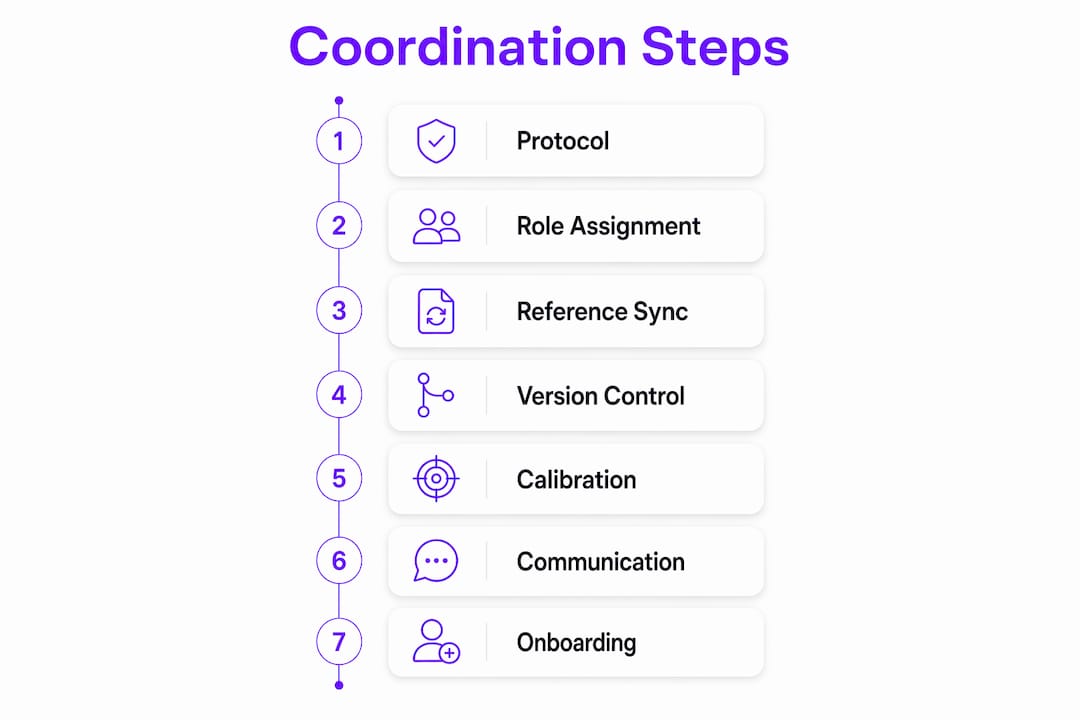
Screening and coding coordination requires a calibration round. Before the full screen begins, have every screener independently review the same 50–100 records, then compare results and resolve disagreements. That calibration session surfaces ambiguities in the inclusion criteria that the protocol did not anticipate. After calibration, dual independent screening with a third-party arbitrator for conflicts is the standard for systematic reviews.
Onboarding new team members is often underestimated. A one-hour walkthrough of the Git repository structure, the screening tool, and the data extraction form prevents weeks of downstream confusion. Pair new members with an experienced screener for their first 100 records before they work independently.
How AI multi-agent systems change the coordination equation
The writing phase of a systematic review has historically been the hardest to automate. Search and deduplication tools have existed for years, but synthesizing findings into a coherent, accurate narrative required a human. That gap is closing fast.
LiRA (Literature Review Agents) is a multi-agent collaborative workflow that emulates the human review process using specialized agents for content outlining, subsection writing, editing, and reviewing. Evaluated on the SciReviewGen benchmark and a proprietary ScienceDirect dataset, LiRA outperforms prior automated baselines in writing quality and citation accuracy while maintaining competitive similarity to human-written reviews. The key mechanism is agent orchestration: no single agent dominates the output, and a voting process aggregates reviewer rankings before the final report is produced.
lit-review-council takes a similar orchestration approach but adds a tiered wave structure. A Planner agent splits research topics into Wave 1 (parallel, independent topics) and Wave 2 (synthesis-dependent topics that require Wave 1 context). Each topic runs through two independent tracks: an academic track that searches ArXiv and OpenAlex, and a practitioner track that searches GitHub and engineering documentation. Three reviewer agents (Researcher, Engineer, Architect) then evaluate anonymized reports, and a Borda-count voting system aggregates their rankings so no single perspective dominates. The final synthesis agent also runs a citation validation loop that rejects hallucinated or broken URLs and retries up to two times before flagging the issue.
The Distributed Meta-Analysis System (DMAS), developed by Solomon Hsiang and James Rising, addresses a different coordination problem: pooling quantitative results across a team. DMAS organizes collaborative meta-analyses by collecting effect size estimates in hierarchical Bayesian frameworks, making statistical relationships searchable and comparable across team contributions. Where most collaboration tools handle documents, DMAS handles the underlying numbers, which is exactly what large-scale quantitative synthesis requires.
CoLRev connects the Git layer to the AI layer. Because every change in a CoLRev repository is tracked and attributable, AI agents can contribute to the review process under the same test-validate-undo discipline that human researchers follow. That architecture matters: if an AI extraction agent misclassifies a paper, the error is visible in the commit history and reversible without corrupting the rest of the dataset.
Pro Tip: When using AI agents for screening or extraction, always run a human validation pass on a random sample of their outputs before accepting the full batch. Even well-performing agents produce systematic errors on edge cases your protocol did not anticipate.
For researchers exploring how AI-driven agents handle planning, searching, extracting, and synthesizing literature, the efficiency gains are real, but they require a human-in-the-loop checkpoint at each stage transition to catch the errors that accumulate silently.
Common challenges and how high-performing teams solve them
Contribution imbalance is the most common failure mode in multi-author reviews. One or two researchers end up doing the bulk of the screening while others contribute sporadically. The fix is explicit, documented assignments with deadlines, not just general expectations. Research on large-group publications shows that storyboard-driven assignments with clear expectations and transparent tracking increase engagement and protect authorship integrity by making each person’s intellectual contribution visible and verifiable.
Version conflicts in shared documents are a symptom of the wrong infrastructure, not a coordination failure. Teams using email attachments or shared drives will always hit this problem. Moving to a Git-based environment like CoLRev eliminates it structurally: every change is a commit, every commit is attributable, and rolling back a bad edit takes seconds.
Common challenges and their practical solutions:
- Consensus building on inclusion decisions: Use a pre-specified arbitration protocol. When two screeners disagree, a third reviewer decides, and the decision is logged with a rationale.
- Data integrity across extraction forms: Lock the extraction template after calibration. Changes to the form mid-review require a full re-extraction of already-processed papers.
- Authorship disputes: Document intellectual contributions at each stage using a contribution matrix (CRediT taxonomy works well). Revisit it at submission, not at the end.
- Keeping up with fast-moving fields: Iterative and dual-track quality assurance strategies balance timeliness with evidence maturity. In rapidly evolving areas like generative AI research, including grey literature alongside peer-reviewed sources and running iterative protocol updates keeps the review current without sacrificing rigor.
- Tool adoption friction: New team members need structured onboarding, not a link to documentation. A 60-minute live walkthrough with a recorded replay reduces the time-to-productivity gap significantly.
Pro Tip: For teams larger than five researchers, use a storyboard approach: map each section of the final review to a named author, a specific set of papers, and a hard deadline. Visible ownership at the section level prevents the diffusion of responsibility that kills large collaborative projects.
Meaningful authorship in large teams requires clear documentation of intellectual contributions and well-defined communication processes. Without that documentation, credit dilutes and engagement drops, often before the review is half finished.
How Papersynapse transforms systematic literature review coordination
Papersynapse addresses the single biggest bottleneck in any team-based literature review: manual data extraction. Reading abstracts, deciding on inclusion, and filling structured tables is slow, subjective, and error-prone when done by hand. Papersynapse automates that entire pipeline.
The platform lets researchers import references directly from Scopus or Web of Science, then uses AI to read abstracts and populate structured extraction tables automatically. The claim from Papersynapse is that up to 200 papers can be processed in under two minutes, a throughput that would take a human screener several days to match. That speed changes what is feasible for a research team: a corpus that previously required weeks of extraction work becomes a morning task.
What makes Papersynapse particularly useful for coordinated, multi-author projects is the consistency it enforces. When multiple researchers extract data manually, they apply slightly different interpretations of the same criteria. Papersynapse applies the same logic to every paper, which means the extraction table a team receives is internally consistent in a way that manual extraction rarely achieves. Researchers can then focus their attention on interpretation and synthesis rather than on cleaning inconsistent data.
The platform’s visualization and categorization features also support the synthesis phase. After extraction, researchers can view results grouped by theme, methodology, or publication year, which accelerates the identification of patterns across a large corpus. For a team working on a joint literature review, that shared visual layer becomes a common reference point that reduces the back-and-forth of trying to reconcile individual summaries.
For teams ready to move beyond manual extraction, Papersynapse offers a direct path to faster, more consistent systematic reviews. The role of AI in literature synthesis is expanding rapidly, and platforms that integrate extraction, normalization, and analysis in one place are where serious research teams are heading.
Key Takeaways
The most effective way to coordinate a multi-researcher literature review combines Git-based version control, explicit role assignments, and AI-driven automation to reduce duplication, enforce consistency, and accelerate synthesis.
| Point | Details |
|---|---|
| Assign roles before searching | Define who owns each stage (search, screening, extraction, synthesis) before the first database query runs. |
| Use Git-based environments | Tools like CoLRev track every change, attribute contributions, and make errors reversible across the full team. |
| Deploy AI multi-agent systems | LiRA and lit-review-council automate search, screening, extraction, and synthesis using orchestrated agent workflows with voting mechanisms. |
| Document contributions explicitly | Storyboard-driven assignments and CRediT taxonomy entries protect authorship integrity in large multi-author projects. |
| Process papers at scale with Papersynapse | Papersynapse processes up to 200 papers in under two minutes, enforcing extraction consistency that manual review cannot match. |