Critical Appraisal Research: A Guide for Students
Critical Appraisal Research: A Guide for Students

Critical appraisal research is defined as the systematic process of evaluating scientific studies to judge their trustworthiness, value, and relevance in a specific context. The formal term used across academic and clinical fields is “critical appraisal,” and it sits at the heart of evidence-based practice. Frameworks like CASP (Critical Appraisal Skills Programme) and JBI (Joanna Briggs Institute) checklists give researchers a structured way to assess study design, methodology, risk of bias, and applicability. For students and early-career researchers, mastering this skill separates passive reading from real scientific thinking.
What is critical appraisal research, and how does it work?
Critical appraisal is not about finding flaws in a study. It is about asking the right questions to decide how much confidence you should place in a study’s findings. The process applies equally to randomized controlled trials (RCTs), cohort studies, qualitative research, and systematic reviews. Each study type carries its own sources of error, and a structured appraisal catches them before you build conclusions on shaky ground.
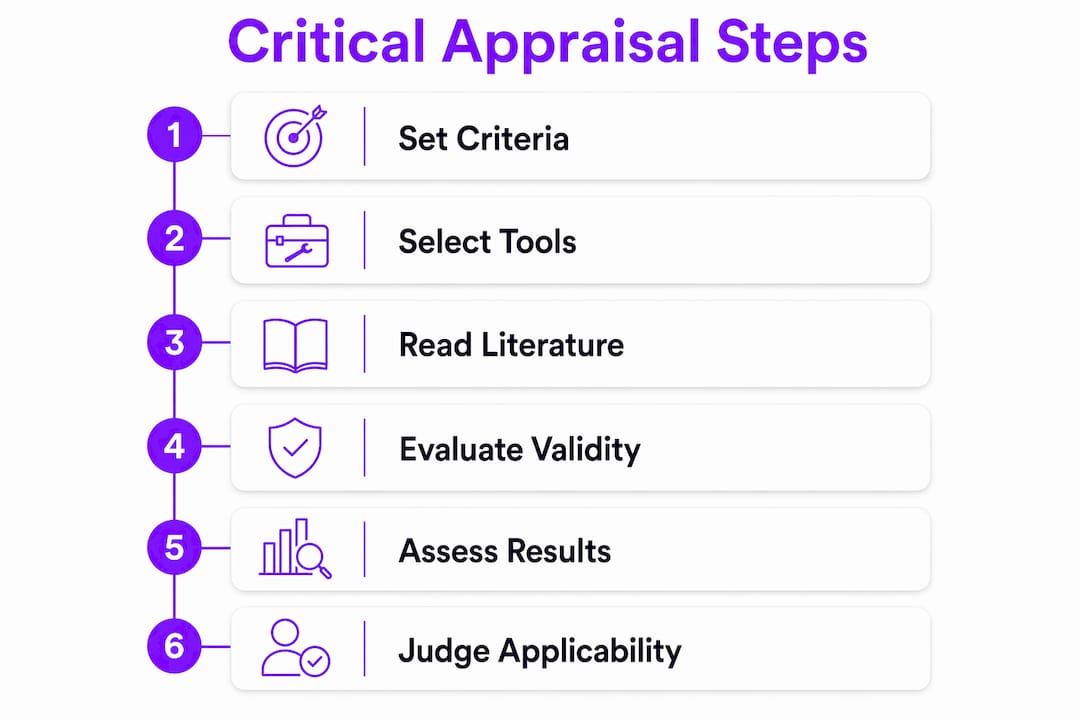
The definition of critical appraisal rests on three core questions: Is the study valid? What are the results? And do those results apply to your specific context? These three questions map directly onto the evaluation domains covered by tools like CASP and JBI. Answering all three gives you a complete picture of a study’s worth.

What are the essential steps for conducting critical appraisal?
A clear process makes appraisal repeatable and defensible. Follow these steps every time you evaluate a study.
-
Define your research question using PICO. PICO stands for Population, Intervention, Comparison, and Outcome. Framing your question this way tells you exactly what kind of study you need and what evidence is relevant. A vague question leads to vague appraisal.
-
Select the right appraisal tool for the study design. An RCT checklist asks about randomization and blinding. A qualitative checklist asks about researcher reflexivity and data saturation. Using the wrong tool produces a misleading quality score. Match the tool to the design before you read a single result.
-
Assess risk of bias systematically. Work through each domain in your chosen checklist. Look for selection bias, performance bias, detection bias, and attrition bias. Appraisal tools provide structured questions covering reliability, validity, conflicts of interest, and methodology soundness. Do not skip domains because a study looks credible on the surface.
-
Evaluate applicability to your context. A study may score well on methodology but still not apply to your research question. Ask whether the study population matches yours, whether the setting is comparable, and whether the outcome measures are relevant. External validity is as important as internal validity.
-
Summarize and record your findings. Write a brief appraisal note for each study. Record the tool used, the scores or judgments made, and your conclusion on whether the study contributes reliable evidence. This record protects you from reviewer bias and keeps your review reproducible.
Pro Tip: Set up your appraisal criteria and select your tools before you start reading the literature. Choosing tools after reading introduces unconscious bias toward studies you already found convincing.
A common pitfall is treating appraisal as a one-time judgment. Strong researchers revisit their appraisal notes when new evidence emerges and adjust their confidence ratings accordingly.
How do critical appraisal tools differ by research study design?
Appraisal tools must match the study design being evaluated. Using a generic checklist across all study types is one of the most common errors in systematic reviews. Each design has distinct methodological features, and each checklist targets those specific features.
The table below shows how tool focus areas shift across common study designs.
| Study design | Primary appraisal focus | Common tool |
|---|---|---|
| Randomized controlled trial | Randomization, allocation concealment, blinding | CASP RCT checklist |
| Cohort study | Confounder control, follow-up completeness | CASP Cohort checklist |
| Case-control study | Selection of controls, recall bias | CASP Case-Control checklist |
| Qualitative study | Researcher reflexivity, data saturation, transferability | CASP Qualitative checklist |
| Systematic review | Search strategy, inclusion criteria, risk of bias synthesis | AMSTAR 2 |
For RCTs, the central question is whether randomization was truly random and whether allocation was concealed from the people enrolling participants. For observational studies like cohort and case-control designs, the focus shifts to how well the researchers controlled for confounding variables. Qualitative studies require a completely different lens: you assess whether the researcher’s own perspective was acknowledged and whether the data collection was thorough enough to support the conclusions.
AMSTAR 2 is the recognized standard for appraising systematic reviews. It evaluates whether the review team registered a protocol in advance, whether the search was comprehensive, and whether individual study biases were assessed and factored into the overall conclusion.
Pro Tip: If you are unsure which tool to use, identify the study design first by looking at the methods section. The design determines the tool, not the topic.
Using the wrong tool does not just produce an inaccurate score. It can lead you to trust a study that has serious design-specific flaws you never checked for. That is a risk no researcher can afford.
Why does critical appraisal matter for interpreting research findings?
The importance of critical appraisal becomes clear the moment you realize that publication does not equal quality. Peer review catches many errors, but it does not catch all of them. Studies with methodological flaws, undisclosed conflicts of interest, or populations that do not match your context can still appear in top journals.
Researchers who skip appraisal risk adopting flawed or harmful interventions based on unchecked systemic errors in studies. That risk is not theoretical. Clinical practice has been shaped by studies later found to have serious bias problems, and policy decisions have been reversed when better evidence emerged.
Critical appraisal in research protects against several specific errors:
- Overconfidence in statistical significance. A statistically significant result in a small, poorly controlled study can disappear in a larger, well-designed replication. Appraisal flags the sample size and power calculations before you draw conclusions.
- Ignoring applicability. A high-quality study may not apply to your population if the study participants differ in age, comorbidities, or cultural context. Generalizability must be evaluated explicitly.
- Missing conflicts of interest. Industry-funded studies show measurable patterns of favorable outcomes. Appraisal tools ask you to check funding sources and author affiliations as a standard step.
- Passive reading. Experts consistently recommend moving beyond passive reading to actively interrogating study validity. Reading a study without questioning it is not evidence-based practice.
The goal of appraisal is not to reject studies. It is to calibrate how much weight each study deserves in your overall evidence synthesis. A study with limitations can still contribute useful data when its limitations are understood and accounted for.
Common misconceptions about critical appraisal in research
The most persistent misconception is that reporting guidelines and appraisal tools are the same thing. They are not. Reporting guidelines like PRISMA tell authors how to write up their studies clearly and completely. Appraisal checklists like CASP or JBI tell readers how to evaluate whether a study was conducted well. Confusing the two leads researchers to use PRISMA as a quality filter, which it was never designed to do.
A second misconception is that finding limitations in a study means the study should be excluded. That framing misunderstands what appraisal is for.
“Identifying study limitations does not invalidate research. It guides how much confidence to place in the findings. Critical appraisal is a quality control mechanism, not a rejection tool.” — Virginia Commonwealth University expert insight
A third misconception is that appraisal is only relevant for systematic reviews. Every researcher who reads a study and draws conclusions from it is performing some form of appraisal, whether structured or not. Doing it without a framework just means doing it inconsistently. Using a validated appraisal framework makes your reasoning transparent and reproducible, which matters whether you are writing a thesis, a grant proposal, or a clinical guideline.
Key Takeaways
Critical appraisal is the structured process of evaluating research quality, bias, and applicability, and it is the foundation of reliable evidence-based conclusions.
| Point | Details |
|---|---|
| Definition of critical appraisal | It is the systematic evaluation of study trustworthiness, value, and relevance using validated frameworks. |
| Match tools to study designs | Use CASP for RCTs and qualitative studies, and AMSTAR 2 for systematic reviews, never a generic checklist. |
| Applicability matters as much as quality | A methodologically sound study can still be irrelevant if its population or setting differs from yours. |
| Set criteria before reading | Defining appraisal tools and criteria before reviewing literature prevents reviewer bias and protects reproducibility. |
| Limitations guide weighting, not exclusion | Identifying flaws tells you how much confidence to place in a study, not whether to discard it entirely. |
What I have learned from watching researchers struggle with appraisal
Early-career researchers tend to make the same mistake: they treat appraisal as a box to check rather than a thinking process to internalize. I have seen graduate students run through a CASP checklist in 10 minutes and declare a study “high quality” without actually engaging with the methodology section. The checklist is a scaffold, not a shortcut.
The researchers who get appraisal right share one habit. They read the methods section before the results. That single shift changes everything. When you understand how a study was designed before you see what it found, you are far less likely to be swayed by a dramatic result that the methodology cannot actually support.
Another pattern I have noticed is that students underestimate how much context matters. A well-designed RCT conducted in a high-income country with a homogeneous population may tell you very little about outcomes in a different setting. Applicability is not a secondary concern. It is the final test that determines whether evidence is actually usable.
My practical advice: build appraisal into your reading routine from day one. Every time you read a paper for your research, spend five minutes with the relevant checklist. You will develop an instinct for spotting bias and weak methodology faster than any course can teach you. Pair that habit with data consistency practices and your evidence synthesis will be far more defensible.
— Ubada
How Papersynapse supports your literature review workflow
Conducting critical appraisal across dozens or hundreds of papers is time-consuming work. Papersynapse is an AI-powered platform built for exactly this kind of systematic literature review work.

Papersynapse lets you import references directly from Scopus or Web of Science, then uses AI to read abstracts and fill structured extraction tables. That means you spend less time on manual categorization and more time on the actual appraisal judgments that require your expertise. The platform processes up to 200 papers in under two minutes, which changes the scale at which early-career researchers can work. For students building their first systematic literature review or researchers managing large evidence bases, Papersynapse removes the extraction bottleneck so appraisal gets the attention it deserves.
FAQ
What is the definition of critical appraisal in research?
Critical appraisal is the systematic process of evaluating a study’s trustworthiness, value, and relevance using structured frameworks like CASP or JBI checklists. It assesses study design, methodology, risk of bias, and applicability to a specific context.
How do I choose the right critical appraisal tool?
Identify the study design first, then select the matching tool. Use CASP checklists for RCTs, cohort studies, and qualitative research, and use AMSTAR 2 for systematic reviews.
Does finding limitations in a study mean I should exclude it?
No. Identifying limitations tells you how much weight to give a study’s findings, not whether to discard it. Most studies have some limitations, and appraisal helps you account for them rather than ignore them.
What is the difference between PRISMA and CASP?
PRISMA is a reporting guideline that tells authors how to write up a systematic review clearly. CASP is an appraisal tool that helps readers evaluate whether a study was conducted with methodological rigor. They serve opposite purposes.
Why is applicability important in critical appraisal?
A study can be methodologically sound but still irrelevant to your research question if the population, setting, or outcomes differ from your context. Evaluating external validity is a required step in any complete appraisal.