Data Consistency in Research Explained for Grad Students
Data Consistency in Research Explained for Grad Students

Data consistency in research is defined as the state where every instance of a data point is identical across all datasets, systems, and time points it appears in. Without this uniformity, research findings cannot be reproduced, compared, or trusted. A June 2026 study identified 19 key measures for data consistency out of 69 total data quality indicators, with contradiction, missing values, and lack of currentness ranked as the most critical. That finding alone signals how much the field has formalized what many researchers still treat as an afterthought. Data consistency in research explained properly means understanding not just what it is, but why it differs from related concepts like data reliability and data integrity, and how to protect it at every stage of a study.
What are the common types of data consistency in research?
Data consistency is not a single condition. It exists on a spectrum, and recognizing the type you are dealing with shapes how you address it.
Strong consistency means every read of a data point returns the most recent write. This is the gold standard in clinical trials and longitudinal cohort studies, where a participant’s updated lab value must be reflected everywhere immediately. Weak consistency allows temporary divergence between copies of a dataset, acceptable in some survey-based studies where minor delays do not affect outcomes. Eventual consistency sits between the two: all copies will converge to the same value, but not instantly. Distributed research databases often operate this way.

Beyond these replication types, researchers also work with internal coherence, which means values within a single dataset do not contradict each other. A participant recorded as 25 years old in one column and born in 1960 in another is internally incoherent. Cross-dataset coherence extends this check across multiple sources, which matters enormously in multi-site studies or systematic reviews that pool data from different labs.
Reliability and consistency are related but not the same thing. Reliability reflects measurement stability across repeated observations. Consistency reflects agreement across data copies or collection points. A scale that always reads 2 kilograms too heavy is reliable but not valid. A dataset where that wrong value is recorded identically in every system is consistent but still incorrect. Separating these concepts prevents a common error: assuming that because data matches across sources, it must be right.
-
Contradiction: Two records for the same entity hold conflicting values.
-
Missingness: Required fields are absent, breaking downstream calculations.
-
Lack of currentness: Data reflects an outdated state, creating temporal inconsistency.
-
Referential mismatch: A record references an entity that no longer exists in a linked table.
Pro Tip: When designing a multi-site study, define a single authoritative source for each variable before data collection begins. Deciding which system “wins” in a conflict after the fact is far harder than preventing the conflict upfront.
Why is data consistency critical for research validity and integrity?
Inconsistent data does not just create inconvenience. It propagates errors through every analysis that touches the affected records.
Consider a meta-analysis that pools effect sizes from 30 studies. If five of those studies contain internally inconsistent outcome measures, the pooled estimate absorbs that noise. Limited access to raw data in systematic reviews often forces researchers to impute missing correlations, and that imputation can shift heterogeneity measures and alter study conclusions. Sensitivity analysis helps but does not fully remove the bias introduced by imputed values.
The distinction between consistency and integrity trips up even experienced researchers. Data consistency means all copies of a value agree with each other. Data integrity means the value is correct against defined rules and constraints. A dataset can pass every consistency check and still be wrong. That is the silent failure mode: zero discrepancies across systems, but a fundamentally flawed dataset.
-
Inconsistency erodes reproducibility. When another lab cannot replicate your findings because your dataset contains contradictions, the problem is structural, not statistical.
-
Inconsistency inflates false positives. Contradictory records create noise that can look like signal, especially in large observational datasets.
-
Inconsistency delays decisions. Poor data integrity causes teams to spend time re-verifying foundational data instead of advancing analysis.
-
Inconsistency undermines systematic reviews. When extraction tables from different reviewers use different coding conventions, pooling becomes unreliable.
“Consistent but incorrect data across systems is a silent failure mode that requires attention beyond replication checks.” This is why cross-system reconciliation alone is not sufficient for high-stakes research.
Current research widely lacks consistent data validation standards. Most journals and grant guidelines impose minimal requirements on validation procedures, leaving researchers to develop ad hoc practices that vary by lab, project, and individual habit. That gap is where most consistency failures originate.
What practical methods ensure data consistency throughout research?
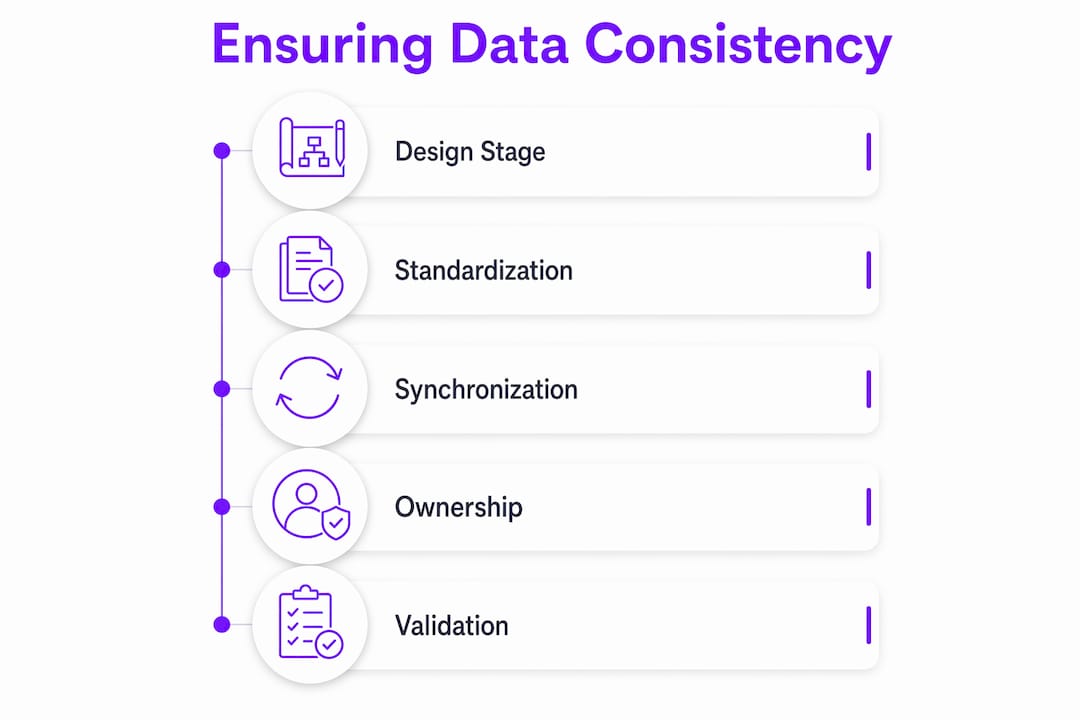
Protecting data consistency requires deliberate choices at the design stage, not just cleanup at the analysis stage.
Standardize collection and entry procedures
Every variable in your dataset needs a defined format before a single observation is recorded. Date fields should follow ISO 8601 (YYYY-MM-DD). Categorical variables need a fixed codebook. Free-text fields should be avoided wherever a controlled vocabulary exists. Standardization at entry is the cheapest form of consistency enforcement because it prevents errors rather than correcting them.
Choose the right synchronization method
When data flows across multiple systems, the synchronization method determines how long inconsistency windows last. Change Data Capture (CDC) monitors changes at the row level and streams updates immediately to connected systems. Batch processing, by contrast, syncs data on a schedule, creating gaps where different systems hold different values. For research databases where timing matters, CDC reduces those gaps significantly.
| Synchronization method | Consistency window | Best fit |
|---|---|---|
| Real-time CDC | Near zero | Clinical trials, longitudinal studies |
| Near-real-time streaming | Seconds to minutes | Multi-site observational research |
| Scheduled batch processing | Hours to days | Low-frequency survey data |
| Manual periodic export | Days to weeks | Small-scale archival projects |
Assign data ownership
Named responsible parties for each dataset are critical to maintaining accuracy, setting validation rules, and managing exceptions. Without ownership, no one has authority to resolve conflicts, and inconsistencies accumulate unchallenged. In a research team, this means designating a data manager per dataset, not per project.
Handle missing data with caution
Imputation is sometimes necessary, but it carries risk. Imputing missing correlation coefficients in meta-analyses can accumulate errors that alter heterogeneity estimates and shift overall conclusions. Use imputation only when the missingness mechanism is well understood, document every imputed value, and run sensitivity analyses that exclude imputed records entirely.
Pro Tip: Build a data dictionary before your first data collection session. A dictionary that defines every variable, its format, its allowable range, and its source takes a few hours to create and saves weeks of cleanup later.
How do researchers evaluate and measure data consistency in research studies?
Measuring consistency requires moving beyond a simple “does it match?” check to a structured assessment framework.
The IDEFIM indicator set, drawn from 61 sources including German clinical guidelines, provides 19 specific consistency indicators for empirical health research. These indicators target contradiction, missingness, and lack of currentness as the dimensions most likely to compromise study conclusions. That level of specificity is what separates a meaningful consistency audit from a superficial one.
Researchers working outside clinical health contexts can adapt the same logic. The core measurement approaches apply broadly:
-
Uniqueness checks: Confirm that each entity appears exactly once in a dataset. Duplicate records are one of the most common consistency failures in survey research.
-
Referential integrity checks: Verify that every foreign key in a relational dataset points to an existing record. Orphaned references signal extraction or merging errors.
-
Internal coherence checks: Flag records where two fields contradict each other logically, such as a study end date earlier than its start date.
-
Temporal consistency checks: Confirm that values recorded at different time points follow a plausible trajectory. A participant’s age should increase by one year per annual follow-up, not decrease.
Experts now advocate for analysis-aware testing, which tailors consistency checks to the specific analytic goals of a study rather than applying generic validation rules. A cross-sectional survey and a randomized controlled trial have different consistency risks. Generic checks catch generic errors. Study-specific checks catch the errors that actually threaten your conclusions.
Tracking consistency metrics over time matters as much as point-in-time checks. A dataset that passes every check at baseline but degrades over a two-year longitudinal study has a consistency problem that only longitudinal monitoring will catch. Build scheduled re-checks into your data management plan from the start.
Key takeaways
Data consistency in research requires uniform, validated data across all systems and time points, and no amount of statistical correction fully compensates for inconsistencies introduced at the collection or entry stage.
| Point | Details |
|---|---|
| Consistency is not correctness | Data can match across all systems and still be wrong; integrity checks are also required. |
| 19 specific indicators exist | The IDEFIM set targets contradiction, missingness, and currentness as the top consistency risks. |
| Synchronization method matters | Change Data Capture reduces inconsistency windows compared to batch processing for active research databases. |
| Assign data ownership | Named responsible parties prevent unresolved conflicts from accumulating across a project’s lifespan. |
| Imputation carries risk | Imputing missing values in meta-analyses can shift heterogeneity estimates; always document and test sensitivity. |
Why I think researchers underestimate the consistency-integrity gap
Most graduate students learn to worry about missing data and outliers. Very few are taught to distinguish between a dataset that is consistent and one that is correct. Those are different problems with different solutions, and conflating them leads to false confidence.
I have seen well-designed studies pass every internal consistency check and still produce unreliable findings because the authoritative source for a key variable was never defined. Two systems agreed with each other perfectly. They were both wrong. AI-driven research pipelines make this problem more acute, not less. AI automates extraction and harmonization, but it requires coherent, correctly defined inputs to produce reliable outputs. Garbage in, consistent garbage out.
The researchers who handle this best are the ones who treat data management as a scientific activity, not an administrative one. They write data dictionaries with the same care they write analysis plans. They assign data ownership the way they assign authorship. They run consistency checks before analysis, not after a reviewer asks why two tables disagree.
The future of research data quality will involve more automation, and tools that integrate extraction, normalization, and validation in one place will reduce the manual errors that currently dominate the problem. But the conceptual work, defining what consistency means for your specific study, remains a human responsibility. No tool substitutes for that decision.
— Ubada
How Papersynapse supports data consistency in literature reviews
Systematic literature reviews concentrate every data consistency challenge into one workflow. Extraction is manual, coding conventions vary by reviewer, and pooling data from dozens of papers creates exactly the kind of cross-dataset incoherence this article describes.

Papersynapse addresses this directly. The platform reads abstracts and fills structured extraction tables with AI, processing up to 200 papers in under two minutes. Researchers import references from Scopus or Web of Science, and Papersynapse normalizes the extracted data within a single workflow. That normalization step is where consistency is built in, not patched on afterward. If you are running a systematic review and want extraction tables that hold up to scrutiny, Papersynapse is worth examining closely.
FAQ
What is data consistency in research?
Data consistency in research means every instance of a data point is identical across all datasets and systems where it appears. It is a prerequisite for reproducible and comparable findings.
How does data consistency differ from data integrity?
Consistency means agreement across copies of a value; integrity means the value is correct against defined rules. A dataset can be fully consistent and still contain wrong values.
What are the most common data consistency challenges in research?
Contradiction between records, missing values, and outdated data are the three most frequently cited consistency failures in empirical research, according to the IDEFIM indicator framework.
How do I ensure data consistency in a multi-site study?
Define a single authoritative source for each variable before data collection begins, assign a named data owner per dataset, and use real-time synchronization methods like Change Data Capture where possible.
Why does data consistency matter for systematic reviews?
Inconsistent extraction coding across reviewers makes pooling unreliable. When raw data is unavailable, researchers must impute missing values, which can alter heterogeneity estimates and shift overall conclusions.