Double Data Extraction for Reviewers, Practical Hybrid Workflow
Double Data Extraction for Reviewers, Practical Hybrid Workflow
Double data extraction reduces errors but does not eliminate them. A randomized crossover trial found error rates dropped significantly after independent double-checking, yet a substantial proportion of studies still carried at least one error afterward. The practical takeaway: budget for double extraction on outcome data, and treat it as harm reduction, not a guarantee.
TL;DR:
- The most critical outcome data fields should always undergo duplicate extraction, while study characteristics are highly desirable but not mandatory to double extract.
- Properly piloting and continuously updating a detailed extraction form with clear definitions and a codebook significantly improves consistency and reduces disagreements.
- AI-assisted tools can streamline initial data pre-filling but should not replace human verification for outcome data to prevent errors from being overlooked.
- Single extraction with verification may be sufficient for low-stakes fields or small teams, but double extraction is essential when accuracy impacts study conclusions or effect estimates.
Table of Contents
- What Is Double Data Extraction, and What Are the Variants?
- Does the Evidence Actually Support Double Extraction?
- How Do You Build and Pilot an Extraction Form?
- How Should Teams Resolve Extraction Disagreements?
- Where Does Automation Fit Into a Double Extraction Workflow?
- When Is Single Extraction Enough, and When Do You Need More?
- What Would I Actually Tell a Review Team to Do?
- Speed Up Extraction Without Cutting Corners on Verification
- Sources
What Is Double Data Extraction, and What Are the Variants?
Double data extraction means two reviewers independently pull data from the same study, then compare results and reconcile any mismatch. It’s distinct from single extraction with verification, where one person extracts and a second person only checks the work rather than extracting from scratch. Teams also use double-checking, a lighter version where the second reviewer scans for obvious errors rather than performing a full parallel pass, and occasionally triple extraction, reserved for high-stakes fields where residual error is unacceptable.
The Cochrane Handbook draws a clear line on which fields warrant which method:
- Outcome data (effect sizes, sample sizes, event counts): mandatory duplicate extraction under MECIR standards.
- Study characteristics (design, setting, funding source): duplicate extraction is “highly desirable” but not required.
- Descriptive fields (author names, publication year): usually single-extracted since transcription errors here rarely distort conclusions.
Protocols typically name the method explicitly in the methods section, since reviewers and editors now expect it stated up front.
Does the Evidence Actually Support Double Extraction?
Yes, but the size of the benefit surprises a lot of people who assume double-checking is close to foolproof. A crossover, multicenter, investigator-blinded randomized controlled trial tested this directly. Study-level error rates fell by about 20 percentage points after cross-checking in both pharmaceutical and non-pharmaceutical intervention groups, meaning a meaningful reduction, but residual errors remained in a considerable share of studies even after two independent passes.
Trial finding: Double extraction cut study-level error rates by about 20 percentage points, but residual errors remained in roughly 4 out of 10 studies even after cross-checking.
An earlier 2006 trial by Buscemi and colleagues reached a compatible conclusion using a different design: single extraction generated more errors than double extraction, though duplicate extraction cost noticeably more reviewer time. That two trials, roughly two decades apart, land on the same directional finding gives the recommendation real weight rather than resting on one isolated result.
A few caveats matter here:
- Error rates varied by intervention type. Pharmaceutical trials with dense numeric outcomes showed higher baseline error than non-pharmaceutical studies.
- Neither trial claims double extraction catches everything. Both frame it as risk reduction, not risk elimination.
- Methodological reviews note that reporting of extraction methods is inconsistent across the literature, which limits how confidently anyone can generalize these numbers to every review type.
If a searcher wants one number to remember, it’s this: expect double extraction to cut errors by somewhere around a fifth, not by half or more.
How Do You Build and Pilot an Extraction Form?
Get the form right before extraction starts, or you’ll be redoing work later. Here’s a workable sequence:
- Draft closed-ended fields wherever possible. Free-text boxes invite inconsistent phrasing that’s hard to reconcile later; dropdowns and coded categories force consistency.
- Add an explicit “not reported” option for every field. Ambiguity between “extractor forgot” and “study didn’t report it” is one of the most common sources of disagreement.
- Write a codebook entry for every field, not just a label. Define exactly what counts as the primary outcome, what unit conversions apply, and how to handle multi-arm trials.
- Pilot on 5 to 10 studies before committing to full extraction, a range echoed across university systematic review guides and methodological handbooks.
- Run a calibration exercise where both extractors independently code the same pilot studies, then compare. Some teams track agreement with Cohen’s kappa, though no universal threshold exists. Set your own internal bar and re-pilot if disagreement stays high.
- Re-pilot after any major form revision. A field definition change midstream without re-testing tends to reintroduce the very inconsistency piloting was meant to catch.
Staffing matters as much as form design. Blind extractors to each other’s entries where feasible, and make sure anyone extracting outcome data has basic statistics literacy. Someone who doesn’t know the difference between a hazard ratio and a risk ratio will introduce errors no amount of form design can prevent.
Pro Tip: Build your codebook as a living document during piloting, not after. Every disagreement in the pilot phase is a sign the definition was ambiguous, not that an extractor made a mistake, so use each one to tighten the field description immediately.
Detailed piloting workflows and templates are worth reviewing in a dedicated piloting guide if your team is starting from scratch.
How Should Teams Resolve Extraction Disagreements?
Discrepancies are normal, even expected. What separates a rigorous review from a sloppy one is how disagreements get resolved and documented.
- Start with pair discussion. Most mismatches resolve once both extractors compare notes against the source paper directly.
- Escalate to a third-party arbiter for anything the pair can’t settle, ideally someone with subject-matter expertise on the outcome in question.
- Contact study authors for numeric ambiguity that the published paper simply doesn’t clarify, particularly around missing standard deviations or unclear denominators.
- Document unresolved items rather than forcing a resolution. If a value stays genuinely ambiguous, report it as such in your methods section instead of quietly picking one number.
Reviews that report their reconciliation process transparently, including how many disagreements arose and how they were settled, hold up better under peer review and replication attempts than reviews that only state “data were extracted in duplicate” with no further detail.
Where Does Automation Fit Into a Double Extraction Workflow?
AI-assisted platforms typically handle two things well: pre-filling structured fields from abstracts and normalizing inconsistent labels across studies (turning “n=45” and “sample size: 45 participants” into one consistent format). What automation does not replace is judgment on ambiguous outcomes: deciding which of three reported endpoints counts as primary, or how to code a composite outcome that wasn’t pre-specified.
A hybrid workflow tends to work better than an all-or-nothing choice between manual and automated extraction:
- AI pre-fills fields directly from abstracts and reference-manager imports.
- Two human reviewers independently verify critical fields, especially outcome data.
- Disagreements route through the same reconciliation process used in a fully manual review.
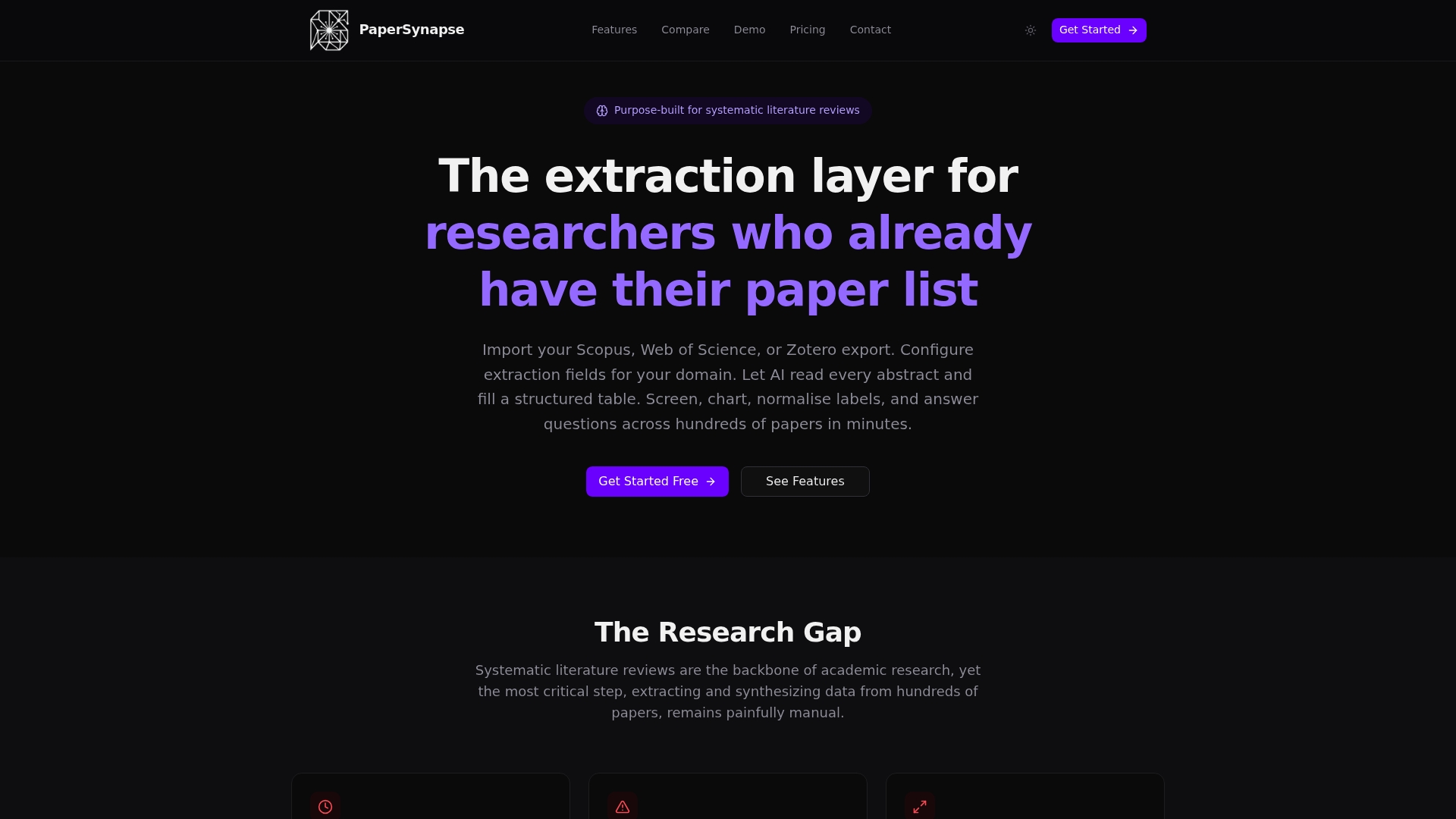
Papersynapse fits this middle position. It imports references from tools like Scopus or Web of Science, uses AI to read abstracts and populate structured tables, and leaves outcome-level verification to the human reviewers who still need to sign off on the numbers that matter.
Pro Tip: Never let automation pre-fill a field and skip the second human check just because the AI output looked confident. Confidence and correctness are not the same thing, and outcome data is exactly where that gap causes the most damage.
For a deeper look at verification techniques once extraction is underway, see this guide to checking extraction accuracy.
When Is Single Extraction Enough, and When Do You Need More?
Single extraction with a verification pass can be defensible for low-stakes descriptive fields, small teams with tight timelines, or reviews where funding simply doesn’t cover duplicate labor. Double extraction earns its cost on outcome data, heterogeneous interventions, or any review where a numeric error would change the pooled effect estimate. Triple extraction or expert arbitration makes sense only in genuinely high-stakes syntheses, such as reviews informing clinical guidelines, where the residual error double extraction leaves behind is not an acceptable risk.
| Criterion | Single extraction + check | Double extraction | Triple/expert arbitration |
|---|---|---|---|
| Critical outcome data | Not recommended | Recommended baseline | Consider for guideline-level reviews |
| Staff availability | Fits small teams | Needs two trained extractors | Needs three or an arbiter |
| Expected heterogeneity | Low heterogeneity only | Handles moderate heterogeneity | Best for highly heterogeneous data |
| Timeline pressure | Fastest option | Adds real time cost | Slowest, highest assurance |
What Would I Actually Tell a Review Team to Do?
Pilot before you extract, full stop. Most of the “double extraction didn’t help” complaints I’ve seen trace back to vague field definitions, not a failure of the method itself. Use automation to cut the grunt work, but never let it substitute for a second human set of eyes on outcome data. Residual error after double-checking is normal, expected, and survivable, as long as you document it honestly instead of pretending your numbers are cleaner than they are.
— Ubada
Speed Up Extraction Without Cutting Corners on Verification
Manual double extraction is the safest method on paper, but it’s also the slowest, and most review teams don’t have unlimited hours to throw at reconciling two independent spreadsheets by hand. There are AI-assisted platforms that import references from common databases, read abstracts, and fill structured extraction tables automatically, with claims of processing hundreds of papers quickly.
That speed doesn’t replace the human verification step your outcome data still needs. It replaces the hours normally spent on first-pass manual entry, freeing your two extractors to focus their independent checks on the fields that actually carry error risk. For teams building an extraction workflow around a structured table already, this piloting resource on building a data extraction table pairs well with an AI pre-fill step. Start a review on Papersynapse and see how much manual entry your team can hand off before the double-checking even begins.
Sources
- Effects of double data extraction on errors in evidence synthesis: a crossover, multicenter, investigator-blinded, randomized controlled trial
- Single data extraction generated more errors than double data extraction in systematic reviews
- Cochrane Handbook: Chapter 5 — Collecting data