Evidence Matrix for Reviewers: Traceable Pilot First Workflow to Scale
Evidence Matrix for Reviewers: Traceable Pilot First Workflow to Scale
An evidence matrix is a structured grid that organizes your sources as rows and analytic fields as columns, letting you compare studies side by side instead of rereading notes to remember what each one found. It’s the tool researchers, systematic reviewers, and graduate students reach for when a simple list of summaries stops being enough to spot patterns, contradictions, and gaps. Build one when you need to synthesize, not just summarize.
TL;DR:
- Building a pilot matrix with a small sample of varied studies helps prevent costly restructuring when adding new data.
- Recording stable source and evidence IDs before extraction ensures traceability for claims and supports transparency.
- Automating large-scale extraction with tools like Papersynapse significantly reduces manual effort and maintains consistency across sources.
- Focusing the matrix on specific review claims guides column selection and prevents overinclusion of unrelated variables.
- Separating factual data extraction from synthesis coding maintains objectivity and simplifies identifying contradictions or gaps.
Table of Contents
- What an Evidence Matrix Does and When to Use One
- Core Columns and Adaptable Templates You Should Capture
- How Do You Build an Evidence Matrix Step by Step?
- Turning the Matrix Into Analytic Writing and Synthesis
- Common Pitfalls and Best Practices in Evidence Matrix Analysis
- Spreadsheet Basics and When to Scale to Automation
- What I’ve Learned Building Evidence Matrices for Real Reviews
- PaperSynapse: A Practical Option to Scale Evidence Extraction
- Where to Go Deeper on Evidence Matrix Methods
- Sources
What an Evidence Matrix Does and When to Use One
A literature summary tells you what each paper says. An evidence matrix tells you how the papers relate to each other, because every row uses the same columns, which makes comparison automatic instead of manual. That structural consistency is the entire point: you can scan down a “sample size” column or an “outcome direction” column and see the whole review question laid out at once.
The matrix earns its place at specific moments in a review. It helps during scoping, when you’re still deciding whether enough studies exist to justify a full synthesis. It helps again during data extraction, when consistency across sources becomes the thing that determines whether your conclusions hold up. And it’s close to mandatory in mixed-methods work, where qualitative and quantitative findings need a shared frame to sit next to each other at all.
Done well, a matrix surfaces things a narrative summary hides:
- Recurring patterns across studies that use different terminology for the same finding
- Direct contradictions between sources that agree on topic but disagree on result
- Gaps in the literature, visible as blank or thin columns across many rows
- Rough quality signals, once you’ve added a limitations or level-of-evidence field
As Atkinson’s foundational work on the evidence matrix argues, the format functions as a heuristic that pushes you past memorizing individual studies toward genuinely integrating evidence across them.
Core Columns and Adaptable Templates You Should Capture
Most working matrices split into four groups of columns, and you build them in that order.
Factual identification fields come first: full citation, publication year, DOI or another stable ID, a short study nickname you’ll reuse in your writing, and the stated purpose of the study. These fields should require zero interpretation. If you’re debating what to write in one of them, it belongs in a later column.
Context and method fields capture design, sample or setting, the comparator or intervention, and how the outcome was measured. Outcome fields record the main result, its units, any reported uncertainty, and the direction of the effect. Finally, quality and synthesis fields hold limitations, a risk-of-bias or level-of-evidence rating, thematic tags, and a marker for whether a finding agrees or contradicts other rows.
A widely used template from health sciences research follows this exact logic. The University of Toledo’s DNP evidence table guide lists citation, purpose, framework, design, sample and setting, variables, measurement, findings, level-of-evidence, strengths and weaknesses, and recommendations as standard fields.
| Column group | Example fields | Purpose |
|---|---|---|
| Identification | Citation, year, DOI, study nickname | Traceability and quick reference |
| Context/method | Design, sample/setting, comparator, measurement | Comparability across studies |
| Outcomes | Main result, units, uncertainty, effect direction | Cross-study pattern detection |
| Quality/synthesis | Limitations, level-of-evidence, theme tags, agree/contradict flag | Supports your written synthesis |
Don’t build all of these on day one. Start with six or eight columns, pilot them, and add fields only once you’ve confirmed they matter for your specific review question.
How Do You Build an Evidence Matrix Step by Step?
Building the matrix in the wrong order is the single most common source of rework in a systematic review. Here’s the sequence that avoids it.
- Plan around the comparison, not the topic. Define exactly what claim your review needs to support, then choose the minimum set of columns that claim requires. A vague topic produces a bloated matrix; a specific comparison produces a lean one.
- Pilot on 3 to 5 diverse papers. Test your column headings against papers that differ in design, setting, or population before you commit. Brandeis University’s matrix method guide recommends this explicitly, and reading a handful of varied studies almost always reveals a field you hadn’t thought to include.
- Extract factual fields verbatim first. Record what the paper actually says before you interpret anything. Assign a stable Source ID and Evidence ID to every row and every extracted passage, so you can trace any claim back to its origin later.
- Add synthesis codes after extraction, not during. Once the factual columns are filled, go back and code theme, direction, confidence, and conflict. Separating these steps keeps your read of the evidence from contaminating your record of it, a principle the BridgeHelix six-layer model builds its entire structure around.
- Maintain the matrix as a living document. Version it, keep a change log, and export snapshots as you go so your reporting stays auditable.
Pro Tip: Keep a running codebook alongside the matrix, a one-page document defining exactly what each theme tag or confidence rating means. Without it, two reviewers coding the same paper six weeks apart will disagree with themselves.
Turning the Matrix Into Analytic Writing and Synthesis
The matrix isn’t the deliverable. The synthesis paragraph is, and the matrix is what makes writing it fast instead of agonizing.
Sort or filter by your synthesis columns, theme tag, agreement flag, confidence rating, and the relationships that matter will surface on their own. A cluster of rows tagged with the same theme and the same effect direction is a paragraph waiting to be written. A cluster that splits on direction is a different, equally important paragraph: an open conflict in the literature that your review needs to name rather than paper over.
A reliable paragraph sequence follows the evidence itself:
- State the claim your rows support
- Cite the specific matrix rows as evidence, by study nickname or Source ID
- Explain why the pattern holds, or why it doesn’t
- Note limitations visible in the quality column
- State the implication for your research question
Report single-source findings differently from multi-source ones. A pattern backed by one study gets hedged language; a pattern backed by five gets a confident claim. The same rows that feed your prose can drive your figures directly, since a matrix organized by theme and outcome converts almost mechanically into a summary table or a comparison chart for publication.
Common Pitfalls and Best Practices in Evidence Matrix Analysis
The two mistakes that derail most first-time matrix builders both happen before extraction even starts.
The first is finalizing columns before reading any papers. It feels efficient, but it guarantees a mid-project rebuild once real data shows your fields don’t fit. Pilot first, always. The second is mixing interpretation with extraction, writing your take on a finding in the same cell where you’re supposed to be recording what the study actually reported. Once fact and opinion share a cell, nobody, including you in six months, can tell which is which.
Best practices that hold up across disciplines:
- Assign Source IDs and Evidence IDs before you extract anything, not after
- Keep a codebook that defines every synthesis tag in plain language
- Treat the matrix as living: update it, version it, don’t freeze it early
- Save linked passages or exact quotes alongside summaries, a workflow guides on passage-level evidence matrices recommend specifically for keeping synthesis claims auditable
Pro Tip: If two rows disagree, don’t quietly pick the one that fits your hypothesis. Flag the conflict in its own column and address it directly in your writing. Reviewers and readers trust a synthesis more when it names its own contradictions.
Spreadsheet Basics and When to Scale to Automation
A spreadsheet is the right starting tool for almost every review. It’s immediate, flexible, and lets you rename or restructure columns in seconds during the pilot phase. Its weaknesses show up at scale: version drift between collaborators, inconsistent phrasing across extractors, and the sheer time cost of reading 150 abstracts by hand.
Automated extraction tools address exactly that gap. They import references directly by DOI, link extracted fields back to specific passages, batch-process large sets of papers, and apply the same field definitions to every row, which cuts down on the inconsistency that creeps in when three research assistants extract data at different times of day.
A hybrid workflow tends to work best: pilot your columns manually on a handful of papers to lock in the right structure, then scale extraction with automation once the codebook is stable. This is the gap platforms like Papersynapse are built for. It imports references from Scopus or Web of Science, uses AI to read abstracts into structured tables, and keeps the extraction traceable back to source, letting a review scale past what manual coding can realistically handle without losing the Source ID discipline that keeps a matrix defensible.

What I’ve Learned Building Evidence Matrices for Real Reviews
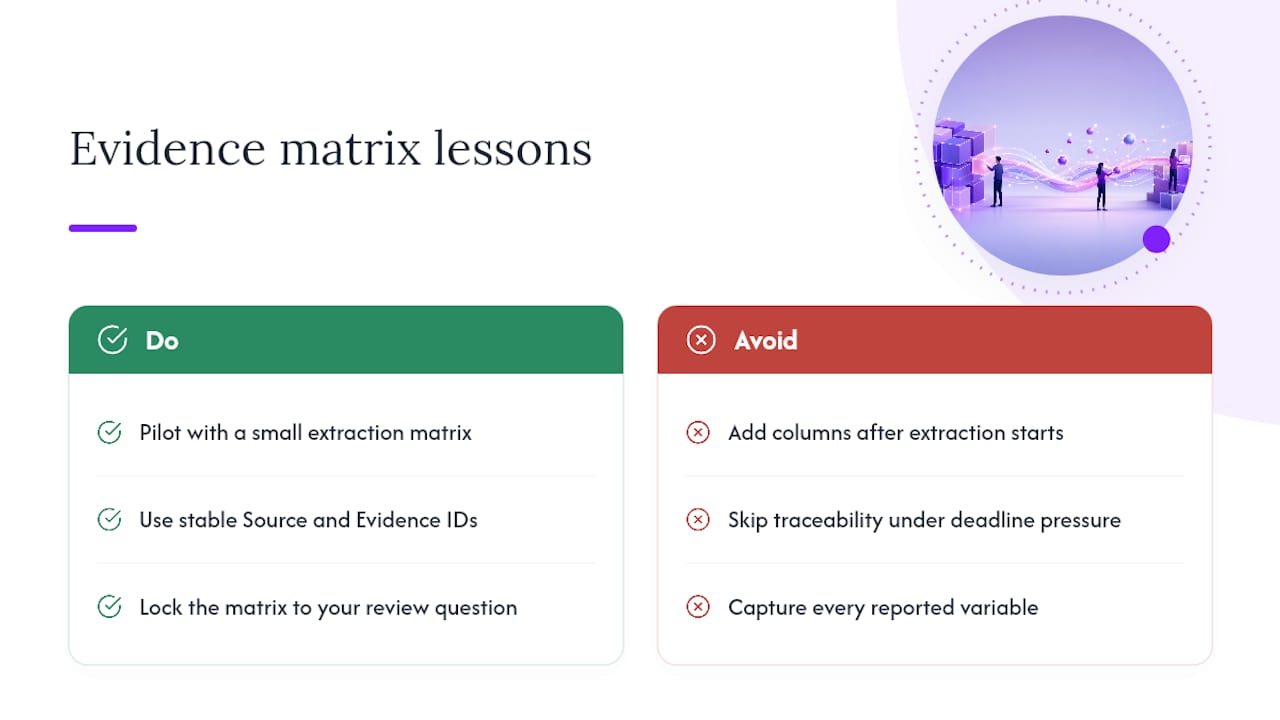
The single habit that saves the most time is piloting before committing. Every column you add after extraction has started costs you a re-read of every paper already logged, and that cost compounds fast on a review of any real size.
Traceability is the second lesson, and it’s the one people skip under deadline pressure. A matrix without stable Source and Evidence IDs looks fine until someone asks you to justify a claim, and you can’t find which paper it came from. Keep the matrix locked to your actual review question, too. It’s tempting to capture everything a paper reports, but a matrix that tries to hold every possible variable stops being a tool and starts being a second, messier copy of your reading pile.
— Ubada
PaperSynapse: A Practical Option to Scale Evidence Extraction
Once your pilot columns are locked in and you know exactly what your matrix needs to capture, the bottleneck shifts from design to volume, and that’s where manual extraction starts to hurt.

Papersynapse is built for that exact shift. Import your references straight from Scopus or Web of Science, and its AI reads abstracts into the structured fields you’ve already defined, reportedly processing up to 200 papers in under two minutes. That replaces the slowest, most error-prone part of matrix building, the hours spent manually copying purpose, method, and outcome fields into a spreadsheet, while keeping every extracted value traceable back to its source. The platform allows adjustment of extraction fields, label normalization, and generation of charts and tables from the dataset for reporting. If your review has moved past the pilot stage and you’re staring down a few hundred abstracts, see how Papersynapse handles extraction at scale and check whether your paper volume fits the free tier before upgrading.
Where to Go Deeper on Evidence Matrix Methods
For hands-on templates and grounding, start with Brandeis University’s matrix method handout, the University of Toledo’s evidence table guide, and Toronto Metropolitan’s BridgeHelix chapter. Atkinson’s original 2008 paper remains the clearest case for the evidence matrix as an analytic heuristic.
Sources
- The Matrix Method for Literature Reviews | Brandeis University
- Creating an Evidence Table—University of Toledo DNP guide
- Organize your readings with a literature review matrix | Toronto Metropolitan (BridgeHelix)
- THE EVIDENCE MATRIX: A SIMPLE HEURISTIC FOR ANALYZING AND INTEGRATING EVIDENCE — Atkinson et al. (2008)
- The Evidence Matrix — Sage Journals (Atkinson)