Review Teams: Full Text Screening Faster With Automation, Pilot 20–30
Review Teams: Full Text Screening Faster With Automation, Pilot 20–30
Full-text screening is the stage after title/abstract screening where reviewers read each retrieved article in full to confirm it meets eligibility criteria. It requires checking methods, participants, and outcomes against your protocol, and recording one exclusion reason per excluded study for the PRISMA flowchart. Independent dual screening with a documented adjudication process is standard.
TL;DR:
- Full-text screening requires retrieving every article before reviewing, prioritizing methods and results sections to quickly assess eligibility against protocol criteria.
- Applying a clear, short exclusion codebook and stopping screening at the first disqualifying detail improve consistency and efficiency.
- Independent dual screening with a pilot process and documented adjudication is essential to maintain reliability and resolve disagreements effectively.
- Tracking reviewer agreement, especially Cohen’s kappa scores, helps identify issues early and ensures reproducibility throughout the process.
- Automation tools like PaperSynapse support structured decision logging, PDF management, and reconciliation, but settling eligibility criteria during pilot testing has the greatest impact on speed and accuracy.
Table of Contents
- Where Full-Text Screening Fits in the Review Workflow
- How to Perform Text Screening at the Full-Text Stage
- Building a Dual-Screening and Adjudication Protocol
- What to Do When You Can’t Find the Full Text
- Common Mistakes That Slow Down Full-Text Screening
- How PaperSynapse Supports the Full-Text Screening Workflow
- What Actually Matters in Full-Text Screening
- Try PaperSynapse for Structured Full-Text Screening
- Sources
- FAQ
Where Full-Text Screening Fits in the Review Workflow
Full-text screening sits between title/abstract screening and data extraction, and skipping straight to extraction before it’s finished is one of the more common ways teams introduce bias into a review. Title and abstract screening is deliberately loose. It casts a wide net and keeps anything that might be relevant. Full-text screening is where that net gets tightened against the actual eligibility criteria in your protocol.
This stage matters because abstracts routinely oversell what a study actually did. A paper might describe an outcome measure in its abstract that never shows up in the results table, or claim a study design it didn’t really use. Reading the full text catches that. It’s also the point at which selective reporting becomes visible, since you’re now looking at the methods and results side by side rather than a 250-word summary.
Every exclusion made here needs a reason attached, because that reason becomes part of your PRISMA flow diagram:
- Wrong population or intervention
- Wrong study design (e.g., not randomized when the protocol required it)
- Wrong outcome measures
- Full text unavailable despite retrieval attempts
- Duplicate publication of an already-included dataset
How to Perform Text Screening at the Full-Text Stage
A repeatable full-text screening process saves far more time than it costs to set up. Here’s a sequence that works for teams of any size.
- Retrieve every full text before you screen a single one. Use Unpaywall, the Open Access Button, your institution’s library proxy, or direct author contact for anything not freely available. If a library doesn’t hold it, request it through interlibrary loan. Attach each PDF directly to the record in your reference manager so nothing gets separated from its citation.
- Read in a fixed order: methods first, then results, then the rest only if needed. The Annual Reviews methodology overview notes that prioritizing methods and results lets reviewers judge eligibility fast, since population, design, and outcome measures usually live there, not in the introduction or discussion.
- Apply a stop rule. The moment you find a disqualifying detail, mark the exclusion and move on. You don’t need to read a paper cover to cover to know it used the wrong comparator.
- Assign exactly one exclusion code per excluded article. If two reasons apply, pick the first one you encountered in the text. Consistency here matters more than precision.
- Attach a short evidence excerpt for any borderline call. A sentence or two copied from the methods section saves you from re-reading the whole paper later when a co-reviewer questions the decision.
Pro Tip: Time-box your first 20 to 30 full texts and track how long each decision takes. Most teams find their pace roughly doubles once the eligibility criteria stop feeling ambiguous, which tells you exactly when a pilot round paid off.
Work in batches of 20 to 25 articles rather than trying to screen an entire corpus in one sitting. Fatigue is a real driver of inconsistent decisions, and batching also gives you natural checkpoints to compare notes with a co-reviewer before drift sets in.
Building a Dual-Screening and Adjudication Protocol
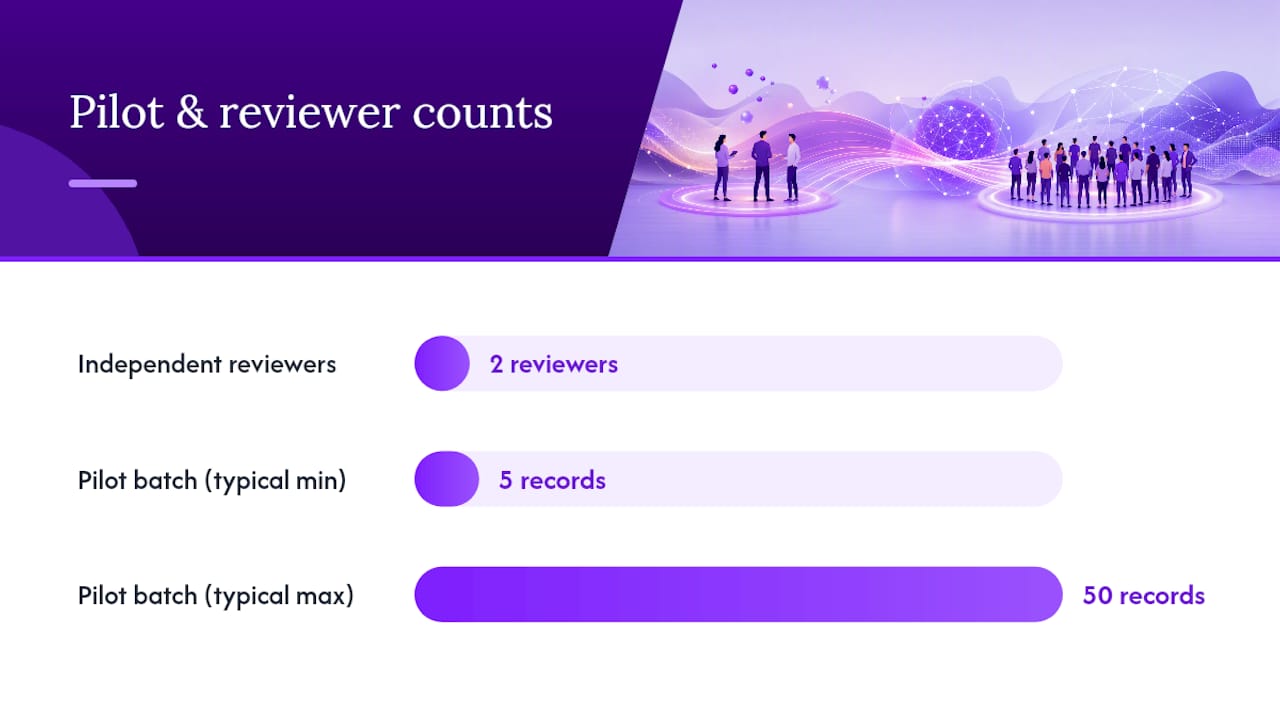
Full-text screening should never rest on one person’s judgment. Two independent reviewers, screening the same batch without seeing each other’s votes, is the baseline structure recommended across current systematic review methodology.
Before the real screening starts, run a pilot round on a small subset. Somewhere between 5 and 50 records is typical, depending on the size of your review.
- Have both reviewers screen the pilot batch independently against the draft criteria.
- Compare decisions and discuss every disagreement as a group, not just the close calls.
- Revise the eligibility codebook based on what actually confused people, not what you assumed would confuse them.
- Re-pilot on a fresh batch if disagreement is still high after the first round.
Once the main screening starts, track reviewer agreement, not just to satisfy a methods section requirement, but because it tells you when something is wrong. Cohen’s kappa is the standard reference statistic here, and a low score should trigger retraining or a criteria revision rather than an automatic tie-break. A PMC review of current systematic review methods confirms that disagreements are meant to be resolved through discussion or a third reviewer, and that documenting how each decision was reached is what makes the review reproducible. Your protocol should name that third reviewer, or the consensus process you’ll use, before screening begins, not after the first disagreement forces the question. Ideally the adjudicator wasn’t one of the original two screeners, so the tie break doesn’t just reproduce the same blind spot twice.
What to Do When You Can’t Find the Full Text
Missing full texts are one of the most predictable snags in any review, and they deserve a documented process rather than an ad hoc workaround. The CRD guidance from the University of York treats pre-specified, methodical retrieval as part of a rigorous protocol, not an afterthought.
Work through retrieval channels in a consistent order and log each attempt:
- Institutional library access and interlibrary loan requests
- Open-access repositories such as Unpaywall or the Open Access Button
- Direct email to the corresponding author, with a second follow-up after two weeks
- Conference proceedings or preprint servers if the study appears to be unpublished in full
“Full text not available” and “excluded for eligibility” are different outcomes and your log needs to keep them separate. A study excluded because the design doesn’t match your criteria tells readers something about your criteria. A study you simply couldn’t get your hands on tells readers something about access gaps, and conflating the two muddies your PRISMA diagram. Keep PDFs and retrieval notes attached to each record in your reference manager, with version history intact, and export the exclusion log as a standalone file you can hand to a co-author or reviewer without digging through your raw data.
Common Mistakes That Slow Down Full-Text Screening
The single most expensive mistake in full-text screening is changing eligibility criteria midway through the batch. It feels efficient in the moment. It isn’t, because it forces you to re-screen everything decided under the old rules, and most teams underestimate how much that costs until they’re staring down a re-screen of 200 articles two weeks before a deadline.
The second most common error is letting extraction creep in before screening is finished. Pulling numbers from a paper you haven’t fully confirmed as eligible wastes effort if it turns out to be excluded, and it quietly biases which papers get extra scrutiny.
A short, shared exclusion codebook, three to seven categories at most, keeps decisions consistent and speeds up screening because reviewers stop debating language and start applying it.
Pro Tip: If the same ambiguous scenario comes up three times, stop screening and call a short consensus meeting instead of letting each reviewer improvise their own interpretation. One five-minute conversation now beats a full re-screen later.
How PaperSynapse Supports the Full-Text Screening Workflow
Automation doesn’t replace the judgment calls described above. It removes the friction around them. Text-mining and automated support are explicitly framed as tools that assist, not substitute for, eligibility decisions, and that’s the philosophy PaperSynapse is built on.
- Import references from various reference managers and attach PDFs to each record within the platform.
- Enforce required exclusion fields so reviewers must log a reason when marking a study “excluded.”
- Track agreement between reviewers during a pilot round to aid the reconciliation process.
- Export an exclusion log alongside the structured extraction tables after screening is complete.
The sensible approach is to pilot a tool like this alongside whatever process your team already trusts, on a small batch, before letting it carry the full review.
What Actually Matters in Full-Text Screening
Most guidance on full-text screening reads like a checklist exercise: retrieve the PDF, read it, decide, move on. That framing undersells how much of the real work happens before a single article gets opened. The teams that screen fastest and most consistently are the ones who treated their pilot round as a genuine negotiation over what the criteria mean, not a formality to satisfy a methods section.
The conventional advice tends to over-index on tools and under-index on the codebook. A team with a mediocre PDF workflow but a crisp, three-category exclusion codebook will out-screen a team with slick software and vague criteria every time. Kappa scores and adjudication rules matter, but they’re diagnostic, not preventive. They tell you something went wrong after the fact.
If there’s one thing worth prioritizing above all else, it’s this: settle your eligibility criteria’s edge cases in the pilot, not the main screen. Every ambiguous scenario you resolve before batch one starts is a re-screen you never have to do later. Everything else, retrieval workflow, software choice, agreement statistics, is scaffolding around that one decision.
— Ubada
Try PaperSynapse for Structured Full-Text Screening
The platform helps reduce the time full-text screening usually takes, while maintaining protocol steps that keep a review defensible. Import your reference library, attach PDFs to each record, and use structured exclusion fields to record reasons behind each decision.
The platform includes reviewer workflows and reconciliation tools so pilot calibration and adjudication occur within the same system as the extraction tables, rather than across separate files. It’s designed to complement existing protocols rather than replace them outright. Start with a subset of your current review on the free tier and compare how the exclusion log holds up against your manual process before deciding whether to run your full batch through it.
Sources
- Full text screening — Imperial Library Guides
- Systematic reviews of the literature: an introduction to current methods — PMC
- Systematic Reviews: CRD guidance for undertaking reviews in health care — CRD (University of York)
FAQ
What Are Some Examples of Screening in a Systematic Review?
Title/abstract screening, full-text screening, and reference list (citation) screening are the three main types. Each stage narrows the pool further against the same pre-specified eligibility criteria.
How Does Full-Text Screening Work With Reference Managers Like Covidence?
Reference management and screening platforms let reviewers import citations, attach PDFs, and vote independently on each record, with built-in conflict flags when two reviewers disagree. PaperSynapse follows the same core structure, adding automated exclusion-field enforcement and PRISMA-ready exports.
What Are the Key Elements of a Strong Literature Review Protocol?
Definitions vary across guidance documents, but most protocols converge on the same core elements: a clear research question, pre-specified eligibility criteria, a documented search strategy, and a plan for how disagreements between reviewers get resolved.
What Is an Example of a Screening Tool Used in Reviews?
A screening tool is any platform or form that lets reviewers vote include/exclude against fixed criteria while logging a reason for each exclusion. That can be a structured spreadsheet, a dedicated screening platform, or an AI-assisted tool like PaperSynapse that also handles extraction once screening is complete.
How Many Reviewers Should Screen Full Text Independently?
Two independent reviewers per record is the standard recommendation, with a third reviewer or documented consensus process available for disagreements.