Researchers: Automate Inclusion/Exclusion Screening, Pilot 5–100 Records
Researchers: Automate Inclusion/Exclusion Screening, Pilot 5–100 Records
Automation earns a place in inclusion and exclusion screening, but only as decision support that sits underneath human judgment, never in place of it. The evidence supports a hybrid approach: rules layered over machine learning, tested on a small pilot sample, with two independent reviewers checking the machine’s calls. Skip the pilot or skip the second reviewer, and you’ve traded a slow bottleneck for a fast, unaudited one.
TL;DR:
- Hybrid automation with rules over machine learning offers the best balance of accuracy, transparency, and auditability for screening processes.
- Large language models like GPT-4 achieve high F1 scores without extensive customization, reducing setup time and complexity.
- Pilot studies involving 5 to 100 records, with independent human review, are essential to validate automation criteria and agreement levels.
- Costlier transformer models provide higher accuracy but may be impractical for large datasets, making rule-based systems more economical for smaller reviews.
- Automation should be viewed as decision support, requiring human review and thorough documentation to ensure reproducibility and prevent bias.
Table of Contents
- How Does Inclusion Exclusion Automation Actually Work?
- Which Method Wins on Accuracy, Cost, and Auditability?
- What’s a Reliable Workflow for Screening Automation?
- What Should Be on Your Screening-Automation Checklist?
- How Does PaperSynapse Apply This Workflow?
- Speed Without Losing Rigor
- Try Papersynapse for Your Next Screening Pilot
- Where to Read More on Screening Automation
- Sources
- FAQ
How Does Inclusion Exclusion Automation Actually Work?
Three approaches dominate the field right now, and they solve different problems.
Rule-based systems use regex patterns and keyword filters to flag records against your criteria. They’re cheap to build, easy to audit line by line, and they work well when your criteria are structured and unambiguous (“age 18 or older,” “published after 2015”). Where they struggle is nuance: a rule can’t tell the difference between a trial that “excluded metastatic patients” and one that “included only metastatic patients” without careful engineering.
Transformer and machine learning models read text more like a person does. They catch context, negation, and phrasing variation that rules miss, which makes them stronger on genuinely complex extraction tasks. The cost is real: these models need compute resources, sometimes labeled training examples, and ongoing monitoring to catch drift as your corpus changes.
Hybrid systems, where fixed rules can override a model’s output, tend to split the difference well. You get the model’s pattern recognition with a rule-based safety net that keeps decisions traceable.
A quick benchmark to anchor this: in one test comparing extraction methods on trial inclusion criteria, rule-based systems scored moderate F1 values, while a transformer model reached much higher scores, and a hybrid rule-over-ML setup matched or slightly beat the transformer alone.
- Rule-based: low cost, high traceability, weak on nuance
- ML/transformer: strong on complex text, needs compute and oversight
- Hybrid: usually the best balance of accuracy and auditability
Which Method Wins on Accuracy, Cost, and Auditability?
Numbers matter here more than intuition. In the same PubMed-indexed comparison of methods for extracting a specific inclusion criterion (metastatic versus localized disease), a large language model like GPT-4o scored high F1 values on its own, without task-specific training. That’s a meaningful finding for anyone weighing whether to build a custom model or lean on a general-purpose one: the general model got close to purpose-built performance with far less setup work.
Translate F1 differences into workload terms. A jump from 0.72 to 0.97 on a screening task isn’t a rounding error. It means far fewer false exclusions slipping through, which in a systematic review translates directly to fewer studies wrongly dropped from your evidence base.
Cost cuts the other way. Large transformer models and LLMs carry higher compute costs than lightweight rule or classical ML systems, and that gap grows with dataset size. For a review screening a few hundred records, the cost difference is trivial. For a living review processing thousands of records repeatedly, it adds up.
- Rule-based: lowest cost, fully transparent decision logic
- ML/transformer: highest raw accuracy on nuanced text, higher compute cost
- Hybrid: near-top accuracy with a rule layer you can actually inspect
Auditability decides whether reviewers and journal editors trust your process. A model that can’t show its reasoning is a hard sell in a PRISMA-governed workflow, no matter how good its F1 score looks on paper.
What’s a Reliable Workflow for Screening Automation?
Screening should always run in two stages: title and abstract first, then full text, with at least two independent reviewers checking decisions at each stage. Automation slots into both stages as a third, faster reviewer whose calls still need human sign-off. Here’s how to build that in without introducing chaos.
- Lock your criteria before you automate anything. Write inclusion and exclusion rules as testable, binary statements (“adults 18+,” “randomized controlled trials only”) rather than vague descriptions. Criteria decided after screening starts tend to drift, and drifting criteria make automated rules useless.
- Pilot on a small batch first. Run 5 to 100 records through your automated process and compare machine decisions against two human reviewers screening the same batch independently. Measure agreement, not just accuracy against a gold standard, since interrater reliability tells you whether your criteria are clear enough for a machine to apply consistently.
- Refine the criteria based on pilot disagreements. If the machine and your reviewers disagree often on a specific criterion, that criterion is probably too vague, not that the model is broken.
- Set decision thresholds and a triage lane. Records the model flags with high confidence can move faster; borderline cases route to manual review by both reviewers rather than a single tiebreaker.
- Log every exclusion reason. Structured, exportable exclusion data is what makes your PRISMA flow diagram defensible later.
Pro Tip: Run your pilot on records you already have a confident manual verdict for. That gives you a clean baseline to measure machine agreement against, instead of guessing.
What Should Be on Your Screening-Automation Checklist?
Most automation failures trace back to skipped groundwork, not bad models. Before you scale anything, run through this list.
- Pilot and lock criteria first. Don’t feed vague criteria to a model and expect it to “figure out” what you mean. Ambiguous or overlapping variables are a documented, common source of screening errors, automated or not.
- Watch for language bias. Automatically excluding non-English studies without an explicit, justified rule for doing so can skew your evidence base, especially in fields with strong non-English research traditions.
- Confirm exportability. Your tool needs to produce structured reasons-for-exclusion and an audit log, not just a pass/fail label, or your PRISMA reporting will have gaps.
- Budget for drift. A model tuned well on your pilot sample can degrade as your corpus grows or shifts topically; plan periodic spot checks, not a one-time validation.
Pro Tip: Keep a running log of every criterion your reviewers disagree on, even after the pilot. That log becomes your evidence trail if a journal reviewer questions your screening methodology.
How Does PaperSynapse Apply This Workflow?
PaperSynapse builds the workflow above into one platform instead of scattering it across spreadsheets and separate tools. You import references directly from Scopus or Web of Science, and the platform reads abstracts with AI to extract structured fields into tables automatically, cutting the manual reading time that normally eats weeks of a review timeline.
The relevant pieces for inclusion/exclusion automation:
- Pilot screening on a smaller batch before committing to a full extraction run
- Extraction, normalization, and visualization inside one workflow, so labels stay consistent across hundreds of records
- Support for the kind of PRISMA-aligned documentation reviewers expect to see in a methods section
- Claimed throughput of up to 200 papers processed in under two minutes, useful for sizing a pilot quickly
None of that replaces the two-reviewer validation step research libraries recommend. Automation here speeds up the first pass; your team still owns the final call and the documentation trail behind it.
Speed Without Losing Rigor
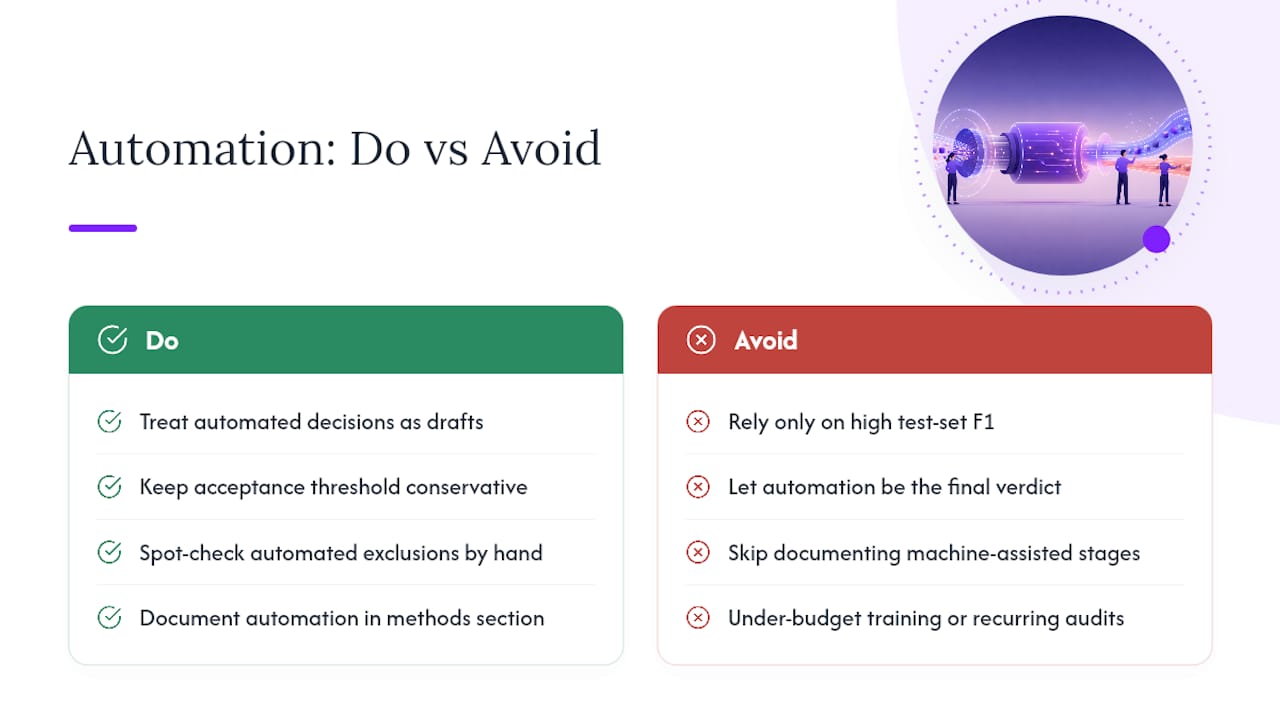
Treat every automated decision as a draft, not a verdict, especially in the first few months of using a new tool. Keep your acceptance threshold conservative and spot check a sample of automated exclusions by hand, even after your pilot numbers look strong. High F1 in a test set doesn’t guarantee the same performance on your specific corpus.
Write your automation method into the paper’s methods section with the same detail you’d give a statistical test. Reviewers and readers deserve to know which stages were machine assisted and which decisions a human made. Budget time and money for this properly: compute costs, a training period for your team, and a recurring audit of the workflow itself. Automation that saves you three weeks of screening but costs you a rejected manuscript over undocumented methods was never actually faster.
— Ubada
Try Papersynapse for Your Next Screening Pilot
Most systematic review tools force a choice: pay an agency-level price to outsource screening, or accept the manual grind of reading every abstract yourself. Some systematic review tools charge by paper volume and offer a free tier for testing the workflow before committing a budget to it. Start small: import a CSV of 50 to 100 records, run extraction, and compare the machine’s labels against two human screeners working independently. That pilot alone tells you whether the tool fits your criteria before you scale to a full review.

Once your pilot numbers look consistent, move to the Free, Pro, or Ultra plan depending on how many papers you’re processing. Read through the guidance on running a title and abstract pilot and structuring a multi-reviewer workflow before you lock your criteria. Keep every PRISMA export from your pilot; you’ll want that trail when you write up your methods section.
Where to Read More on Screening Automation
For deeper methodology and reporting standards, a few sources are worth keeping open in a browser tab while you build your protocol.
- Drexel University’s guide on screening for inclusion or exclusion covers two-stage screening and reviewer requirements in detail.
- The Texas Medical Center Library’s guide on inclusion and exclusion criteria explains how to pilot and document criteria before full screening.
- PMC’s overview of inclusion and exclusion criteria in research flags the most common design mistakes.
- Papersynapse’s post on literature review automation benefits walks through practical gains and limits for researchers adopting these tools.
Sources
- Screening for inclusion or exclusion - Systematic Reviews - LibGuides at Drexel University Libraries
- Metastatic Versus Localized Disease as Inclusion Criteria That Can Be Automatically Extracted From Randomized Controlled Trials Using Natural Language Processing - PubMed
- Inclusion and Exclusion Criteria - Systematic Reviews - LibGuides at Texas Medical Center Library
FAQ
Is Automation Reliable Enough to Replace Manual Screening?
No. Even high-performing models need validation by at least two independent human reviewers to catch errors and preserve reproducibility.
Which Automation Method Gives the Best Accuracy?
Hybrid systems that let rules override machine learning output tend to reach the top F1 scores in benchmark comparisons while staying easier to audit than a pure transformer model.
How Many Records Should I Pilot Before Scaling Up?
Somewhere between 5 and 100 records is enough to test agreement between your criteria, your reviewers, and your automated tool before committing to a full run.
Does Papersynapse Handle the Full Screening Workflow?
Papersynapse covers reference import, AI-based extraction, normalization, and visualization in one platform, with support for pilot testing and PRISMA-friendly exports; current pricing for the Free, Pro, and Ultra plans is listed on the Papersynapse site.
Can Automated Screening Introduce Bias?
Yes. Automatically excluding non-English studies or applying overly restrictive rules without justification can skew the evidence base, so every automated rule needs a documented rationale.