Literature Review Protocol for PhD Researchers: 2026 Guide
Literature Review Protocol for PhD Researchers: 2026 Guide

A literature review protocol is defined as a predetermined methodology document that outlines the research question, objectives, inclusion and exclusion criteria, and methods for a systematic or scoping review before any searching begins. The term “review protocol” is the recognized standard in academic publishing, though researchers also encounter it as “systematic review protocol” or “protocol for literature review.” Frameworks like PRISMA 2020, the PICO model, and registries like PROSPERO and OSF form the backbone of any credible protocol. Without a protocol, a literature review lacks the structure needed to defend its findings during peer review or replication.
What is a literature review protocol and why does it matter?
A literature review protocol is the foundational, predefined methodology document developed before searching begins to guide systematic or scoping reviews with transparency and reproducibility. It functions as a binding contract between the researcher and the scientific community. Every decision about which studies to include, which databases to search, and how to extract data gets locked in before you see a single result.
The importance of this upfront commitment cannot be overstated. Protocols prevent researcher bias and loss of focus during literature searching, ensuring reproducible and objective results. Without predefined criteria, researchers unconsciously favor studies that support their hypothesis. That is selection bias in its most common form, and it invalidates the entire review.

Leading journals increasingly require protocol citation in manuscripts. Lack of a documented protocol is viewed as a critical weakness during peer review and reduces research credibility. For PhD candidates, this means a missing protocol can delay publication or trigger a major revision request from reviewers.
What are the essential components of a literature review protocol?
A complete protocol covers every stage of the review process. Each component serves a specific function in keeping the review objective and auditable.
- Rationale and background: Explains why the review is needed and what gap in knowledge it addresses.
- Research question: Formulated using the PICO framework (Population, Intervention, Comparison, Outcome) or PICOS, which adds Study design. PICO gives your question a testable structure that reviewers can evaluate.
- Eligibility criteria: Defines exactly which study types, populations, interventions, and publication dates qualify. Strict adherence to inclusion and exclusion criteria minimizes selection bias, validated through tools like the PRISMA flowchart.
- Search strategy: Lists every database (PubMed, Embase, Scopus, Web of Science), grey literature sources, and the exact keyword strings and Boolean operators you will use.
- Screening and selection process: Describes how many reviewers screen titles and abstracts, and how disagreements get resolved, typically by a third reviewer or consensus discussion.
- Data extraction plan: Specifies which data fields get pulled from each study and which standardized form or table structure captures them. A guide on structuring data tables can sharpen this section considerably.
- Bias assessment: Names the tool used to evaluate study quality, such as the Cochrane Risk of Bias tool or ROBINS-I.
- Synthesis plan: States whether you will use meta-analysis, narrative synthesis, or thematic analysis, and under what conditions.
- Registration details: Records where and when the protocol was registered, plus how amendments will be documented.
Protocol sections adhere to PRISMA 2020 standards to ensure systematic review quality and reproducibility. PRISMA 2020 is the current reporting checklist, and aligning your protocol to it from day one saves significant revision time later.
Pro Tip: Write your eligibility criteria as a decision table with “include” and “exclude” columns. Ambiguous cases become much easier to resolve consistently when the logic is visual.
Why is registering a review protocol important?
Registration transforms a private document into a public commitment. Registering protocols in public registries like PROSPERO is recommended for transparency and to prevent post-hoc changes, benefiting reproducibility and reducing duplication. Post-hoc changes are alterations made after data collection begins, and they are the primary mechanism through which outcome reporting bias enters the literature.
The registration process is more accessible than most PhD candidates expect. Follow these steps:
- Complete your protocol draft first. Registration requires a near-final document. Attempting to register an incomplete protocol wastes time and creates version confusion.
- Choose your registry. PROSPERO accepts health-related systematic reviews. OSF (Open Science Framework) accepts any discipline and allows full protocol uploads.
- Create an account and submit. Registration takes 15–30 minutes to complete online, though preparing the protocol itself can take weeks. PROSPERO reviews submissions before publishing them, which adds a short delay.
- Record your registration number. This number goes into your manuscript and signals to reviewers that your protocol predates your results.
- Document any amendments. If your protocol changes after registration, log the amendment with a date and reason. Unrecorded changes undermine the review’s credibility.
Registration using PROSPERO or OSF is free and open to all reviewers. Many journals now publish protocols as standalone articles, which gives PhD candidates an early publication credit before the full review is complete.
Pro Tip: Register your protocol before you run your first database search, not after. Reviewers check registration dates against search dates. A registration that postdates your search raises immediate red flags.
How does a protocol prevent bias and improve reproducibility?
A protocol is a legally defensible audit trail. Changing inclusion or exclusion criteria mid-review without documented amendments can invalidate the entire review during peer review. Researchers must treat protocols as living documents with version control to maintain auditability and research trustworthiness.
Selection bias and cherry-picking are the two most damaging forms of bias in literature reviews. Selection bias occurs when the criteria for including studies shift based on what the data shows. Cherry-picking happens when researchers unconsciously favor studies with results that match their expectations. Both are nearly impossible to detect after the fact without a predefined protocol.
The rigidity of a protocol ensures objective review outcomes by requiring advance definitions of search parameters and analysis, safeguarding against subjective data cherry-picking. That rigidity feels constraining at first. Over time, it becomes the feature that makes your review defensible.
Scope creep is a separate but related problem. It occurs when researchers keep expanding their research question to include adjacent topics, accumulating irrelevant studies and diluting the review’s focus. Strict enforcement of PICO-based inclusion criteria via the protocol prevents accumulation of irrelevant studies and preserves review clarity. For a PhD candidate managing hundreds of papers, this discipline saves weeks of wasted screening effort.
The protocol also functions as an audit trail during manuscript submission. Peer reviewers can compare your reported methods against your registered protocol line by line. Any deviation without a documented amendment signals methodological weakness. Journals that follow PRISMA 2020 guidelines treat this comparison as a standard part of the review process.
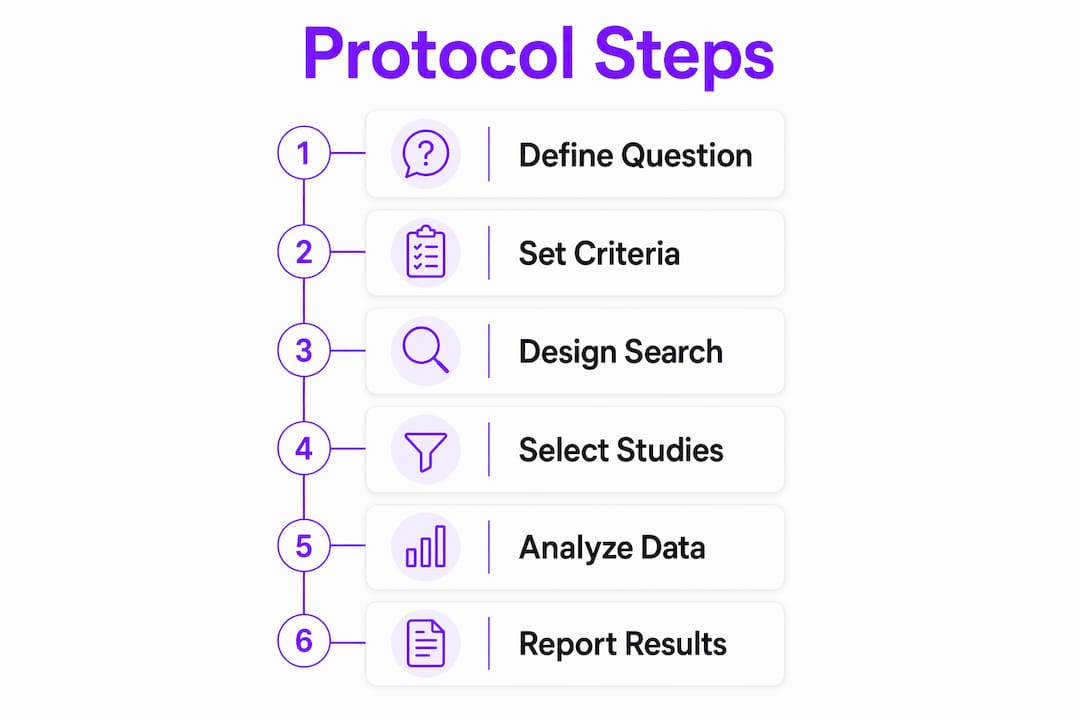
Step-by-step guide to writing a literature review protocol
Writing a protocol from scratch feels daunting until you break it into discrete tasks. Each step builds on the previous one.
- Articulate your rationale. Write two to three sentences explaining what is unknown and why a systematic review is the right method to address it. This section anchors every decision that follows.
- Formulate your research question using PICO or PICOS. A well-formed PICO question defines your population, the intervention or exposure, the comparison condition, and the outcome you are measuring. PICOS adds study design as a fifth element, which is useful when you want to restrict to randomized controlled trials or cohort studies.
- Define eligibility criteria explicitly. Write separate lists for inclusion and exclusion. Include criteria for study design, population characteristics, language, publication date range, and outcome measures. Vague criteria produce inconsistent screening decisions.
- Develop your search strategy. List every database you will search, the date range, and the exact keyword strings with Boolean operators (AND, OR, NOT). Include grey literature sources such as government reports, conference proceedings, and thesis repositories.
- Outline your screening procedure. Specify how many reviewers screen each record, whether screening happens in two stages (title and abstract, then full text), and how conflicts get resolved.
- Plan your data extraction. Design your extraction form before you start. Decide which variables you need from each study and how you will handle missing data. A structured data extraction approach reduces inconsistency across reviewers.
- Select your quality assessment tool. Match the tool to your study types. Cochrane Risk of Bias 2 suits randomized trials. ROBINS-I suits observational studies. AMSTAR 2 suits systematic reviews of reviews.
- Describe your synthesis method. State whether you will pool data statistically (meta-analysis) or synthesize narratively. Define the threshold for statistical pooling in advance.
- Register and version your protocol. Submit to PROSPERO or OSF before searching begins. Save each version with a date stamp so amendments are traceable.
Pro Tip: Keep your protocol to 10–15 pages. Longer protocols are harder to follow and harder to register. If a section runs long, move the detail to a supplementary appendix.
The table below maps each protocol section to its primary function in the review process.
| Protocol section | Primary function |
|---|---|
| Rationale and background | Justifies the review and defines the knowledge gap |
| Research question (PICO/PICOS) | Structures the question for testability and consistency |
| Eligibility criteria | Controls which studies enter the review |
| Search strategy | Ensures comprehensive and reproducible database coverage |
| Screening procedure | Standardizes study selection across multiple reviewers |
| Data extraction plan | Captures consistent variables from each included study |
| Quality assessment | Evaluates risk of bias in included studies |
| Synthesis method | Defines how evidence gets combined and interpreted |
Key Takeaways
A literature review protocol is the predefined document that controls every methodological decision in a systematic review, from research question to synthesis, and its registration in PROSPERO or OSF is the single most effective step for protecting research credibility.
| Point | Details |
|---|---|
| Protocol defined before searching | Write and register your protocol before running any database search to prevent post-hoc bias. |
| PICO framework structures the question | Use PICO or PICOS to give your research question a testable, auditable structure. |
| Registration prevents outcome bias | PROSPERO and OSF registration creates a public, timestamped record that journals verify. |
| Protocol as audit trail | Treat the protocol as a living document with version control; undocumented changes invalidate the review. |
| Scope creep is the silent threat | Strict PICO-based eligibility criteria prevent irrelevant studies from diluting your review’s focus. |
Why I think most PhD candidates underestimate the protocol
Most PhD candidates treat the protocol as a bureaucratic hurdle. They write it quickly, skip registration, and move straight to searching. That approach costs them far more time than the protocol would have taken.
I have watched researchers reach the synthesis stage only to realize their inclusion criteria were ambiguous. Two reviewers interpreted the same criterion differently across 300 papers. The entire screening process had to restart. A single afternoon spent tightening the eligibility criteria in the protocol would have prevented weeks of rework.
The other mistake I see repeatedly is treating the protocol as static. A protocol is a living document. Research questions evolve. Databases change their indexing. New study designs emerge. The answer is not to abandon the protocol. The answer is to log every amendment with a date and a reason. That discipline is what separates a defensible review from one that collapses under scrutiny.
For PhD candidates specifically, the protocol serves one more function that rarely gets discussed: it forces you to think through your entire methodology before you are emotionally invested in your results. Once you have read 200 papers, it is psychologically difficult to exclude a study that supports your argument. The protocol removes that temptation by making the decision before you know the outcome.
The systematic review process rewards researchers who invest in the protocol early. The ones who skip it spend the back half of their review defending decisions they cannot explain.
— Ubada
How Papersynapse supports your protocol workflow
Managing a literature review protocol across hundreds of papers is where most researchers lose time. Papersynapse is built specifically for this stage of the research process.

Papersynapse lets you import references directly from Scopus or Web of Science, then uses AI to read abstracts and fill structured extraction tables aligned with your protocol’s data fields. The platform processes up to 200 papers in under two minutes, which means your inclusion and exclusion decisions get applied consistently at scale rather than drifting across a manual screening session. Version tracking keeps your protocol amendments documented alongside your data. For researchers who want to move from literature review automation to a publication-ready synthesis, Papersynapse provides the workflow in one place.
FAQ
What is a literature review protocol?
A literature review protocol is a predefined methodology document that specifies the research question, eligibility criteria, search strategy, and analysis methods for a systematic or scoping review before any searching begins. It ensures transparency, reproducibility, and protection against bias.
What is the difference between a protocol and a systematic review?
The protocol is the plan; the systematic review is the execution of that plan. A protocol is written and registered before searching starts, while the systematic review is the completed research product that follows the protocol’s methods.
Does every literature review need a protocol?
Systematic reviews and scoping reviews require a protocol as a standard of practice. Narrative or integrative reviews benefit from a protocol but do not always require formal registration.
How long does it take to write a review protocol?
Writing a thorough protocol typically takes several weeks, though the actual registration submission takes 15–30 minutes once the document is complete. Rushing the protocol to save time at the start reliably creates larger problems during screening and synthesis.
What happens if I need to change my protocol after registration?
Document every change as a formal amendment with a date and a clear reason. Submit the amendment to your registry and report all deviations in your final manuscript. Undocumented mid-review changes are treated as methodological failures during peer review.