Literature Review Workflow Checklist for Researchers
Literature Review Workflow Checklist for Researchers

A rigorous literature review follows eight sequential steps: define your scope, design a reproducible search, chase citations, screen in two passes, build a synthesis matrix, outline by themes, draft argumentative paragraphs, and close with a precise gap statement. Budget several weeks for a thesis-level chapter. The checklist below gives you the full sequence at a glance.
Your complete literature review workflow checklist:
- Scope the question before reading anything (population, phenomenon, outcomes, time window)
- Design a reproducible search strategy with synonym blocks and Boolean logic across multiple databases
- Chase citations backward from reference lists and forward through “Cited by” chains
- Screen in two passes: title/abstract first, then full text, against written criteria
- Build a synthesis matrix with one row per paper before writing a single word
- Outline by themes drawn from the matrix, never author by author
- Draft synthesis paragraphs that open with a claim and group citations beneath it
- Close with a precise gap statement that positions your own research
Each step is detailed below, with time estimates, pro tips, and the pitfalls that sink most first attempts.

How do you define scope before your literature review begins?
Scoping before you read a single paper is the single most protective move you can make. Scope creep is the most common reason literature reviews balloon past their deadlines, and it almost always traces back to a question that was never properly bounded.
Write one paragraph that answers three things: what specific question does this review answer, what is explicitly out of scope, and who is the reader. “AI in healthcare” is a topic. “How large language models have been evaluated for clinical reasoning in peer-reviewed literature between 2022 and 2026” is a scope.
Define your boundaries using these four dimensions:
- Population: who or what is being studied
- Phenomenon: the concept, intervention, or condition of interest
- Outcomes: what results or effects you are tracking
- Time window: the publication date range you will cover
Defining inclusion and exclusion criteria at this stage, before you see which papers are available, prevents the bias that comes from retrofitting criteria to a preferred result. Different types of literature review frameworks carry different expectations here: a systematic review demands a formal protocol, while a narrative review allows more interpretive flexibility, but both require a documented scope.
Pro Tip: Write your scope as one sentence you could hand to a colleague and have them replicate your search. If they would ask clarifying questions, your scope is not tight enough yet.
What makes a search strategy reproducible and transparent?
A search strategy is reproducible when someone else can run it and get the same results. That means writing out your Boolean strings, not just your keywords, and recording the exact date you ran each search.
Decompose your question into 2–4 concept blocks, list synonyms for each block (different fields name the same phenomenon differently), and combine blocks with AND while joining synonyms with OR. Run the strings across at least two databases: a broad one like Google Scholar or Scopus and a domain-specific one like PubMed, Web of Science, ACM Digital Library, or EconLit.
Your search strategy documentation should include:
- The exact Boolean string used in each database
- The database name and date of each search
- Any field tags, filters, or date restrictions applied
- The number of results returned at each stage
Failing to log exact queries is one of the most common non-obvious pitfalls in academic research. When your supervisor asks how you found your sources, “I searched around” is not a defensible answer. Export results as .ris or .bib files and deduplicate before you start reading.
Pro Tip: Save your query log in a plain text file alongside your reference manager library. When a reviewer asks you to re-run the search six months later, you will have the exact strings ready.
How should you screen sources and document your decisions?
Screening happens in two passes, and the order matters. For a deep dive into effective methodologies, see how page citations work in medical AI systems. Title and abstract screening comes first: apply your inclusion criteria, and when in doubt, retain the paper. Full-text screening follows for everything that survived the first pass, and this is where final include/exclude decisions are made.
Transparent documentation of your inclusion and exclusion reasoning is what separates a credible review from one a committee cannot verify. Log the reason for every exclusion at the full-text stage. For systematic reviews, this documentation feeds directly into a PRISMA flow diagram. For all other review types, it protects you during defense.
Screening checklist:
- Pre-define inclusion/exclusion criteria before screening begins
- Apply criteria consistently across both passes
- Log exclusion reasons for every full-text rejection
- Hand-search reference lists of your most relevant papers
- Export all retained sources into a reference manager like Zotero or EndNote
A reference manager with annotated notes on each paper’s key features, strengths, and weaknesses makes later retrieval fast and citation accurate. Screening alone typically takes 4–10 hours, a phase most researchers underestimate by half.
Pro Tip: Allocate sufficient time for full-text screening. Rushed exclusions are where reviewable papers get dropped and where committees push back hardest.
Why does a synthesis matrix come before your first draft?
The synthesis matrix is the highest-leverage artifact in the entire process, and the one most first-time reviewers skip. It is a spreadsheet with one row per included paper and columns for the analytic dimensions that matter to your question: method, sample or context, key finding, theme, and limitation.
Building the matrix before drafting forces you to extract from each paper rather than re-read it later. Once filled, it does the synthesis work: sort by theme and you see which claims are crowded and which are thin; sort by method and you see whether a contested finding splits along methodological lines.
The most common error in literature reviews is producing isolated author summaries instead of thematic argumentation. A synthesis matrix makes that error structurally impossible because your section headings come directly from the theme column, not from author names or publication years.
Building your synthesis matrix:
- One row per included paper, filled during reading
- Columns: method, sample/context, key finding, provisional theme, limitation
- Expect to relabel themes after 20–30 rows as the real structure emerges
- Final theme labels become your outline headings
Pro Tip: Do not wait until you have read everything to assign themes. Write them provisionally as you go. The matrix reveals the field’s structure; you do not impose it.
How do you write and manage your time across the full review?
With a synthesis matrix and thematic outline in place, drafting is assembly rather than invention. Each synthesis paragraph opens with a claim about the literature, groups citations beneath it, and closes with what remains unknown. If you deleted every citation and the remaining sentences still read as a connected argument, you are synthesizing. If what remains is disconnected summaries, you are writing an annotated bibliography.
A thesis-level literature review typically requires a substantial amount of time spread over several weeks. Distribute that time deliberately: screening and matrix building together account for a significant portion of the effort, drafting takes additional substantial time, and revision passes consume the remainder.
Writing and revision checklist:
- Draft from your thematic outline, not from scratch
- Open each paragraph with a claim, not an author name
- Run multiple revision passes: one for argument coherence, one for citation accuracy, one for clarity
- Update your search within 3–6 months of submission to catch recent publications
- Get supervisor feedback before the final proofread
For structuring your extracted data into tables that support analysis, a consistent format across all papers saves hours during the writing phase. The gap statement that closes your review should name exactly what the assembled literature has not done: a population not studied, a mechanism not tested, two literatures that never cite each other. “More research is needed” is the most-flagged sentence in peer review.
How Papersynapse accelerates your systematic review workflow
Manual extraction is where most systematic reviews lose days. Reading abstracts, filling structured tables, and normalizing data across hundreds of papers is repetitive, error-prone, and slow. Papersynapse automates that bottleneck.
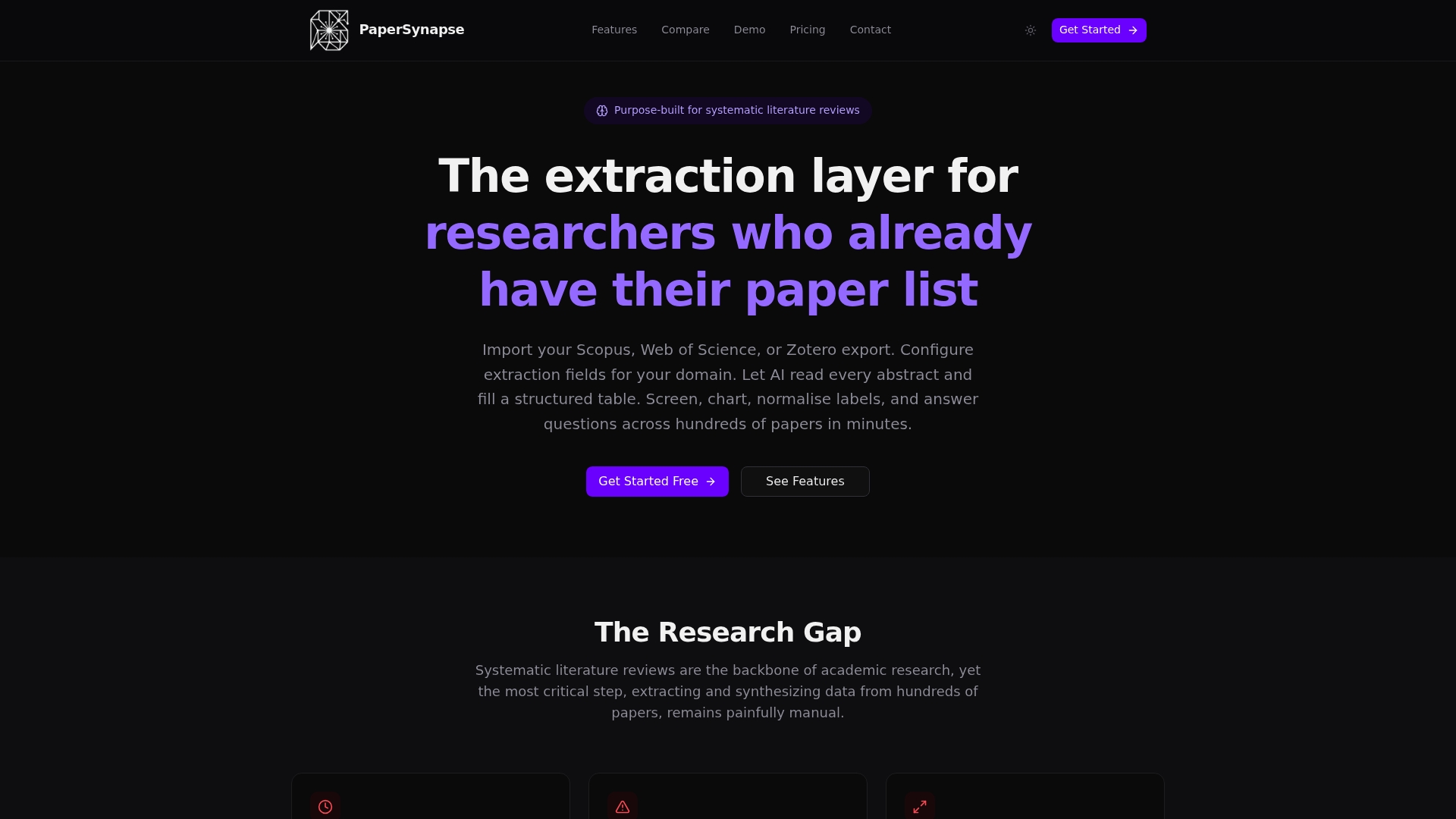
Papersynapse integrates directly with Scopus and Web of Science, so you import your reference list and the platform’s AI reads abstracts and populates structured extraction tables for you. The platform claims to process up to 200 papers in under two minutes, handling extraction, normalization, and categorization within a single workflow. That means you spend your time on the synthesis and argumentation that only you can do, not on copying data between spreadsheets.
For researchers who want to understand how automation improves consistency across large reference sets, Papersynapse’s approach reduces the subjectivity that creeps into manual extraction when you are reading paper 180 differently than you read paper 12.
What Papersynapse handles in your workflow:
- Reference import from Scopus and Web of Science
- AI-powered abstract reading and structured table population
- Extraction normalization across all included papers
- Categorization and result visualization within one platform
Ready to cut extraction time and focus on the analysis that matters? Start your review with Papersynapse.
Key Takeaways
A structured literature review workflow checklist, followed in sequence, produces a review that is reproducible, transparent, and defensible at any level of academic scrutiny.
| Point | Details |
|---|---|
| Scope before reading | Define population, phenomenon, outcomes, and time window before opening a single paper. |
| Document every search | Log exact Boolean strings, databases, and search dates to support reproducibility and supervisor verification. |
| Screen in two passes | Title/abstract screening followed by full-text screening, with exclusion reasons logged at each stage. |
| Build the matrix first | A synthesis matrix with one row per paper must come before drafting; it generates your thematic outline. |
| Budget several weeks | A thesis-level review takes several weeks; screening alone requires 4–10 hours. |