Automate Deduplication First in a Living Systematic Review Workflow
Automate Deduplication First in a Living Systematic Review Workflow
A living systematic review workflow is continuous surveillance plus a documented update decision framework. Before anything else, teams must pick an update trigger policy (event driven or fixed interval, often every few months) and a search cadence they can sustain, typically at regular monthly intervals. Standard systematic review methods still apply underneath, but the protocol has to spell out the living-mode rules explicitly.
TL;DR:
- Continuous surveillance is necessary only when evidence changes rapidly enough to impact decision-making, otherwise fixed review cycles remain more cost-effective.
- A detailed living protocol must specify search sources, update rules, decision criteria, roles, and amendments before starting, with registration recommended for transparency.
- Monthly search strategies should use source-specific syntax and automated alerts to balance sensitivity with workload, while tracking yields helps optimize the process.
- Maintaining two independent screeners plus adjudication, supplemented by machine learning triage and quality checks, ensures accuracy amid increasing review volume.
- Automation tools like reference import platforms speed up extraction and normalization, but human judgment on risk-of-bias and update significance remains essential.
Table of Contents
- When Should You Choose Living Mode for a Systematic Review?
- Drafting a Living Protocol: What Actually Needs to Be in It
- How Do You Set Search Frequency and Automate Surveillance?
- Building a Screening Pipeline That Scales
- Data Extraction and Normalization Without Losing Consistency
- Deciding When New Evidence Triggers an Update
- Reporting and Dashboards: Keeping Readers Informed of Currency
- Team Roles and Where Automation Actually Pays Off
- How Extraction Platforms Fit Into a Living Review Pipeline
- An Editor’s Take on Sustaining a Living Review
- Papersynapse: Cutting the Extraction Bottleneck in Living Reviews
- Sources
When Should You Choose Living Mode for a Systematic Review?
Living mode makes sense when a question genuinely needs continuous answers, not when it seems trendy to keep a review “alive.” The right triggers are urgency for real-time decision-making and evidence that is changing fast enough to destabilize existing conclusions. If neither applies, a standard update cycle every few years is cheaper and just as credible.
Scoping matters more than most teams expect going in. A living protocol can only be narrowed later without a major rework, so start tight rather than broad.
- Restrict populations and interventions to what you can realistically re-search monthly.
- Predefine subgroups you intend to extract from the start, not retroactively.
- Estimate the person-hours per update cycle before committing.
- Write preliminary stopping criteria, such as stable effect estimates or a question that has lost policy relevance.
Drafting a Living Protocol: What Actually Needs to Be in It
A living protocol carries more operational detail than a conventional one. Reviewers unfamiliar with living-mode work often under-specify these fields, then improvise decisions mid-review, which undermines the transparency the format is supposed to deliver.
- List exact search sources and the frequency of updates for each one.
- Define the update decision rule: event-driven, fixed-interval, or a hybrid.
- Specify the statistical approach for incorporating new data, including any plan for sequential meta-analysis.
- State stopping criteria for exiting living mode entirely.
- Assign roles and responsibilities so no update decision depends on one person’s memory.
Document every protocol amendment before it goes live, not after, so the public version history stays accurate. Register the baseline protocol on PROSPERO, post it to OSF, or publish it as a preprint; any of the three gives reviewers a fixed reference point to cite when the scope shifts later. Note also that Cochrane guidance treats the baseline review as a prerequisite: living mode starts only once a complete initial synthesis is published, not before.
How Do You Set Search Frequency and Automate Surveillance?
Search strategy in living mode is less about writing one perfect query and more about running the same set of queries reliably, forever. Database selection should reflect where your evidence actually publishes, not habit.
- Cover MEDLINE, Embase, and Web of Science with source-specific syntax rather than one generic string copied across platforms.
- Register trial databases (ClinicalTrials.gov, WHO ICTRP) if unpublished results matter to your question.
- Use saved searches, RSS feeds, or API pulls where the database supports it, so alerts arrive automatically instead of relying on someone remembering to log in.
- Deduplicate on a fixed schedule, ideally right after each pull, using consistent matching fields (DOI, title, author, year).
Balancing sensitivity against screening workload is the real art here. A monthly search cadence is common because it’s frequent enough to catch practice-changing evidence without flooding a small team every week.
Pro Tip: Log every search’s yield (hits, duplicates removed, records screened) in a running spreadsheet from day one. Six months in, that log tells you whether your search strategy has drifted or whether the literature itself has simply picked up pace.
Building a Screening Pipeline That Scales
Two independent screeners plus a third adjudicator for disagreements remains the backbone of rigorous screening, and living mode doesn’t change that baseline. What changes is volume, and that’s where most teams first feel the strain.
- Keep the two-reviewer, third-adjudicator model for every screening round, no exceptions for “small” batches.
- Add crowdsourced screeners for high-volume periods, but pair each with a trained reviewer’s spot-check.
- Batch new records into fixed screening windows tied to your search cadence rather than screening continuously.
- Use lightweight machine-learning triage to rank likely-relevant records higher, cutting the pile reviewers see first.
Refresh training materials each time you bring on a new screener, and run periodic quality-assurance checks against a gold-standard set of already-screened records. For deeper guidance on splitting disagreements and allocating reviewer time, see this multi-reviewer screening resource.
Data Extraction and Normalization Without Losing Consistency
Extraction templates should be built and pilot-tested before the first real update cycle, not improvised on the fly once new studies arrive. Pretest on five to ten sample papers and revise fields before locking the template.
- Standardize categorical fields (outcome type, population subgroup, risk-of-bias domain) with a fixed value list, not free text.
- Resolve conflicting extractions through the same adjudication pathway used for screening disagreements.
- Flag missing data explicitly rather than leaving cells blank, so gaps are visible in later analysis.
- Version every extracted dataset with a timestamp and change log, and export in a format (CSV, structured JSON) that supports quick re-analysis.
Normalization is where inconsistency quietly creeps in across update cycles, especially when different team members extract at different points in the review’s life. A locked template with controlled vocabulary is the single best defense against that drift.
Deciding When New Evidence Triggers an Update
Not every new study deserves a full update cycle, and treating every hit as urgent is how teams burn out within a year. A three-tier triage keeps the workload proportional to actual impact.
- No relevant evidence. Log the null search result and move on; no action needed.
- Evidence identified but deferred. New studies exist but are unlikely to shift conclusions; note them transparently as evidence identified but not yet incorporated and revisit at the next fixed interval.
- Evidence triggers a full update. A study is judged likely to change the conclusion, so extraction, synthesis, and reporting all restart for that cycle.
Assign who has authority to make the tier-three call, and record the reasoning. Editorial sign-off works for lower-stakes reviews; full peer re-review suits high-stakes clinical guidance where an error carries real cost.
Reporting and Dashboards: Keeping Readers Informed of Currency
Readers of a living review need to know, at a glance, how current it actually is. A “What’s New” log with the last search date and a short note on what changed does more for trust than a buried change table ever will.
- State the last search date prominently, on every published version.
- Separate deferred evidence from integrated evidence in the change log, using the same tiering language from your protocol.
- Build a dashboard tracking study counts, shifts in pooled effect estimates, and certainty-of-evidence ratings over time.
- Choose a publication home that supports frequent updates: a preprint server, a journal’s living-review track, or a dedicated project site.
Interactive dashboards let stakeholders judge relevance themselves instead of waiting for a formal update cycle to land. For practical formatting ideas, this guide on visualizing systematic review results is a useful starting point.
Team Roles and Where Automation Actually Pays Off
Living reviews fail less often from bad methodology than from underestimated workload. Practical experience consistently shows teams underestimate the ongoing effort required, and at least one core member needs programming skills to automate repetitive steps.
- Assign a search manager, data manager, content lead, and an automation lead as distinct core roles, even on small teams.
- Bring in crowd or volunteer screeners for surge periods, always paired with a trained reviewer for QA.
- Automate search feeds, deduplication, and structured extraction first; keep human judgment on risk-of-bias calls and update-trigger decisions.
- Train new screeners against a shared gold-standard batch before they touch live records.
How Extraction Platforms Fit Into a Living Review Pipeline
Repetitive extraction work is exactly where teams lose the most time in every update cycle, and it’s also the least intellectually demanding part of the job. A platform that imports references directly from Scopus or Web of Science exports, reads abstracts, and auto-fills structured tables removes hours of manual reformatting each cycle.
- Faster re-extraction when new studies pass the update trigger, since fields stay consistent cycle over cycle.
- Normalized labels across batches, reducing the drift that creeps in when different people extract at different times.
- Exportable, versioned datasets ready for re-analysis without rebuilding spreadsheets from scratch.
Automation still can’t replace human judgment on risk-of-bias assessment or borderline update decisions. Validated automation tools speed the mechanical steps; the judgment calls stay with your team, and a quality checklist for AI-assisted work is worth keeping nearby.
An Editor’s Take on Sustaining a Living Review
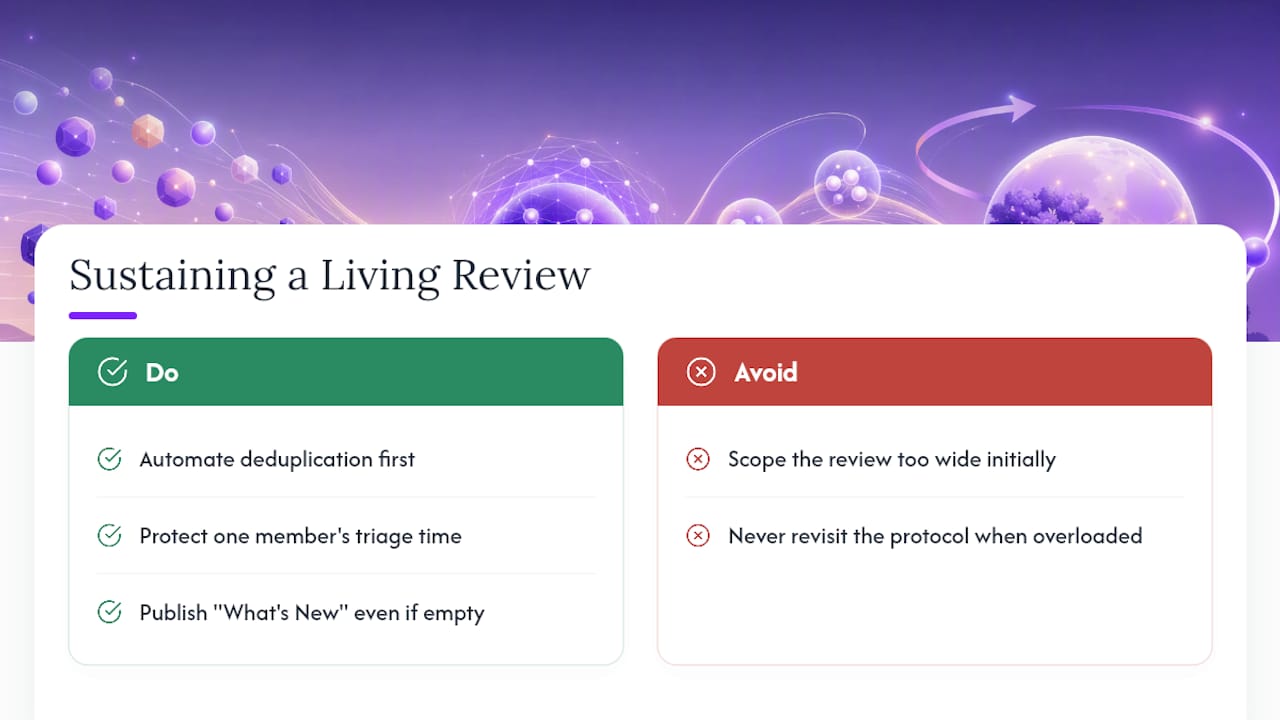
The mistake I see most often isn’t sloppy methodology. Its scope written too wide in month one, followed by a protocol that never gets revisited when the workload proves unsustainable by month four. Fix that by scoping tight from the start and building in a real narrowing checkpoint.
Three things consistently save teams: automate deduplication before anything else, protect one team member’s time exclusively for triage decisions, and publish your “What’s New” log even when the update is “nothing changed.” That last one builds more trust than people expect.
— Ubada
Papersynapse: Cutting the Extraction Bottleneck in Living Reviews
The extraction and normalization cycle is what quietly drains a living review team, cycle after cycle, long after the search strategy is running smoothly. Papersynapse is built for exactly that friction point: import your reference list from Scopus or Web of Science, and the platform reads abstracts to auto-fill structured extraction tables, with claims of processing up to 200 papers in under two minutes.

Every update cycle in a living review means re-running extraction on a fresh batch of studies, and doing that by hand is where consistency breaks down across months. Papersynapse keeps fields normalized across batches, so your dataset from cycle six still matches the structure from cycle one, and exports straight to enriched CSV for re-analysis. Plans scale by paper volume, from a limited free tier for testing the workflow up to higher-capacity tiers for teams running frequent updates. If your team is planning its next search cycle, take a look at the Papersynapse platform and see where it fits your extraction pipeline.
Sources
For rules on registration, update cadence, and stopping criteria, Cochrane’s living systematic review guidance is the operational reference. For workload and team-scaling realities, the practical update guide covers pandemic-era lessons still relevant today. For baseline systematic review steps, the Ohio State SR guide covers the foundation every LSR builds on. For evidence-based practice applications, see this nursing practice overview.
- Guidance for the production and publication of Cochrane living systematic reviews: Cochrane Reviews in living mode
- How to update a living systematic review and keep it alive during a pandemic: a practical guide
- Living Systematic Reviews: Practical Considerations for Adapting Scope and Communicating the Evolving Evidence - NCBI Bookshelf