Managing a Growing Research Reference List Without Losing Control
Managing a Growing Research Reference List Without Losing Control
The fastest reliable way to manage a growing research reference list for a systematic literature review is a workflow with six links: import, deduplicate, prioritize, extract, verify, analyze. Each step needs a decision rule, not just a tool.
- Import RIS or CSV files from your reference manager or database export.
- Deduplicate using DOI and fuzzy title matching before anyone screens a single abstract.
- Prioritize records with AI-assisted triage, tuned for recall over precision.
- Extract into a piloted, structured schema, not a running spreadsheet.
- Verify every numeric and risk-of-bias field with a human reviewer.
- Analyze once the dataset passes your QC checks.
Platforms like PaperSynapse now bundle these steps into one interface. Even so, AI accelerates the reading and sorting. It doesn’t replace the judgment call on what a study actually found.
Key Takeaways
Managing a growing systematic review reference list works when AI handles volume and triage while humans verify every numeric and risk-of-bias judgment before analysis.
| Point | Details |
|---|---|
| Deduplicate before screening | Match on DOI first, then fuzzy title and author-year, to avoid double-counting studies. |
| Prioritize for recall | Set AI screening thresholds to favor including borderline studies over excluding them. |
| Pilot your extraction form | Test on 20 to 50 records first, since piloting catches ambiguous fields before they cost you rework. |
| Verify numeric fields by hand | Extraction error audits found rates up to 50%, making human confirmation non-optional for key data. |
| PaperSynapse runs the full pipeline | Import, extraction, normalization, and export live in one platform, with vendor-stated throughput up to 200 papers in under two minutes. |
Table of Contents
- How Do You Manage a Growing Research Reference List in a First Session?
- Should You Use a Relational or Flat Data Structure?
- When Should AI Handle Screening and Extraction Tasks?
- What Quality Control Standards Do PRISMA and Cochrane Expect?
- How Much Time Does AI-Assisted Extraction Actually Save?
- What I’d Tell Any Team Adopting This Workflow
- Try PaperSynapse for Faster, Verified Extraction
- Sources
How Do You Manage a Growing Research Reference List in a First Session?
The first working session with a new corpus sets the tone for the entire review. Do it badly and you’ll spend weeks untangling duplicate records and inconsistent field definitions. Do it well and the rest of the project runs on rails.
- Import in RIS or CSV format straight from Scopus, Web of Science, or PubMed. Avoid manually retyping citations; that’s where silent errors creep in.
- Run deduplication immediately, matching on DOI first, then fuzzy title and author-year combinations for records missing a DOI.
- Set a recall-focused threshold for automated title/abstract prioritization. You want the AI erring toward “include for full-text screening,” not toward efficiency.
- Pilot your extraction form on 20 to 50 records before touching the full set. This surfaces ambiguous fields and missing categories early.
- Assign roles explicitly: one person extracts, a second verifies, and a third adjudicates disagreements. Nobody should extract and verify their own work.
- Export to CSV, .bib, or RevMan-ready formats and store a dated audit log of every extraction batch somewhere your whole team can access.
Pro Tip: Run your pilot batch twice, a week apart, with the same two extractors. If their field-by-field agreement drops on the second pass, your form’s definitions are ambiguous, not your team.
Should You Use a Relational or Flat Data Structure?
Use a relational schema the moment a single paper can generate more than one row of data. A flat spreadsheet works fine for simple reviews with one outcome per study. It falls apart fast once studies report multiple effect sizes, multiple time points, or nested subgroup comparisons, because you end up either duplicating study-level fields across rows or cramming multiple outcomes into one cell.
Relational structures separate study-level information (design, population, funding) from outcome-level information (effect size, measurement unit, follow-up point), linked by a study ID. Practitioner guidance on complex reviews treats this separation as a core structural decision, not a nice-to-have for large teams.
A workable core field set includes:
- Study ID and DOI, plus a pointer to the source PDF or its storage location.
- PICO elements: population, intervention, comparator, outcome.
- Sample size, by arm, at baseline and at each follow-up.
- Measurement units and scale direction, tagged explicitly rather than assumed.
- Extraction provenance: which extractor, which tool version, and the date.
Piloting matters here more than teams expect. Guidance on reporting extraction methods across systematic reviews links piloted, calibrated forms to measurably better extraction quality and cleaner downstream reporting. Document every change you make to the schema after piloting starts; a form that shifts mid-extraction without a change log makes early records incomparable to later ones.
Build validation rules into the schema itself. A simple example: flag any row where a “mean” field and a “median” field both have values, since that usually signals someone extracted the wrong summary statistic from a table.
When Should AI Handle Screening and Extraction Tasks?
AI earns its place on three tasks: ranking titles and abstracts for review priority, highlighting candidate sentences that likely contain your target data, and pre-filling structured fields from abstract text for a human to confirm or correct, as described in The Ultimate Guide to AI for Educators. It has no business making the final call on inclusion, risk-of-bias ratings, or contested numeric values.

The metric you optimize for depends on the task. Screening calls for recall, or sensitivity: missing a relevant study is far more costly than reviewing a few extra irrelevant ones. Preliminary guidelines for evaluating generative AI in reviews recommend cost-sensitive metrics precisely because plain accuracy hides how a tool performs on the minority class of truly relevant papers. Extraction workload estimates, by contrast, need precision, or positive predictive value, so your team can plan verification hours realistically.
Operational discipline keeps the workflow reproducible:
- Build a seed set of known-relevant papers and test any new tool or prompt against it before deploying it on the live corpus.
- Log the exact prompt version and tool version used for every extraction batch.
- Never run two different tool-and-prompt combinations against the same validation sample; you’ll never know which one is actually working.
- Require human confirmation for every numeric field and every risk-of-bias judgment, full stop.
A living systematic review of semi-automated extraction methods found that large language models show real promise but a worrying trend toward unstable quantitative outputs between runs. Treat AI output as an annotated first draft.
Pro Tip: Design numeric fields with explicit unit tags (mg vs g, SD vs SE) and a normalization rule attached to each. Most extraction errors on quantitative fields trace back to a unit mismatch nobody caught.
What Quality Control Standards Do PRISMA and Cochrane Expect?
Empirical audits of published reviews have found extraction error rates running as high as 50% on individual data points when checked against source papers, with errors sometimes shifting the review’s effect estimate. Double extraction, or single extraction plus independent verification, is the accepted countermeasure. The Cochrane Handbook recommends structured, piloted data collection forms and is explicit that automation should support extraction, not substitute for a human reading the paper.
Your methods section should report: the tool name and version used, the confidence or recall thresholds set for screening, results from your validation sample, and how extraction conflicts got resolved.
- Keep a change log for every schema revision after piloting begins.
- Record every adjudication decision with a rationale, not just the final value.
- Export verification evidence in a format a peer reviewer could actually check.
Automation can reasonably stand in as a second reviewer for routine updates to a living review, where the baseline data has already been human-verified once. It should not replace the second human reviewer on initial critical extractions.
Double extraction or thorough independent verification isn’t procedural overhead. It’s the step that catches the errors capable of changing your review’s conclusion.
How Much Time Does AI-Assisted Extraction Actually Save?
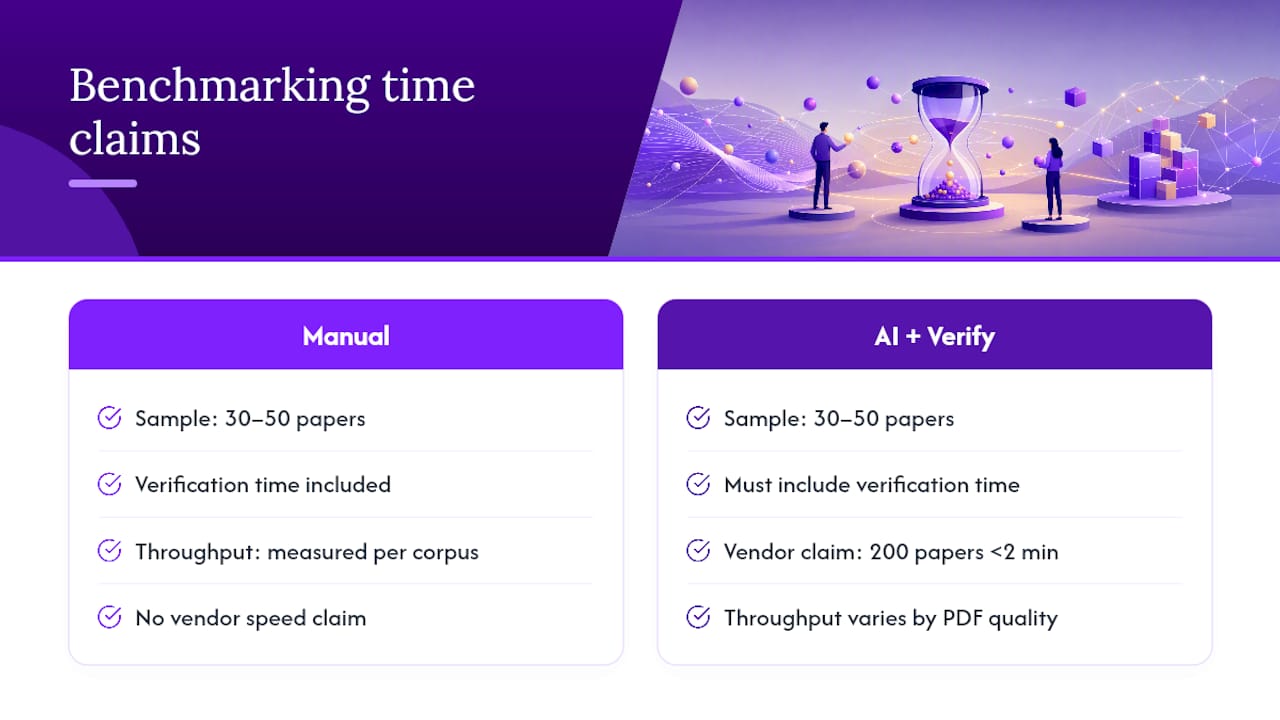
Before trusting any throughput claim, benchmark your own baseline: time a subset of papers extracted manually, then time the same subset with AI assistance plus full verification. Compare against a sample large enough to matter, generally 30 to 50 papers, and include verification time in both totals. Skipping verification time in the AI condition is the single most common way teams fool themselves into an inflated savings figure.
PaperSynapse states it can process up to 200 papers in under two minutes for initial abstract extraction. Treat that as a vendor claim worth testing against your own corpus, not a guarantee, since throughput depends heavily on PDF quality and how domain-specific your extraction fields are.
Expect diminishing returns on reviews with scanned or poorly formatted PDFs, on highly technical extraction fields the AI hasn’t seen much training data for, and on nuanced risk-of-bias judgments that resist structured field capture. When you report savings to a supervisor or funder, present both the raw time saved and the verification hours spent catching AI errors. That second number is what makes the first one credible.
What I’d Tell Any Team Adopting This Workflow
Pick one review question and run the full pipeline on it before rolling this out across your whole research group. Passing your validation checks on a narrow question tells you far more than a rushed deployment across ten questions at once.
Budget real time for piloting extraction forms and calibrating extractors against each other. Teams that skip this step because they’re already behind schedule almost always pay for it twice, once in rework and once in credibility when a reviewer questions the data.
Assign a verification lead and an audit owner as distinct roles, and put a re-benchmarking date on the calendar before you start, not after something breaks.
— Ubada
Try PaperSynapse for Faster, Verified Extraction
The workflow above (import, dedupe, prioritize, extract, verify, analyze) is exactly what PaperSynapse was built to run in one interface, instead of stitching together a spreadsheet, a screening tool, and a separate extraction system. You import your RIS or CSV list from Scopus or Web of Science, the platform reads abstracts and pre-fills structured extraction tables, and you keep full control over normalization and inline edits before export.

PaperSynapse states it can process up to 200 papers in under two minutes for initial extraction, a claim worth validating against your own dataset the same way you’d validate any screening tool. Exports go to enriched CSV or PNG for your charts, and team members can collaborate on the same dataset with a real-time AI chat for querying your literature set directly. If your reference list has outgrown a spreadsheet, start a review on PaperSynapse and run your own pilot batch this week.
Sources
- Chapter 5: Collecting data | Cochrane
- Frequency and impact of data extraction errors in systematic reviews