How to Merge Team-Extracted Research Data Without Losing Trust in It
How to Merge Team-Extracted Research Data Without Losing Trust in It
To merge team-extracted research data reliably, standardize your extraction schema, pilot it on a small batch, run staged verification, then align and merge with clear provenance for every value. Skip the pilot and you inherit weeks of rework once mismatched labels and inconsistent date formats surface halfway through synthesis.
Three moves matter most this week:
- Run a 3 to 5 document pilot with two extractors and compare results field by field.
- Lock canonical field names, units, and date formats before anyone extracts a sixth record.
- Capture a provenance ID (source, page, extractor) on every cell you plan to merge.
Pro Tip: A pilot-tested extraction form catches 80 percent of your schema problems before they multiply across 200 papers. Whether your team uses a human–AI teaming (HAT) platform like Papersynapse or a set of Python scripts depends on volume, not ambition. Both approaches work when the schema is locked first.
Key Takeaways
A reliable merge of team-extracted research data depends on locking a canonical schema, piloting it, and verifying provenance before any programmatic alignment happens.
| Point | Details |
|---|---|
| Pilot before scaling | Test your extraction form on 3 to 5 documents with multiple extractors before full-scale extraction. |
| Lock the schema first | Define field names, types, and mapping rules in a versioned file before merging any records. |
| Match methods to data shape | Use concatenation for identical schemas, one-to-one joins with stable keys, and link tables for many-to-many relationships. |
| Provenance protects trust | Record source ID, page coordinates, and extractor ID on every cell to support audits and disputes. |
| Papersynapse handles the middle steps | Its AI-assisted extraction, provenance capture, and PRISMA-aligned exports support this workflow directly for literature review teams. |
Table of Contents
- How Do You Merge Team-Extracted Research Data Correctly?
- What Belongs in a Canonical Extraction Schema?
- How Do You Detect Duplicate Records Across Extractors?
- When Should You Automate the Merge Instead of Doing It by Hand?
- What Quality Gates Protect a Merged Dataset?
- Where Does Papersynapse Fit in This Workflow?
- What Should Your Team Do in Week One?
- Get From Extraction to a Merged Dataset Faster With Papersynapse
- Frequently Asked Questions
- Sources
How Do You Merge Team-Extracted Research Data Correctly?
The merge method depends entirely on your data’s shape, not on preference. Pick wrong and you either lose records silently or double-count them.
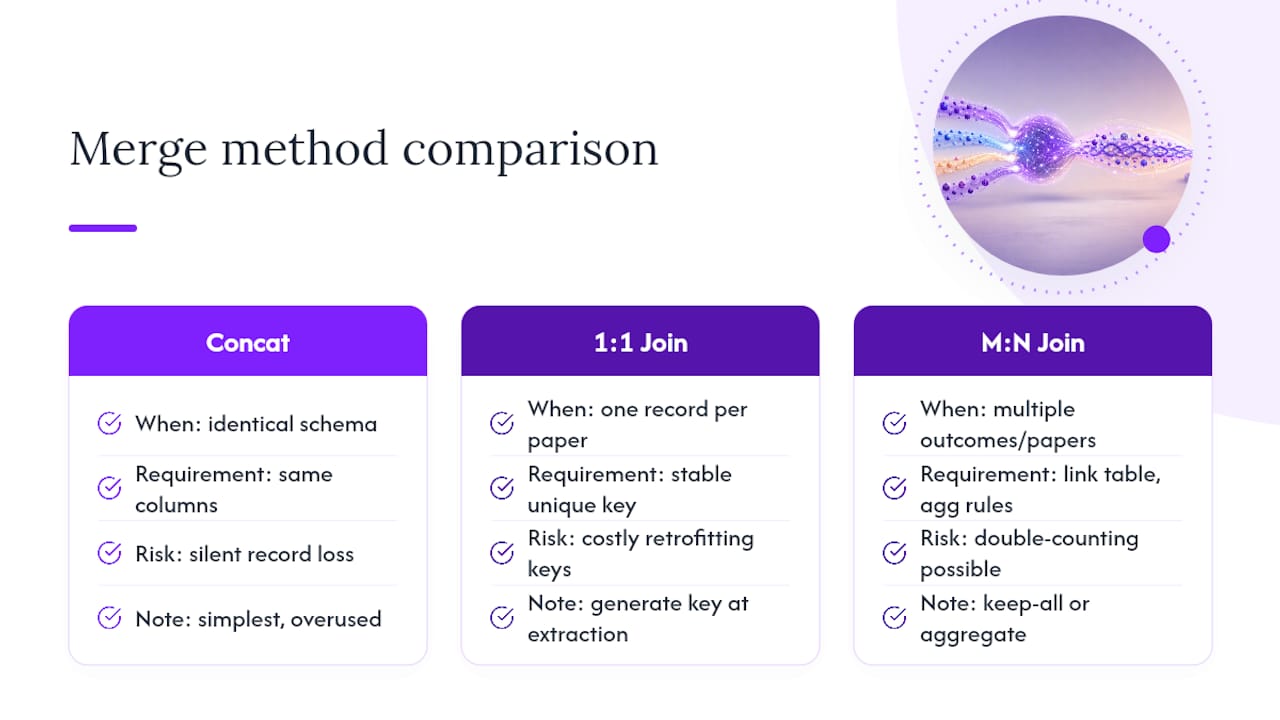
Concatenation works when every extractor used the identical schema and no article appears twice across files. Stack the rows, check the column count matches, done. This is the simplest case and the one teams overuse when a real join is needed instead.
One-to-one joins need a stable unique key, usually a DOI, PubMed ID, or a hash of title plus first author plus year. Generate that key at extraction time, not after the fact. Retrofitting keys onto 150 already-extracted rows is where afternoons disappear.
Many-to-many joins show up when one paper reports multiple outcomes or multiple papers describe one trial. These need a link table connecting record IDs, plus explicit aggregation rules (sum, average, or keep-all-rows).
Sometimes the right move is not merging at all. When two extractors read the same abstract and reached genuinely different interpretations, merging strategies that force alignment paper over the disagreement. Re-extract the record with a third reviewer instead.
What Belongs in a Canonical Extraction Schema?
Set the schema before volume extraction starts, not after. A locked schema is what makes any later merge fast instead of forensic.
- Define field names, types, and allowed values. “Sample size” should always be an integer, “intervention type” should draw from a fixed list, not free text three different extractors phrase three different ways.
- Pilot on 3 to 5 articles with more than one extractor. This is the single fastest way to expose ambiguity. If two people extract the same paper and land on different values for “outcome measure,” your field definition is broken, not your extractors.
- Document mapping rules explicitly. Note how you’ll handle unit conversions, date formats (ISO 8601 avoids the US/UK ambiguity entirely), and label normalization for things like drug names or intervention categories.
- Store the schema as a versioned CSV or JSON file. Treat schema changes like code changes, with a change log, so a merge run in week six isn’t silently incompatible with data from week one.
Teams that skip the pilot tend to discover schema drift at the worst possible moment, usually the week before a submission deadline.
How Do You Detect Duplicate Records Across Extractors?
Start simple, escalate only when simple fails. Normalize every field first: trim whitespace, lowercase text fields, convert all dates to one format. Then run exact-match rules on your unique key. This alone resolves most duplicates in a single-schema project.
When exact matching misses variants, three tools handle the gray area:
- String similarity (Levenshtein distance) catches typos and minor formatting differences in titles or author names.
- Token-based similarity handles reordered words, useful when one extractor wrote “Smith et al. 2023” and another wrote “2023, Smith and colleagues.”
- Embedding-based matching catches semantic near-duplicates, like two abstracts describing the same trial under slightly different titles.
For pairwise alignment across two full datasets, a maximum-matching approach (the Hungarian algorithm) finds the best one-to-one correspondence between records based on a similarity matrix, rather than greedily accepting the first plausible match. SCILIRE’s HAT-DC framework uses exactly this technique for record alignment in extraction pipelines.
When two matched records disagree on a value, decide the adjudication rule in advance: majority vote across extractors, a senior reviewer’s call, or automatic preference for whichever record has stronger provenance. Deciding this mid-project under deadline pressure produces inconsistent calls.

When Should You Automate the Merge Instead of Doing It by Hand?
Volume should drive the automation decision, not comfort with spreadsheets. A few dozen records merge fine in a spreadsheet with manual review of every row. Once you cross into the hundreds, programmatic matching with logged rules becomes faster and more consistent than manual review. At the thousands scale, you need full pipeline automation with sampling-based audits, because 100 percent manual review simply isn’t achievable in a reasonable timeframe.
At the high end, scMerge2 demonstrated integrating five million records from over 1,000 samples across 20 studies within a single day, using pseudo-bulk construction and hierarchical integration. That’s genomics data, not literature review data, but the underlying pattern applies broadly: batch smaller units first, then integrate the batches hierarchically rather than trying to merge everything in one flat pass.
- Hundreds of records: move to programmatic matching with a defined rule set.
- Thousands of records: automate the full pipeline and rely on stratified sampling for verification.
- Heterogeneous sources (different journals, different reporting formats): borrow information-retrieval-style alignment before merging.
Sampling-based verification, checking a stratified slice rather than every record, preserves auditability without demanding impossible review hours.
What Quality Gates Protect a Merged Dataset?
Never merge raw, unverified extraction output directly into your master dataset. That single habit prevents more downstream disasters than any algorithm choice.
- Build four sequential gates: intake, extraction, verification, synthesis. Each stage should have a pass/fail check before data advances to the next.
- Record provenance on every cell. Save the source document ID, the page or paragraph coordinate, and the extractor ID. Traceable data extraction cuts the time spent re-locating a disputed value in the original paper, sometimes from twenty minutes down to seconds.
- Run double extraction on a meaningful subset. Two independent extractions of the same record, with discrepancies logged and routed to adjudication, catches errors single extraction misses entirely.
- Automate schema validation and range checks. A sample size of negative four or a publication year of 2099 should flag automatically, not get caught by a human three weeks later.
Pro Tip: Log discrepancies even when you resolve them fast. A discrepancy log from your pilot phase becomes the evidence you cite when a peer reviewer asks how you handled interrater disagreement.
Where Does Papersynapse Fit in This Workflow?
The sequence holds regardless of tooling: import references, lock the schema, pilot it, extract, verify, align, merge, export. What changes is how much of that sequence a platform handles for you versus how much falls to scripts and spreadsheets.
Papersynapse covers the middle of that chain directly. It imports reference lists from Scopus or Web of Science, uses AI to read abstracts and populate your structured extraction fields, and keeps a record of which source informed which value, which matters when a reviewer asks where a number came from. Its screening workflow supports PRISMA reporting, and exports move into enriched CSV for downstream analysis or into visual outputs for a manuscript.
A platform built around intake, extraction, and normalization in one place reduces the seams where merge errors typically creep in, the gaps between what got extracted and what got recorded.
For bespoke alignment logic, a many-to-many join with unusual aggregation rules, say, pairing Papersynapse’s structured exports with a short Python script or OpenRefine still makes sense. Human review stays essential at the verification gate no matter which tool did the extraction.
- Reference import and schema setup: handled inside the platform.
- AI-assisted extraction with provenance: built into the workflow.
- Custom many-to-many logic or unusual conflict rules: often faster with a lightweight script layered on top.
What Should Your Team Do in Week One?
Move fast but in the right order. Skipping straight to bulk extraction is the single most common way teams waste a month.
- Run a 3 to 5 document pilot and write down every place two extractors disagreed on a field value.
- Lock canonical field names and document every mapping rule (units, dates, label normalization) in a shared file.
- Normalize values across whatever’s already extracted and run a first-pass deduplication using exact-match rules on your key field.
- Set your verification sampling rate (start around 20 percent for a new schema) and freeze the master schema version.
Pro Tip: Version your schema file from day one, even if it’s just a dated CSV. The team that changes “outcome_type” to “outcome_category” in week four without a version note is the team debugging a broken merge in week six.
Teams that follow this exact order tend to reach a stable, mergeable dataset in five to seven working days instead of the three to four weeks it takes when extraction and schema design happen simultaneously.
Author note: what actually derails these projects
The costliest failures aren’t technical. They’re interpretive: two extractors reading “adverse events” differently, one counting mild cases and one not. Standardizing the form early doesn’t just speed things up. It’s usually the difference between a clean merge and a monthlong argument about whose numbers are right.
Get From Extraction to a Merged Dataset Faster With Papersynapse
Manual extraction across a research team usually means someone spends a week reconciling spreadsheets that never quite match, chasing down which reviewer entered which value and why. Papersynapse cuts that reconciliation work down by handling extraction, provenance capture, and normalization inside one workflow instead of scattering it across shared drives and email threads.
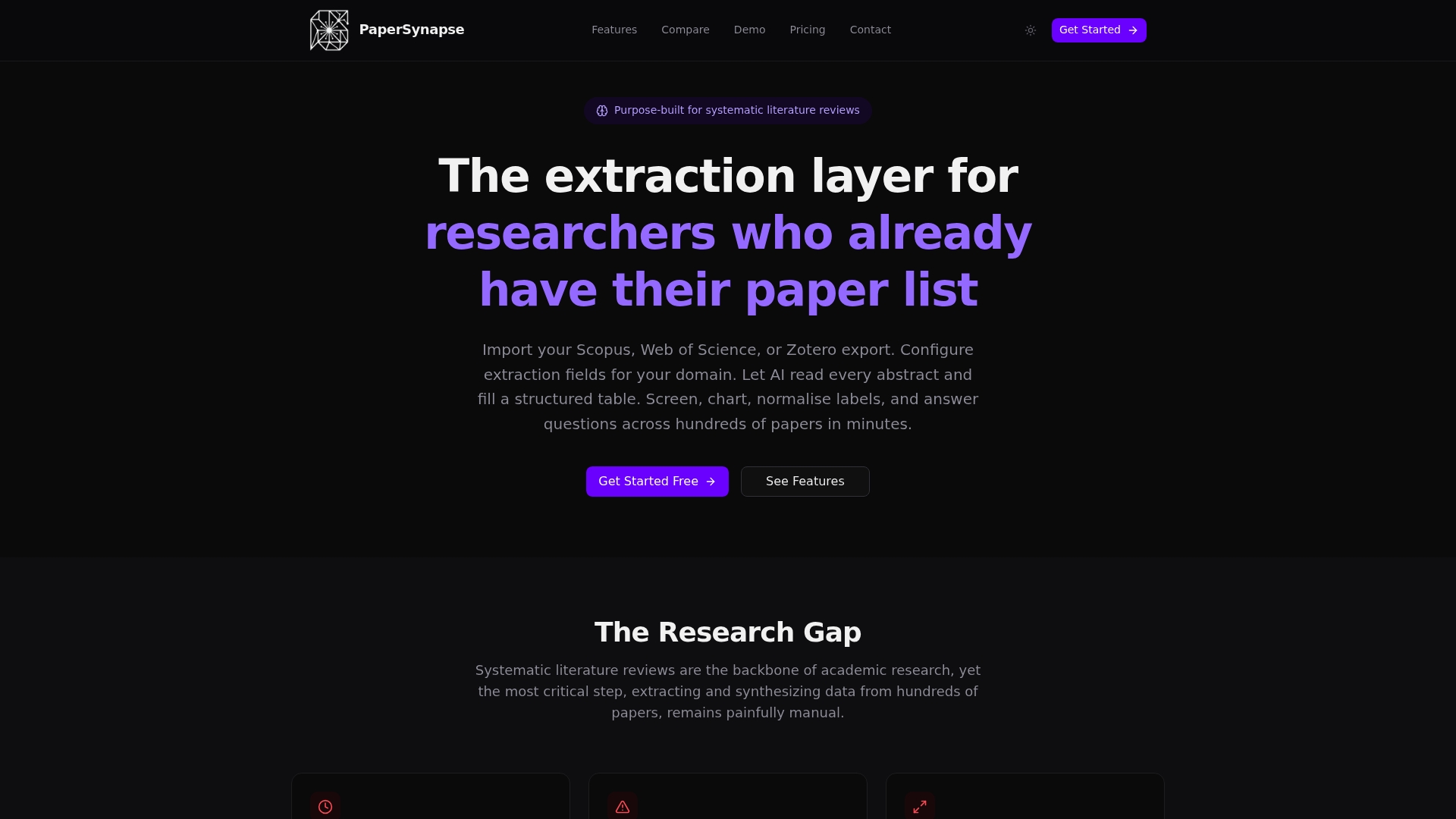
Import your reference list directly from Scopus or Web of Science, and Papersynapse’s AI reads each abstract to populate your structured fields, the same canonical schema your team piloted, so every extractor’s output lands in a comparable format from the start. The platform tracks source provenance automatically and supports PRISMA-aligned screening, so your merged dataset carries an audit trail without extra spreadsheet work. Papersynapse runs on tiered subscription plans based on paper volume, with a free tier for smaller reviews and higher-capacity plans as your project scales.
If your team is staring down a pile of abstracts and a merge deadline, start a review on Papersynapse and see how much of this workflow the platform already handles for you.
Frequently Asked Questions
What’s the fastest way to merge team-extracted research data without losing accuracy? Lock a canonical schema, pilot it on a small batch with more than one extractor, then merge using the method that matches your data’s structure, concatenation, a one-to-one join, or a many-to-many link table. Skipping the pilot is the step most teams regret.
How do you handle disagreements between extractors during a merge? Set an adjudication rule before extraction starts, majority vote, senior reviewer decision, or preference for the record with stronger provenance, and log every discrepancy so patterns become visible instead of buried in email threads.
Can you merge extracted research data at scale without full automation? Yes, up to a few hundred records with clear matching rules and manual spot-checks. Past that volume, algorithmic alignment paired with stratified sampling for verification becomes far more practical than manual review of every record.
Does Papersynapse support team collaboration on merged datasets? Papersynapse supports collaborative extraction and normalization within one platform, with provenance tracking on extracted values, so multiple team members can work from the same schema and export a unified dataset for analysis.
Sources
- scMerge2 scalability for single-cell integration (PubMed entry)
- Increasing value and reducing waste in data extraction for systematic reviews (PMC)
- Quantitative guide to merging strategies (Columbia Academic Commons)