Multi Reviewer Screening: Best Practices for Study Selection
Multi Reviewer Screening: Best Practices for Study Selection
For rigorous study selection, run independent dual screening at both the title/abstract and full-text stages, with a prespecified conflict-resolution rule and a documented pilot calibration round. Multi-reviewer screening simply means two or more reviewers assess each record independently, then compare notes according to, rules set before screening starts, not during a disagreement. The protocol runs in a fixed order:
- Pilot calibration on a moderate number of records to align criteria
- Independent screening by two or more reviewers at title/abstract stage
- Independent full-text screening on everything that survives round one
- Conflict resolution through discussion, then a third-party adjudicator if needed
- Reporting of agreement statistics and PRISMA flow counts
Quick stat: A single reviewer working alone misses roughly 13% more eligible studies than a two-reviewer team catches. That gap alone justifies the extra screening hours on any review headed for publication.
Key Takeaways
Multi-reviewer screening works because independent dual assessment at both screening stages, backed by a prespecified conflict rule, catches the studies a single reviewer’s judgment alone would miss.
| Point | Details |
|---|---|
| Run a pilot first | Calibrate on 30 to 50 records before full screening to catch ambiguous criteria early. |
| Screen independently, twice | Two reviewers assess every record at title/abstract and full-text stages without seeing each other’s labels. |
| Set conflict rules in advance | Define the discussion and adjudicator escalation path before screening starts, not during a dispute. |
| Report both agreement statistics | Pair percent agreement with Cohen’s kappa and note prevalence effects when they diverge. |
| Use Papersynapse for the workflow | Papersynapse supports independent labeling, audit logs, and PRISMA exports across the pilot and full screening stages. |
Table of Contents
- What does the evidence say about multi reviewer screening?
- How do you run pilot calibration and two-stage screening?
- What roles and conflict rules should the protocol define?
- How do you measure and report reviewer agreement?
- Which tools support a multi reviewer screening workflow?
- What do teams underestimate about running this protocol?
- Start a pilot screening run on Papersynapse
- Sources
What does the evidence say about multi reviewer screening?
The Cochrane standard and Institute of Medicine guidance both converge on the same rule: use at least two independent reviewers at every stage of study selection. That is not a bureaucratic preference. It is a response to a documented failure mode, where a lone screener’s fatigue, bias, or unfamiliarity with the topic silently drops eligible studies from a review before anyone downstream ever sees them.
The clearest empirical case for this comes from a methodological study that compared single reviewer against dual reviewer abstract screening on the same dataset. The single reviewer missed about 13% of studies that the dual-reviewer process caught. In a review with a few hundred candidate records, that is not a rounding error. It is potentially a dozen or more studies that never reach full-text screening, never get extracted, and never influence a pooled estimate or a set of recommendations.
Academic library guidance echoes the same conclusion from a different angle. Guides from institutions including Virginia Tech and Queen’s University recommend two reviewers per article at both screening stages, paired with a decision, made in advance, about how disagreements will get resolved. Independent screening also does something beyond catching missed studies: it creates a built-in check on inclusion and exclusion decisions that a solo screener simply cannot generate on their own.
Single-reviewer screening has been studied mostly as a cautionary case rather than a viable default. It shows up in the literature as the condition researchers compare against, not the condition they recommend. Its limitations are consistent across studies: higher variance, no independent check, and no way to distinguish a reviewer’s honest judgment call from a plain oversight.
How do you run pilot calibration and two-stage screening?
Screening breaks into three phases, run in sequence, and skipping the first one is the most common reason teams end up rerunning screening halfway through a review.

1. Pilot calibration. Pull a random sample of a moderate number of records from your search results and have every reviewer screen them independently using your draft inclusion criteria. The point is not to finalize decisions. It is to surface ambiguity in your criteria before you apply them to thousands of records. Compare labels, discuss every disagreement as a group, and rewrite the codebook to close the gaps that produced them. A useful pilot deliberately includes borderline cases alongside clearly eligible and clearly excluded ones, and calibration should continue until disagreement drops below a threshold your team sets in advance, often a kappa above 0.6 or percent agreement above 80%.
2. Title/abstract screening. Each reviewer works through the full record set independently, applying a fixed labeling schema (typically include, exclude, or unsure) without seeing the other reviewer’s decisions. Blinding to co-reviewer labels prevents anchoring, where one reviewer’s early call quietly shapes the other’s judgment. High-volume reviews benefit from splitting records into batches so reviewers can compare progress and catch drift in interpretation before it compounds.
3. Full-text screening. Everyone who cleared round one moves to full-text retrieval, again with independent decisions and this time with a mandatory reason recorded for every exclusion. Reason-coding matters more here than it did at the abstract stage, because full-text exclusions are what populate your PRISMA flow diagram’s excluded-with-reasons box.
Deduplication belongs before round one starts, not after. Run it once, on the combined search results, and record the resulting count as your first PRISMA number.
Pro Tip: Run your pilot on records pulled from at least two different databases if your search spans several. A codebook that only gets tested against one database’s abstract style can fail badly on a source with a different formatting convention.
What roles and conflict rules should the protocol define?
A protocol only works if roles are assigned before screening starts, not improvised once disagreements show up. Four roles cover almost every review team structure:
- Primary screener: completes the first independent pass on every record.
- Second reviewer: completes a fully independent second pass, blinded to the primary screener’s decisions.
- Adjudicator (third reviewer): resolves conflicts the first two reviewers cannot settle through discussion.
- Supervisor: monitors agreement statistics over time and calls for recalibration if drift appears.
The conflict-resolution algorithm itself should be simple enough to write in three lines: reviewers label independently, disagreements go to a discussion between the two original reviewers, and anything still unresolved after discussion goes to the adjudicator. Writing this rule down before screening begins is what separates a defensible protocol from an ad hoc one. Reviewers under deadline pressure tend to split the difference or defer to whoever screens faster, and a prespecified rule is the only thing that stops that habit from quietly biasing your results.
Larger reviews sometimes need more than two reviewers per record, particularly when the corpus runs into the thousands or when a review uses crowdsourced screening to speed things up. In that case, the team needs to prespecify how records get distributed across reviewers, how multiple labels get aggregated into one decision, and what threshold of disagreement triggers adjudication. These decisions belong in a written protocol before screening starts, not in a footnote written after the fact to explain what happened.
Your methods section should report four things at minimum:
- The pilot calibration sample size and outcome (agreement before and after refinement).
- The final interrater agreement statistic, reported as both percent agreement and Cohen’s kappa.
- PRISMA flow counts at each stage: identified, screened, excluded with reasons, included.
- A brief audit trail statement confirming that reviewer identity, timestamps, and decision reasons were logged throughout.
A reviewer picking up your manuscript for peer review should be able to reconstruct your screening decisions from that paragraph alone, without needing to email you for clarification.
How do you measure and report reviewer agreement?
Two numbers matter here, and they answer different questions. Percent agreement is the simple share of records where both reviewers landed on the same decision. It is intuitive but can look deceptively high when most records are obvious excludes. Cohen’s kappa corrects for agreement you would expect by chance alone, which makes it the more defensible statistic to report in a methods section.
There is a catch worth flagging explicitly: when eligible studies are rare in your screened set, kappa can come out low even while percent agreement stays high, purely because of how the math handles low prevalence. Report both numbers side by side and note the prevalence effect if your kappa looks worse than your raw agreement suggests. Readers who only see kappa without that context sometimes conclude a screening process was unreliable when it was not.
Your reporting should cover:
- Pilot calibration results, including the agreement level reached before full screening began.
- How disagreements were resolved at each stage (discussion rate versus adjudicator referral rate).
- PRISMA counts: records identified, duplicates removed, screened, excluded with reasons, and included.
- An audit-log statement confirming reviewer IDs and timestamps were captured for every decision.
That last point matters more than most teams realize until a peer reviewer asks a pointed question about a specific exclusion six months after screening wrapped, and nobody remembers who made the call.
Which tools support a multi reviewer screening workflow?
Four tool categories cover the ground: reference managers with deduplication built in, screening platforms that offer active-learning prioritization, plain audit-log spreadsheets, and full collaboration platforms that combine several of these functions. Each solves a piece of the problem; none of them replaces the independent-judgment requirement at the center of the protocol.

Prioritization and active-learning tools, including approaches built around frameworks like ASReview’s crowdscreen model, can meaningfully speed up screening by surfacing likely-relevant records earlier. The tradeoff is real: these tools work only when reviewer independence survives the speedup, which means keeping separate reviewer queues, blinding reviewers to each other’s labels, and exporting a full audit log rather than trusting a black-box ranking. Papersynapse builds toward this balance directly, supporting RIS and CSV import from reference managers, independent labeling per reviewer, PRISMA-compliant exports, and audit logs that record who decided what and when, which maps cleanly onto the abstract screening workflow most teams already follow.
Pro Tip: Before adopting any screening tool, confirm it can export a full decision-level audit log, not just a summary count. Journals increasingly ask for that log during peer review, and rebuilding it after the fact from memory is close to impossible.
When evaluating a platform, check four things: does it log decisions immutably, does it keep each reviewer’s labels genuinely independent until a comparison step, does it export in formats your reporting standard requires, and does it support a dedicated pilot calibration round before full screening begins.
What do teams underestimate about running this protocol?
Speed and thoroughness pull against each other more than most protocols admit. Prioritized screening genuinely helps when your corpus runs into the thousands, but it carries real risk of burying a legitimately relevant study near the bottom of a ranked queue that nobody reaches before a deadline.
The most common failure I see is not the disagreement itself. It’s the fact that criteria were vague enough for the disagreement to happen in the first place. Pair that with a rushed or skipped pilot round, and conflicts pile up during full screening instead of getting caught early. Fix it with a codebook precise enough to survive contact with a borderline abstract, a scheduled consensus meeting rather than an ad hoc Slack thread, and an independent log every reviewer trusts because nobody can quietly edit it after the fact.
— Ubada
Start a pilot screening run on Papersynapse
Papersynapse turns the pilot-to-protocol workflow above into something you can run in an afternoon instead of a week of spreadsheet wrangling. Import your reference list directly from Scopus or Web of Science in RIS or CSV format, then let each reviewer screen independently with their labels kept separate until you’re ready to compare.
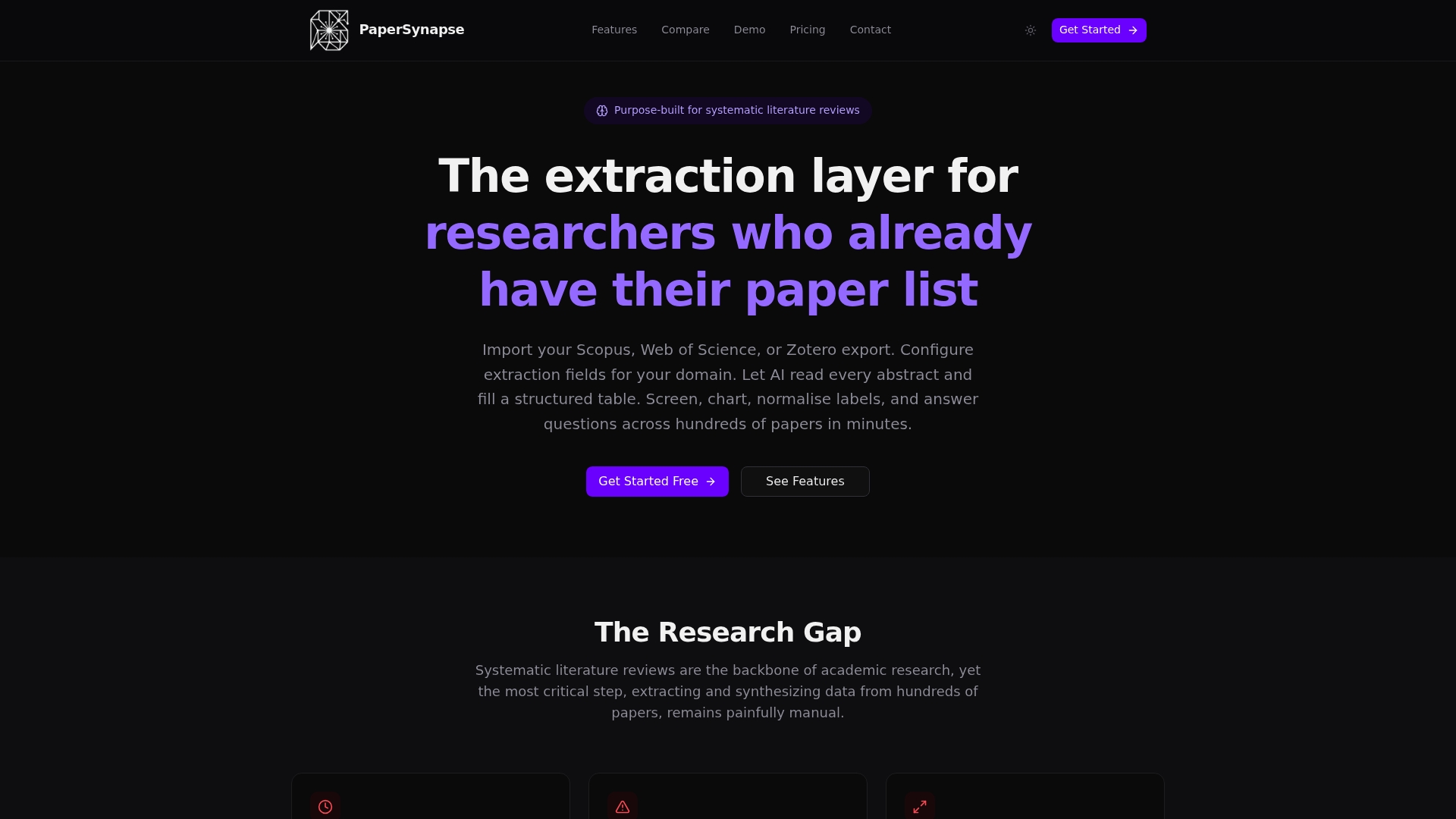
The platform logs every decision with a timestamp and reviewer ID automatically, so your audit trail exists from the first record screened rather than getting reconstructed after the fact. Run your 30 to 50 record pilot first, check agreement before moving to full screening, then export your PRISMA counts and decision logs directly for your methods section. If your team is still tracking dual-reviewer decisions across three spreadsheets and a shared drive folder, start a screening pilot on Papersynapse and see how much of that overhead disappears.
Sources
- The Value of a Second Reviewer for Study Selection in Systematic Reviews
- Single-reviewer abstract screening missed 13 percent of eligible studies (methodological study)
- Eligibility Screening - Systematic Reviews and Meta-Analyses (Virginia Tech guide)
- Selecting Studies - Systematic Reviews & Other Syntheses (Queen’s University Library)