Organize Research Findings Efficiently for PhD Researchers
Organize Research Findings Efficiently for PhD Researchers
Efficient research organization is defined as the systematic process of collecting, tagging, indexing, and synthesizing academic literature so every claim stays traceable and every insight stays retrievable. For PhD candidates and academic researchers, the ability to organize research findings efficiently separates productive scholarship from buried notebooks and forgotten PDFs. AI-powered platforms now index over 460 million papers and generate structured, citable outputs in minutes. Combining those tools with disciplined documentation workflows gives researchers a real edge in literature management and knowledge synthesis.
What tools are essential to organize research findings efficiently?
The right tools do more than store papers. They make your entire literature base queryable, cross-referenced, and ready for AI-assisted synthesis.
Reference management software forms the foundation. Platforms that support metadata tagging, BibTeX export, and library syncing with databases like Scopus or Web of Science let you build a structured catalog from day one. The key is not just collecting references but attaching controlled vocabulary tags to every entry so searches return precise results later.

Hybrid semantic search is the next layer. Hybrid RAG search tools combine keyword search with semantic embeddings and cross-encoder reranking to achieve precise retrieval across academic libraries covering over 200 million works. That precision matters when you are pulling evidence for a specific claim across hundreds of papers.
Hierarchical directories paired with machine-readable metadata complete the stack. Combining hierarchical directories with BibTeX or JSON sidecar files enables AI agents to perform scalable literature queries, turning a static paper library into a dynamic knowledge base. This approach scales from dozens of papers to thousands without losing structure.
Here is a quick breakdown of the core tool categories and what each one does:
| Tool category | Primary function | Best for |
|---|---|---|
| Reference manager | Metadata tagging, citation export | Building a structured paper catalog |
| Hybrid semantic search | Keyword plus semantic retrieval | Precise claim-level evidence retrieval |
| AI research agent | Automated synthesis and PRISMA output | Systematic literature review acceleration |
| Knowledge base platform | Cross-referenced wikis and page indexes | Long-term, queryable research archives |
A knowledge vault system batch-ingests library exports and compiles sources into cross-referenced wikis with hierarchical page indexes. Queries use tiered reasoning cascades to retrieve precise answers without loading full documents. That is a significant time saving when your library exceeds a few hundred papers.
Pro Tip: Tag every paper at import with at least three controlled vocabulary terms: topic, methodology, and study design. Retroactive tagging at the end of a project takes three times as long and misses nuance you had at first read.
How to implement effective workflows for organizing and synthesizing findings
Structure beats effort every time. A researcher who collects papers without a workflow ends up with a cluttered archive. A researcher with a clear process ends up with a knowledge base.
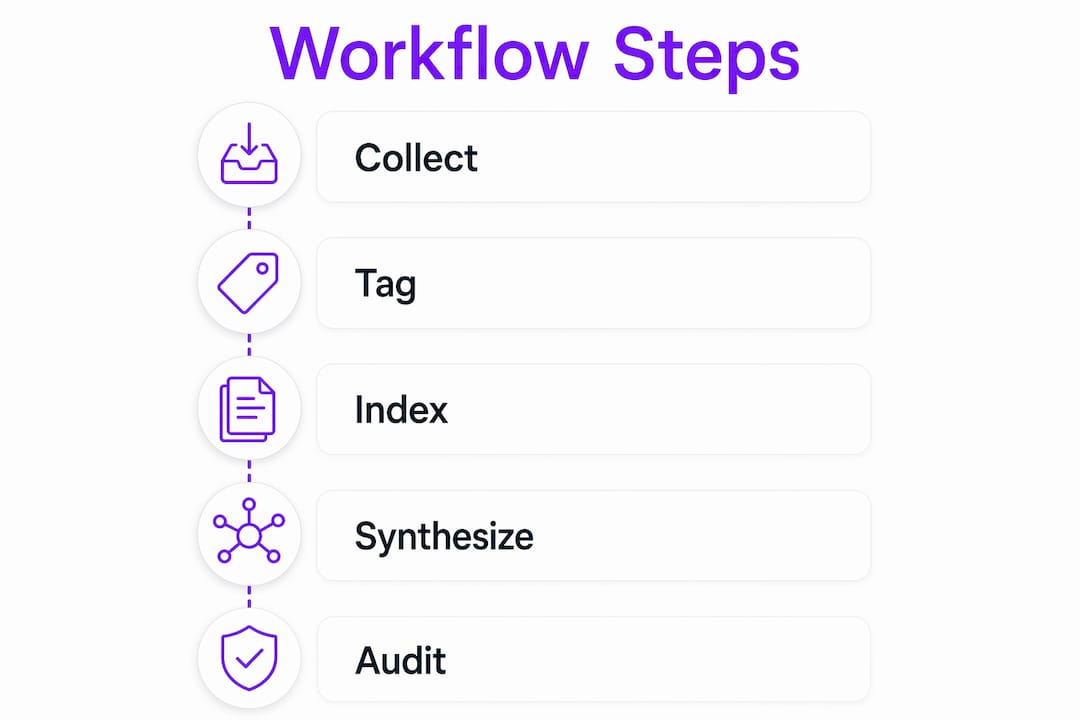
Start active documentation at collection, not at writing. Research data management guidelines advise implementing active documentation and storage strategies from the initial collection phase to preserve reproducibility and shareability. Delaying organization until the writing stage risks data loss and forces you to re-read papers you already processed.
Follow this workflow sequence to build a traceable, agent-ready research archive:
- Import references from a structured database. Pull from Scopus, Web of Science, or PubMed using a defined search string. Save the search string itself as a documented artifact.
- Apply controlled vocabulary tags at import. Assign topic, methodology, and outcome tags before you read the abstract. Adjust after reading.
- Write structured annotation notes. For each paper, record the core claim, the method, the sample, and the limitation. Keep these in a machine-readable format like Markdown or JSON.
- Build a hierarchical directory. Organize folders by theme, not by author or year. Themes map directly to your research questions.
- Link claims to sources explicitly. Every note that references a finding should include the paper ID and page number. This is the foundation of a provenance-first system.
- Run periodic gap analysis. After every 20 to 30 papers, review your theme folders and identify which research questions still lack evidence.
- Sync your library with an AI research agent. Feed your structured archive into an AI platform that can query across your notes and generate synthesis drafts.
Treating research as networked knowledge rather than a linear narrative prevents the loss of exploratory insights and supports future reusability. Dead ends and pivots belong in your archive too. They prevent you from repeating failed approaches and give AI agents richer context to work with.
Pro Tip: Build your annotation template before you read your first paper. A consistent structure across 300 notes is worth far more than 300 perfectly written but inconsistently formatted summaries.
For researchers conducting systematic literature reviews, this workflow maps directly onto PRISMA stages. Each step above corresponds to a documented phase that auditors and reviewers can trace.
What are the common mistakes in organizing research and how to avoid them?
Most researchers lose productivity not from lack of effort but from structural mistakes made early in the project. These mistakes compound over time.
- Flat folder structures. Organizing papers by author last name or download date creates a retrieval nightmare. A folder called “Smith 2021” tells you nothing about content. Use theme-based hierarchies instead.
- No metadata on annotation notes. A note without a paper ID, date, and tag is an orphan. It cannot be queried by an AI agent and cannot be traced back to its source.
- Treating paper collection as the goal. Accumulating 500 PDFs without structured notes is not research organization. It is digital hoarding. The goal is a queryable knowledge base, not a large file count.
- Skipping provenance tagging. A provenance-first strategy tags every extracted claim with a trust level to prevent AI hallucinations and maintain traceability to original sources. Without this, AI-generated synthesis can introduce errors that are hard to detect.
- Ignoring dead ends. Researchers who delete notes on failed searches lose institutional memory. Those dead ends are data.
“The shift from paper management to knowledge flywheels marks a paradigm change in research productivity. A knowledge flywheel creates a closed loop where feedback drives gap detection and continuous improvement in retrieval and synthesis, surpassing static paper management entirely.”
The audit layer is the practical fix for most of these problems. Build a simple cross-check habit: after every synthesis session, verify three randomly selected claims against their source paragraphs. This catches hallucinated or misattributed content before it reaches a draft. For research database management, this kind of spot-checking is the difference between a reliable literature review and a retraction risk.
How to leverage AI platforms for systematic literature reviews
AI research platforms have moved well beyond citation managers. The best ones now handle the full find-review-write cycle, cutting the time from search to draft from weeks to hours.
Advanced AI platforms provide find-review-write workflows with interactive mindmaps, automatic PRISMA flow diagrams, and citation linkage to speed systematic literature reviews. Collaborative workspaces include built-in IP controls, which matters for PhD candidates working on unpublished thesis chapters.
The most useful AI platform features for systematic reviews fall into two categories:
Discovery features include interactive topic maps that visualize the literature by theme, gap detection that flags under-researched areas, and automated outline generation based on your research question. These features replace hours of manual mapping with a structured starting point.
Synthesis features include claim-to-source linking, traceable draft generation, and PRISMA diagram automation. ResearchFlow’s layered architecture blends coarse and fine retrieval layers with evidence and output layers, facilitating multi-agent collaboration and AI-assisted ideation tied to current paper analysis. That layered approach means the AI is not just summarizing. It is reasoning across your full library.
The practical workflow looks like this: import your tagged library, define your research question, run a gap analysis, generate a structured outline, and then use the AI to draft synthesis sections with embedded citations. You review, verify provenance, and revise. The AI handles retrieval and first-draft generation. You handle judgment and accuracy.
Pro Tip: Never accept an AI-generated synthesis paragraph without verifying at least two of its cited claims against the original source. AI platforms reduce reading time dramatically, but the researcher remains responsible for accuracy.
For literature review automation, the combination of structured input and AI-powered synthesis is the fastest path from raw literature to a defensible, citable review.
Key Takeaways
Researchers who build structured, traceable knowledge bases from day one produce faster, more defensible literature reviews than those who organize retroactively.
| Point | Details |
|---|---|
| Start documentation at collection | Tag and annotate every paper at import to avoid costly retroactive organization. |
| Use provenance-first tagging | Link every extracted claim to its source paragraph and trust level to prevent AI errors. |
| Build theme-based hierarchies | Organize by research question, not by author or date, to enable fast retrieval. |
| Treat dead ends as data | Document failed searches and pivots to prevent repeated effort and enrich AI context. |
| Combine AI synthesis with human audit | Use AI for retrieval and drafting, then verify claims manually before finalizing. |
What I’ve learned from watching researchers drown in their own archives
I’ve seen PhD candidates spend six months collecting papers and three weeks trying to find a specific claim they know they read somewhere. The problem is never the volume of literature. The problem is always the structure, or the lack of it.
The researchers who finish faster are not the ones who read more. They are the ones who documented better from the start. A 200-paper library with structured annotations and provenance tags is worth more than a 2,000-paper library of untagged PDFs. The first one is a knowledge base. The second one is a search problem.
The shift I find most underappreciated is moving from static archives to what the field now calls a knowledge flywheel. Your library should get smarter as you add to it. Every new paper should connect to existing themes, fill a gap, or challenge a prior claim. If adding a paper does not change anything in your knowledge base, you either already have that insight covered or you have not tagged it correctly.
AI tools make this possible at scale. But they only work well when the input is structured. Garbage in, garbage out applies to AI synthesis just as much as it does to statistical analysis. The researchers who get the most from AI platforms are the ones who already have clean, tagged, hierarchically organized libraries. The tool amplifies the structure you built. It does not replace it.
My honest advice: spend the first two weeks of any research project building your documentation system, not reading papers. That investment pays back every week until submission.
— Ubada
How Papersynapse supports your research organization workflow
Papersynapse is built for exactly the workflow described in this article. It imports references directly from Scopus and Web of Science, uses AI to read abstracts, and fills structured extraction tables automatically.
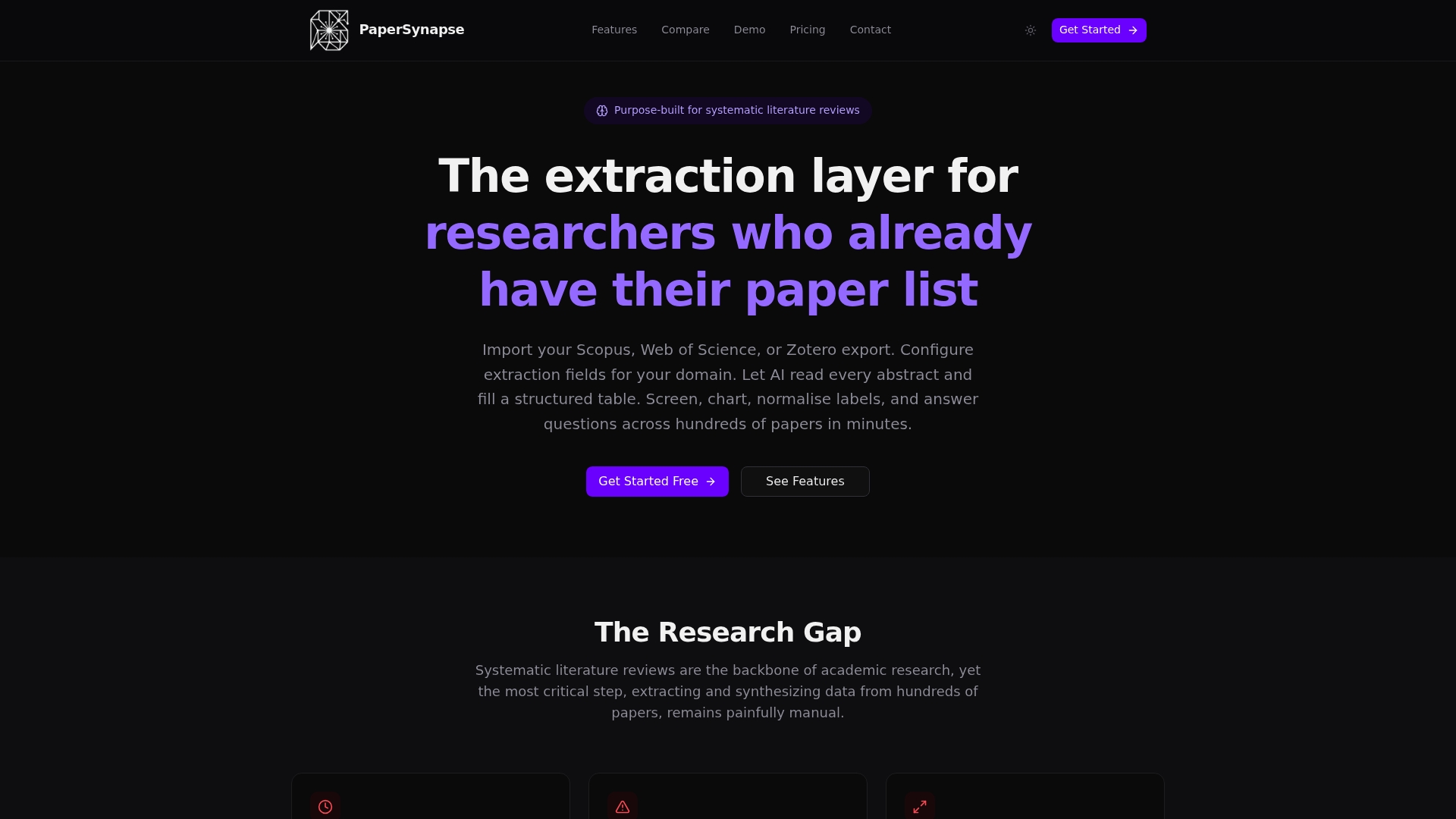
The platform processes up to 200 papers in under two minutes, which means the tagging and categorization work that typically takes days happens before your first coffee. Papersynapse integrates extraction, normalization, and analysis in one place, so your library stays consistent from import to final synthesis. For PhD candidates who need a systematic literature review tool that keeps every claim traceable and every table reproducible, Papersynapse removes the manual bottleneck without sacrificing rigor. The result is a structured, queryable knowledge base ready for AI-assisted synthesis from day one.
FAQ
What does it mean to organize research findings efficiently?
Efficient research organization means every paper is tagged, every claim is traceable to its source, and your entire library is queryable without manual searching. The goal is a structured knowledge base, not a large file collection.
What is the best workflow for categorizing research results?
Start by tagging papers at import with topic, methodology, and outcome labels. Build theme-based folder hierarchies, write structured annotation notes for each paper, and link every extracted claim to its source paragraph.
How does a provenance-first strategy prevent AI hallucinations?
A provenance-first strategy tags every extracted claim with a trust level and links it explicitly to the source paragraph. This makes AI-generated synthesis verifiable and prevents misattributed or fabricated claims from entering your draft.
When should I start organizing my research data?
Start at the first paper you collect. Research data management guidelines confirm that delaying organization until project end risks data loss and forces inefficient retroactive work.
How do AI research platforms speed up systematic literature reviews?
AI platforms automate PRISMA diagram generation, interactive topic mapping, and claim-to-source linking. They handle retrieval and first-draft synthesis so researchers can focus on verification and interpretation rather than manual extraction.