6 Research-Tested Time Hacks for PhD Students
6 Research-Tested Time Hacks for PhD Students
Six changes move the needle on weekly research progress more than any other adjustment: time-block your core research hours, name three most important tasks (MITs) each morning, plan backward from your fixed submission date, run focused work in Pomodoro Technique bursts, set up one recurring accountability check-in, and protect a buffer day for spillover. None of these require new software or a personality change. They require fifteen minutes of setup and a calendar.
- Block 2 to 4 hours of protected research time daily in Google Calendar, before anything else fills it.
- Write your 3 MITs the night before; not the morning of.
- Set your final defense or submission date first, then work backward to today.
- Use 25/5 or 50/10 Pomodoro cycles for reading, coding, or writing sprints.
- Book a weekly 15 minute check-in, with a supervisor, peer, or writing group.
- Reserve one flexible day a week to absorb spillover tasks.
Key Takeaways
Consistent weekly progress in a PhD comes from planning backward from a fixed deadline, protecting daily focus blocks, and reviewing progress weekly rather than relying on motivation alone.
| Point | Details |
|---|---|
| Plan backward first | Fix your submission date, then map milestones and buffers backward from it. |
| Protect focus blocks | Use Pomodoro Technique cycles (25/5 or 50/10) for reading, writing, and analysis. |
| Set 3 daily MITs | Choose them the night before and protect the first one until it’s done. |
| Review weekly | Spend 10 to 20 minutes checking planned versus actual progress to catch drift early. |
| Automate literature review extraction | Papersynapse imports references and auto-extracts abstract data into structured tables, cutting manual coding time. |
Table of Contents
- Why PhD Time Management Research Tips Actually Matter
- Common PhD Time-Management Traps and How to Stop Them
- Proven Systems That Map Well to PhD Research
- How Do You Plan Backward From a Fixed Deadline?
- Daily and Weekly Routines That Reliably Produce Progress
- External Accountability, Supervisor Boundaries, and Meeting Templates
- Practical Tools and Templates to Run the Systems
- Save Hours on Literature Review With a Scalable Workflow
- Tips for Effective Literature Review Scheduling and Information Management
- Advice on Handling Unexpected Disruptions or Setbacks
- Strategies for Balancing Research With Teaching and Personal Life
- Techniques for Overcoming Procrastination in Research Tasks
- Methods for Tracking and Measuring Research Progress
- Consider PaperSynapse for Your Next Literature Review
- Frequently Asked Questions
- Sources
Why PhD Time Management Research Tips Actually Matter
Generic productivity advice assumes a project with a clear scope and a short runway. A PhD has neither. You’re managing a project that runs three to seven years, layered with teaching loads, funding applications, ethics approvals, and a moving target of what “done” even means.
Two things quietly wreck good intentions. First, long-horizon drift: writing and synthesis eat far more of the calendar than students expect, and Asana’s project planning research puts writing at roughly 30 to 40 percent of total project time, a figure most students only discover in year three when it’s too late to plan around it. Second, external constraints outside your control. Ethics board timelines, equipment bookings, and funding cycles don’t care about your personal deadline, and a time management system built only around self-discipline collapses the first time a lab machine breaks or an IRB review stalls.
Common PhD Time-Management Traps and How to Stop Them
Most doctoral students don’t fail at time management from laziness. They fail from a handful of specific, fixable habits.
- Perfectionism on early drafts. You rewrite the same paragraph five times before finishing the section. Fix: set a “good enough for now” rule and move forward; polish in a dedicated revision pass later.
- Treating every email as urgent. Shallow work expands to fill available time. Fix: batch email and admin into two fixed windows a day.
- Saying yes to every request. Committee invites, guest lectures, favors for labmates. Fix: apply a 48-hour delay before agreeing to anything non-essential.
- Ignoring your energy rhythm. Scheduling data analysis for 4 p.m. when your brain peaks at 9 a.m. Fix: put cognitively demanding work in your sharpest hours.
- Skipping backward planning. Working forward from today instead of back from your deadline. Fix: map your submission date first, then fill in phases.
- No buffer time. Every week is booked at 100 percent capacity. Fix: leave 20 to 30 percent of each week unscheduled for overruns.
- Confusing motion with progress. Reading 40 papers without extracting usable data from any of them. Fix: require a structured output (a note, a table row) before moving to the next task.
Proven Systems That Map Well to PhD Research
Structured systems work because they replace willpower with a repeatable process, and PhD research generates too many decision points a day to survive on willpower alone.
Pomodoro Technique. Short, timed bursts protect focus during dense reading or coding, which is exactly the kind of work that invites distraction. Rice University’s graduate research office recommends 25 minute work intervals with 5 minute breaks, or 50 minutes with 10 minute breaks for deeper tasks like writing. Use the shorter cycle for literature scanning and email triage; switch to the 50/10 rhythm once you’re deep in a manuscript draft.
- Set a timer before opening your first paper or document.
- Log what you accomplished in each interval, not just time spent.
- Take the break away from your screen, not scrolling a phone.
- After four cycles, take a longer 20 to 30 minute reset.
Time blocking with Google Calendar. Reserve specific hours for specific work instead of hoping unstructured time gets used well. Color code blocks by category (analysis, writing, admin, teaching) so a glance at your week shows where the imbalance is.
Kanban with Trello. Move papers, chapters, or experiments through columns like “To Screen,” “In Progress,” and “Extracted.” It turns an invisible backlog into something you can see and triage.
Structured capture with Notion. Build a single database for literature notes, meeting logs, and weekly plans instead of scattering them across apps.
Pro Tip: Match the strategy to your life, not the other way around. A monastic strategy (long uninterrupted blocks, few interruptions) suits students without teaching duties; a bimodal approach (a few intense days mixed with lighter ones) suits those juggling a lab and a class schedule.
How Do You Plan Backward From a Fixed Deadline?
Start with your submission or defense date and work backward, not forward from today. Forward planning tells you what you did; backward planning tells you what you must still finish and by when.
- Fix the final date. Everything else is relative to it.
- Place major milestones on the calendar: proposal defense, ethics approval, data collection window, analysis phase, full draft, revision rounds.
- Add buffer of 25 to 50 percent to each phase estimate, since timeline-based research planning shows initial estimates routinely run short once external dependencies hit.
- Integrate writing throughout, not as a final phase. Since writing consumes close to a third of total project time, treating it as a last step is the single most common planning error.
- Identify your critical path, the sequence of tasks where any delay pushes the whole timeline back, and protect those specifically.
A rough example: months 1 to 3 for proposal and ethics, months 4 to 9 for data collection with weekly draft notes running alongside, months 10 to 14 for analysis and a full draft, months 15 to 18 for revisions and defense prep, each phase overlapping with writing rather than waiting for it.
Daily and Weekly Routines That Reliably Produce Progress
Pick a weekly rhythm and protect it. A plan that changes every week never becomes a habit, and Rochester’s graduate studies office found that students who time-block and set a few daily priorities report lower planning stress.
| Day type | Sample structure |
|---|---|
| Bench/experiment-heavy | Mornings: lab work in 2 to 3 hour blocks. Afternoons: data logging, one Pomodoro block for reading. |
| Writing/analysis-heavy | Mornings: 50/10 Pomodoro cycles on drafting. Afternoons: analysis, admin batch (email, forms). |
| Both | Fridays open as buffer for spillover, catch-up reading, or supervisor follow-ups. |
- Write your 3 MITs the night before; protect the first one until it’s done.
- Batch email and meetings into a single afternoon window, not scattered all day.
- Put your hardest cognitive task (writing, statistical modeling) in your peak energy hours, whatever those are for you.
- Treat one weekday, often Friday, as flexible buffer rather than another fully booked day.
External Accountability, Supervisor Boundaries, and Meeting Templates
Isolation kills momentum faster than any single bad habit. Build in outside pressure on purpose.
- Join or start a peer writing group that meets weekly.
- Schedule recurring supervisor check-ins rather than waiting to be summoned.
- Attend or organize a writing camp during heavy drafting phases.
- Post a short weekly lab update, even if nobody asks for one.
Ask your advisor directly: how fast should you expect feedback turnaround, what’s their typical availability, and how do they handle vacation or conference travel gaps?
A 10 to 15 minute check-in works best with a tight agenda: (1) what got done since last time, (2) what’s blocking progress, (3) one decision or approval needed today, (4) the next concrete date. Keep it centered on actions and dates, not general updates.
Practical Tools and Templates to Run the Systems
The right tool matters less than using one tool consistently instead of five inconsistently.
- Google Calendar for protected time blocks and recurring check-ins.
- Trello for a kanban view of your literature or experiment pipeline.
- Notion for a research database combining weekly plans, meeting logs, and literature notes.
- Zotero or Mendeley for reference management and citation tracking.
- Pomodoro apps like Forest or Focus To Do for timed work intervals with minimal setup.
If you’ve committed to a monastic strategy, pair your calendar with a distraction blocker. If you’re running bimodal, pair Trello’s pipeline view with periodic writing camps to compress intense drafting into short windows. Papersynapse’s own guides on organizing research findings and literature review workflows walk through templates for weekly plans and reading logs you can adapt directly.
Save Hours on Literature Review With a Scalable Workflow
A four-step workflow cuts literature review time without cutting corners: import your references, auto-extract abstracts and metadata, screen and tag by criteria, then export structured tables ready for synthesis.
- Import your Scopus or Web of Science exports in one batch instead of opening papers one by one.
- Let extraction tools pull key fields automatically instead of manually retyping data into a spreadsheet.
- Screen and tag in short, timed sessions rather than open-ended reading marathons.
- Export a clean, structured table you can filter and chart immediately.
Pro Tip: Batch your screening into fixed 90 minute sessions and let automated extraction handle the tedious first pass, so your own reading time goes toward judgment calls, not data entry.
Papersynapse builds this exact workflow into one platform: import CSV or RIS files from your reference manager, apply AI-powered extraction to fill structured tables from abstracts, and export enriched data for analysis. The platform reports processing up to 200 papers in under two minutes, turning what used to be weeks of manual coding into an afternoon.
Tips for Effective Literature Review Scheduling and Information Management
Treat your literature review as its own project with its own critical path, not a vague task hovering in the background for two years. Set a hard cap on initial screening (say, three weeks for a first pass through 150 to 200 abstracts) so it doesn’t quietly expand to fill your entire semester.
Separate three distinct activities that students often blur together: discovery (finding relevant papers), screening (deciding what’s in scope), and extraction (pulling usable data). Each has a different rhythm. Discovery benefits from long, uninterrupted search sessions. Screening works well in short, repeated Pomodoro bursts since it’s a yes/no decision task. Extraction benefits from batching, doing ten papers in one sitting rather than one paper ten separate times.
Keep a single literature tracker rather than scattered notes across notebooks, browser tabs, and folders. A structured database, whether in Notion or a dedicated extraction tool, lets you filter by theme, methodology, or publication year instead of re-reading abstracts to remember which paper said what. Papersynapse’s guide on building a structured research database covers how to set this up so it stays usable months later, not just on the day you built it.
Revisit your search strategy every four to six weeks. New papers publish continuously, and a review that stops updating after the first pass risks missing work that shifts your framing entirely.
Advice on Handling Unexpected Disruptions or Setbacks
Every PhD hits at least one derailment: a failed experiment, a reviewer rejection, a health issue, an equipment failure. The plan that survives isn’t the one with no disruptions built in. It’s the one with room to absorb them.
Distinguish hard deadlines from soft ones before disruption hits, not during the panic. Duke’s research on self-imposed deadlines draws a clear line between institutional deadlines (ethics submissions, funding reports) that genuinely can’t move, and self-imposed ones (a chapter draft by a certain date) that can flex without real consequence. Knowing which is which lets you adjust the soft ones deliberately instead of treating every slip as a crisis.
Map your dependencies before you need to reshuffle them. Timeline-based planning research recommends identifying finish-to-start and start-to-start relationships between tasks explicitly, so when one phase slips, you know immediately whether it cascades into your critical path or can be absorbed locally without touching anything else.
When a setback hits, don’t just push everything back by the same number of days. Re-run your backward plan from the fixed end date, re-check which tasks sit on the critical path now, and protect buffer time for whatever comes next. A disruption handled with a five-minute replanning session costs far less than one handled with two weeks of anxious drift.

Strategies for Balancing Research With Teaching and Personal Life
Teaching loads, administrative committees, and a personal life outside the lab all compete for the same 168 hours a week that research does. Treating research as the only legitimate use of time is how burnout starts.
Batch teaching-related work into fixed blocks rather than letting grading and office hours bleed into research time unpredictably. If you teach on Tuesdays and Thursdays, contain grading to those same days instead of letting it spill into your writing time on Wednesday.
Set a hard stop time most evenings and treat it the same way you’d treat a client meeting: non-negotiable unless something urgent actually requires it. Students who never disconnect don’t produce more over a year; they produce less, because sustained fatigue erodes the quality of the hours they do work.
Use your protected buffer day, discussed earlier, for the administrative tasks that always seem to eat into research time: committee service, recommendation letters, department paperwork. Keeping those contained to one day protects the rest of your week for actual research output.
Personal life needs the same scheduling respect as research tasks. A recurring gym slot or dinner with friends that sits unprotected on your calendar gets sacrificed first when things get busy; block it the same way you’d block a lab session, and it survives.
Techniques for Overcoming Procrastination in Research Tasks
Procrastination on research tasks rarely comes from laziness. It comes from ambiguity. “Work on chapter three” is vague enough to avoid indefinitely; “write 300 words on the limitations section” is specific enough to start.

Break vague tasks into the smallest next physical action. Instead of “analyze data,” write “open the dataset and run the first regression.” The smaller the entry point, the lower the activation energy needed to begin.
Use the two-minute rule for administrative procrastination: if a task takes under two minutes, do it immediately rather than adding it to a list you’ll revisit later. Small tasks left unprocessed accumulate into a background hum of unfinished business that makes bigger work feel heavier.
Pair procrastination-prone tasks with your Pomodoro Technique blocks specifically. Committing to just one 25 minute interval feels far more achievable than committing to “finish the literature review,” and most people find that starting is the hard part, not continuing once the timer’s running.
Finally, track avoidance patterns the same way you’d track an experimental variable. If you notice you consistently avoid statistical analysis on Monday mornings, that’s data. Move that task to whatever time slot you don’t avoid, rather than fighting the same resistance every week.
Methods for Tracking and Measuring Research Progress
You can’t adjust a plan you’re not measuring. Vague impressions of “I’ve been busy” tell you nothing useful about whether your time management system is actually working.
Track concrete, small metrics weekly: hours of genuinely focused work (not just hours at a desk), words drafted, papers extracted and coded, experiments completed. These numbers reveal patterns that feelings hide, like discovering you’ve spent three weeks “working on” a chapter but produced fewer than 500 usable words.
Run a short weekly review, 10 to 20 minutes, comparing planned versus actual progress. Research on planner maintenance found that even a well-built plan turns into wishful thinking without this regular check, since drift compounds silently week over week until a deadline exposes it all at once.
A research planner built around seven core parts, a timeline, milestone tracker, reading log, literature tracker, writing schedule, deadline and funding tracker, and supervision log, keeps this measurement visible in one place instead of scattered across sticky notes and half-remembered conversations. Papersynapse’s research time cost analysis guide breaks down how to estimate and then track actual time spent per phase, which is the piece most planners skip entirely.
Incremental gains are the realistic goal
I’d rather see a student test one change a week and track it in hours of focused work than overhaul everything at once. Try protecting two mornings, say Tuesday and Thursday, for deep work only, and measure what changes.
Consider PaperSynapse for Your Next Literature Review
Time-blocking and Pomodoro cycles handle your daily focus. The literature review itself is where hours disappear fastest, often because manual extraction from dozens or hundreds of abstracts eats entire weeks that could go toward analysis and writing.
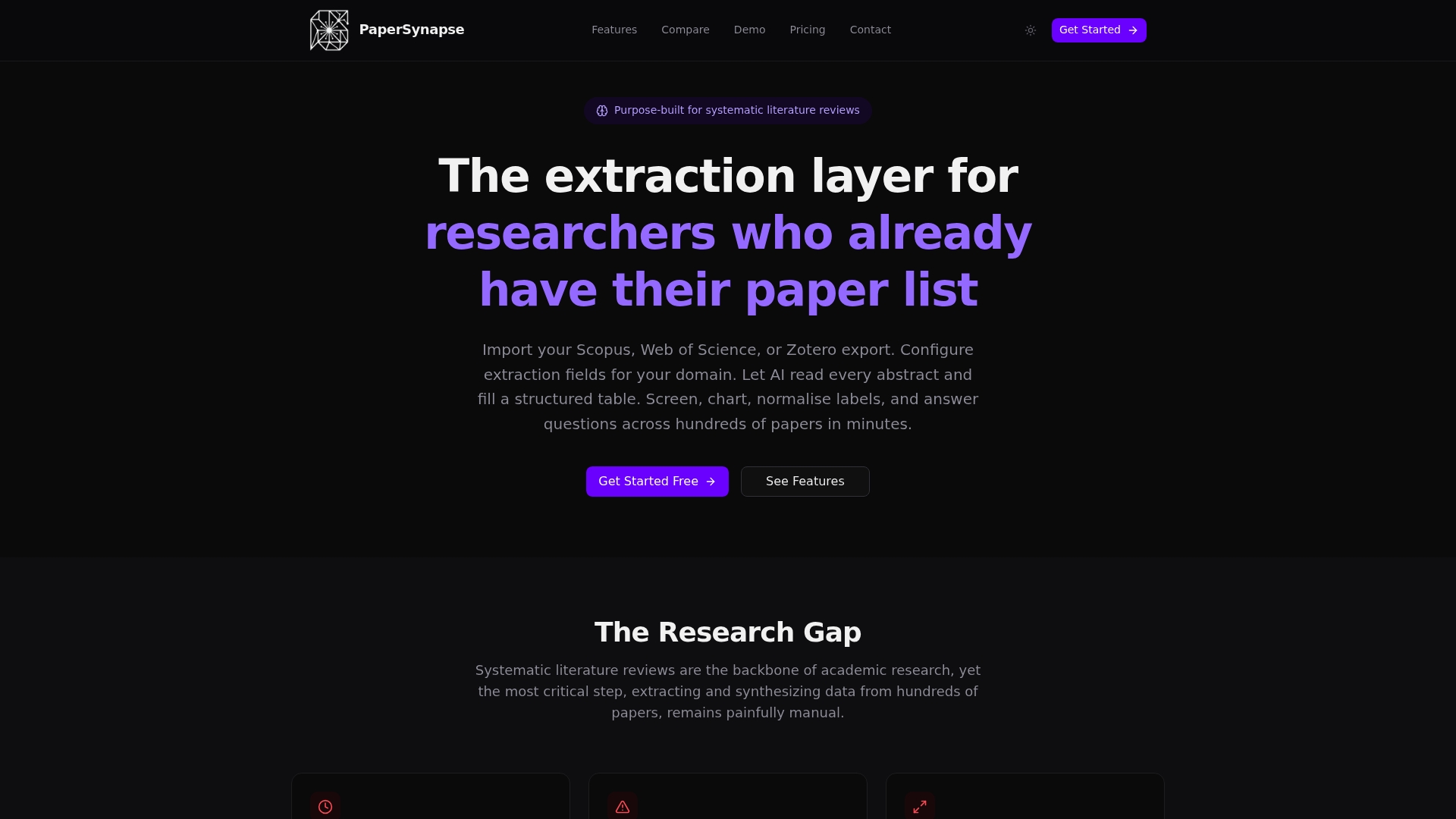
Consider trying Papersynapse for the extraction and screening stage specifically. Import your Scopus or Web of Science references directly, let AI-powered extraction fill structured tables from abstracts, and export enriched CSVs ready for your analysis chapter, all without retyping data by hand. The platform reports processing up to 200 papers in under two minutes, and a free tier lets you test the workflow on your own dataset before committing to a paid plan. Start by importing your current review’s reference list and see how much of that first screening pass it clears in one sitting.
Frequently Asked Questions
What is the best time management method for PhD students? No single method fits every research stage. Time blocking with Google Calendar works well for protecting daily research hours, while the Pomodoro Technique suits focused reading or writing sprints. Most successful students combine a few systems rather than relying on one.
How many hours a day should a PhD student work? There’s no universal number, since output depends more on focused quality than raw hours logged. Protecting 4 to 6 hours of genuinely focused, distraction-free research time daily tends to produce more usable progress than 10 hours spread thin across meetings and shallow tasks.
How do I stop procrastinating on my dissertation? Break vague tasks into a specific, small next action, then commit to just one Pomodoro interval to start. Track which tasks you consistently avoid and reschedule them to a different time slot rather than repeatedly fighting the same resistance.
How far in advance should I plan my PhD timeline? Plan backward from your final submission or defense date as early as possible, ideally at the start of each major phase. Build in 25 to 50 percent buffer time for each estimate, since external dependencies like ethics approval or equipment access routinely run longer than expected.
Can software help with literature review time management? Yes. Tools that automate reference import and data extraction, such as Papersynapse, reduce the manual coding time that typically consumes weeks of a literature review, freeing that time for analysis and writing instead.
Sources
- Time management for PhD students — Rice University graduate news
- Critical Path Method for project planning — Asana Resources
- Day in the life of a PhD student + time management tips — University of Rochester Grad Studies
- Timeline-based research planning — LucenSoftware expert analysis
- Research Planner: Structure a Thesis or Dissertation — Templacity