Best Rayyan.ai Alternatives for Systematic Reviews in 2026
Best Rayyan.ai Alternatives for Systematic Reviews in 2026
What are the best Rayyan.ai alternatives right now?
The strongest Rayyan.ai alternatives in 2026 are Covidence, DistillerSR, EPPI-Reviewer, Elicit, and ASReview, each covering workflow stages and compliance requirements that Rayyan simply does not reach. Rayyan excels at title and abstract screening with machine learning predictions and inter-rater agreement tracking, but its free tier stops well short of full extraction, synthesis, or audit-grade compliance. If your review needs to go beyond screening, you need a different tool.
The shortlist below covers the most commonly needed use cases:
- Covidence — best for Cochrane-aligned reviews needing full workflow coverage from screening through risk-of-bias assessment
- DistillerSR — best for regulatory submissions and health technology assessments requiring verifiable audit trails
- EPPI-Reviewer — best for mixed-methods and qualitative synthesis beyond standard screening
- ASReview — best for researchers who want open-source, customizable AI screening with active learning
- Elicit — best for AI-driven paper discovery and structured metadata extraction
- Nested Knowledge — best for medical teams needing interactive evidence visualization
- PICO Portal — best for institutions wanting machine learning to accelerate review timelines
- Paperguide — best for researchers wanting a direct AI assistant alternative to Rayyan
- SciSpace — best for navigating and summarizing large bodies of scientific literature
- GenexAI — best for life sciences teams focused on clinical trial data and regulatory analytics
- Latent Knowledge — best for semantic search across large research corpora
- Atlas Workspace — best for qualitative and mixed-methods evidence synthesis
The table below maps each tool across the dimensions that matter most for selection.
| Tool | Best For | Pricing | Workflow Stages | AI Features | PRISMA Compliance | Data Extraction | Screening & Labeling | Integration/Export |
|---|---|---|---|---|---|---|---|---|
| Covidence | Full systematic review, Cochrane-aligned | Paid (tiered) | Screening, extraction, risk-of-bias, reporting | ML screening predictions | Yes (integrated) | Customizable forms | Yes, with conflict resolution | RIS, CSV, Word |
| ASReview | Open-source AI screening | Free/open-source | Screening, prioritization | Active learning AI | Partial | Limited | Yes, AI-prioritized | RIS, CSV |
| Elicit | AI paper discovery and extraction | Free tier + paid | Search, extraction | AI metadata extraction | Partial | Structured tables | Yes | CSV, Zotero |
| Atlas Workspace | Qualitative and mixed-methods synthesis | Paid | Qualitative coding, synthesis | NLP-assisted coding | Partial | Qualitative extraction | Yes | Multiple formats |
| Nested Knowledge | Medical evidence visualization | Paid | Screening, extraction, meta-analysis | AI-assisted tagging | Yes | Structured forms | Yes | CSV, RIS |
| GenexAI | Clinical trial and regulatory analytics | Paid | Trial data, regulatory reporting | Advanced regulatory AI | Regulatory-grade | Regulatory data | Yes | Regulatory formats |
| Latent Knowledge | Semantic literature search | Paid | Search, discovery | NLP semantic search | Partial | Limited | Yes | Export formats vary |
| PICO Portal | Accelerated enterprise reviews | Paid (institutional) | Screening, extraction | ML + NLP acceleration | Yes | Yes | Yes | RIS, CSV |
| DistillerSR | Regulatory and HTA compliance | Paid (enterprise) | Full lifecycle | Audit-grade AI assistance | Yes | Advanced forms | Yes, with audit trail | Multiple formats |
| EPPI-Reviewer | Complex qualitative and mixed-methods | Paid | Screening, synthesis, coding | ML text mining | Yes | Concept extraction | Yes | Multiple formats |
| Paperguide | AI-assisted literature review | Free tier + paid | Screening, extraction | AI screening assistant | Partial | Yes | Yes | Export formats vary |
| SciSpace | Paper discovery and summarization | Free tier + paid | Search, summarization | AI summarization | Partial | Limited | Yes | PDF, CSV |
| Atlas | — | — | — | — | — | — | — | — |
How do you evaluate Rayyan.ai competitors fairly?
Picking the wrong tool costs weeks. A screening-only platform looks fine until you hit the extraction phase and realize you need a second tool, a second login, and a second learning curve. The criteria below reflect what actually separates these platforms in practice.
Workflow coverage is the first filter. Rayyan covers title and abstract screening well, but most published systematic reviews also require full-text review, structured data extraction, and risk-of-bias assessment. Tools like Covidence and DistillerSR handle all of these in one place; others, like ASReview and Elicit, are purpose-built for specific phases.
AI assistance quality varies widely. Active learning in ASReview re-ranks your unseen records after every decision, so the most likely relevant papers surface first. That is meaningfully different from a static ML classifier that scores papers once at import. Elicit takes a different approach entirely, using large language models to pull structured fields directly from full-text PDFs.
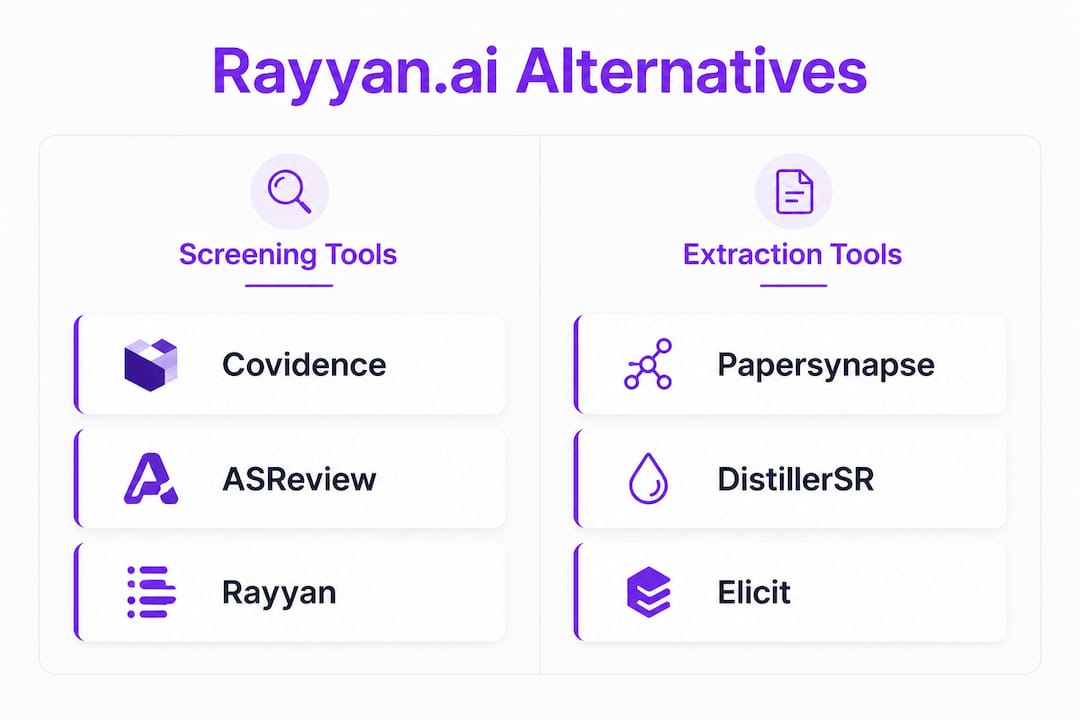
PRISMA compliance and audit trails separate tools built for publication from tools built for exploration. Cochrane recommends Covidence for new reviews partly because its reporting maps directly to PRISMA 2020 requirements. DistillerSR goes further, maintaining timestamped audit logs that meet regulatory submission standards.
Additional criteria worth scoring before you commit:
- Pricing model: free tiers (ASReview, Colandr, Elicit basic) versus institutional subscriptions (DistillerSR, PICO Portal) versus per-review fees (Covidence)
- Collaboration features: real-time conflict resolution, role-based access, and team dashboards
- Security and data privacy: especially relevant for clinical or proprietary datasets
- Support and training: live onboarding, documentation depth, and community forums
- Export formats: RIS, CSV, Word, and direct reference manager integration
In-depth profiles of the top alternatives to Rayyan.ai
Covidence is the closest thing to an industry standard for academic systematic reviews. It covers screening, extraction, and risk-of-bias assessment in one platform, with no need to stitch together separate tools. The Harvard Library guide lists it alongside EPPI-Reviewer and DistillerSR as a primary recommendation for systematic review teams. There is no meaningful free tier, but the per-review pricing is predictable for grant-funded projects.

ASReview takes a fundamentally different philosophy. It is open-source, runs locally or in the cloud, and uses active learning to continuously reprioritize your unscreened records based on your decisions. A published methodological case study in the Journal of Clinical and Translational Science validated its screening efficiency gains. Researchers comfortable with Python or command-line tools will find it highly configurable; those who need a polished UI may find the learning curve steep.
Elicit sits at the discovery end of the workflow. Its AI reads full-text papers and populates structured extraction tables automatically, which is genuinely useful for early-stage scoping reviews. The free tier handles a reasonable volume of papers; the paid plan unlocks higher limits and more extraction columns. It does not replace a full systematic review platform, but as a first-pass discovery and extraction tool, it covers ground Rayyan never attempted.
Nested Knowledge, PICO Portal, and DistillerSR
Nested Knowledge targets medical research teams specifically. Its interactive evidence maps let you visualize relationships between studies in ways that a standard PRISMA flowchart cannot capture. The platform supports screening, structured extraction, and meta-analysis, with critical appraisal tools built in.

PICO Portal combines machine learning and natural language processing to compress review timelines for enterprise and institutional teams. Its NLP engine parses PICO elements directly from abstracts, reducing the manual tagging burden that slows large reviews. Institutional pricing means it is better suited to university libraries or research centers than individual researchers.
DistillerSR is the compliance-first choice. Its audit trail capabilities meet the documentation standards required for health technology assessments and regulatory submissions, areas where Rayyan’s lack of verifiable audit logs is a genuine disqualifier. The platform covers the full review lifecycle and supports multiple simultaneous projects, which matters for organizations running parallel reviews.
EPPI-Reviewer, GenexAI, and Latent Knowledge
EPPI-Reviewer extends well past screening into ML-assisted text mining and qualitative synthesis, making it the strongest option for mixed-methods reviews. Its concept extraction tools can identify themes across hundreds of qualitative studies, a capability no other tool on this list matches at the same depth.
GenexAI is purpose-built for life sciences. Its AI analytics target clinical trial data and regulatory compliance reporting rather than general academic literature, so it fits a narrow but important niche: pharmaceutical and biotech teams preparing regulatory submissions.
Latent Knowledge applies NLP-based semantic search to help researchers surface relevant papers they would miss with keyword-only queries. It is more of a discovery accelerator than a full review platform, but for researchers working in fast-moving fields with inconsistent terminology, semantic search meaningfully changes what you find.
Paperguide, SciSpace, and Atlas Workspace
Paperguide positions itself as a direct AI assistant for literature review, covering screening and data extraction with a lighter interface than enterprise tools. It suits researchers who want something closer to Rayyan in simplicity but with stronger AI assistance.
SciSpace focuses on paper summarization and discovery. Its AI can answer questions about a paper’s methods or findings directly from the PDF, which speeds up full-text triage considerably. It is not a systematic review platform in the formal sense, but as a reading and summarization layer it saves real time.
Atlas Workspace addresses the qualitative side of evidence synthesis that most tools ignore. Its NLP-assisted coding tools support grounded theory, thematic analysis, and framework synthesis, making it the right choice for reviews that cannot be reduced to quantitative extraction tables.
How to choose the right Rayyan alternative for your project
Start with your review methodology, not your budget. Cochrane-aligned reviews have specific tool expectations, and Covidence is the most straightforward path to meeting them. JBI-aligned reviews have similar documentation requirements that favor platforms with structured extraction templates and PRISMA reporting.
Budget and scale come next. Free tools like ASReview and Colandr handle screening well for smaller teams, but they require more manual coordination for extraction and synthesis. Paid platforms like DistillerSR and PICO Portal justify their cost through time savings and compliance features, particularly for multi-reviewer teams running large reviews.
Key questions to answer before committing:
- Does your review require a verifiable audit trail for journal submission or regulatory filing?
- How many reviewers will work simultaneously, and do you need real-time conflict resolution?
- Which phases does your team need covered: screening only, or the full pipeline through synthesis?
- What are your export requirements, and do they need to connect to a reference manager like Zotero or EndNote?
- Does your institution already have a license for one of these platforms?
Pro Tip: Request a demo or activate a free trial before purchasing. Most platforms, including Covidence, DistillerSR, and PICO Portal, offer trial projects. Running a small pilot with your actual data reveals workflow gaps that feature lists never show.
Security and data privacy matter more than most researchers realize until they are mid-review with sensitive clinical data. Confirm that any platform you choose meets your institution’s data governance requirements before uploading patient-level or proprietary datasets.
Other AI-assisted review tools worth knowing about
Beyond the main alternatives, several tools fill specific niches that the larger platforms do not address as well.
Abstrackr is free and focused entirely on abstract screening prioritization. Its machine learning algorithms reduce reviewer burden for large-volume datasets by surfacing the most likely relevant records first. It covers a narrower workflow than Rayyan, but for teams that only need screening prioritization and have budget constraints, it is a practical option.
Colandr is an open-source screening platform with ML-assisted relevance predictions, inter-rater agreement tracking, and PRISMA export. It lacks built-in data extraction forms, so teams will need a separate tool for that phase. For research groups with tight budgets who need a free, actively maintained screening tool, Colandr is one of the strongest no-cost options available.
JBI SUMARI is the official platform of the Joanna Briggs Institute and is built specifically around JBI methodology. If your review protocol follows JBI guidelines, SUMARI’s templates and appraisal tools align directly with what your reporting will require.
Rayyan itself remains a reasonable starting point for title and abstract screening, particularly for teams new to systematic reviews or working with limited funding. Its free tier supports basic ML screening predictions and collaboration, though advanced features like PICO extraction require a paid subscription.
How Papersynapse approaches systematic review automation
Papersynapse takes a different entry point into the systematic review workflow. Rather than focusing on screening decisions, it targets the extraction bottleneck: the hours researchers spend reading papers and manually filling structured tables.
The platform lets researchers import references directly from Scopus or Web of Science, then uses AI to read abstracts and populate extraction tables automatically. Papersynapse claims to process up to 200 papers in under two minutes, which addresses one of the most time-consuming phases of any large review. Manual extraction is not just slow; it is inconsistent, and inconsistency across reviewers is one of the most common sources of error in published systematic reviews.
What makes Papersynapse’s approach worth noting:
- Integrated extraction and normalization: AI reads and categorizes paper content, then normalizes terminology across studies for consistent comparison
- Visualization tools: researchers can see patterns across their extracted dataset without exporting to a separate analysis tool
- Scalability: the platform handles large reference sets without requiring manual batch processing
- Workflow consolidation: extraction, analysis, and categorization happen in one place rather than across multiple tools
For researchers who have already completed screening in Rayyan or another tool and are now facing the extraction phase, Papersynapse fits naturally as the next step. It does not replace a full systematic review platform, but for the specific bottleneck of literature review automation, it addresses a gap that most screening-focused tools leave open.
Key Takeaways
The best Rayyan.ai alternative depends on your review’s compliance requirements, workflow scope, and budget, with Covidence and DistillerSR leading for publication-grade reviews and ASReview and Colandr offering strong free options for screening-focused projects.
| Point | Details |
|---|---|
| Workflow coverage matters most | Choose a tool that covers every phase your review needs, from screening through extraction and synthesis. |
| Compliance drives platform choice | Regulatory and Cochrane-aligned reviews require audit trails and PRISMA reporting that free tools rarely provide. |
| Free tools have real limits | ASReview and Colandr handle screening well but lack built-in extraction forms for full review pipelines. |
| AI features vary by design | Active learning in ASReview differs fundamentally from LLM-based extraction in Elicit; match the AI type to your phase. |
| Papersynapse targets extraction | For researchers past screening and facing manual extraction, Papersynapse processes up to 200 papers in under two minutes. |
The part of this conversation that most tools avoid
The systematic review software market has a quiet consensus problem. Nearly every platform markets itself as an “end-to-end solution,” yet most researchers end up using two or three tools across a single review. Rayyan for screening, something else for extraction, something else again for synthesis. That is not a failure of the tools individually. It reflects the fact that the systematic review workflow is genuinely complex, and no single platform has solved every phase equally well.
What concerns me more is the growing pressure to treat AI-assisted screening as a substitute for methodological rigor rather than an accelerant for it. Active learning tools like ASReview can dramatically reduce the number of records a human needs to read, but they require careful stopping-rule decisions and transparent reporting of how the AI was used. The PRISMA 2020 statement does not yet have a fully standardized extension for AI-assisted reviews, which means researchers are currently making judgment calls about what to report and how. That gap will close, and when it does, the tools that have built transparent logging and reproducible workflows from the start will have a significant advantage over those that bolted compliance on afterward.
The researchers who will navigate this transition best are the ones who choose platforms based on their audit and reporting architecture, not just their feature count. A tool that processes papers quickly but cannot tell you exactly which records were screened by AI versus by a human is a liability in a high-stakes review. Vendor roadmaps matter here. Ask whether the platform is actively engaging with PRISMA working groups or Cochrane methodology committees. The answer tells you more about long-term fit than any feature comparison table.
Pro Tip: Before finalizing any platform, ask the vendor directly: “How does your platform support reporting of AI-assisted decisions in a PRISMA-compliant flow diagram?” A vague answer is a red flag.
Papersynapse fills the extraction gap most screening tools leave open
If you have evaluated the tools above and found that screening is covered but extraction is still a manual slog, Papersynapse is worth a close look. Most researchers spend far more time on extraction than on screening, yet the tool ecosystem has historically focused on the screening phase.
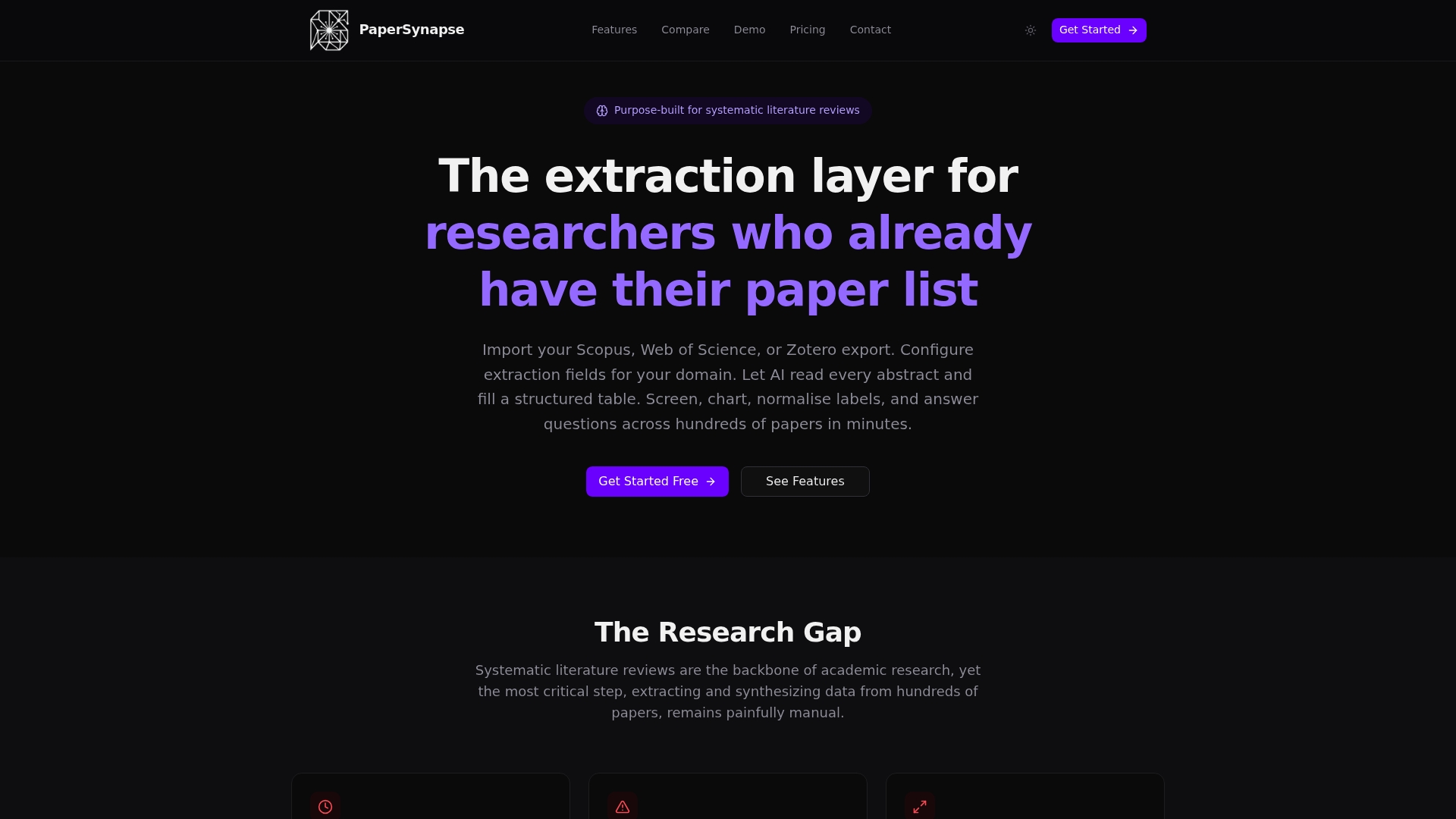
Papersynapse imports your references from Scopus or Web of Science and uses AI to read abstracts and fill structured extraction tables automatically. The platform integrates extraction, normalization, and visualization in one place, so you are not copying data between tools or reconciling inconsistent terminology across reviewers. For academic researchers running systematic literature reviews at scale, that consolidation alone saves meaningful time. It is a different kind of solution from the screening platforms compared above, and for the extraction bottleneck specifically, it is one of the most direct answers available.