Reduce Manual Coding Research Data: SLR Guide
Reduce Manual Coding Research Data: SLR Guide
Automate your first-pass coding with an evidence-grounded, human-in-the-loop pipeline and you can cut manual coding time from days to minutes. Start today with three moves: isolate each paper as a separate API call, require verbatim evidence spans in every output, and bulk-accept high-confidence codes while flagging the rest for manual review. Platforms like Papersynapse can process up to 200 papers in under two minutes, a throughput that no manual team matches.
Quick-start actions:
- Import your reference list from Scopus or Web of Science into a versioned project before touching any abstracts
- Write prompts that require the model to return both a code and the exact sentence that supports it
- Set a confidence threshold (e.g., 0.85) and bulk-accept above it; adjudicate everything below
Stat: Automated tools deliver coded results in minutes versus days for manual methods, even across thousands of verbatim responses.
Pro Tip: Run a 5–10% pilot set before committing to a full batch. Catching prompt failures on 50 abstracts costs nothing; catching them on 500 costs a week.
Table of Contents
- How do you automate coding and extraction for a systematic literature review?
- What technical pitfalls should you watch for when automating research coding?
- Why do structured tables make downstream analysis faster?
- How do you measure the ROI of switching to automated coding?
- How do you build a reproducible research pipeline?
- What does an automated SLR look like in practice?
- Key Takeaways
- The shift that actually surprised me
- Papersynapse cuts your coding time without sacrificing rigor
- Useful sources
How do you automate coding and extraction for a systematic literature review?
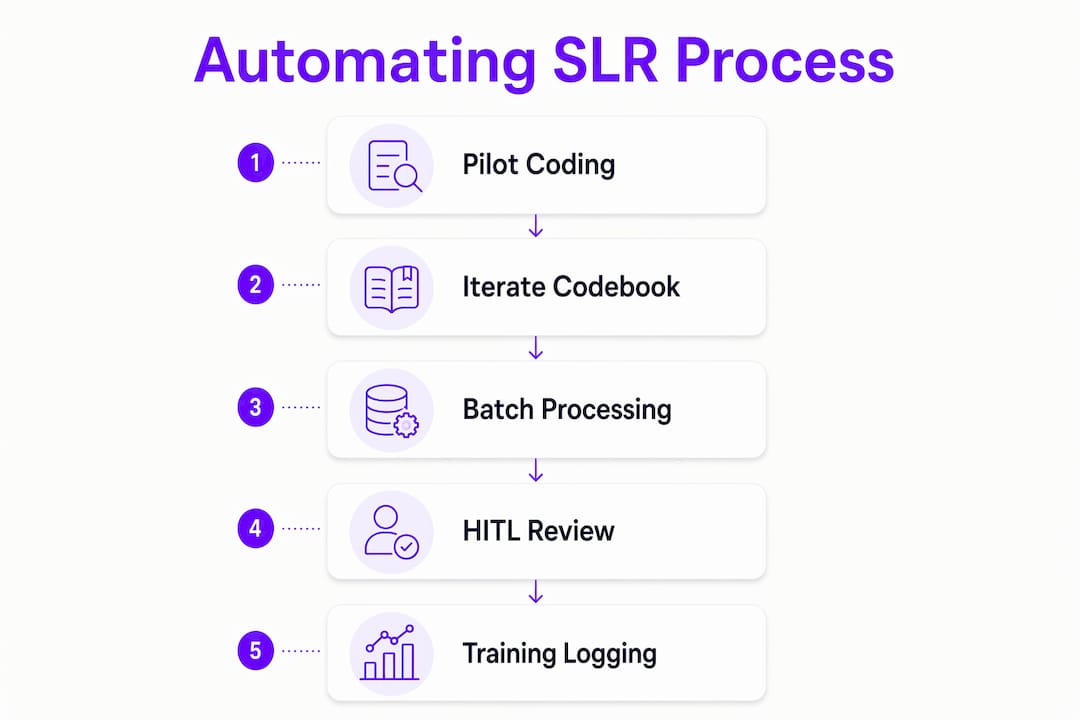
A reproducible SLR pipeline has six ordered steps. Each one builds on the last, and skipping any of them tends to surface as a quality problem later.
-
Import and version your references. Pull your deduplicated reference list from Scopus or Web of Science directly into a versioned project. Store raw PDFs and abstracts together so every downstream step traces back to the same source files. The role of AI in organizing references has expanded precisely because this step is where most manual errors enter.
-
Build your codebook from a pilot set. Select 5–10% of your corpus at random. Run LLM-assisted clustering on that subset to surface candidate themes, then review and finalize your codebook before touching the rest. Codebook iteration on 50 papers takes an hour; on 500, it takes a week.
-
Batch-code with isolated API calls. Process each abstract or full-text section as a separate, stateless call. Per-response isolation prevents earlier responses from biasing later classifications, a subtle but real source of order effects that undermines agreement metrics.
-
Run a human-in-the-loop review pass. Bulk-accept codes above your confidence threshold. Route everything below it to a manual adjudication queue. HITL workflows are the single most recommended success factor for automated qualitative coding, because they catch systematic bias before it compounds.
-
Export to structured formats. Generate CSV, SPSS, or R-ready tables from your validated codes. Platforms that support structured export formats plug directly into meta-analysis pipelines without reformatting.
-
Validate and lock the dataset. Calculate inter-coder reliability on your adjudicated sample, document your prompt version and model metadata, and freeze the dataset. Any future re-run gets a new version number.
Timeline estimates: Pilot and codebook iteration: 1–2 hours. Full batch run on 500 items: under 30 minutes. HITL review pass: 2–4 hours depending on threshold. Export and validation: 1 hour.
Pro Tip: Reconciled disagreements from your HITL pass are labeled training examples. Log them. Over iterative runs, dual-model consensus coding converts those disagreements into accuracy gains.
What technical pitfalls should you watch for when automating research coding?
The four failure modes that derail automated SLRs are order effects, hallucination, normalization drift, and poor inter-coder reliability. Each has a concrete fix.
-
Order effects and context leakage. When a single API call processes multiple abstracts, the model’s interpretation of abstract 47 can be colored by abstract 46. Stateless, per-response calls eliminate this. Off-the-shelf LLMs often skip this design choice; research-focused platforms build it in by default.
-
Hallucination and unsupported codes. Require every output to include the verbatim evidence span alongside the assigned code. Evidence-span outputs allow rapid human validation and expose cases where the model assigned a code with no textual support. A code without a span is a red flag, not a result.
-
Versioning failures. Capture the exact prompt text, model version, and raw input snapshot for every run. Without this, you cannot reproduce your own results six months later, let alone respond to a peer reviewer. Complete data lineage capture from raw input to final classification is non-negotiable for audit-ready work.
-
Normalization drift. Date formats, unit abbreviations, and controlled-vocabulary terms accumulate inconsistencies across hundreds of records. Automated fixes using regex and lookup tables catch most of these, but schema validation at import catches them before they propagate.
For inter-coder reliability, Cohen’s kappa and Krippendorff’s alpha are the standard metrics. A kappa of κ ≥ 0.80 is the widely accepted threshold for reliable classification. Cycle-based validation that requires consecutive perfect agreements before declaring a classifier reliable is a rigorous alternative to one-shot checks.
Pro Tip: Always capture the exact verbatim evidence span for every automated code. During HITL review, a human can accept or reject a code in two seconds when the supporting sentence is right there. Without it, they have to re-read the abstract.

Why do structured tables make downstream analysis faster?
Consistent columns, typed fields, and validated units are what separate a usable extraction dataset from a spreadsheet that needs another week of cleaning. For SLRs specifically, the payoff is direct: a well-designed schema means your synthesis step starts the moment validation ends.
Core fields to extract for most SLRs:
- Citation metadata: authors, year, DOI, source database
- Study design: RCT, cohort, cross-sectional, qualitative
- Sample size and population descriptors
- Primary and secondary outcomes with units
- Measurement instruments and scales
- Assigned coding labels with evidence spans
Example schema (simplified):
| Field | Data type | Normalization rule |
|---|---|---|
pub_year |
Integer | 4-digit YYYY; reject partial dates |
sample_size |
Integer | Strip commas; convert ranges to midpoint |
study_design |
Controlled vocab | Map synonyms to canonical terms (e.g., “RCT”, “randomized trial” → “RCT”) |
outcome_measure |
String | Lowercase; strip trailing punctuation |
evidence_span |
String | Verbatim; max 250 characters |
code_label |
Controlled vocab | From locked codebook only |
Automated normalization handles the mechanical work: regex strips stray characters, lookup tables map abbreviations to canonical forms, and unit conversion functions standardize numeric fields, as explained in this automatización de procesos de RRHH guide. The types of normalization that matter most for SLRs are controlled-vocabulary mapping and date standardization, because those are where manual inconsistency concentrates.
Pro Tip: Enforce schema validation at import, not at export. Failing fast on a malformed record costs seconds. Discovering the same problem after 500 records have been coded costs hours.
How do you measure the ROI of switching to automated coding?
The primary metrics are time per item, throughput, total hours saved, and extraction quality. Run a pre/post comparison on your pilot set to get real numbers before scaling.
| Metric | Manual baseline | Automated (post-HITL) |
|---|---|---|
| Time per abstract | typically minutes when manual | seconds with automated methods |
| Throughput (items/hour) | low with manual coding | substantially higher with automation |
| Inter-coder kappa | varies with manual coding | improved with adjudicated automated coding |
| Evidence span capture rate | inconsistent in manual processes | consistently captured in automated workflows |
Stat: Transitioning to automated coding reduces processing time from days to minutes for open-ended responses, even at thousands of items.
Quality metrics to track alongside throughput: false discovery rate (codes assigned with no textual support), omission rate (relevant codes missed), and evidence-span acceptance rate during HITL review. A high acceptance rate above your confidence threshold confirms your prompt is well-calibrated. A low one signals prompt revision is needed before the full run.
For a formal pilot validation, 50–100 items coded independently by two reviewers gives you a reliable kappa estimate. That sample size is enough to detect systematic disagreement before it scales.
How do you build a reproducible research pipeline?
Treat your pipeline as a versioned scientific asset, not a one-time script. Every input, transformation, and output gets a version number and a timestamp.
- Ingestion layer: raw PDFs, abstracts, and reference metadata stored with checksums
- Extraction layer: prompt text, model version, and API parameters logged per run
- Normalization layer: regex rules and lookup tables stored as versioned config files
- Validation layer: HITL decisions, adjudication logs, and final kappa scores
- Export layer: locked CSV/JSON snapshots with full provenance metadata
Designing pipelines as versioned scientific assets improves reproducibility, auditability, and collaboration in ways that ad hoc scripts simply cannot. When a peer reviewer asks how you coded “intervention type,” you pull the exact prompt version and the evidence span, not a vague methods paragraph.
“Systems thinking — treating pipelines and experiments as first-class versioned assets — makes reproducibility and audit responses trivial instead of ad hoc.” — DataJoint
Open-source toolkits can serialize the entire project state into a single JSON snapshot, restoring cursor position, coding history, and session metadata for later review. That approach pairs well with a reproducible literature review methodology that documents every pipeline decision from import to export.
Pro Tip: Every project snapshot should include the exact prompt text and model version used for that run. Model providers update weights without notice. A snapshot without that metadata is not reproducible.
What does an automated SLR look like in practice?
Scenario: 500 abstracts plus 200 full texts for a health-intervention SLR, imported from Web of Science.
Timeline:
- Import and deduplication: 10 minutes
- Pilot run (50 abstracts, codebook iteration): 90 minutes
- Full batch extraction (500 abstracts + 200 full texts): under 30 minutes
- HITL review pass (bulk-accept above 0.85 threshold): 2–4 hours
- Export and validation: 1 hour
- Total: roughly 5.5 hours versus an estimated 3–4 days manually
Example output fields per record: DOI, pub_year, study_design, sample_size, primary_outcome, intervention_type, code_label, evidence_span, confidence_score.
| Phase | Time saved | Quality outcome |
|---|---|---|
| Batch extraction | 3–4 days | Evidence spans captured for 100% of coded items |
| HITL adjudication | 2–4 hours | Kappa above 0.80 after reconciliation |
| Export to CSV/SPSS | 1 hour | Zero reformatting needed for meta-analysis |
Papersynapse handles the Scopus and Web of Science import directly, fills structured tables from abstracts using AI, and exports to CSV for immediate use in R or SPSS. The literature review automation benefits compound when you run multiple SLRs on the same versioned schema.
Key Takeaways
Automating SLR coding with per-response isolation, evidence-span grounding, and a HITL validation pass cuts total project time from days to hours while maintaining kappa scores above 0.80.
| Point | Details |
|---|---|
| Start with a pilot set | Code 5–10% of your corpus first to catch prompt failures before they scale. |
| Require evidence spans | Every automated code must include the verbatim supporting sentence to enable fast human validation. |
| Enforce schema at import | Validate field types and controlled vocabularies on ingestion to prevent normalization drift downstream. |
| Version every pipeline asset | Store prompt text, model version, and raw inputs together so any run is fully reproducible. |
| Use Papersynapse for scale | Papersynapse processes up to 200 papers in under two minutes with structured export to CSV and SPSS. |
The shift that actually surprised me
The conventional framing around automation is speed. And yes, the throughput gains are real. But the more significant shift is what you stop doing: you stop reading the same abstract four times trying to decide whether “quasi-experimental” counts as your “non-randomized” code. That decision gets made once, in the codebook, and applied consistently at scale.
What caught me off guard was how much the evidence-span requirement changes the HITL review experience. When every code arrives with the exact sentence that triggered it, review becomes triage rather than re-reading. You scan the span, confirm or reject, move on. The primary benefit of automation is shifting human effort from repetitive tagging to higher-level interpretation, and that only happens when the evidence is surfaced, not buried.
One cautionary note: confidence thresholds need calibration per codebook, not per tool. A threshold that works well for “study design” may be too permissive for “primary outcome measure,” because the latter requires more interpretive judgment. Set thresholds by code category, not globally, and your HITL queue will be far more manageable.
Papersynapse cuts your coding time without sacrificing rigor
Spending three days on first-pass coding when your contribution is the synthesis is the wrong trade-off. Papersynapse gives you the throughput of automation with the auditability your methods section requires: import directly from Scopus or Web of Science, extract structured fields with AI-generated evidence spans, and export clean CSV or SPSS files the moment validation is done.

What you get with Papersynapse:
- Direct import from Scopus and Web of Science
- Per-response isolated extraction with verbatim evidence spans
- Structured table output with typed, normalized fields
- Bulk review by confidence threshold with adjudication queue
- Versioned projects with full prompt and model metadata
- Export to CSV and SPSS, ready for R or meta-analysis tools
Up to 200 papers processed in under two minutes. No reformatting, no manual copy-paste, no lost provenance. Start your first SLR on Papersynapse and run your pilot set today.
Useful sources
- Papersynapse: literature review automation benefits — why automation improves consistency for academic reviews
- Reproducible literature review methodology guide — versioned SLR pipelines in practice
- Types of normalization in research data — controlled vocabularies and schema enforcement
- DataJoint: versioned scientific pipelines — systems thinking for reproducible research
- DERIVA: versioned data asset management — FAIR data curation and provenance at scale
- Georgetown CNDLS: AI-assisted qualitative coding — shifting effort from tagging to interpretation
- Baron-Sun/socialscikit — evidence-span outputs and JSON project snapshots
- giobuzala/forage — HITL workflow recommendations for qualitative coding
- Code It! cycle-based validation — kappa thresholds and classifier reliability methods
- ELabELN Suite research operating system — end-to-end data lineage from instrument to publication