5 Practices for Reproducible Data Extraction by Review Teams
5 Practices for Reproducible Data Extraction by Review Teams
Reproducible data extraction means treating every extracted dataset as a machine-readable, version-controlled research output rather than a personal notes file. That requires a piloted, documented codebook, independent checks on the fields that matter most, and immutable raw records tied to a persistent ID. Follow the Cochrane Handbook on extraction rigor and the C5-DM framework for data management, and a platform like PaperSynapse can help operationalize both.
TL;DR:
- Using independent dual extraction on critical fields significantly reduces error rates that can be as high as 50 percent in single-extractor reviews.
- Building a detailed, pre-defined codebook and piloting it on three to five studies helps identify ambiguous variables early and improves overall reproducibility.
- Automating extraction with大型 language models requires careful validation, version logging, and structured exports to maintain reproducibility and prevent drift.
- Discrepancies between datasets should be systematically compared using programmatic tools and resolved through predefined adjudication rules to ensure transparency.
- Sharing raw search exports, codebooks, changelogs, and analysis scripts in open repositories ensures long-term reproducibility and auditability of the review process.
Table of Contents
- What Makes Data Extraction Reproducible?
- How Do You Build a Reproducible Extraction Workflow?
- Where Does Automation Help, and Where Does It Add Risk?
- How Do You Catch and Resolve Extraction Discrepancies?
- What Should You Publish and Preserve After Extraction?
- When Should a Team Adopt an Integrated Extraction Platform?
- What the Research Actually Tells You to Prioritize
- Try PaperSynapse for an Integrated Reproducible Workflow
- Sources
- FAQ
What Makes Data Extraction Reproducible?
Extraction is a methodological step, not clerical data entry. The Cochrane Handbook is blunt about this: the accuracy and completeness of your extraction determines whether your review’s conclusions hold up at all. Treat it with the same rigor you’d give your search strategy, because sloppy extraction produces a clean-looking review built on a shaky floor.
Five practices separate a reproducible process from an ad hoc one:
- Build a data dictionary first. Define every variable name, type, allowed codes, and provenance note before anyone touches a form. This document, not your memory, is the source of truth.
- Use independent dual extraction for critical fields. Your protocol should state explicitly what “critical” means, typically primary outcomes, sample sizes, and effect estimates. Methodological reviews have found data extraction error rates as high as 50% in some studies, and independent parallel extraction consistently outperforms a single extractor plus spot-check.
- Keep raw search outputs immutable. Once you export your search results, freeze them. Link every extracted record back to that frozen export through a persistent study ID, never a filename that might get renamed next week.
- Store extraction artifacts in machine-readable formats. CSV or JSON files under version control let you see exactly what changed, when, and why, which flat spreadsheets buried in email threads never do.
- Pilot your forms before full extraction. Methodological guidance on form design consistently recommends testing on a small sample and training extractors against the same instructions.
Pro Tip: Version your codebook the same way you version code. When you add a field or change a coding rule mid-review, log the date and reason in a changelog, not just in someone’s inbox.
How Do You Build a Reproducible Extraction Workflow?
A reproducible workflow follows the same five stages every time, regardless of review size or topic. Skipping the order, especially jumping straight to extraction without piloting, is where most teams lose reproducibility.
- Plan your fields and structure. Map out a hierarchical schema: study, then arm, then outcome. A DECiMAL step-by-step guideline for complex reviews recommends this nested structure specifically because flat spreadsheets struggle once a study reports multiple arms and multiple outcomes per arm. Record your field choices before extraction starts, ideally in your protocol.
- Pilot on 3 to 5 studies. Run your draft form against a handful of included papers, then refine the codebook based on what actually confused your extractors. Document every change.
- Extract in parallel, independently. Two reviewers work from the same codebook without seeing each other’s entries for pre-specified critical variables. Log which reviewer extracted which record and when.
- Compare and adjudicate. Run an automated, row-level comparison between the two datasets rather than eyeballing two spreadsheets side by side. Produce a discrepancy report and resolve each mismatch with a recorded rationale.
- Normalize and export. Convert raw values into consistent units, calculate effect sizes from raw numbers rather than copying published estimates, and export both the dataset and the script that produced your analysis.
Pro Tip: For reviews with nested outcomes across multiple arms, a relational database structure eases reconciliation far more than a flat CSV, especially once you’re comparing two independent datasets against each other.
Where Does Automation Help, and Where Does It Add Risk?
Automation earns its place on the parts of extraction that are mechanical: pulling metadata, flagging candidate numbers in an abstract, and pre-populating fields for human confirmation. It becomes risky the moment you let it finalize a quantitative value without a person checking the source text.
A living systematic review of automated extraction tools found that large language models can speed up extraction meaningfully, but they often reduce reproducibility for quantitative outputs specifically. That is not a reason to avoid automation. It is a reason to validate it on held-out samples before trusting it at scale.
Practical guardrails when using LLM-assisted tools:
- Log the model version and the prompt used for every extraction run, not just once at the start of the project.
- Store both the raw extracted text and the normalized output as separate, comparable artifacts.
- Choose tools that export structured, versioned files rather than locking your data inside a proprietary interface.
- Run periodic spot checks against a held-out sample of studies you’ve extracted manually, and treat any drift as a signal to retrain your prompts or your extractors.
The takeaway from that living review is worth repeating: faster is not automatically more reproducible. Speed and auditability are separate axes, and a tool needs to earn both.
How Do You Catch and Resolve Extraction Discrepancies?
Two independent datasets will disagree somewhere. The question is whether you catch it systematically or discover it three months later when a reviewer questions your forest plot.
Programmatic comparison tools, like the compareDF function used in step-by-step DECiMAL guidance, compute disagreement rates field by field so you know exactly where extractors are diverging. If one variable shows a high mismatch rate across many studies, that’s a signal your codebook definition for that field is ambiguous, not that your extractors are careless.
Adjudication needs its own rules, decided before disagreements happen:
- Prefer the dataset with more complete source documentation when values conflict.
- Route unresolved disagreements to a senior reviewer or a designated third adjudicator, never back to the original two extractors alone.
- Record the page or table reference for every adjudicated value so a future auditor can trace the decision to its source.
- Set a quality threshold, for instance a disagreement rate above a fixed percentage on a given field, that automatically triggers re-piloting rather than a one-off fix.
| Discrepancy signal | Adjudication response |
|---|---|
| High mismatch on one field across many studies | Revise the codebook definition, not just the value |
| Isolated mismatch on a single study | Third-reviewer adjudication with recorded rationale |
| Missing or ambiguous source value | Flag as “unclear,” document reason, do not guess |
| Repeated errors from one extractor | Retrain against the piloted examples, re-check their prior batch |
What Should You Publish and Preserve After Extraction?
Your extraction dataset outlives your review’s publication date, and reviewers who come after you will either thank you or curse you depending on what you leave behind. Share your search strings, your raw reference export, your extraction CSV, your codebook, your changelog, and your analysis scripts wherever licensing allows.
Deposit these in the Open Science Framework, an institutional repository, or a Git-based version control system, and export plain-text formats so the files remain usable long after today’s software is obsolete. Keep the immutable raw search export separate from your mutable extracted dataset at all times; conflating the two is how audit trails collapse. Where copyright restricts sharing raw records, publish study identifiers instead and document your transformation scripts so the calculation provenance stays reproducible even without the original files attached.
When Should a Team Adopt an Integrated Extraction Platform?
Treating extraction artifacts as first-class outputs, not scratch notes, cuts rework dramatically because nobody has to reconstruct decisions from memory six months later. Whether that means adopting a platform like PaperSynapse or building composable scripts depends on three factors: how many papers you’re processing, how many reviewers need synchronized access, and whether your fields can be defined from abstracts alone or need full-text nuance.
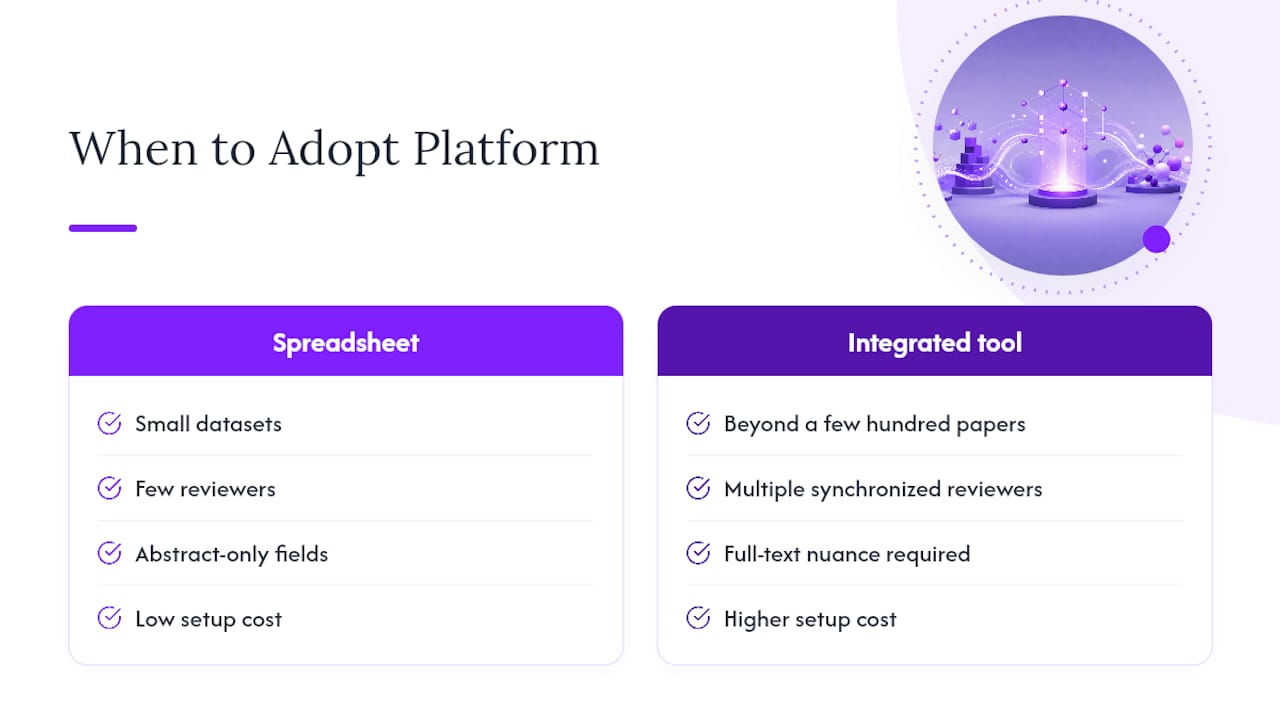
If your team is small and your dataset modest, a spreadsheet with strict version control might suffice. Past a few hundred papers with multiple reviewers, the manual reconciliation burden usually outweighs the setup cost of an integrated tool. Speed should never replace verification on critical fields, whichever route you choose.
What the Research Actually Tells You to Prioritize
The evidence here points in one direction that a lot of review teams still resist: extraction deserves the same protocol rigor as your search strategy, and most reproducibility failures trace back to skipping the boring parts. Piloting, dual extraction on critical fields, and a documented codebook aren’t bureaucratic overhead. They’re the entire mechanism by which a review earns the word “systematic.”
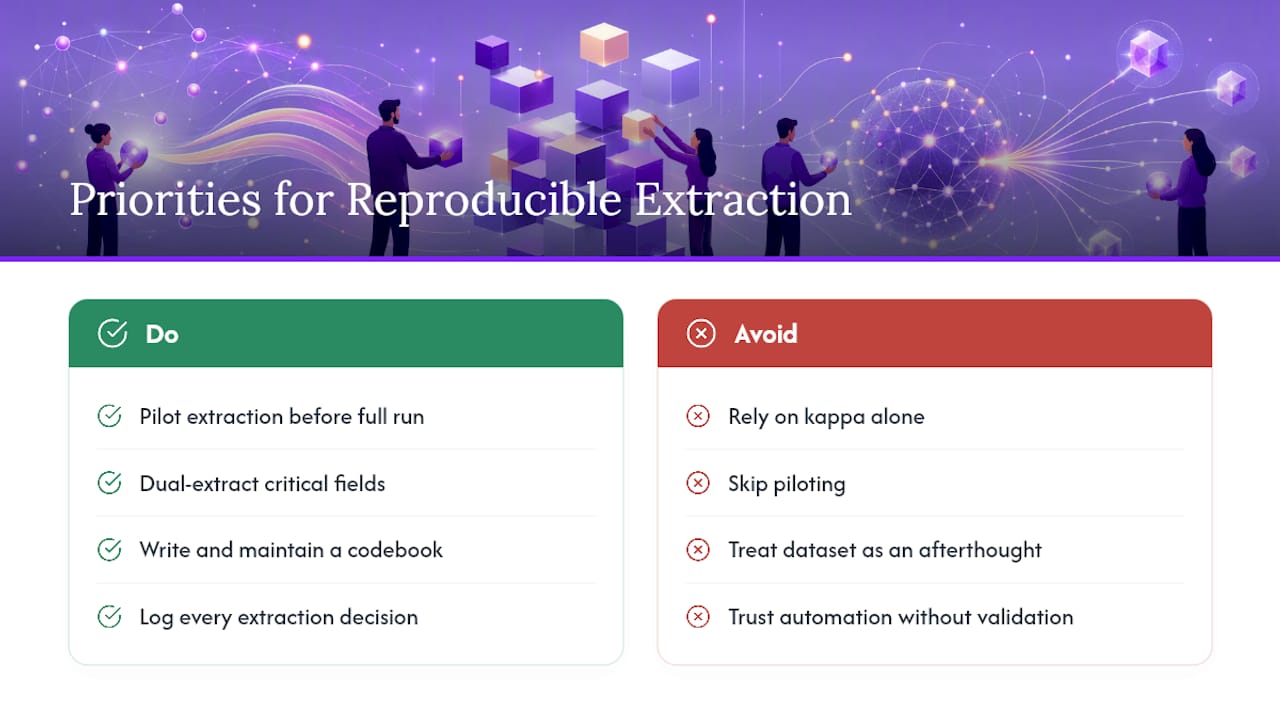
Conventional advice tends to fixate on inter-rater reliability statistics after the fact, a kappa score reported in the methods section as proof the extraction was sound. That’s backward. A high kappa score tells you two people agreed; it says nothing about whether your codebook definitions were clear enough to prevent disagreement in the first place. Fix the codebook, and the kappa score takes care of itself.
If you adopt one thing from this piece, adopt this: pilot before you extract, and log every decision as you go. Automation, including LLM-assisted extraction, is a genuine accelerant for the mechanical parts of the job. But it earns trust through validation against held-out samples, not through the promise of speed alone. The teams that get reproducibility right are the ones who treat their dataset as a publishable artifact from day one, not an afterthought they clean up before submission.
— Ubada
Try PaperSynapse for an Integrated Reproducible Workflow
PaperSynapse gives you the full extraction pipeline, import, extraction, normalization, and visualization, inside one platform, so you’re not stitching together five separate tools to keep your dataset auditable. You import references directly from Scopus or Web of Science, define custom extraction fields for your specific research domain, and let AI read abstracts to populate structured tables without needing full PDFs.

The platform normalizes labels automatically, so “myocardial infarction” and “heart attack” land in the same category instead of splintering your analysis into inconsistent buckets. Teams collaborate on the same dataset in real time, and every extracted table can be exported to enriched CSV for the version-controlled archiving your protocol requires. The platform can process large numbers of papers quickly, which can be significantly faster than manually reading abstracts one by one.
Plans scale with your review’s size: details and current prices are available on the pricing page at papersynapse.com. Start on the free tier at Papersynapse and see how your next pilot batch extracts before committing to a paid plan.
Sources
- Data management in literature reviews: The C5-DM Framework
- Cochrane Handbook — chapter on data extraction
- Data extraction and comparison for complex systematic reviews: a step-by-step guideline
FAQ
What Is Reproducible Data Extraction in a Systematic Review?
It means capturing study data in a consistent, auditable, machine-readable form so another reviewer could retrace every decision. That requires a piloted codebook, independent extraction on critical fields, and version-controlled outputs, as outlined in the Cochrane Handbook.
How Many Studies Should You Pilot Your Extraction Form On?
Most methodological guidance recommends piloting on 3 to 5 included studies before full extraction begins. This surfaces ambiguous codebook definitions early, when fixing them is cheap.
Does Dual Extraction Really Reduce Errors?
Yes. Methodological reviews have found single-extractor error rates as high as 50% in some studies, while independent dual extraction on critical fields catches far more of these before they reach your analysis.
Can LLMs Be Trusted for Systematic Review Data Extraction?
LLMs speed up extraction but a living review found they can reduce reproducibility for quantitative outputs specifically. Validate any AI-assisted extraction against a held-out manually extracted sample, and log the model version and prompt for every run.
What Does PaperSynapse Cost for a Systematic Review Team?
PaperSynapse offers a Free plan at $0 per month, a Pro plan at $10 per month, and an Ultra plan at $25 per month, scaled by paper volume. Details and sign-up are available at Papersynapse.