Reproducible Literature Review Methodology: 2026 Guide
Reproducible Literature Review Methodology: 2026 Guide

A reproducible literature review methodology is a protocol-driven, transparent, and bias-minimized systematic process that documents every decision from the initial search through to the final synthesis, so another researcher can replicate your findings independently. The PRISMA-P 2015 statement defines the minimum requirements: a detailed protocol specifying goals, search strategy, study selection criteria, data extraction procedures, and a synthesis plan, all recorded before the review begins.
The core elements that separate a reproducible review from a one-off literature summary:
- Detailed protocol: Written before data collection, covering objectives, eligibility criteria, and analysis plans
- Comprehensive search strategy: Multiple databases, explicit search strings, and documented filters
- Explicit inclusion and exclusion criteria: Applied consistently across all screened records
- Dual independent screening and extraction: Two reviewers working separately, with a third resolving conflicts
- Pre-specified synthesis plan: Whether meta-analytic or narrative, the approach is decided in advance
- Full audit trail: Every decision logged so external reviewers can trace and verify each step
Three institutions have shaped how researchers operationalize these principles. The Cochrane Collaboration set the gold standard for health-related systematic reviews, publishing detailed methods guidance that most other disciplines have adapted. The Centre for Reviews and Dissemination (CRD) at the University of York provides its own systematic review guidance, covering everything from protocol development to synthesis. The C5-DM Framework structures the data management lifecycle across five stages: conceptualization, collection, curation, control, and consumption, addressing data quality and transparency challenges that have become especially relevant as AI tools enter the workflow.
Table of Contents
- What types of literature reviews actually support reproducibility?
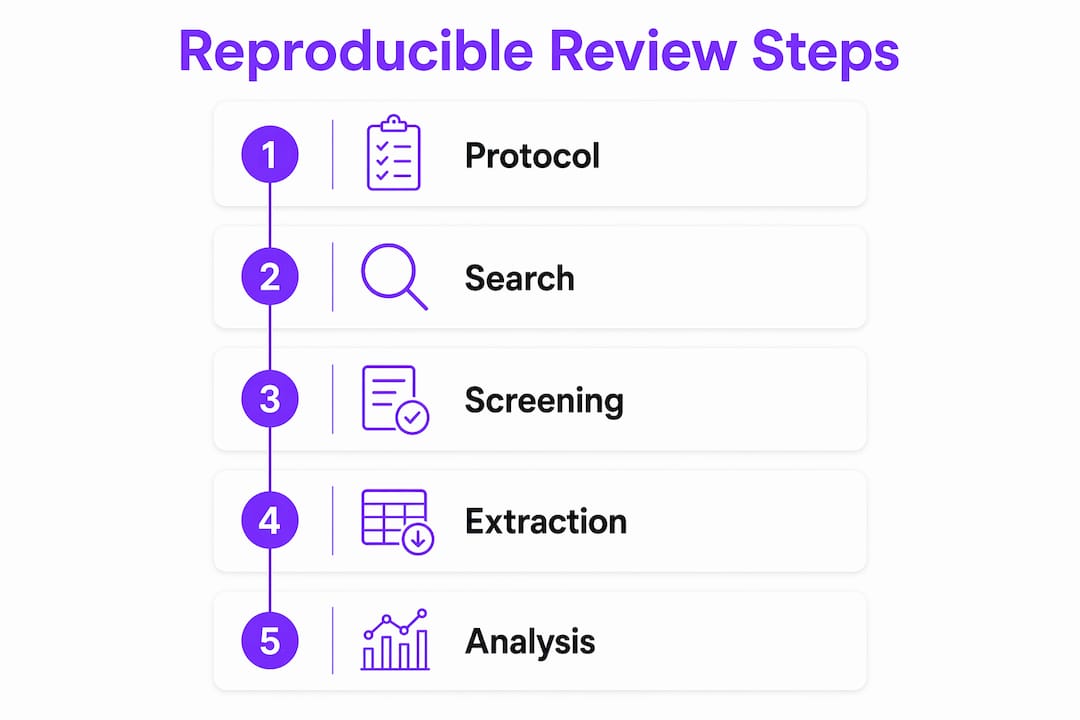
- How to conduct a reproducible literature review, step by step
- Which standards and frameworks actually underpin rigorous reviews?
- How AI tools can strengthen reproducibility without undermining it
- Reporting standards and checklists that make reviews verifiable
- Data management and sharing practices that make replication possible
- Common pitfalls in reproducible reviews and how to avoid them
- Case studies that show reproducible methodology in practice
- Papersynapse cuts the extraction bottleneck without cutting corners
- Key Takeaways
What types of literature reviews actually support reproducibility?
Not every review type is built for replication. The choice of review type shapes how much methodological rigor is possible, and researchers often pick the wrong one for their question.
Types of literature reviews:
- Systematic review: The most reproducible type. Pre-specified protocol, exhaustive search, dual screening, and formal synthesis. Designed explicitly to minimize bias.
- Scoping review: Highly reproducible when conducted with a registered protocol. Maps the breadth of a field rather than answering a specific effectiveness question.
- Integrative review: Combines experimental and non-experimental studies. Reproducibility depends on how rigorously the search and selection criteria are documented.
- Narrative review: Flexible and useful for synthesizing complex topics, but selection of studies is rarely systematic, making replication difficult.
- Rapid review: Applies systematic methods under time constraints, often with a single screener or narrower search. Reproducibility is compromised by design.
- Critical review: Evaluates and synthesizes literature with a critical lens. Transparency varies widely; rarely pre-registered.
| Review Type | Transparency | Reproducibility | Primary Purpose |
|---|---|---|---|
| Systematic | High | High | Answer a specific clinical or research question |
| Scoping | High | High | Map evidence breadth and identify gaps |
| Integrative | Moderate | Moderate | Synthesize diverse study designs |
| Narrative | Low–Moderate | Low | Provide expert overview of a topic |
| Rapid | Moderate | Moderate–Low | Inform time-sensitive decisions |
| Critical | Variable | Low | Evaluate and critique existing literature |
Systematic and scoping reviews earn their reproducibility reputation because they require a registered protocol before any searching begins. A narrative review written by a domain expert can be enormously valuable, but a second researcher following the same process would likely arrive at a different set of included studies. That gap is exactly what systematic review methodology is designed to close.

How to conduct a reproducible literature review, step by step
The sequence matters as much as the individual steps. Skipping protocol registration, for instance, opens the door to outcome-reporting bias even when every other step is executed perfectly.
The core steps:
- Define the research question using a structured framework like PICO (Population, Intervention, Comparator, Outcome) or SPIDER for qualitative questions. A precise question determines every downstream decision.
- Develop and register the protocol on PROSPERO (for health reviews) or OSF Registries before searching begins. Protocol pre-registration prevents post-hoc changes to eligibility criteria.
- Build the search strategy with a librarian. The strategy should cover multiple databases (PubMed, Embase, Scopus, Web of Science, CINAHL as appropriate), use controlled vocabulary terms alongside free-text synonyms, and document every filter applied.
- Run and document searches in each database, recording the date, platform version, and exact string used. Export all results to a reference manager such as Zotero, EndNote, or Covidence.
- Deduplicate records systematically before screening begins. Manual deduplication is error-prone; tools with cross-database deduplication logic reduce missed duplicates.
- Screen titles and abstracts independently with two reviewers. Disagreements go to a third reviewer or are resolved by consensus, as Cochrane guidelines require for bias minimization.
- Screen full texts against pre-specified eligibility criteria, documenting the reason for each exclusion.
- Extract data using a standardized form, again with two independent reviewers. The form should capture study design, population, intervention, outcomes, and risk-of-bias indicators.
- Assess risk of bias using validated tools: RoB 2 for randomized trials, ROBINS-I for non-randomized studies, or CASP checklists for qualitative work.
- Synthesize findings using the pre-specified approach: meta-analysis when data permit, narrative synthesis otherwise, with explicit heterogeneity assessment.
- Report according to PRISMA or the relevant reporting guideline, including a flow diagram and completed checklist.
| Step | Key Checkpoint | Documentation Required |
|---|---|---|
| Protocol development | Registered before search | PROSPERO/OSF registration number |
| Search execution | All databases searched | Date, platform, full search string |
| Deduplication | Duplicates removed before screening | Record count before and after |
| Title/abstract screening | Two independent reviewers | Inter-rater reliability statistic (e.g., Cohen’s kappa) |
| Full-text screening | Exclusion reasons logged | PRISMA exclusion table |
| Data extraction | Dual extraction completed | Completed extraction form per study |
| Risk of bias | Validated tool applied | Per-study ratings with justification |
| Synthesis | Pre-specified method used | Analysis code or narrative synthesis notes |
Systematic review steps from the Ohio State University Health Sciences Library confirm that involving a librarian at the search strategy stage is not optional for a review that will withstand peer scrutiny. Their expertise in controlled vocabulary, database-specific syntax, and filter construction is what separates a search that captures 95% of relevant literature from one that misses a third of it.
Which standards and frameworks actually underpin rigorous reviews?
Standards are not bureaucratic overhead. They are the shared language that lets a reviewer in Tokyo verify a protocol written in Toronto.
Core standards and frameworks:
- Cochrane MECIR (Methodological Expectations of Cochrane Intervention Reviews): The most detailed set of conduct and reporting standards available, covering 82 mandatory and 16 highly desirable standards for systematic reviews
- CRD guidance: The Centre for Reviews and Dissemination’s handbook covers systematic reviews, economic evaluations, and diagnostic test accuracy reviews, with specific chapters on search strategy construction
- PRISMA 2020: The updated Preferred Reporting Items for Systematic Reviews and Meta-Analyses checklist, with 27 items covering every section of a review report
- PRISMA-P: The protocol-specific extension, ensuring pre-registered plans are complete enough to be auditable
- ROSES (Reporting Standards for Systematic Evidence Syntheses): Developed for environmental and conservation science, where Cochrane-derived standards do not always fit
- C5-DM Framework: Structures data management across the full review lifecycle, with explicit attention to AI content verification, as described in 2026 research
- GRADE (Grading of Recommendations Assessment, Development and Evaluation): Rates the certainty of evidence across outcomes, adding a layer of interpretive transparency beyond study-level risk of bias
The role of librarians and subject-matter experts in this framework ecosystem deserves more attention than it typically gets. A librarian who specializes in systematic reviews does not just run database searches. They translate a clinical or research question into Boolean logic, identify grey literature sources, and document the search in a way that satisfies peer reviewers. Subject experts, meanwhile, validate that the inclusion criteria actually capture the relevant literature in their field, catching gaps that a methodologist without domain knowledge would miss.
Pro Tip: When selecting a reporting standard, match it to your discipline and review type before you write the protocol. Using PRISMA for a scoping review requires the PRISMA-ScR extension, not the core checklist. Using the wrong checklist creates gaps that reviewers will flag at submission.
How AI tools can strengthen reproducibility without undermining it
AI does not replace the methodological structure of a systematic review. What it does is compress the time spent on the most labor-intensive steps, particularly abstract screening and data extraction, while introducing new risks that require explicit mitigation.
A hybrid framework for AI-augmented systematic literature reviews published in 2026 identifies five foundational principles for keeping AI integration methodologically sound: transparency, validity, reliability, comprehensiveness, and reflective agency. The last one matters most in practice. Reflective agency means the research team actively monitors AI outputs rather than treating them as ground truth.
AI introduces risks of hallucination and bias that require human-in-the-loop validation cycles and independent verification of AI-extracted data by multiple reviewers. Inter-model comparisons and iterative validation improve reliability.
How to integrate AI tools while preserving reproducibility:
- Use AI for title and abstract pre-screening only. Flag records as likely relevant or likely irrelevant, then have human reviewers confirm every inclusion decision.
- Run parallel human extraction on a random sample (typically 10–20%) to calculate agreement rates and catch systematic extraction errors.
- Document every AI tool used: name, version, prompt text, and date of use. This is part of the audit trail.
- Apply iterative validation cycles. Do not accept a single AI pass. Run the extraction, check a sample, refine the prompt, and re-run if agreement is below an acceptable threshold.
- Store AI outputs separately from final extraction data so the human-verified layer is clearly distinguished.
Papersynapse is built around this workflow. Researchers import references directly from Scopus or Web of Science, and the platform uses AI to read abstracts and populate structured extraction tables, processing a large set of papers rapidly. The extraction output is structured for human review, not delivered as a finished product, which keeps the human-in-the-loop requirement intact. For teams managing large corpora where manual extraction would take weeks, that speed difference is the practical argument for literature review automation.
Manual deduplication is one of the most underappreciated failure points in reproducibility. Cross-database deduplication tools that use containerized, isolated environments create an audit trail that manual processes cannot match, as demonstrated by open-source workbenches like ReviQ.
Reporting standards and checklists that make reviews verifiable
A completed PRISMA flow diagram is not the finish line. It is the minimum. Reviewers and editors increasingly expect the full replication package, and the reporting standards have evolved to reflect that.
PRISMA 2020 is the baseline for intervention reviews. Its 27-item checklist covers the abstract, introduction, methods, results, and discussion, with specific items for search strategy documentation, study selection, and synthesis methods. The PRISMA flow diagram tracks records from initial identification through final inclusion, making the attrition at each stage visible.
PRISMA extensions cover specialized review types: PRISMA-ScR for scoping reviews, PRISMA-DTA for diagnostic test accuracy, PRISMA-IPD for individual patient data meta-analyses, and PRISMA-NMA for network meta-analyses. Using the wrong extension, or ignoring extensions entirely, is one of the most common reasons systematic review manuscripts are returned at peer review.
ROSES was developed specifically for environmental and conservation evidence synthesis, where the population-intervention-comparator-outcome framework does not always translate cleanly. It covers 45 items across the search, screening, and synthesis stages, with explicit attention to grey literature and non-English sources.
AMSTAR 2 (A Measurement Tool to Assess Systematic Reviews) is worth knowing even if you are the author rather than the appraiser. It is the tool other researchers will use to evaluate your review’s methodological quality, and its 16 domains map almost exactly onto the decisions you make during protocol development.
True reproducibility, as open science guidance makes clear, requires sharing the entire research pipeline: search strings, raw extraction data, risk-of-bias assessments, and analysis code, not just summary tables. A completed PRISMA checklist with no underlying data is transparent about what you did but does not enable replication.
Data management and sharing practices that make replication possible
Sharing a PRISMA flow diagram is not the same as sharing your data. The distinction matters because a reviewer reading your published paper cannot verify your extraction decisions without access to the underlying files.
Open data repositories are the practical solution. OSF (Open Science Framework) is the most widely used platform for pre-registering protocols and depositing review data. Zenodo, maintained by CERN, accepts datasets of any size and assigns a DOI. Figshare works similarly and integrates with several journal submission systems.
What belongs in a replication package for a systematic review:
- Full search strings for every database searched, including date and platform version
- Raw export files from each database before deduplication
- Screening decisions at title/abstract and full-text stages, with exclusion reasons
- Completed data extraction forms for every included study
- Risk-of-bias assessments with item-level ratings and justifications
- Analysis code or synthesis notes depending on whether meta-analysis or narrative synthesis was used
- PRISMA checklist with page numbers indicating where each item is addressed
Reference managers play a structural role here. Zotero and EndNote both support group libraries that can be shared with collaborators and, eventually, deposited as part of the replication package. Covidence, a web-based screening and extraction platform, exports decisions in formats that are directly depositable.
Data management planning should happen at the protocol stage, not after the review is complete. Many funders, including NIH and NSF, now require a data management plan as part of grant applications. Specifying where data will be stored, in what format, and for how long is a protocol-level decision, not an afterthought.
Common pitfalls in reproducible reviews and how to avoid them
Most reproducibility failures are not the result of fraud. They are the result of decisions made under time pressure that were never documented.
Changing eligibility criteria mid-review is the most damaging. If a team realizes halfway through screening that their original PICO was too narrow, the temptation is to quietly expand it. The reproducible approach is to document the change, amend the registered protocol, and note the amendment in the final report.
Single-reviewer screening is a shortcut that undermines the entire audit trail. When one person makes all inclusion decisions, there is no way to assess whether those decisions were consistent or biased. Even in rapid reviews where resources are constrained, a second reviewer should cover at least a random sample of records.
Incomplete search documentation is surprisingly common. A search string reconstructed from memory six months after the fact is not reproducible. Every search should be exported and saved on the day it is run, with the exact string, database, date, and number of results.
Neglecting grey literature introduces publication bias. Registered trials, conference abstracts, government reports, and dissertations often contain findings that never reach peer-reviewed journals, particularly null results. Searching only PubMed and Scopus misses a meaningful portion of the evidence base.
Over-relying on AI outputs without validation is an emerging failure mode. AI tools can extract data at scale, but they hallucinate, misattribute, and miss context-dependent information. A team that accepts AI extraction without human verification has not conducted a reproducible review. They have conducted a fast one.
Pro Tip: Register your protocol on PROSPERO or OSF before running a single database search. The registration timestamp is the only proof that your eligibility criteria, outcomes, and analysis plan were pre-specified rather than chosen after seeing the data.
Case studies that show reproducible methodology in practice
Abstract principles land differently when you can see them applied to a real review.
Cochrane Review on hand hygiene interventions: One of the most cited examples of full methodological transparency. The review team registered a protocol on PROSPERO, searched 12 databases with a librarian-developed strategy, conducted dual independent screening with Cohen’s kappa reported at each stage, and deposited all extraction data on OSF. The published report includes the complete search strings in an appendix, allowing any researcher to re-run the search and verify the yield.
Environmental systematic reviews using ROSES: Conservation evidence synthesis teams at Collaboration for Environmental Evidence have used ROSES reporting standards to document reviews of biodiversity interventions. Because the evidence base includes grey literature, field reports, and non-English studies, the search documentation is especially detailed. These reviews demonstrate that reproducibility is achievable outside the health sciences, even when the evidence base is messier.
AI-augmented review with hybrid validation: A 2026 management review published in Management Review Quarterly applied the hybrid AI-augmented framework, using large language models for initial abstract classification while retaining dual human extraction for all included studies. The team documented prompt versions, model names, and agreement rates between AI pre-screening and human decisions, creating an audit trail that covered both the human and computational layers of the workflow. This approach, described in the hybrid framework research, is becoming a template for AI-assisted reviews that still meet reproducibility standards.
Graduate student scoping review with OSF pre-registration: A doctoral candidate at a U.S. research university pre-registered a scoping review protocol on OSF, used Zotero for reference management, conducted dual screening with a faculty advisor, and deposited the full extraction dataset before submission. The journal accepted the manuscript without major revisions, citing the completeness of the methods section. The pre-registration timestamp was the deciding factor when a reviewer questioned whether the scope had been expanded post-hoc.
These examples share a common thread: the teams that produced reproducible reviews made documentation decisions at the start, not the end. The audit trail is built during the review, not reconstructed after it.
Papersynapse cuts the extraction bottleneck without cutting corners
Manual data extraction is where most reproducible reviews lose time and consistency. Two reviewers working independently through hundreds of PDFs, reconciling disagreements in spreadsheets, and normalizing terminology across studies can consume weeks of a research team’s capacity. That bottleneck is where Papersynapse fits.

Papersynapse connects directly to Scopus and Web of Science, imports your reference set, and uses AI to read abstracts and populate structured extraction tables. The platform claims to process up to 200 papers in under two minutes, with outputs organized for human review rather than delivered as final decisions. That distinction matters: the AI handles the first pass, and your team verifies, which keeps the dual-reviewer requirement intact while eliminating the manual transcription work that introduces inconsistency.
The workflow integrates extraction, normalization, and analysis in one place, so the structured data your team reviews is already in a format ready for synthesis and export. For graduate students managing a dissertation-level review, or research teams running multi-database searches across hundreds of records, that compression in the extraction phase is the difference between a six-month timeline and a manageable one.
Start your first automated extraction and see how much of the manual work Papersynapse can absorb while keeping your methodology fully auditable.
Key Takeaways
A reproducible literature review methodology requires a pre-registered protocol, dual independent screening, complete search documentation, and a full replication package deposited in an open repository before the review can be considered truly transparent.
| Point | Details |
|---|---|
| Pre-register before searching | Register your protocol on PROSPERO or OSF before running any database search to prove pre-specification. |
| Dual screening is non-negotiable | Two independent reviewers at every screening and extraction stage, with a third resolving conflicts, is the Cochrane-standard minimum. |
| Document the full pipeline | Share search strings, raw exports, extraction forms, and analysis code, not just summary tables, for genuine replication. |
| Match standards to review type | Use PRISMA-ScR for scoping reviews, ROSES for environmental synthesis, and AMSTAR 2 to anticipate how others will appraise your work. |
| Papersynapse accelerates extraction | Papersynapse automates abstract reading and structured table population, processing a large set of papers rapidly while preserving human verification. |