Research Cataloging Best Practices for Faculty: AI-Assisted SLRs
Research Cataloging Best Practices for Faculty: AI-Assisted SLRs
The most effective research cataloging best practices faculty can apply to systematic literature reviews combine standardized metadata schemas, persistent identifiers (DOI, ORCID), controlled vocabularies (MeSH or LCSH), documented provenance, and mandatory human review at every AI extraction stage.
Quick-reference checklist for faculty leading SLRs:
- Standardize a metadata schema before ingesting a single record (required fields: title, authors + ORCID, abstract, DOI, publication date, study design, key outcomes, funding/conflicts, keywords, affiliations)
- Assign persistent identifiers to every record; use DOI as the primary deduplication key
- Map subject terms to an established controlled vocabulary (MeSH for health sciences, LCSH for humanities/social sciences)
- Treat every AI-extracted field as a draft; require human sign-off before records enter the final dataset
- Log source, extraction date, reviewer initials, and license status in a provenance field for every record
- Measure throughput before and after automation so you can report ROI to your department or IRB
AI-assisted workflows have reduced manual cataloging and metadata processing time by roughly 30–60% in library settings, enabling teams to process previously unmanageable backlogs; platforms like Papersynapse report processing up to 200 papers in under two minutes — improvements that change what a two-person research team can realistically accomplish in a semester.
Table of Contents
- What are the core cataloging principles for systematic literature reviews?
- Which metadata fields does every SLR team need to capture?
- What metadata standards and controlled vocabularies should faculty adopt?
- How should faculty design an AI-assisted cataloging workflow?
- How do you maintain quality control with human-in-the-loop review?
- What U.S. legal and ethical rules govern automated text-and-data mining?
- Which export formats and integrations should faculty use?
- How do you measure time savings and ROI from AI-assisted cataloging?
- What does a practical implementation checklist look like?
- How does Papersynapse fit into an end-to-end SLR workflow?
- Key Takeaways
- The part most faculty get wrong about AI cataloging
- Papersynapse cuts extraction time without sacrificing rigor
- Useful sources for implementation and governance
What are the core cataloging principles for systematic literature reviews?
Cataloging exists to serve three goals that Charles Cutter articulated in 1876 and that remain the right rubric for evaluating AI-generated metadata today: enable a researcher to find a known item, discover all holdings on a topic, and choose intelligently among similar items. Each maps directly to SLR needs.
Finding maps to reproducible search sets: if your metadata schema is inconsistent, a re-run of the same query six months later returns different results. Discovery maps to subject tagging precision: loose or inconsistent subject headings cause relevant papers to fall outside your inclusion criteria. Selection maps to the abstract, methods, and outcomes fields that let a screener decide in 30 seconds whether a paper belongs in the review.
Governance principles that hold this together: use controlled vocabularies consistently, document every local cataloging decision in a written policy, and assign a named human accountable for final record acceptance. University library guides recommend continuous record review cycles and linked data for discovery — both practices transfer directly to SLR catalog management.
Which metadata fields does every SLR team need to capture?
Start with the required fields. Everything else is negotiable; these are not.
| Field | Recommended format | Why it matters for SLRs |
|---|---|---|
| Title | Plain text, full title | Primary search and deduplication key |
| Authors + ORCID | Normalized surname, given name; ORCID iD | Authority control; prevents duplicate author records |
| Abstract | Full text | Enables AI screening and human eligibility decisions |
| DOI | Persistent URI | Deduplication; stable citation link |
| Publication date | ISO date format (YYYY-MM-DD) | Date-range filtering; temporal analysis |
| Study design / methods | Controlled term + free text | Risk-of-bias coding; inclusion/exclusion criteria |
| Key outcomes / results | Structured summary | Data extraction for meta-analysis |
| Funding / conflicts | Free text + flag field | Bias assessment |
| Keywords | Author keywords + assigned vocabulary terms | Subject clustering |
| Affiliations | Normalized institution name + ROR identifier | Geographic and institutional analysis |
For multilingual records, add a language-detection flag and a translation-status field so reviewers know whether the abstract was machine-translated. Normalized author name strings combined with ORCID iDs are the single most reliable way to collapse variant spellings into one authority record.
Pro Tip: Run a deduplication pass using DOI as the primary key and ORCID + normalized author name as secondary keys before any human screening begins. Catching duplicates at ingest saves hours of reconciliation later.
What metadata standards and controlled vocabularies should faculty adopt?
The short answer: Dublin Core for lightweight, portable exports; RDA/MARC for institutional catalog ingest; MeSH for health and life sciences; LCSH for humanities and social sciences. Use ORCID for author authority and ISSN for journal authority.
- Dublin Core covers the 15 core elements (title, creator, subject, description, date, identifier, etc.) and exports cleanly to most repository systems
- RDA (Resource Description and Access) replaced AACR2 as the descriptive standard for institutional catalogs; the Library of Congress completed its transition to RDA in 2013
- MeSH (Medical Subject Headings) is the controlled vocabulary for PubMed and most health-sciences SLRs; its hierarchical structure supports both broad and narrow searches
- LCSH (Library of Congress Subject Headings) covers humanities, social sciences, and interdisciplinary fields
- ORCID and DOI serve as persistent identifiers for people and documents respectively; the ENRESSH manual of good practices recommends maintaining dynamic authority lists with persistent identifiers and documenting provenance throughout
When your SLR spans a specialized subfield, discipline-specific task forces often publish optional-field recommendations that supplement national standards. A local topical taxonomy is worth building when no established vocabulary covers your domain precisely — but document it, version it, and review it at least annually as the field evolves.
How should faculty design an AI-assisted cataloging workflow?
The one-line summary: ingest from a named database, extract with AI, normalize against authority files, validate with a human reviewer, then export in the format your downstream tool requires.
- Ingest — Import records from Scopus, Web of Science, PubMed, or your institutional repository in RIS or BibTeX format. Run automated deduplication on DOI before anything else.
- Extraction — Use AI to parse titles, abstracts, and targeted sections (methods, results, funding). Capture DOI and ORCID automatically where the source record provides them. Flag records where confidence scores fall below your threshold.
- Normalization — Match author names against ORCID; match journal names against ISSN. Apply your chosen controlled vocabulary to subject fields. Set language-detection rules to flag non-English records for translation review.
- Human QA — A faculty member or librarian reviews flagged records, a random sample of accepted records, and all records in high-impact categories. Document reviewer initials and timestamp every edit.
- Export — Deliver CSV or JSON for data analysis, RIS or BibTeX for reference managers, Dublin Core or MODS for repository deposit.
Cataloging specialists report that AI is most valuable when deployed incrementally against high-friction tasks — repetitive entry and unfamiliar-language records — and when outputs are treated as drafts for librarian validation. Understanding how AI processes and scores extraction requests helps teams set realistic confidence thresholds before going live.
Pro Tip: Deploy on a pilot batch of 50–100 records first. Measure your error rate on that batch, set your confidence threshold accordingly, and only then scale to the full corpus.

How do you maintain quality control with human-in-the-loop review?
The governing rule: never promote an AI-extracted record to “accepted” status without at least one human review step. AI accelerates repetitive work and provides a strong starting point, but subject headings and complex fields require expert validation.
Sampling strategies that work in practice:
- Random sample review — Review a fixed percentage of every batch (10% is a common starting point for established workflows; 25–30% for new deployments)
- Stratified by confidence score — Pull all records below your confidence threshold for mandatory review, regardless of batch size
- Priority review for high-impact items — Any record that will anchor a meta-analysis or inform a clinical recommendation gets full human review, no exceptions
Acceptance criteria for a reviewed record: all required fields populated, DOI resolves, author names match authority file, subject terms drawn from the designated controlled vocabulary, and provenance fields complete (source database, extraction date, reviewer initials, version number).
Trust signals to embed in every record: provenance fields, timestamped edits, reviewer initials, and a version counter. Peer-reviewed extraction practices consistently show that these audit-trail elements are what make AI-assisted catalogs defensible to journal editors and IRBs.
What U.S. legal and ethical rules govern automated text-and-data mining?
Confirm permissions before running large-scale automated extraction. This is not optional.
- Publisher license terms — Most major publishers (Elsevier, Springer, Wiley) include text-and-data mining clauses in their institutional license agreements. Your library’s e-resources team holds these agreements; check before you build an extraction pipeline.
- Fair use — Non-consumptive text mining (extracting metadata and statistical patterns without reproducing full text) has stronger fair use arguments under U.S. copyright law, but “stronger” is not “guaranteed.” Consult your institution’s legal office for your specific use case.
- Embargo periods — Some databases restrict automated access to records within a rolling embargo window. Log the embargo status in your catalog.
- Institutional repository policies — If you plan to deposit extracted metadata in your IR, confirm the repository’s ingestion and re-use policies.
Log source license metadata in every catalog record and maintain an audit trail of TDM approvals. That documentation protects your team if a publisher queries your extraction activity.
Which export formats and integrations should faculty use?
Match the format to the downstream task:
- CSV / JSON for data analysis, meta-analysis spreadsheets, and reproducible SLR datasets
- RIS / BibTeX for import into reference managers (Zotero, Mendeley, EndNote) and SLR screening tools
- Dublin Core / MODS for institutional repository deposit and linked-data discovery
- API access for live integrations between your extraction platform and your analysis environment
For a narrative SLR, RIS export into a reference manager is usually sufficient. For a quantitative meta-analysis, JSON with a documented schema gives you the structured fields you need for statistical software. For repository deposit, Dublin Core is the lowest-friction option across most U.S. institutional systems. The role of AI in organizing references covers practical integration patterns for common reference manager workflows.
How do you measure time savings and ROI from AI-assisted cataloging?
Run a baseline batch first. Measure items per hour, field-level error rate, and time-to-screen on 50–100 records processed manually. Then run the same batch through your AI workflow and compare.
| Metric | How to measure | Benchmark |
|---|---|---|
| Throughput (papers/hour) | Records processed ÷ staff hours | 2–4× increase feasible with AI assistance |
| Field error rate | Manual spot-check of required fields | Target < 5% after human QA |
| Time saved per reviewer | Pre/post hours logged per 100 records | 30–60% reduction reported in library studies |
| Cost per item | Total staff cost ÷ records processed | Compare manual vs. AI-assisted runs |
One LLM-based cataloging evaluation reported speeds roughly 183× faster than manual cataloging in a limited lab test — a figure worth noting, but not a number to put in a grant proposal without your own local baseline. Vendor claims and lab results rarely survive contact with a real institutional corpus. Measure your own. The literature review automation benefits guide offers a practical framework for translating throughput gains into staffing and budget arguments.
What does a practical implementation checklist look like?
Before you begin extraction:
- [ ] Written metadata schema approved by PI and librarian
- [ ] Controlled vocabulary selected and documented
- [ ] Source databases identified; license/TDM permissions confirmed
- [ ] Deduplication rules defined (primary key: DOI; secondary: ORCID + normalized name)
- [ ] QA sampling plan documented (sample %, confidence threshold, reviewer roles)
- [ ] Export formats specified for each downstream use
- [ ] Provenance fields defined in the schema
Responsibility matrix:
| Task | PI | Librarian | Data manager | RA |
|---|---|---|---|---|
| Schema design | Approves | Leads | Advises | — |
| Source selection | Decides | Advises | — | — |
| Ingest / deduplication | — | Reviews | Runs | Assists |
| AI extraction | — | Validates | Configures | — |
| Human QA | Spot-checks | Leads | — | Reviews sample |
| Export / deposit | — | Approves | Executes | — |
Quick wins for sprint one: get DOI and ORCID capture working automatically, run automated deduplication before any human screening, and authority-match author names against ORCID on ingest.
Pro Tip: Involve your subject librarian from day one, not after the schema is built. Librarians know which authority files your institution already maintains and can save you weeks of redundant work.
How does Papersynapse fit into an end-to-end SLR workflow?
The tool categories you need at each stage: database connectors (ingest), LLM extractors (extraction), authority matchers (normalization), review dashboards (human QA), and format exporters (output). Papersynapse covers all five within a single platform.
A representative workflow using Papersynapse:
| Workflow stage | Papersynapse capability | Output artifact |
|---|---|---|
| Ingest | Import from Scopus or Web of Science | Deduplicated record set |
| AI extraction | Abstract parsing; methods/results targeting | Structured metadata table |
| Normalization | Authority matching; controlled vocabulary mapping | Normalized, tagged records |
| Human validation | Reviewer dashboard; confidence-score flagging | Accepted record set with audit trail |
| Export | RIS, BibTeX, CSV, JSON | Analysis-ready dataset |
The platform’s AI-assisted SLR workflow processes up to 200 papers in under two minutes, which means a faculty team can screen a 500-paper corpus in a single afternoon rather than across several weeks.
That shift in scale changes what questions you can realistically ask in a semester-long project.
Key Takeaways
Consistent metadata schemas, persistent identifiers, and mandatory human review are the three non-negotiable pillars of defensible AI-assisted SLR cataloging.
| Point | Details |
|---|---|
| Standardize before you ingest | Define your metadata schema and controlled vocabulary before importing a single record. |
| Use persistent identifiers | DOI as deduplication key and ORCID for author authority prevent the most common catalog errors. |
| Human review is non-negotiable | Treat every AI output as a draft; require reviewer sign-off and timestamped provenance on all accepted records. |
| Measure your own ROI | Run a 50–100 record baseline batch; AI workflows have shown 30–60% time reductions, but local measurement is what convinces administrators. |
| Papersynapse for end-to-end SLRs | Papersynapse covers ingest through export in one platform, processing up to 200 papers in under two minutes. |
The part most faculty get wrong about AI cataloging
AI scales cataloging, but it shifts the work rather than eliminating it. The effort moves from data entry to validation and governance — and that shift catches most research teams off guard.
Three pitfalls show up repeatedly. First, teams overtrust low-confidence outputs. An AI extractor that is 92% accurate on English-language abstracts may drop to 70% on German or Chinese records, and that gap is invisible unless you stratify your QA by language. Second, teams skip authority matching because it feels like extra work. It is not extra work — it is the work. A catalog where “Smith, J.” appears as three separate author records is not a catalog; it is a liability. Third, teams treat provenance as optional. When a journal reviewer asks how you identified your corpus, “we used an AI tool” is not an answer. “We imported from Web of Science on March 14, 2026, applied MeSH terms X and Y, and two reviewers validated a 20% random sample” is.
The practical fix for all three: run a small pilot with your subject librarian before committing to a full extraction run. Fifty papers is enough to surface your platform’s weak spots, calibrate your confidence threshold, and build the governance documentation your IRB will eventually ask for.
Papersynapse cuts extraction time without sacrificing rigor
Faculty running systematic literature reviews face a specific bottleneck: manual extraction is slow, inconsistent, and hard to audit. Papersynapse addresses that directly. Import your references from Scopus or Web of Science, let the AI fill structured extraction tables from abstracts and full-text sections, then review flagged records in the built-in validation dashboard before exporting to RIS, BibTeX, CSV, or JSON.
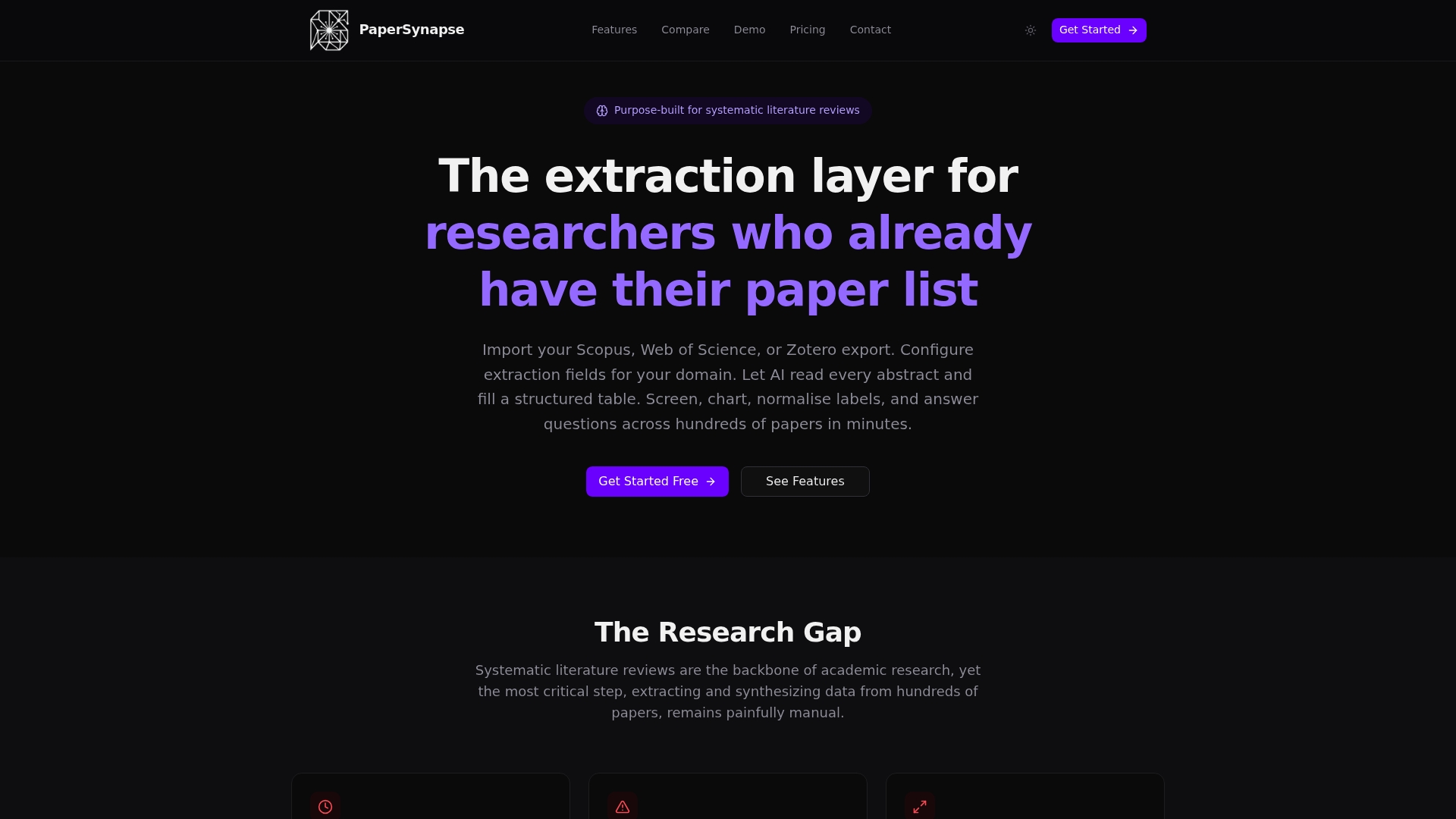
Two things faculty consistently care about: how fast extraction runs (up to 200 papers in under two minutes) and whether the output is audit-ready (every record carries extraction timestamps, confidence scores, and reviewer fields). Both are built into the core workflow, not bolted on as add-ons. If your next SLR involves more than 100 papers, the time case for automation is straightforward. Start your first extraction on Papersynapse and run it against a batch you have already screened manually — the comparison will tell you everything you need to know.
Useful sources for implementation and governance
Consult these documents when building your schema, governance policy, or ROI case. They are organized by primary audience.
For research teams and PIs:
- Clarivate: AI cuts library workflow time by 30–60% — Throughput benchmarks and case observations on incremental AI deployment; use for ROI arguments and QA design
- Infonomy: LLM-based cataloging evaluation — Lab-scale speed data (183× faster than manual); useful context, but pair with local baselines
- Cataloging Research by Design (Syracuse University) — Taxonomic framework for cataloging research questions; useful for framing your SLR design decisions
For librarians and metadata specialists:
- ENRESSH Manual of Good Practices for Research Output Databases — Authoritative guidance on metadata schemas, authority lists, persistent identifiers, and provenance
- ATLA Cataloging Best Practices — Discipline-specific authority-record recommendations and optional-field guidance for specialized collections
- University Libraries Cataloging Guide — LCC adoption, RDA transition management, linked data, and continuous record review
For legal and compliance offices:
- Publisher license agreements held by your institution’s e-resources librarian (not publicly linked; request directly)
- U.S. Copyright Office fair use guidance for non-consumptive text mining (consult your institution’s legal office for your specific extraction scope)
This article provides general informational guidance on cataloging practices and AI-assisted workflows. It is not legal advice. Confirm current publisher license terms, copyright status, and institutional policies with your library’s e-resources team and your institution’s legal counsel before running large-scale automated extraction.