Research Data Categorization Explained for Academics
Research Data Categorization Explained for Academics

Research data categorization is the systematic process of labeling and organizing research data based on its characteristics, sensitivity, and intended use. Academics call this practice “data classification” in formal governance contexts, and both terms describe the same core workflow. Getting it right determines whether your data survives a project handoff, passes a GDPR audit, or gets reused five years later by a colleague. For PhD candidates running systematic literature reviews, poor categorization is the single most common cause of duplicated effort and inconsistent extraction. This article covers the main data types, standard tiered frameworks, file organization best practices, and the methods researchers use to apply categorization at scale in 2026.
What is research data categorization explained in academic terms?
Research data categorization is the practice of assigning labels to datasets so researchers can manage, protect, and analyze them consistently. The standard industry term is data classification, and it operates across two dimensions: data type and data sensitivity. Understanding both dimensions is the foundation of any solid research data management strategy.
The most common data types researchers work with fall into three paired categories:
- Qualitative vs. quantitative. Qualitative data captures meaning, experience, and context through text, audio, or images. Quantitative data captures measurable values through numbers, counts, or ratings.
- Structured vs. unstructured. Structured data fits neatly into rows and columns, like a spreadsheet of survey responses. Unstructured data does not follow a fixed format, like interview transcripts or open-ended field notes.
- Primary vs. secondary. Primary data is collected directly by the researcher for the current study. Secondary data comes from existing sources, such as published datasets, government records, or prior studies.
These categories are not mutually exclusive. A single interview transcript is simultaneously qualitative, unstructured, and primary. Categorization works best as a set of overlapping lenses rather than rigid, separate boxes. That flexibility matters when you are building extraction tables for a systematic review, because the same paper can contribute data across multiple category dimensions at once.
How these categories influence your workflow is concrete. Quantitative structured data supports statistical meta-analysis directly. Qualitative unstructured data requires thematic coding before it can be compared across studies. Secondary data demands provenance tracking to satisfy reproducibility standards. Recognizing which type you are handling at the start of a project shapes every downstream decision about storage, access, and analysis.
How do researchers classify data using tiered sensitivity frameworks?
Sensitivity classification is the second dimension of data categorization, and it governs who can access your data and under what conditions. Most organizations adopt a tiered framework with 3–5 levels. That range is not arbitrary. Simpler models get used consistently; complex ones get ignored.

A standard four-tier model looks like this:
| Tier | Label | Description | Regulatory relevance |
|---|---|---|---|
| 1 | Public | Freely shareable, no restrictions | None |
| 2 | Internal | For project team use only | General data governance |
| 3 | Confidential | Contains PII, PHI, or financial data | GDPR, HIPAA, PCI DSS |
| 4 | Restricted | Highly sensitive, legal or security risk | GDPR Article 9, HIPAA Safe Harbor |
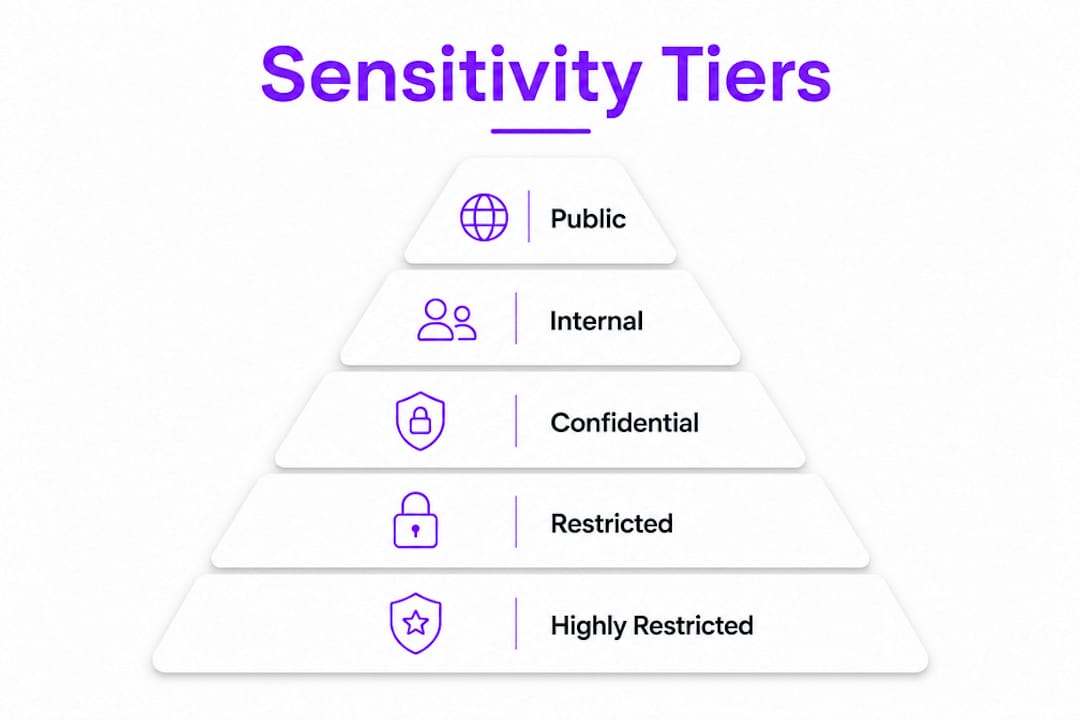
Content type tags like PII (personally identifiable information), PHI (protected health information), and PCI (payment card information) attach to tiers 3 and 4. These tags tell data stewards exactly which regulation applies and what controls are required. A survey dataset with participant names and email addresses is Confidential under GDPR. Genomic data linked to identifiable individuals is Restricted under both GDPR and HIPAA.
The practical advantage of a 3–5 tier model is daily usability. Overly complex schemes discourage consistent application. A researcher who has to choose between eight sensitivity levels will default to guessing or skipping the step entirely. Three to five tiers force a clear decision without creating decision fatigue.
Pro Tip: Label your data at the point of collection, not after the project ends. Retroactive classification is slower, less accurate, and far more likely to miss a sensitive field buried in a large dataset.
What are best practices for organizing and naming research data files?
File organization is where categorization becomes tangible. A well-named file communicates its content, version, and context without opening it. A poorly named file, like “finalfinal_v3_USE THIS.xlsx,” destroys reproducibility and wastes hours during a systematic review.
Follow these steps to build a file organization system that holds up over time:
- Limit file names to approximately 30 characters. Names exceeding 30 characters cause compatibility failures in legacy systems and reduce interoperability across platforms. Use kebab-case (project-experiment-date) or CamelCase (ProjectExperimentDate) consistently.
- Build a logical folder hierarchy. Separate raw data, processed data, analysis scripts, and outputs into distinct folders. Never overwrite raw data files.
- Create a README or PROJECT_STRUCTURE file in the root folder. This file documents your folder hierarchy, naming conventions, and abbreviation standards. It is the single most important artifact for preventing data loss during team transitions.
- Separate study-level from data-level documentation. Study-level documentation covers the overall project: aims, methods, and ethical approvals. Data-level documentation covers individual files: variable definitions, units, and collection dates. Missing either type directly impairs long-term data reuse and interpretation.
- Avoid spaces and special characters in file names. Spaces break file paths in many programming environments. Use underscores or hyphens inside file names only, never in folder names that will appear in scripts.
Pro Tip: Add a date stamp in ISO 8601 format (YYYYMMDD) to every file name that will have multiple versions. It sorts chronologically in any file browser and removes ambiguity about which version is current.
The table below shows how good and poor naming practices compare in a real research context.
| Scenario | Poor practice | Better practice |
|---|---|---|
| Survey data file | “data final FINAL.xlsx” | “survey-climate-20260315.xlsx” |
| Interview transcript | “interview transcript john.docx” | “int-P04-20260210.docx” |
| Analysis script | “script v2 use this one.R” | “analysis-regression-v2.R” |
| Codebook | “codes.xlsx” | “codebook-themes-v1.xlsx” |
Good data organization techniques like these reduce the time researchers spend locating files and increase the chance that a dataset gets reused rather than recreated.
Which methods apply data categorization at scale?
Applying categorization to hundreds or thousands of files requires a method that balances speed with accuracy. Three approaches exist, and each has a distinct role.
Manual classification relies on data stewards or domain experts reviewing each file and assigning labels. It is the most accurate method for ambiguous or sensitive data. The limitation is speed. A single researcher manually reviewing 500 papers for a systematic review can spend weeks on extraction alone.
Rule-based automated classification uses pattern matching to scan file contents and metadata for keywords, regular expressions, or structural signals. It is fast and consistent for well-defined data types. The weakness is brittleness. Rule-based systems produce false positives and negatives when data does not match expected patterns, which happens frequently in interdisciplinary research.
Machine learning classification trains models on labeled examples to predict categories for new data. It handles ambiguity better than rule-based systems and scales to large corpora. The trade-off is that ML models require substantial labeled training data and periodic retraining as research domains evolve.
The practical solution is a hybrid approach. Combining ML tools with expert review improves precision for high-risk or low-confidence data. Run automated classification first to handle the clear cases, then route uncertain or sensitive items to a human reviewer. This is exactly the workflow that AI in reference organization tools now support for literature reviews.
Effective classification programs also follow four phases: inventory, framework definition, initial classification, and operationalization. Operationalization integrates monitoring and access controls into daily workflows, so classification does not stop at labeling but continues through the data lifecycle.
How does good categorization improve research workflows and data reuse?
Well-executed categorization produces compounding benefits across the research lifecycle. The gains are not abstract. They show up in concrete time savings, fewer errors, and stronger compliance.
Systematic literature reviews depend on consistent categorization. When every paper in your corpus is tagged by study design, population type, and outcome measure, you can filter and compare across hundreds of sources in minutes rather than days. That consistency also supports meta-analysis, where pooling results across studies requires confidence that the same variable means the same thing in every dataset.
Data reuse and sharing compliance improve directly. GDPR and HIPAA require researchers to demonstrate that they know what data they hold, where it lives, and who can access it. A documented classification framework provides that audit trail. Without it, a data sharing request becomes a manual investigation.
Well-organized, clearly categorized data does not just satisfy compliance requirements. It makes your research reproducible, shareable, and genuinely useful to the next researcher who builds on your work.
Categorization also reduces duplication. When datasets are labeled and discoverable, researchers find existing data before collecting new data. That matters in fields where data collection is expensive, ethically complex, or time-consuming. Structured literature review data tables are one concrete output where this benefit is most visible.
Key Takeaways
Effective research data categorization requires combining clear type labels, a 3–5 tier sensitivity framework, consistent file naming, and a hybrid classification method to produce data that is reproducible, compliant, and reusable.
| Point | Details |
|---|---|
| Use overlapping category lenses | Treat data type labels as multidimensional, not mutually exclusive, for accurate classification. |
| Adopt a 3–5 tier sensitivity model | Simpler frameworks get applied consistently; complex ones get skipped in daily workflows. |
| Limit file names to 30 characters | Shorter names prevent legacy system failures and improve cross-platform interoperability. |
| Maintain two documentation levels | Keep study-level and data-level documentation separate to support long-term reuse and reproducibility. |
| Use hybrid classification methods | Combine automated tools with expert review to balance speed and accuracy at scale. |
Where most researchers get categorization wrong
I have reviewed dozens of research data management plans over the years, and the same mistake appears repeatedly. Researchers treat categorization as a one-time administrative task rather than a living part of their workflow. They label files at the end of a project, after the data has been reorganized, renamed, and partially lost to “final_v2_REAL” naming chaos.
The second mistake is building frameworks that are too detailed. A researcher who creates 12 sensitivity tiers because they want to capture every nuance will abandon the system by week three. The 3–5 tier standard exists because it works in practice, not just in theory.
What I have found actually works is treating your README file as a living document. Update it every time you add a new data type or change a naming convention. That single habit prevents more data loss than any formal data management policy I have seen.
The future of categorization in academic research is clearly moving toward AI-assisted workflows. But the researchers who get the most out of AI tools are the ones who already have clean, consistently labeled data. The tool amplifies the quality of what you feed it. If your categorization is inconsistent, the AI output will be too. Build the foundation manually first, then automate.
— Ubada
Papersynapse and the categorization bottleneck in literature reviews
Categorizing hundreds of papers manually is the slowest part of any systematic literature review. Papersynapse addresses that bottleneck directly.

Papersynapse uses AI to read abstracts and fill structured extraction tables after researchers import references from Scopus or Web of Science. The platform processes up to 200 papers in under two minutes, handling the categorization and extraction steps that typically consume weeks of manual work. The workflow integrates extraction, normalization, and analysis in one place, so researchers maintain consistency across large corpora without sacrificing control. Researchers who want to run a systematic review with AI-assisted categorization can start directly on the Papersynapse platform.
FAQ
What is research data categorization?
Research data categorization is the process of labeling and organizing research data by type, sensitivity, and intended use. It is also called data classification in formal governance contexts.
How many tiers should a data classification framework have?
A 3–5 tier framework is the standard. Simpler models are applied more consistently than complex ones, making them more effective in daily research workflows.
What is the difference between qualitative and quantitative data categorization?
Qualitative data categorization involves labeling text, audio, or image data by theme or meaning. Quantitative data categorization involves labeling numerical data by measurement type, scale, or statistical role.
Why does file naming matter for data categorization?
File names exceeding 30 characters cause compatibility issues in legacy systems and reduce interoperability. Consistent, descriptive names make data discoverable and reproducible without opening individual files.
How does categorizing qualitative data support systematic reviews?
Categorizing qualitative data by study design, population, and outcome before extraction allows researchers to filter and compare sources consistently, which is the foundation of a reliable systematic literature review.