Research Database Management: A Guide for Academics
Research Database Management: A Guide for Academics
Research database management is defined as the systematic practice of organizing, documenting, storing, backing up, and sharing research outputs across the full lifecycle of a project. The formal industry term is research data management, or RDM, and it sits at the core of scientific integrity and reproducibility. RDM covers every stage from initial planning through long-term preservation. For academic researchers managing literature reviews, understanding RDM is the difference between a traceable, defensible body of work and a pile of PDFs no one can reconstruct.
What is research database management and why does it matter?
Research database management is the structured process of capturing, organizing, and maintaining research literature and data so it remains findable, usable, and verifiable over time. The recognized framework behind this practice is the FAIR principles: Findability, Accessibility, Interoperability, and Reusability. FAIR principles are now a foundation of modern research integrity and open science. When your database violates any of these four properties, your work becomes harder to reproduce and harder for collaborators to trust.
The practical stakes are high. A researcher reviewing 80 papers without a structured system will lose track of which sources were screened, which were excluded, and why. That loss of traceability is not just inconvenient. It introduces bias and makes the review impossible to audit. Structured database management eliminates that risk by creating a documented record at every stage.

The importance of database management extends beyond individual projects. Institutions, journals, and funding bodies increasingly require researchers to submit data management plans alongside grant applications. Treating RDM as an afterthought is no longer an option for serious academic work.
What are the key components of a research database?
A well-built research database rests on seven core metadata fields. Standardizing these fields prevents fragmentation and keeps citation workflows clean across the entire project.
The seven fields are:
- Author and year: Anchors every record to a citable source and enables chronological sorting.
- Title: The primary identifier for quick scanning and deduplication.
- Source type: Journal article, conference paper, book chapter, gray literature. Knowing the source type shapes how you weight evidence.
- DOI or URL: The permanent locator. Without it, you will spend hours re-finding sources you already read.
- Thematic tags: Custom labels that group papers by topic, method, or research question. These power your synthesis later.
- Reading status: Unread, in progress, completed, excluded. This field alone prevents duplicate effort across a team.
- Personal notes and findings: Your interpretation of what the paper contributes. This is where your analysis lives.
Consolidating all seven fields in a single database is what creates a true source of truth. Using multiple disjointed systems leads to inefficiency and errors. A researcher who stores citations in one tool, PDFs in another, and notes in a third will inevitably lose the connections between them.
Pro Tip: Build your metadata schema before you run your first search. Retrofitting fields onto 60 existing records is far more painful than designing the structure upfront.
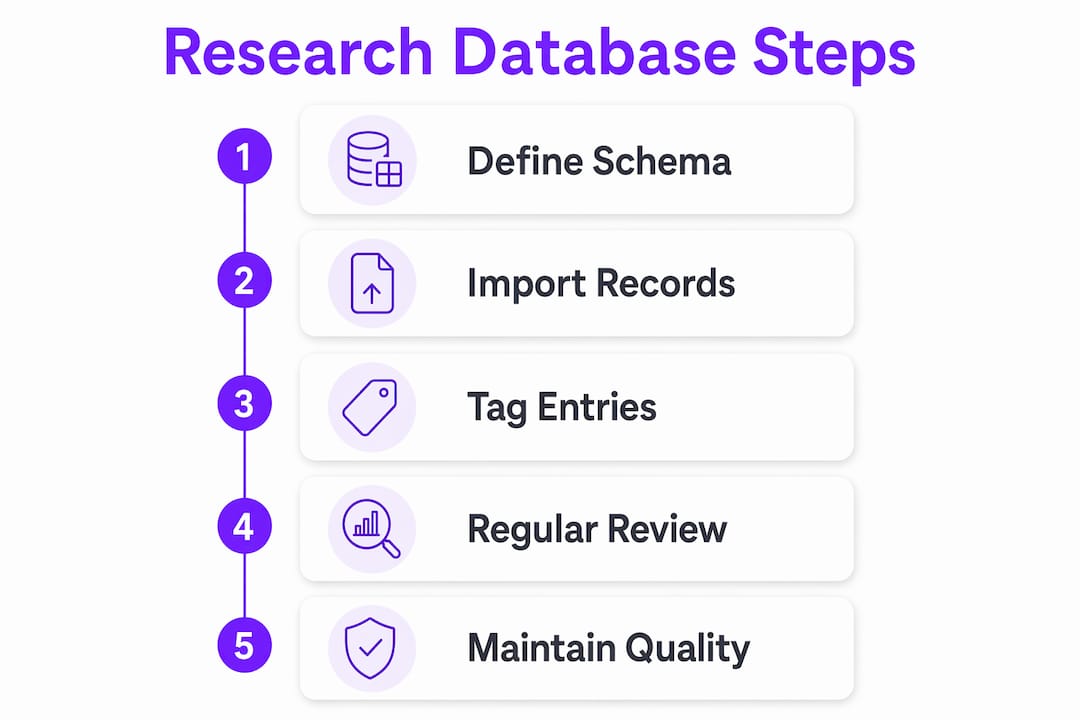
The types of research databases researchers use fall into three broad categories. Reference managers handle bibliographic metadata and PDF storage. Spreadsheet-based systems offer flexibility for custom tagging and status tracking. Institutional digital libraries provide curated, peer-reviewed access to source material. The strongest workflows combine all three layers, with one master record linking them together.
| Database type | Primary strength | Common limitation |
|---|---|---|
| Reference manager | Bibliographic metadata, citation export | Limited custom tagging and analysis fields |
| Spreadsheet system | Flexible schema, reading status tracking | No native PDF handling or search indexing |
| Digital library | Curated, peer-reviewed content access | Requires export to manage locally |
How do you manage large literature search results?
The funnel screening process is the standard method for handling large sets of search results without losing quality or introducing bias. This staged approach is mandatory for systematic reviews and highly recommended for any literature-intensive research.
The four stages work as follows:
- Duplicate removal. Run deduplication before any human screening begins. Duplicates inflate your record count and waste screening time. Most reference managers and database export tools include a deduplication function.
- Fast title screening. Spend 2–3 seconds per title. The goal is to eliminate clearly irrelevant records, not to make final inclusion decisions. Speed and efficiency here come from applying your inclusion criteria as a binary filter, not a judgment call.
- Abstract assessment. Read abstracts for records that passed title screening. Document your exclusion reason for every paper you reject at this stage. That documentation becomes your PRISMA flow diagram.
- Full-text inclusion tracking. Retrieve and read full texts for abstract-approved records. Record your final inclusion or exclusion decision with a specific reason code.
PRISMA (Preferred Reporting Items for Systematic Reviews and Meta-Analyses) flow diagrams are the standard documentation format for this process in systematic reviews. For non-systematic literature reviews, an informal version of the same diagram still protects you from reviewer questions about your selection process.
The most common pitfall is database overload: importing every vaguely relevant result without applying inclusion criteria early. A database with 2,000 unscreened records is not an asset. It is a liability that will slow your review to a halt.
Pro Tip: Create a dedicated “exclusion log” column in your database with a controlled vocabulary of reason codes. “Out of scope,” “wrong population,” and “not peer-reviewed” are enough to cover most cases. Consistent codes make your PRISMA diagram nearly automatic.
What tools and techniques build a reliable research database?
The best research database workflows center on a single, linked system rather than a collection of separate tools. Linking bibliographic metadata, PDFs, and notes in one place prevents data loss and eliminates the wasted effort of re-reading papers you already annotated.
Core capabilities to look for in any database management system include:
- Integrated metadata and PDF handling: The system should store the citation record and the full text in the same location, linked by a persistent identifier like a DOI.
- Note tagging and annotation: Inline annotations tied to specific passages are more useful than separate note documents. They preserve context.
- Export to standard citation formats: APA, MLA, Vancouver, and BibTeX exports are non-negotiable for academic publishing workflows.
- Search and filter across all fields: You need to retrieve every paper tagged “qualitative” and “intervention” simultaneously, not scroll through a flat list.
Mastering Boolean operators and search string construction is equally important. Effective searching is as critical as database management for research quality. A poorly constructed search string will miss key papers regardless of how well your database is organized.
Database maintenance is where most researchers fail. Cleaning and tagging entries every two weeks is the minimum standard for keeping a research database usable over time. Neglecting maintenance turns a structured system into a cluttered archive that no one trusts.
Pro Tip: Schedule a 20-minute database review at the end of every writing session. Check for missing DOIs, untagged entries, and papers stuck in “in progress” status. Small, regular maintenance beats a quarterly overhaul every time.
The role of reference management tools in this workflow is to handle the mechanical parts: importing records, generating citations, and syncing with word processors. The intellectual work of tagging, annotating, and synthesizing belongs to you.
How does structured database management improve literature reviews?
A structured research database directly improves literature review quality by making the selection process transparent and the synthesis process faster. When every paper has a reading status, a thematic tag, and a notes field, you can filter your database to show only “completed” papers tagged “methodology” and write that section of your review without re-reading a single source.
The benefits extend to collaboration and reproducibility. A co-author joining a project mid-review can open the database and immediately see which papers were included, which were excluded, and why. That traceability is what separates a defensible systematic review from an informal narrative summary.
Organizing literature review data tables by thematic tags rather than by author or year produces a synthesis-ready structure. You write about themes, not about individual papers. The database makes that shift possible because the grouping is already done.
Bias reduction is another concrete benefit. When your inclusion and exclusion criteria are encoded as database fields, you apply them consistently across every record. Inconsistent application of criteria is one of the most common sources of bias in literature reviews, and a structured database is the most direct defense against it.
Key Takeaways
Effective research database management requires a unified system, consistent metadata, and regular maintenance to produce literature reviews that are traceable, reproducible, and bias-resistant.
| Point | Details |
|---|---|
| Define your schema first | Set all seven metadata fields before importing any sources to avoid retrofitting later. |
| Use the funnel process | Apply duplicate removal, title screening, and abstract assessment in sequence to control database size. |
| Maintain one source of truth | Link bibliographic records, PDFs, and notes in a single system to prevent data loss. |
| Schedule regular maintenance | Review and clean your database every two weeks to keep it usable and trustworthy. |
| Tag for synthesis, not storage | Use thematic tags designed around your research questions, not generic subject labels. |
Why I think most researchers build their databases too late
The most damaging mistake I see in academic research workflows is treating database management as a cleanup task rather than a foundation. Researchers run their searches, download 150 PDFs, and then try to organize them after the fact. By that point, they have already lost track of which search string produced which results, which papers they skimmed and dismissed, and which ones they meant to read more carefully.
The funnel process only works if you start it at the beginning. A PRISMA diagram you reconstruct from memory is not a PRISMA diagram. It is a guess dressed up in a flowchart.
The second mistake is fragmentation. I have seen PhD candidates with citations in one reference manager, notes in a separate document, and PDFs scattered across three folder structures. When it comes time to write, they spend more time finding sources than analyzing them. A structured research database for faculty and graduate researchers is not a luxury. It is the minimum viable infrastructure for serious academic work.
The counterintuitive truth about database management is that more structure early means less work later. Spending 10 minutes tagging and annotating a paper when you first read it saves 45 minutes of re-reading during the writing phase. The researchers who resist structured systems because they feel like overhead are the same ones who spend weeks reconstructing their own work before submission.
Start with the schema. Build the funnel. Maintain the database. The review writes itself from there.
— Ubada
How Papersynapse fits into your research database workflow
Managing a structured research database manually works, but it does not scale. When your literature set grows past 50 papers, the time cost of manual extraction and tagging becomes the bottleneck in your review.
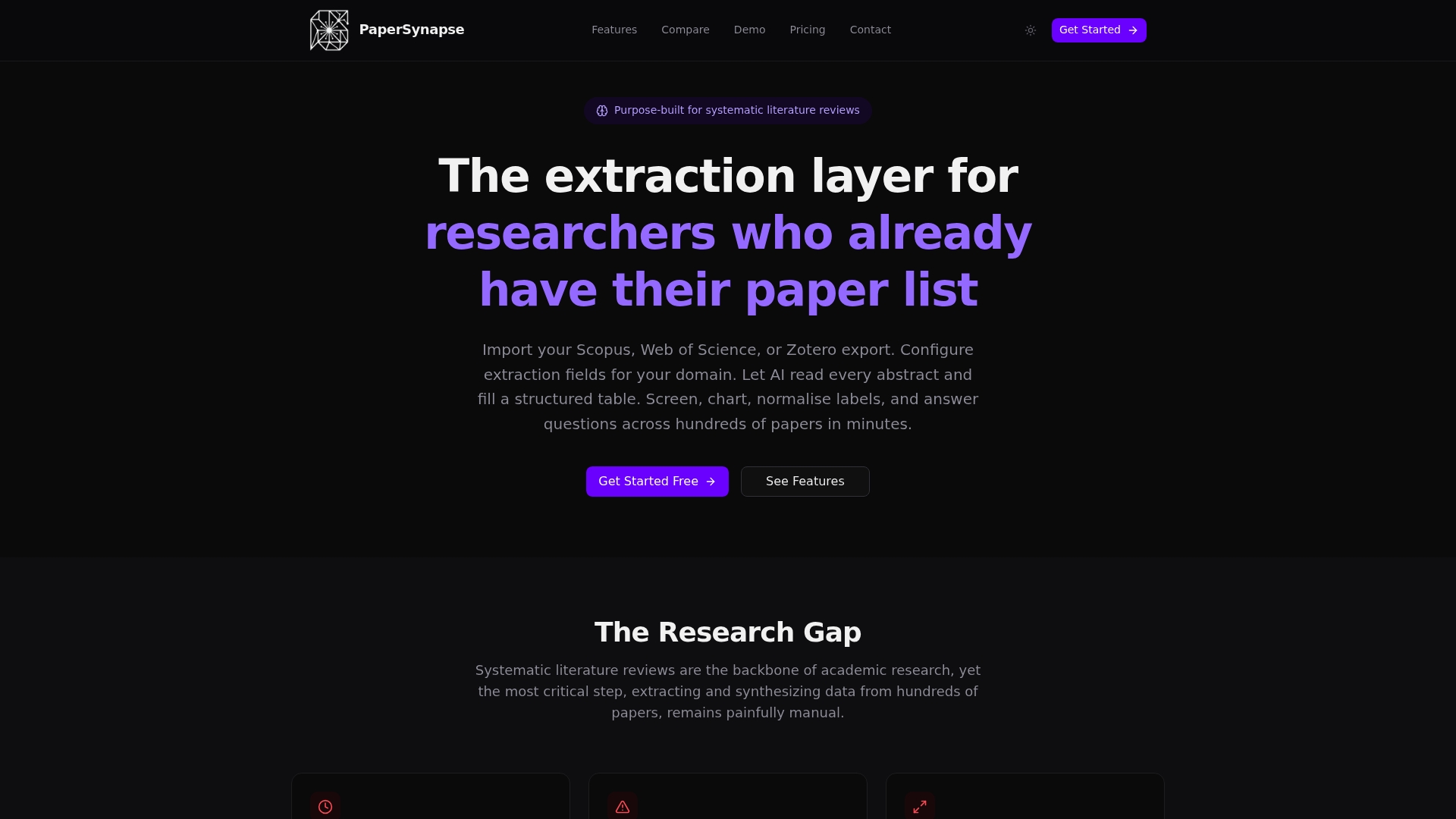
Papersynapse addresses that bottleneck directly. The platform lets you import references from Scopus or Web of Science, then uses AI to read abstracts and fill structured extraction tables automatically. Papersynapse claims to process up to 200 papers in under two minutes. That speed does not replace your judgment on inclusion decisions, but it eliminates the mechanical work of transferring metadata and extracting key findings by hand. The result is a structured, analysis-ready database built in a fraction of the time. Researchers who want to start a systematic review with a clean, organized database from day one will find Papersynapse a practical fit for that workflow.
FAQ
What is research data management in simple terms?
Research data management is the practice of organizing, storing, and documenting research outputs so they remain accessible and reproducible. It covers the full project lifecycle, from planning through publication and preservation.
What are the FAIR principles in research database management?
FAIR stands for Findable, Accessible, Interoperable, and Reusable. These four principles define the standard for well-managed research data and are required by many funding bodies and journals.
How do I manage a large set of literature search results?
Use a four-stage funnel: remove duplicates, screen titles quickly, assess abstracts, and track full-text decisions. Document every exclusion with a reason code to support your PRISMA flow diagram.
What metadata fields does every research database need?
A research database needs seven fields: author and year, title, source type, DOI or URL, thematic tags, reading status, and personal notes. These fields support citation accuracy, synthesis, and reproducibility.
How often should I maintain my research database?
Clean and tag your database at least every two weeks. Regular maintenance prevents records from becoming disorganized and keeps the database usable throughout the full research project.