6 Steps to Resolve Screening Conflicts for PRISMA Aligned Review Teams
6 Steps to Resolve Screening Conflicts for PRISMA Aligned Review Teams

Resolve screening conflicts with a short, timeboxed discussion aimed at consensus. When reviewers still disagree, escalate to a pre-specified third reviewer or adjudicator whose decision is logged with a rationale. Conflicts must close before a record moves to the next screening stage: carrying disagreement forward risks inconsistent inclusion decisions and undermines the reliability of the final dataset.
TL;DR:
- Most screening conflicts are procedural, solved through brief, focused discussions based on written criteria, with escalation only if consensus remains elusive.
- The adjudicator’s role should be fixed and criteria-based, with either blinded or open discussion styles, to ensure unbiased and reproducible tie-breaking decisions.
- Running pilot tests, calibration checks, and maintaining a detailed log of decisions and rationales prevent conflicts and minimize subjective bias.
- Repeating inter-rater reliability checks at multiple stages captures reviewer drift early and improves overall screening consistency.
- Documenting review workflows, automation tools, and dispute resolutions simplifies PRISMA reporting and enhances review transparency.
Table of Contents
- A step-by-step checklist for handling a screening conflict
- Setting adjudication rules that hold up under scrutiny
- Preventing conflicts through piloting and calibration
- Documenting conflict resolution for PRISMA-compliant reporting
- Troubleshooting common screening bottlenecks
- What actually reduces bias in practice
- Reducing subjective drift with structured extraction tools
- Sources
- FAQ
A step-by-step checklist for handling a screening conflict
Most conflicts are procedural rather than personal: two reviewers read the same abstract and applied the eligibility criteria differently. A consistent workflow keeps resolution fast and reproducible.
- Group conflicted records together and triage by complexity: borderline cases needing full-text review go first, since they take longer.
- Hold a focused discussion, timeboxed to 10 to 20 minutes, where both reviewers restate their reasoning against the written eligibility criteria rather than general impressions.
- Reread the protocol’s inclusion and exclusion criteria together: many disagreements come from criteria that were ambiguous, not from reviewer error.
- If discussion produces agreement, record the shared decision and the criterion that settled it.
- If consensus is not reached, escalate to the named adjudicator with both reviewers’ written reasons attached.
- Log the final decision, a timestamp, and the rationale so the choice is reproducible if questioned later.
This structure mirrors standard multi-reviewer screening practice, and keeping the discussion step short prevents one disagreement from stalling the whole screening batch.
Setting adjudication rules that hold up under scrutiny
The adjudicator’s job is to break ties without introducing new bias, so who fills that role matters as much as the process itself. Cochrane Handbook guidance points to bringing in a third, more experienced reviewer once the original two cannot agree, since unresolved disagreements can threaten a review’s validity. The strongest choice balances content expertise in the review’s subject area with fidelity to the protocol itself, so the adjudicator is not simply the most senior voice in the room.
Two adjudication styles suit different situations. Blinded adjudication, where the third reviewer sees the record without knowing either original vote, reduces anchoring on a colleague’s opinion and suits high-stakes or borderline inclusion calls. Open discussion, where the adjudicator hears both arguments directly, resolves conflicts faster and works well for lower-stakes or clearly definitional disputes.
Whichever style is used, the rule should be fixed in advance: majority vote among three reviewers, or a designated adjudicator’s call as the tie-breaker. Document the adjudicator’s stated rationale for every conflict, not just the outcome, so the decision can be checked later.

Preventing conflicts through piloting and calibration
Most screening conflicts are predictable and preventable. Running a pilot phase before full screening begins catches ambiguous criteria while they are cheap to fix.
- Pilot the eligibility criteria on 50 to 100 records, then refine the wording and add exemplar decisions for edge cases.
- Schedule inter-rater reliability checks at the start, midpoint, and end of screening rather than only once at the finish; periodic checks catch drift earlier than a single end-of-screening check.
- Report percent agreement or kappa at each checkpoint when the team wants a quantitative signal of consistency.
- Pair reviewers with mixed expertise, combining subject knowledge with methodological neutrality, since balanced reviewer pairs improve protocol fidelity.
Pro Tip: Keep a running log of every calibration decision during piloting: it becomes the exemplar bank that new reviewers reference instead of re-litigating settled edge cases.
Many published reviews still skip this reporting step entirely, which is worth avoiding since transparent IRR tracking is part of what separates a defensible screening process from a rushed one.
Documenting conflict resolution for PRISMA-compliant reporting
PRISMA 2020 asks reviews to state how many reviewers screened each record, whether they worked independently, and what automation tools, if any, were used. Building a documentation habit during screening, rather than reconstructing it afterward, saves time when writing up Methods and Results.
- Log reviewer count per record, independence status, screening dates, and any automation tool involved.
- Map these logs directly to PRISMA’s selection process item and its study-selection reporting item, so the write-up follows from the log rather than memory.
- Save decision logs, exemplar records from calibration, and calibration session notes as supplementary material or in a repository.
This habit also makes the screening workflow easier to design around from the outset, since the reporting requirements shape what data is worth capturing at each step.
Troubleshooting common screening bottlenecks
A few recurring problems slow screening down beyond ordinary conflicts. Each has a pragmatic fix that keeps the process moving without cutting corners on transparency.
If a reviewer becomes unavailable mid-screening, reassign their conflicted records to another qualified reviewer and rerun arbitration on any records affected. If the conflict rate climbs unexpectedly high across a batch, pause screening and re-pilot with clearer exemplars and tighter criteria rather than pushing through inconsistent decisions. When an abstract simply lacks enough information to decide, use an interim “maybe” bin and pull the full text rather than guessing. Any post-hoc change to eligibility criteria should be documented and justified in the protocol or its registration update, since silent changes undermine the audit trail reviewers rely on later.

What actually reduces bias in practice
Seniority is not a substitute for protocol alignment: the most experienced reviewer in the room is not automatically right, and letting rank settle disputes quietly erodes the criteria the whole team agreed to follow. The habits that hold up under scrutiny are the unglamorous ones: recording calibration decisions as they happen, publishing exemplar cases alongside the final review, and treating every adjudication as a data point rather than a private judgment call.
Speed and reproducibility are not opposites here. A team with fixed adjudication rules and a documented pilot phase moves faster in the long run than one that debates each conflict from scratch, because the rules absorb the decisions that would otherwise reopen every time. Piloting structured automation during calibration, rather than adopting it wholesale on day one, is the version of that habit worth testing before it becomes policy.
— Ubada
Reducing subjective drift with structured extraction tools
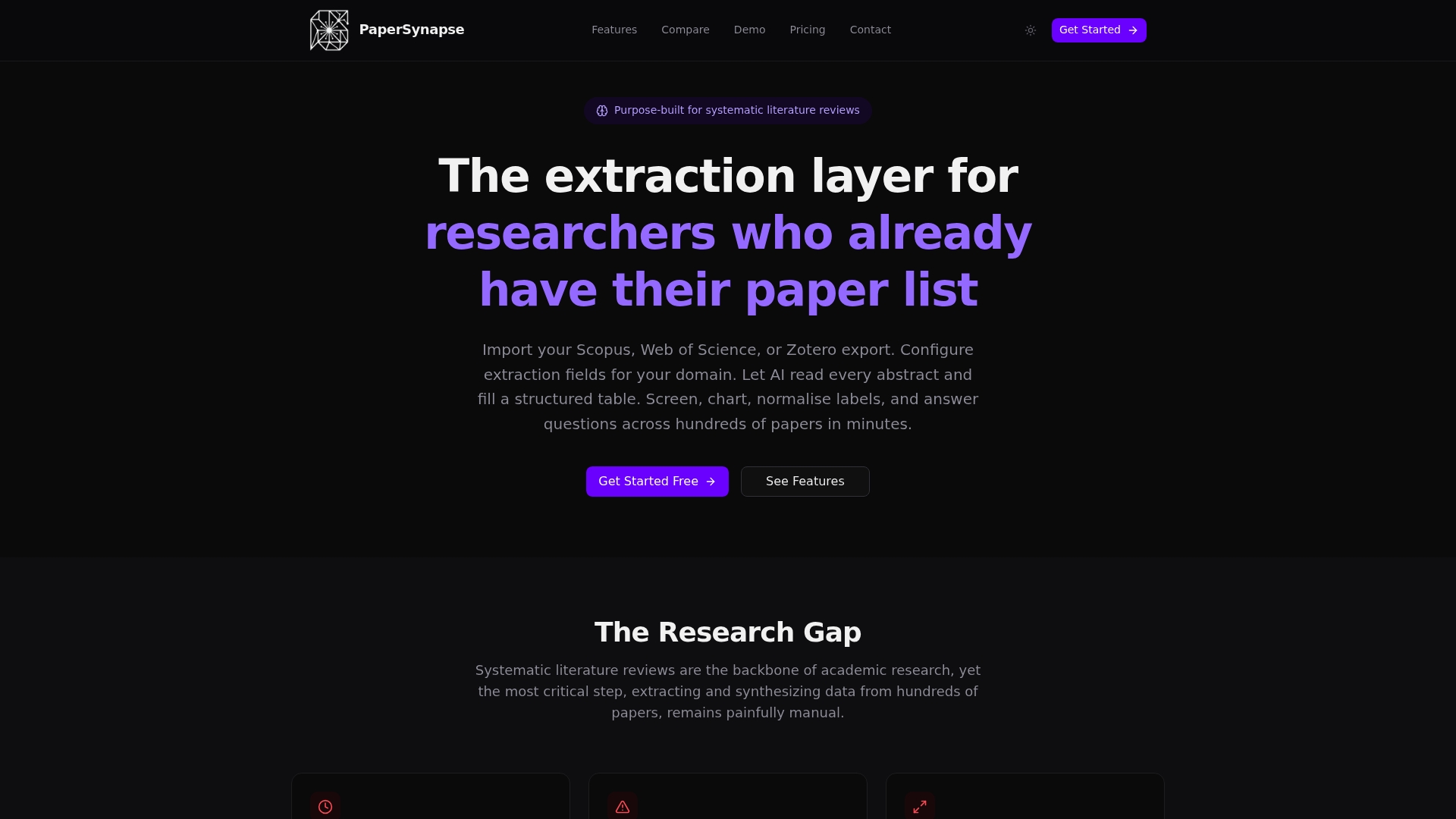
Manual abstract screening is where subjective drift creeps in fastest: two reviewers read the same sentence and weigh it differently because nothing forces them to apply the same structured fields. PaperSynapse automates extraction and analysis from research paper abstracts, which addresses that bottleneck directly rather than leaving it to reviewer memory.
- Shared extraction templates apply the same structured fields to every record, cutting down on the interpretive variance that produces conflicts in the first place.
- AI-assisted extraction flags discrepancies between reviewers faster than manual cross-checking, so calibration sessions have concrete examples to work from instead of vague disagreement.
- A practical pilot: run a subset of records through PaperSynapse during the calibration phase and compare conflict rates and processing time against your usual manual pass.
The platform offers a free plan alongside paid tiers priced by processing volume, allowing teams to test the approach on a pilot batch before committing to a paid tier. Check current plan details on the PaperSynapse pricing page.
Sources
For adjudication rules, consult the Cochrane Handbook’s guidance on resolving disagreements. For reporting requirements, PRISMA 2020’s items on reviewer counts and study selection matter most. For calibration timing, the methodological literature on repeated IRR checks explains why a single end-of-screening check misses drift that periodic checks catch.
- Cochrane Handbook guidance on resolving disagreements
- Methodological literature recommending repeated IRR checks
FAQ
What are the 5 steps to resolve a screening conflict?
Group the conflicted record, hold a timeboxed discussion against the written eligibility criteria, attempt consensus, escalate to a named adjudicator if unresolved, and log the final decision with its rationale. This sequence keeps resolution fast while staying reproducible for later reporting.
What are the core principles behind resolving screening disagreements?
Clarity, communication, criteria, and consistency: reviewers need clear eligibility criteria, open communication about their reasoning, criteria applied the same way each time, and consistent documentation of every decision. These principles underpin both Cochrane’s adjudication guidance and PRISMA’s reporting expectations.
How do you choose a third reviewer or adjudicator?
Choose someone with methodological experience who understands the protocol, ideally paired with enough subject knowledge to judge borderline cases fairly. The Cochrane Handbook recommends a more experienced reviewer specifically because unresolved disagreements can threaten the review’s validity.
How often should teams run inter-rater reliability checks?
Run IRR checks at the start, midpoint, and end of screening rather than only once at the finish. Periodic checks catch drift earlier than a single check run after screening is already complete.
What should be logged when a screening conflict is resolved?
Record the reviewers involved, whether they worked independently, the date, any automation tool used, and the adjudicator’s rationale if escalation was needed. These details map directly onto PRISMA’s reporting items for study selection and reviewer workflow.