7 Step Screener Calibration for Review Teams Mapped to PRISMA/Cochrane
7 Step Screener Calibration for Review Teams Mapped to PRISMA/Cochrane
Run an independent duplicate pilot before splitting screening workload, not after. Draw 30 to 100 records (or roughly 10% of your total pool, whichever is more practical), have every screener code them without discussion, then compute agreement. Fix whatever ambiguity the disagreements expose, update your screening form, and document the revision. Only then split the remaining records across the team, following PRISMA and Cochrane reporting norms.
TL;DR:
- Conduct an independent pilot with 30 to 100 records to identify and fix ambiguities before splitting screening workload across the team.
- Use calibration to prevent coder drift, inconsistent thresholds, and ambiguous criteria from affecting the reliability of screening decisions.
- Measure inter-rater reliability with Cohen’s kappa, aiming for at least substantial agreement (0.61–0.80) before proceeding with full screening.
- Document all calibration processes, decisions, and revisions thoroughly to ensure reproducibility and compliance with PRISMA and Cochrane standards.
- Utilize platforms like PaperSynapse to streamline logging, disagreement analysis, and reporting efforts during calibration and review.
Table of Contents
- What Is Screener Calibration and Why Does It Matter?
- How Do You Design a Pilot for Screening Calibration?
- How Do You Run a Screener Calibration Exercise Step by Step?
- How Do You Measure Inter-Rater Reliability in Screening?
- What Belongs in Your Recalibration and Documentation Plan?
- How Can PaperSynapse Support Your Screener Calibration Workflow?
- What Screener Calibration Mistakes Show Up Most Often?
- Run Your Next Pilot Without the Spreadsheet Headache
- Sources
- FAQ
What Is Screener Calibration and Why Does It Matter?
Screener calibration is the process of aligning multiple reviewers on how to apply eligibility criteria before they screen independently at scale. It matters because eligibility criteria that read as clear in a protocol document routinely turn out ambiguous the moment two humans apply them to real abstracts.
Cochrane’s MECIR standards require at least two reviewers to independently determine study eligibility, with a disagreement-resolution procedure agreed on in advance and final decisions usually made from full texts rather than abstracts alone, according to Cochrane’s guidance on selecting studies. PRISMA 2020 goes further on the reporting side: your methods section must state how many reviewers screened each record, whether they worked independently, and how any automation tools were used, per the PRISMA 2020 statement.
The evidence for duplicate screening isn’t just procedural box checking. Dual review across title/abstract and full-text stages has been shown to catch additional eligible studies that single reviewers miss, with some comparisons reporting cumulative gains as high as 20%, according to EPPI-Centre study selection guidance.
What calibration actually prevents:
- Coder drift, where a screener’s interpretation of “comparator population” or “outcome measure” quietly shifts over hundreds of records
- Ambiguous criteria surviving into full-scale screening because nobody tested the form on a shared batch first
- Reviewers applying inconsistent thresholds for borderline inclusion calls, which inflates disagreement late in the process when it’s expensive to fix
How Do You Design a Pilot for Screening Calibration?
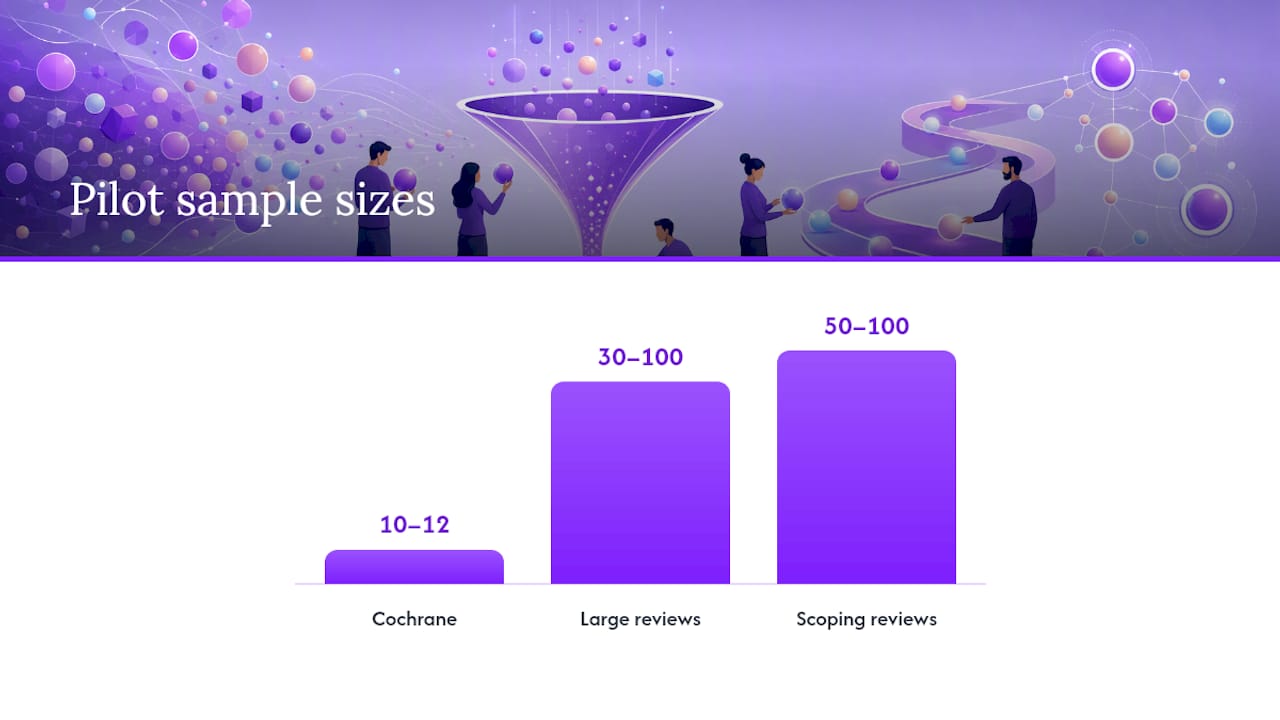
Pilot size is the first decision, and the guidance varies by source for a reason: review scope changes what’s practical. Cochrane’s own suggestion runs small, around 10 to 12 abstracts, useful for tight protocols with a narrow question. The Agency for Healthcare Research and Quality guidance cited in the best-practice literature recommends 10% to 20% of your total pool. Larger reviews with tens of thousands of records often settle on a pragmatic range of 30 to 100 records, since a fixed percentage of a huge pool becomes unmanageable as a first pilot.
- Pick your sample. Random sampling works for most reviews, but stratified sampling, deliberately including records you already suspect are borderline, does a better job of stress testing your criteria than a purely random draw.
- Design the coding form. Use a binary include/exclude choice plus a mandatory “unsure” option. Forcing a false binary hides exactly the disagreement you’re trying to surface.
- Order your questions hierarchically. Put population and study-design questions first, since a failure there ends the screening decision immediately and saves reviewers from working through outcome criteria that no longer matter.
- Choose which PICO elements to pilot first. Start with whichever criteria your team already flagged as ambiguous during protocol drafting, comparator definitions and outcome timing windows are frequent culprits.
The Pilot 50 to 100 records first approach for scoping reviews covers exporting these pilot counts in PRISMA-ready format, which saves rework later.
Pro Tip: Build your pilot batch from records pulled across your whole search date range, not just the newest ones. Older or oddly worded abstracts expose form weaknesses that recent, well-abstracted papers won’t.
How Do You Run a Screener Calibration Exercise Step by Step?
The mechanics matter as much as the intent. A calibration session that quietly turns into a group consensus meeting defeats its own purpose, because you lose the independent signal you need to measure real disagreement.
- Hold a short facilitator-led walkthrough. Explain the form and clarify wording, but stop short of walking through actual pilot records as a group. The goal is shared understanding of instructions, not shared decisions.
- Screen the pilot batch independently and blind. Every participating screener codes the same batch without seeing anyone else’s answers. No side conversations, no “quick check” with a colleague.
- Aggregate the results. Pull every screener’s decisions into one table and flag every record where decisions diverge.
- Compute disagreement and find the pattern. Don’t just count mismatches, look for themes. Are disagreements clustering around one PICO element, one study design category, or one wording choice in the form?
- Hold a group discussion, but only after independent coding is locked in. This is where you resolve the flagged records, but the discussion happens after the independent data exists, not instead of it.
- Update the form and decision rules. Write down the exact wording change and the reasoning behind it. Vague fixes like “be more careful about X” don’t survive contact with reviewer number four.
- Re-run the pilot if disagreement stayed high. One round of calibration is often not enough for reviews with more than two screeners or unusually technical inclusion criteria.
Checklist for what to bring into that discussion:
- The full list of discrepant records, not just a summary count
- Each screener’s stated reasoning for the flagged decisions, collected before the meeting
- A proposed rewrite of any ambiguous criterion, ready for the group to react to rather than draft from scratch
- A decision on whether the disagreement pattern warrants a full re-pilot or just a documented clarification
The Multi Reviewer Screening best-practices guide walks through conflict-resolution models in more depth if your team is choosing between full dual screening and a proportional split.
How Do You Measure Inter-Rater Reliability in Screening?
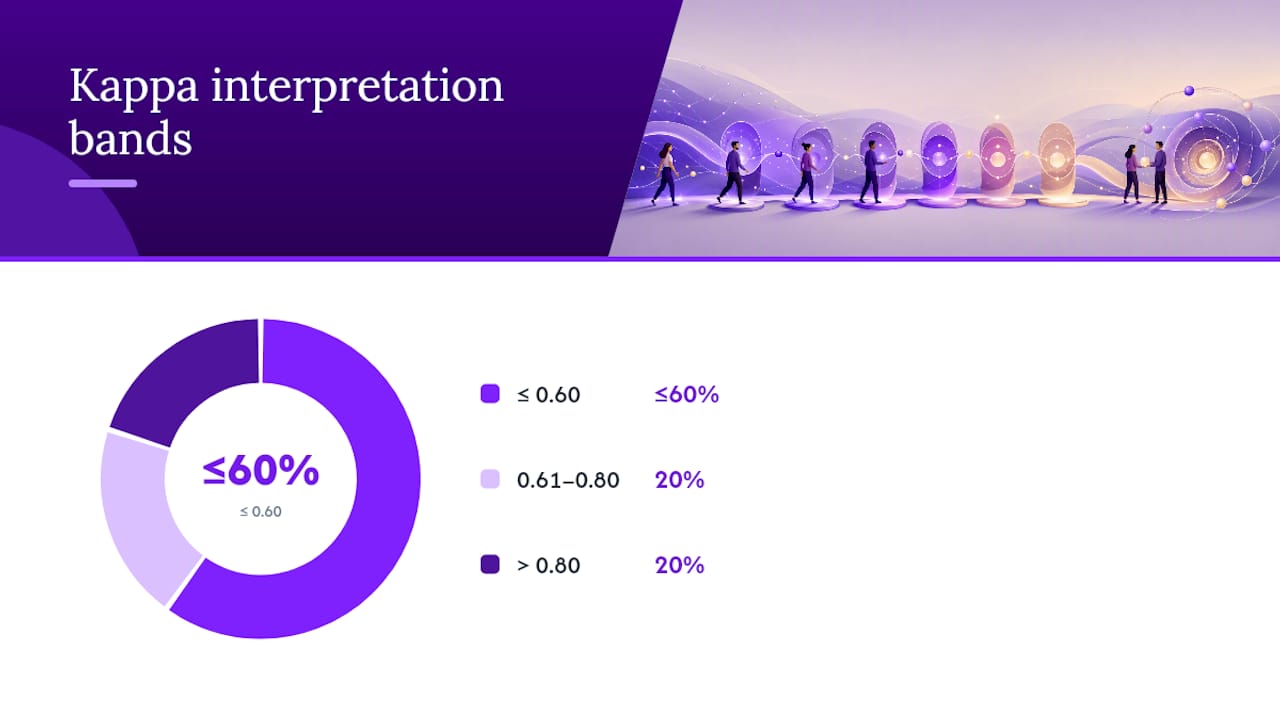
Cohen’s kappa is the standard statistic for a binary pilot batch, and it matters because raw percent agreement overstates reliability when most records are easy excludes. Kappa corrects for the agreement you’d expect by chance alone, which makes it a formative tool: a low kappa on your pilot is a signal to fix the form, not a final grade on your team.
Interpretation bands and how to use them:
- The widely cited Landis and Koch bands treat 0.61 to 0.80 as substantial agreement and above 0.80 as almost perfect, but treat these as guidance, not a hard pass/fail line
- Context changes what’s acceptable. A rare, tightly defined outcome tolerates a lower kappa than a broad inclusion criterion with many borderline calls
- Report kappa alongside percent agreement, since kappa can look artificially low or unstable when one category (like “exclude”) dominates the pilot batch
- For multi-category decisions (include, exclude, unsure, defer to full text), use weighted kappa, which penalizes near-miss disagreements less than a total mismatch
The operational rule most teams should follow: don’t split the workload until you hit substantial agreement on the pilot. Once full screening starts, spot-check disagreement rates periodically rather than assuming the pilot’s kappa holds steady for the next 5,000 records.
What Belongs in Your Recalibration and Documentation Plan?
PRISMA and Cochrane guidance both point toward the same underlying principle: your calibration process needs to be reconstructable by someone who wasn’t in the room. That means writing down decisions as you make them, not reassembling them from memory when a reviewer asks for your methods draft.
What to log for every calibration round:
- Pilot sample size and how records were selected (random or stratified)
- The IRR statistic used, kappa value, and percent agreement
- Who screened, whether independently, and the exact conflict-resolution rule applied
- Protocol version number and date for each form revision
- A description of any automation tool used and what it did
| Trigger for recalibration | What to do |
|---|---|
| Eligibility criteria change mid-review | Re-pilot on a fresh sample before resuming |
| A new reviewer joins the team | Run them through the existing pilot batch and compare against established screeners |
| Disagreement rate climbs during full screening | Pull a new sample, recompute kappa, revise wording |
| New terminology appears in the literature | Update the form’s definitions and version the change |
The PRISMA screening workflow guide covers how to fold these details into the flow diagram and Methods section without cluttering either one.
How Can PaperSynapse Support Your Screener Calibration Workflow?
The platform imports references from CSV or RIS exports, processes abstract-based extraction with user-defined structured screening fields, helping transform kappa calculations from manual spreadsheet tasks into data derived from existing logs.
Where it fits into calibration specifically:
- Screening decisions land in structured tables automatically, so pulling a pilot batch’s agreement data doesn’t mean hunting through separate reviewer files
- AI-flagged disagreement patterns can help prioritize which records deserve a human re-check first, though every automated step still needs to be described in your PRISMA methods, per PRISMA’s reporting requirement
- Visualizations can aid in identifying disagreement clusters by criterion, facilitating the discrepancy-analysis step.
Pro Tip: Run your first calibration pilot on PaperSynapse’s Free tier before committing to a paid plan. A 30 to 50 record pilot is small enough to test the workflow without needing higher-volume capacity.
What Screener Calibration Mistakes Show Up Most Often?
The biggest one is letting the pilot meeting quietly become a consensus exercise. Once screeners talk before coding, you’ve lost the independent signal that makes kappa meaningful, and your apparent agreement will look better than your real one.
The second is treating calibration as a one-time event. Coder drift is real over long screening phases, and a booster session partway through catches it before it compounds. Keep every version of your protocol and form timestamped. When someone asks six months later why a criterion changed, you want an answer on file, not a memory.
— Ubada
Run Your Next Pilot Without the Spreadsheet Headache
The platform provides a workflow including import, abstract-based extraction, screening, and visualization, consolidating tasks that might otherwise require separate spreadsheets and logs. That matters most during calibration, when you need clean structured data fast to compute kappa and spot disagreement patterns before they spread across your full screening phase.

Import your reference list straight from Scopus or Web of Science exports, let the platform extract structured fields from abstracts without needing full PDFs, and keep every screener’s decisions logged in one table for your pilot analysis. Teams running a small calibration batch can start on the Free plan, while Pro and Ultra tiers scale up for full-review volume once your pilot clears substantial agreement. If your team wants a walkthrough of how the logs map to your PRISMA methods section, reach out for a demo. Authored by Ubada.
Sources
Your protocol and methods sections should cite the same standards that back this guide: Cochrane’s MECIR standards on selecting studies, the PRISMA 2020 statement, and the 2019 best-practice guideline for abstract screening. Reviewers checking your methodology will look for exactly these three references, and citing them directly saves your team from paraphrasing standards that already have precise, citable language.
- Selecting studies to include in the review (C39-C42) | Cochrane
- The PRISMA 2020 statement: An updated guideline for reporting systematic reviews
- Study selection guidance (EPPI/Booth)
FAQ
What Is the Minimum Sample Size for a Screening Pilot?
There’s no single fixed number. Cochrane suggests 10 to 12 abstracts for tightly scoped reviews, while AHRQ guidance recommends 10% to 20% of your total pool. Large reviews often use a pragmatic range of 30 to 100 records regardless of what percentage that represents.
What Kappa Score Counts as Good Agreement for Screening?
Most teams treat a kappa of 0.61 to 0.80 as substantial agreement, using the widely cited Landis and Koch bands, and aim to hit at least that level before splitting workload. Report kappa alongside percent agreement, since a heavily skewed pilot batch can make kappa look unstable even when raw agreement is high.
Can One Reviewer Screen Instead of Two?
Cochrane’s standards call for at least two independent reviewers determining eligibility, with disagreements resolved through a prespecified procedure. Some rapid-review methods allow single-screening trade-offs, but these should be prespecified in the protocol and clearly reported as a deviation from full dual screening.
How Often Should a Team Recalibrate During Full Screening?
Recalibrate whenever eligibility criteria change, a new reviewer joins, or disagreement rates start climbing during full screening. There’s no fixed schedule. It’s triggered by these events rather than a calendar interval, and each round should be versioned and dated in your protocol.
Does PaperSynapse Help With Calibration Reporting?
PaperSynapse keeps screening decisions in structured, exportable tables, which makes pulling pilot-batch data for kappa calculations and PRISMA reporting more straightforward than working from scattered spreadsheets. Current plan pricing and capacity limits are listed on the PaperSynapse site.