Shared Research Database Explained for Systematic Reviews
Shared Research Database Explained for Systematic Reviews
A shared research database is a centralized metadata aggregator that harvests, normalizes, and links scholarly outputs from multiple repositories into a single, unified resource. For researchers running systematic literature reviews, this distinction matters: you are not just searching one journal index, you are querying a connected ecosystem where author identifiers, institutional affiliations, and funding records resolve across sources. The core features that define these platforms include:
- Curated metadata harvesting from institutional repositories, preprint servers, and journal publishers
- Cross-repository linking that connects related outputs (datasets, grants, publications) through persistent identifiers
- Controlled vocabulary indexing using thesauri and semantic embeddings for precise retrieval
- Structured academic discovery with Boolean, field-specific, and abstract-paste search modes
Unlike a general web search engine, a research database restricts content to peer-reviewed academic material and applies metadata standards that Google simply does not enforce.
Table of Contents
- What sets shared research databases apart from standard academic databases?
- What challenges make shared research databases hard to build and maintain?
- How do shared research databases benefit systematic literature reviews?
- How Papersynapse automates systematic reviews with an AI-driven platform
- What are the most widely used shared research databases in academic research?
- Best practices for contributing to and accessing shared research databases
- Data privacy and ethical considerations in shared research databases
- How shared research databases integrate with your existing academic tools
- Key Takeaways
What sets shared research databases apart from standard academic databases?
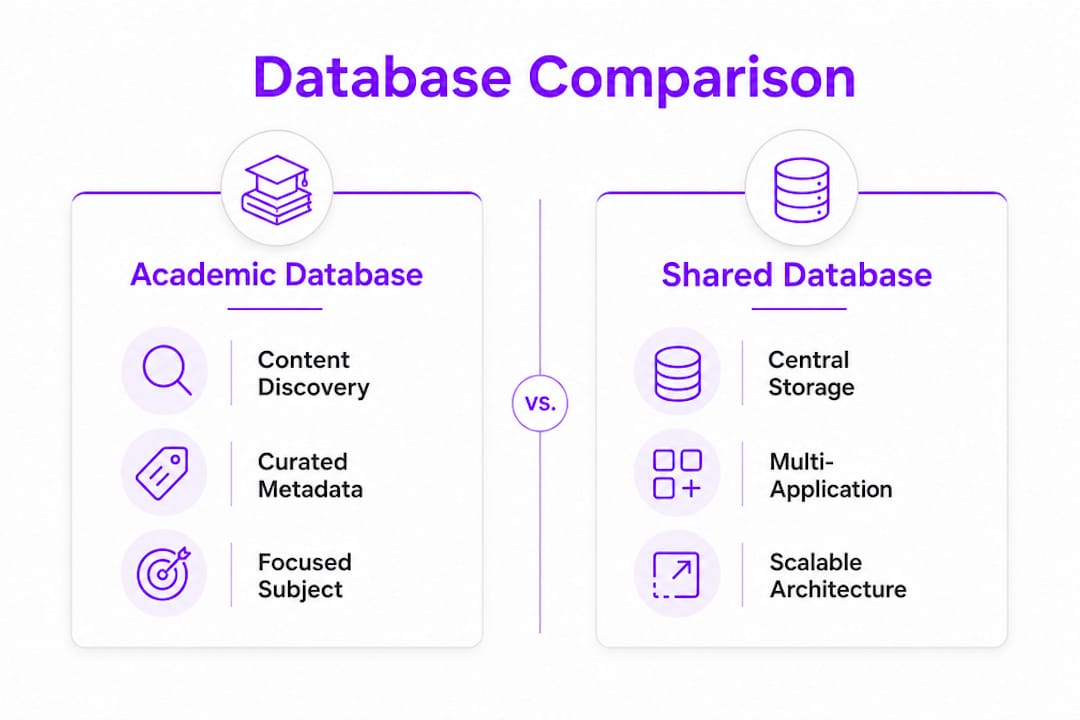
Researchers and IT teams often use “research database” and “shared database” interchangeably, but they describe very different things. Academic researchers often confuse library databases for discovery with shared databases as software data patterns, despite their different objectives.
An academic research database (think PubMed, Scopus, or Web of Science) is a curated content discovery platform. Its job is to help you find and access scholarly literature through advanced NLP indexing that extracts authors, abstracts, and keywords into searchable metadata.

A shared database in software architecture is a technical pattern where multiple applications read and write to one centralized data store, prioritizing immediate consistency over service independence. The shared database pattern trades runtime coupling and scaling headroom for reduced data redundancy.
Key contrasts at a glance:
| Dimension | Academic research database | Architectural shared database |
|---|---|---|
| Primary goal | Scholarly content discovery | Data consistency across applications |
| Users | Researchers, librarians | Software services, microservices |
| Main challenge | Metadata normalization across sources | Schema conflicts, write bottlenecks |
| Access model | Subscription or open access | Internal service-to-service |
What challenges make shared research databases hard to build and maintain?
Building a shared research database for scholarly use is harder than it looks. The Center for Open Science highlights metadata siloing as a primary obstacle: the same author may appear under a dozen name variants across institutional repositories, and funding records rarely carry consistent identifiers.
Three categories of friction stand out:
- Metadata inconsistency: Author names, institution strings, and grant IDs vary by source, requiring AI-driven disambiguation before any unified view is possible.
- Schema conflicts: Shared database design often produces least-common-denominator schemas when multiple stakeholder groups must agree on a single structure, causing deployment delays and political friction between departments.
- Runtime coupling and write bottlenecks: Long-running transactions can lock tables and degrade performance system-wide, a well-documented risk in microservices database design.
Pro Tip: Mitigate coupling by keeping write operations in private service databases and exposing only read-only replicas to the shared layer. This preserves consistency for consumers without creating a single write bottleneck.
How do shared research databases benefit systematic literature reviews?
The practical payoff for systematic review researchers is concrete. Shared research databases aggregate metadata from multiple repositories, creating linked, normalized views of academic outputs that resolve inconsistencies across platforms. That means fewer duplicate records to deduplicate manually and cleaner author and affiliation data from the start.
Specific benefits for systematic review workflows:
- Reduced manual extraction errors through pre-normalized metadata that arrives structured rather than raw
- Consistent terminology via controlled vocabularies that map synonymous terms to single concepts
- Interoperability with citation managers through standardized export formats like BibTeX, RIS, and CSV, plus RESTful APIs
- Faster screening because linked records surface related datasets, preprints, and grant records alongside publications
Efficiency in focus: Papersynapse reports rapid AI-powered extraction enabling processing of up to 200 papers in under two minutes, a speed that manual workflows cannot approach.
The role of AI in organizing references has grown precisely because metadata normalization at scale requires machine-level consistency that human reviewers cannot sustain across hundreds of records.
How Papersynapse automates systematic reviews with an AI-driven platform
Papersynapse is built around the bottleneck that slows most systematic reviews: manual data extraction from paper abstracts into structured tables. The platform connects directly to Scopus and Web of Science, so researchers import their reference sets without re-entering citation data.
From there, AI reads each abstract and fills a structured extraction table automatically, applying consistent rules across every paper rather than relying on a reviewer’s judgment call at 11 PM. Papersynapse processes up to 200 papers in under two minutes, a claim that reflects the platform’s batch extraction architecture rather than sequential reading.
Platform capabilities at a glance:
- Automated abstract-to-table extraction with AI-assigned field values
- Metadata normalization that reconciles author and keyword variants across imported references
- Structured visualization of categorized results for PRISMA-compatible reporting
- Scalable batch processing that handles large reference sets without manual throttling
The consistency gain is the real story. When two reviewers code the same paper differently, the review’s reliability suffers. Papersynapse applies the same extraction logic to every record, which addresses the subjectivity problem at its root. Researchers can learn more about building a structured research database to see how this workflow fits into broader academic data management.
What are the most widely used shared research databases in academic research?
Several platforms have become standard infrastructure for U.S. researchers conducting systematic reviews.
SHARE (Scholarly Heritage and Academic Research Exchange) is a partnership of the Association of Research Libraries and the Center for Open Science. It harvests, normalizes, and links dispersed metadata from institutional repositories, preprint servers, and grant databases using a schema-agnostic approach, meaning it does not require every source to adopt a common format before contributing.
Dimensions describes itself as the world’s largest linked research database, with deep indexing of more than 98 million publications and 150 million patents, plus links across grants, clinical trials, and policy documents.
PubMed covers biomedical and life sciences literature from MEDLINE and remains the default starting point for health sciences systematic reviews in the United States.
Scopus and Web of Science are the two multidisciplinary bibliographic databases most commonly required by U.S. journal editors for systematic review search documentation.
arXiv serves physics, mathematics, and computer science with open-access preprints, making it a critical source for fields where journal publication lags research activity by months.
Best practices for contributing to and accessing shared research databases
Getting the most from these platforms requires deliberate habits on both the input and retrieval sides.
When accessing data: Use controlled vocabulary terms rather than natural language phrases. Most academic databases apply thesauri (MeSH in PubMed, for example) that map your keyword to the preferred indexing term, catching synonyms you would otherwise miss. Combine Boolean operators with field-specific filters (title, abstract, author affiliation) to narrow results without losing relevant records.
When contributing data: Attach persistent identifiers to every output. An ORCID for authors, a DOI for publications, and a funder registry ID for grants give aggregators like SHARE the hooks they need to link your work into the broader ecosystem. Inconsistent author name strings are the single most common reason a paper fails to surface in cross-repository searches.
Pro Tip: Export your final reference set in RIS or BibTeX format before importing into any extraction platform. Structured exports preserve field-level metadata that plain-text exports collapse into unstructured strings.
Understanding types of normalization in research data helps researchers make smarter decisions about which export format retains the metadata their extraction workflow actually needs.
Data privacy and ethical considerations in shared research databases
Shared research databases raise real privacy questions, particularly when they aggregate researcher-level data across institutions. Authentication for access typically relies on IP-range verification, Shibboleth federated identity, or institutional single sign-on, all of which log access patterns that institutions may retain.
For researchers working with sensitive data, the key considerations are:
- Data governance policies at the database level (GDPR compliance for European-hosted platforms, institutional data use agreements for U.S. repositories)
- Author consent when aggregating researcher profiles, especially for early-career researchers whose publication records are thin enough to be individually identifying
- Open access obligations from funders like NIH, which require deposit in PubMed Central, creating a public record that researchers should account for in their data management plans
The ethical dimension extends to how AI-driven platforms use extracted metadata. Researchers should confirm that any extraction tool processes data under a clear privacy policy and does not retain proprietary paper content beyond the session.
How shared research databases integrate with your existing academic tools
The practical integration question is whether a shared database fits into the tools you already use. The answer is generally yes, provided the platform exposes standard APIs or export formats.
Most major platforms support OAI-PMH for metadata harvesting and RESTful APIs for programmatic access, which means reference managers like Zotero and Mendeley can pull records directly. For systematic review workflows, the critical path runs from database search to reference manager to extraction platform. Papersynapse sits at the extraction end of that chain, accepting imports from Scopus and Web of Science in the formats those platforms natively export.
AI tools are increasingly central to this stack. Researchers exploring how AI learning tools fit into academic workflows will find that the same NLP techniques powering database indexing also drive automated extraction platforms. The infrastructure is converging: databases normalize metadata on ingest, and extraction platforms apply that normalized structure to populate review tables without manual re-entry.
Key Takeaways
A shared research database aggregates, normalizes, and links scholarly metadata from multiple sources, giving systematic review researchers a consistent foundation that manual database searching cannot provide.
| Point | Details |
|---|---|
| Core function | Shared research databases centralize and normalize metadata across repositories, resolving author and affiliation inconsistencies. |
| Architecture distinction | Academic discovery databases differ fundamentally from software shared-database patterns, which prioritize write consistency over content curation. |
| Metadata challenge | Schema conflicts and siloed institutional records are the primary obstacles to building reliable shared research infrastructure. |
| AI extraction speed | Papersynapse processes up to 200 papers in under two minutes, replacing subjective manual extraction with consistent AI-driven table filling. |
| Integration path | Standard exports (BibTeX, RIS, CSV) and RESTful APIs connect shared databases to reference managers and extraction platforms without re-entry. |