Systematic Review for Dissertation: A Step-by-Step Guide
Systematic Review for Dissertation: A Step-by-Step Guide

A systematic review is the right choice for your dissertation when your research question is focused, your timeline allows several months of active work, and your program explicitly requires one. If you are unsure, the single most useful thing you can do this week is schedule a meeting with your supervisor to confirm whether a full systematic review is expected or whether a structured literature review will satisfy your degree requirements. That one conversation can save you months of misdirected effort.
Before you commit, check these four conditions:
- You have a clearly defined, answerable research question (ideally structured with PICO or a similar framework)
- You have a realistic plan for protocol registration (PROSPERO or OSF)
- You can access at least two major bibliographic databases through your institution
- You have a plan for a second reviewer or an approach for automation-assisted validation
If all four are in place, proceed. If not, address the gaps before writing a single search string.
Table of Contents
- What sets a systematic review apart from a literature review
- Can you realistically complete a systematic review for your dissertation?
- The complete workflow: from focused question to final report
- How to build a search strategy that holds up to scrutiny
- Screening, data extraction, and quality appraisal
- Choosing the right synthesis method
- Writing the dissertation chapters that contain your systematic review
- Where to get help before and during your review
- Balancing rigor with what is actually feasible for one student
- Key Takeaways
- What examiners actually look for in a dissertation systematic review
- Cut extraction time without cutting corners
- Essential sources to read before you start
What sets a systematic review apart from a literature review
A systematic review is a structured, reproducible synthesis of existing research on a defined question, conducted using explicit, pre-specified methods to minimize bias. Every decision — which studies to include, how to search, how to extract data — is documented in advance in a protocol and reported transparently so another researcher could replicate the process.
That is the core distinction from a narrative or traditional literature review. A narrative review selects and interprets sources based on the author’s judgment, with no obligation to document search strings, justify exclusions, or assess study quality systematically. It is not inherently inferior; it just answers a different kind of question.
The practical differences matter for your planning:
- Protocol: Required for a systematic review; optional for a narrative review
- Search documentation: Must be reproducible and date-stamped in a systematic review
- Screening: Requires two independent reviewers and a conflict-resolution process
- Quality appraisal: Mandatory; uses validated tools (e.g., ROB 2 for RCTs, Newcastle-Ottawa Scale for observational studies)
- Synthesis: Follows a pre-specified method; cannot be changed after seeing the results
Many graduate students are actually asked for a systematized or structured review, which adapts systematic elements to a shorter timeline without requiring full PROSPERO registration or duplicate extraction. University library guides consistently flag this as the most common source of confusion. Confirm the terminology with your committee before you start.
Can you realistically complete a systematic review for your dissertation?
Feasibility is the question most guides skip. A full systematic review is resource-intensive, and the scope of your question is the single biggest lever you control.
Scope and timeline
A broad question (“What interventions improve mental health in adolescents?”) can generate a large volume of records and take a full research team a significant amount of time. A narrowly focused question (“Does cognitive behavioral therapy reduce anxiety symptoms in college students compared to waitlist control?”) is manageable for a dissertation student within a typical thesis project timeline. Narrow the question until the expected record count feels uncomfortable — then narrow it once more.
A realistic milestone timeline for a dissertation-scale review includes stages such as finalizing the research question and protocol, registering the protocol, performing database searches, screening, data extraction, and write-up, typically spread over several months
This 16-week framework aligns with master’s thesis schedules and assumes a narrowly scoped question. Add buffer time at every stage.
Team and reviewer options
The recommended standard is having two independent reviewers at every stage, with a third to resolve disagreements. For solo students, this is the hardest constraint to meet. Your options:
- Recruit a peer reviewer: A fellow graduate student in your program can serve as a second reviewer for screening and extraction, even informally
- Use automation with human validation: Platforms that pre-fill extraction fields can reduce effort, but a human check of a random sample remains expected
- Systematized review: If your program permits it, a systematized approach with transparent documentation and one reviewer may be acceptable
When to step back from a full systematic review
Consider a systematized or structured review instead if:
- Your program does not explicitly require a full systematic review
- Your timeline is under 12 weeks
- You cannot identify a second reviewer
- Your research question is exploratory rather than confirmatory
- The existing literature is sparse, heterogeneous, or largely qualitative
The complete workflow: from focused question to final report
The sequence matters. Skipping or reordering steps is the most common reason dissertation systematic reviews fail at examination.

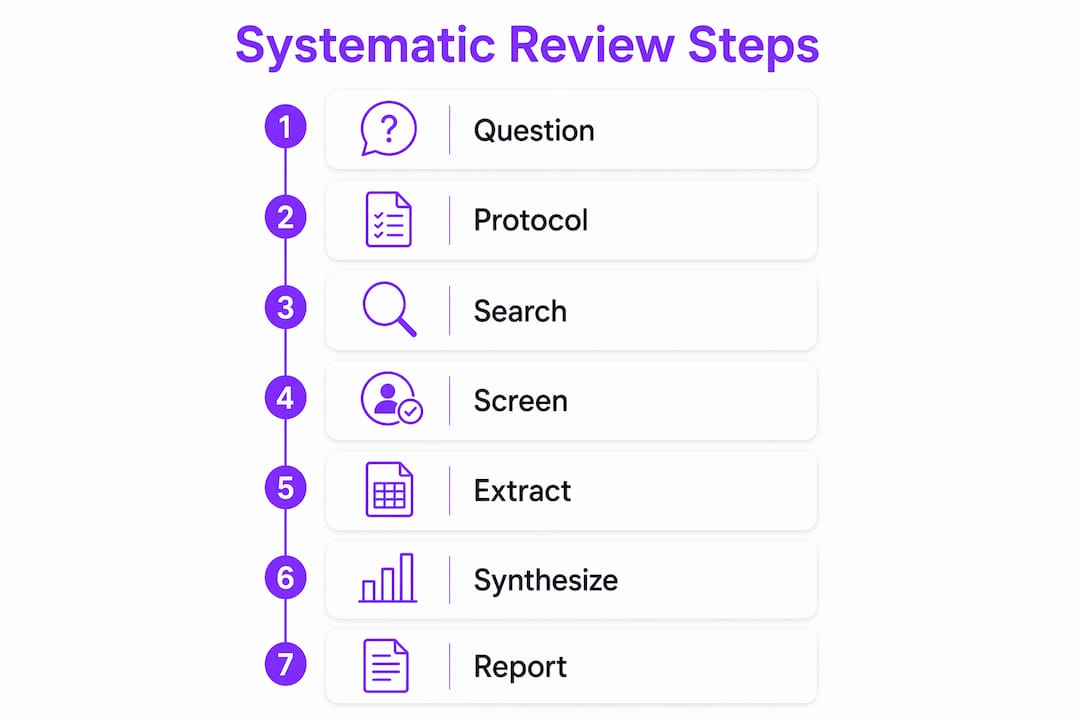
The core steps in order: question formulation → protocol drafting and registration → database searching → deduplication → title/abstract screening → full-text screening → data extraction → quality appraisal → synthesis → PRISMA reporting → dissertation write-up.
Protocol essentials
Your protocol is a public commitment to your methods. It should include:
- Background: Why the question matters and what is already known
- Research question: Stated in PICO (Population, Intervention, Comparator, Outcomes) or an equivalent framework
- Eligibility criteria: Inclusion and exclusion criteria for study design, population, intervention, comparator, outcomes, language, and date range
- Search strategy: Databases to be searched, search strings, grey literature sources
- Selection process: How screening will be conducted and by whom
- Data extraction plan: What will be extracted and using which template
- Quality appraisal: Which validated tool will be used and why
- Synthesis approach: Narrative synthesis, meta-analysis, or SWiM
- Dissemination plan: Where results will be reported
Register this protocol on PROSPERO (for health-related reviews) or OSF before you run your searches. Registration timestamps your methods and demonstrates they were not adjusted after seeing results.
Sample protocol outline for PROSPERO/OSF submission
| Protocol Section | What to Include |
|---|---|
| Title and registration | Review title, lead reviewer, institution, registration date |
| Background | Brief summary of the problem and why a review is needed |
| Research question | Full PICO statement |
| Eligibility criteria | Study design, population, intervention, comparator, outcomes, language, date |
| Search strategy | Databases, search strings, grey literature sources |
| Selection process | Screening stages, reviewer roles, conflict resolution |
| Data extraction | Template fields, extraction software, pilot plan |
| Quality appraisal | Tool name, domains assessed, how results will be reported |
| Synthesis | Method (narrative/meta-analysis), heterogeneity handling |
| Amendments | How protocol changes will be documented and reported |
PRISMA flow diagram
The PRISMA flow diagram records how many records were identified, deduplicated, screened, assessed for eligibility, and included. Document the numbers at each stage as you go — reconstructing them at the end from memory is unreliable. Most dissertation committees expect the PRISMA flow in the methods chapter or as a figure in results.
Pro Tip: Run a pilot of your protocol on 10–20 randomly selected records before the full search. This surfaces ambiguous eligibility criteria early, when fixing them is cheap. Document any changes to the protocol as amendments with a date and rationale.
How to build a search strategy that holds up to scrutiny
A reproducible search strategy is essential in a systematic review. The objective is to find all relevant studies, avoiding selective inclusion.
Choosing databases
Search multiple major bibliographic databases. The right pair depends on your discipline:
| Discipline | Primary databases to search |
|---|---|
| Health and medicine | PubMed/MEDLINE, Embase, CINAHL |
| Psychology and education | PsycINFO, ERIC, Scopus |
| Social sciences | Web of Science, Scopus, Sociological Abstracts |
| Multidisciplinary | Scopus + Web of Science (strong default pair) |
Single-database searches miss a significant share of relevant literature. Comprehensive search guidance consistently recommends at least two databases, plus grey literature sources.
Building your search string
Translate your PICO question into keywords and controlled vocabulary (MeSH terms in PubMed, Emtree in Embase). A basic structure:
- Concept 1 (Population): All synonyms connected by OR
- Concept 2 (Intervention): All synonyms connected by OR
- Concept 3 (Comparator/Outcome): All synonyms connected by OR
- Combine concepts: Connect concept blocks with AND
Example search string (PubMed format):
("cognitive behavioral therapy" OR "CBT" OR "cognitive behaviour therapy") AND ("anxiety" OR "anxiety disorders") AND ("college students" OR "university students" OR "young adults")
Translate this string into each database’s controlled vocabulary before running it. Save the exact string, the database, the date, and the number of results returned.
Grey literature
Grey literature reduces publication bias by capturing studies that never made it into indexed journals. Sources to check:
- Thesis registries: ProQuest Dissertations & Theses, EThOS
- Trial registries: ClinicalTrials.gov, WHO International Clinical Trials Registry Platform
- Conference abstracts: Relevant discipline-specific conference proceedings
- Government and NGO reports: Agency websites, policy repositories
Record every grey literature source searched, the date, and the search terms used. This documentation belongs in your methods appendix.
Screening, data extraction, and quality appraisal
Screening is where most of the labor lives, and where most of the bias risk hides. A clear process protects both.
Screening workflow
- Deduplicate all records from all databases before screening begins (Zotero, EndNote, or Rayyan handle this automatically)
- Pilot screen 50–100 records independently with your second reviewer; calculate agreement and resolve disagreements before proceeding
- Title and abstract screening: Both reviewers screen independently; conflicts go to a third reviewer or are resolved by discussion
- Full-text screening: Apply eligibility criteria to the full text; document the reason for every exclusion
Cochrane’s conduct standards require duplicate screening and extraction at every stage. For dissertation reviews, this standard is the benchmark examiners use.
Pro Tip: Use a shared screening platform (Rayyan, Covidence, or a shared Papersynapse workspace) so both reviewers work from the same record set and conflicts are automatically flagged. This creates an audit trail without extra administrative work.

Data extraction
Build your extraction template before you start, not after. Standard fields include:
| Extraction field | Examples |
|---|---|
| Study characteristics | Author, year, country, design, sample size |
| Population | Age, diagnosis, setting, inclusion criteria met |
| Intervention | Type, dose, duration, delivery mode |
| Comparator | Control condition, usual care, waitlist |
| Outcomes | Primary and secondary outcomes, measurement tools |
| Effect measures | Mean difference, odds ratio, risk ratio, p-value |
| Risk-of-bias items | Per domain, per validated tool |
Extract independently, then compare. Discrepancies get resolved by discussion or a third reviewer. Keep a version-controlled extraction file so every change is traceable.
Quality appraisal
Use a validated tool matched to your study designs. Common options:
- ROB 2 (Cochrane): Randomized controlled trials
- ROBINS-I: Non-randomized intervention studies
- Newcastle-Ottawa Scale: Cohort and case-control studies
- CASP tools: Qualitative studies, diagnostic accuracy studies
Report appraisal results per study and per domain. A summary table in your appendix, with a narrative interpretation in your results section, is the standard format. Do not exclude studies solely on quality grounds without pre-specifying that criterion in your protocol.
Choosing the right synthesis method
The data you have determines the synthesis you can do. Deciding this after extraction is too late; specify it in your protocol.
Choose narrative synthesis when:
- Studies are heterogeneous in design, population, or outcome measurement
- Data cannot be pooled statistically
- The review question is broad or exploratory
- Fewer than three or four studies report comparable outcomes
Choose meta-analysis when:
- At least two (ideally more) studies report the same outcome with extractable effect sizes
- Populations and interventions are sufficiently similar
- You can assess and report statistical heterogeneity (I² statistic)
Synthesis Without Meta-Analysis (SWiM) is a structured approach for narrative synthesis that requires you to describe the direction and magnitude of effects across studies, even without pooling. It is increasingly expected when meta-analysis is not possible and is a credible alternative for dissertation-scale reviews.
For meta-analyses, report heterogeneity measures such as the I² statistic, conduct sensitivity analyses as appropriate, and consider assessment of small-study effects when enough studies are available. Pre-specify all of this in your protocol.
Writing the dissertation chapters that contain your systematic review
A systematic review does not replace your dissertation’s structure — it occupies specific chapters within it. The mapping below is the standard approach most committees expect.
Recommended chapter structure
- Introduction: Frames the research problem and justifies why a systematic review is the appropriate method
- Methods: Full description of the protocol (PICO, eligibility criteria, search strategy, screening process, extraction template, quality appraisal tool, synthesis plan); cite your registered protocol here
- Results: PRISMA flow diagram, study characteristics table, quality appraisal summary, synthesis findings
- Discussion: Interpret findings in relation to your original research question; address limitations, heterogeneity, and gaps
- Appendices: Full search strings with dates, complete extraction tables, risk-of-bias assessments, protocol and any amendments
Integrating findings into the broader dissertation narrative
The synthesis chapter should not read as a standalone report dropped into a dissertation. Connect the evidence back to your theoretical framework and original research questions in the discussion. Where the review finds gaps, those gaps should motivate your own primary research (if any) or your recommendations.
For visualizing results effectively, forest plots work for meta-analyses; summary tables and bubble charts work for narrative synthesis. Every figure needs a caption that explains what it shows.
PRISMA reporting and appendices
Cite the PRISMA 2020 statement in your methods section and include the completed PRISMA checklist as an appendix. Reference your registered protocol by its PROSPERO or OSF registration number. The Cochrane Handbook requires summary-of-findings tables with GRADE ratings when appropriate; check whether your committee expects this level of detail.
Where to get help before and during your review
Start these conversations early. Waiting until you are stuck costs weeks.
Academic liaison librarian: Your most underused resource. Librarians can help design and run your search strategy, identify grey literature sources, and review your search strings for completeness. Contact them before you run a single search, not after. Most university libraries offer systematic review support services specifically for graduate students.
Your supervisor: Confirm the review type expected, the protocol registration requirement, and the two-reviewer plan. Supervisors should review your protocol before registration and your PRISMA flow before submission.
Methods or statistics support: If you plan a meta-analysis, consult a statistician before extraction, not after. Many universities offer free graduate student statistics consulting.
PROSPERO and OSF: Both registries provide registration templates that double as protocol checklists. PROSPERO is the standard for health-related reviews; OSF works for any discipline.
Sample librarian email template:
Balancing rigor with what is actually feasible for one student
Automation can accelerate repetitive tasks, but it does not replace the two-independent-reviewer standard unless your institution explicitly permits an alternative. That distinction matters for how you design your workflow.
Where automation genuinely helps:
- Deduplication: Reference managers and screening platforms handle this faster and more accurately than manual review
- Screening assistance: AI-assisted screening can prioritize records by likely relevance, reducing the volume both reviewers must assess
- Extraction pre-fill: Platforms that read abstracts and pre-populate extraction fields cut the time spent on initial data entry
- Normalization: Automated label normalization reduces inconsistencies across extracted fields
Where human validation remains mandatory:
- Final inclusion/exclusion decisions at full-text stage
- Quality appraisal judgments
- Interpretation of ambiguous or conflicting data
- Any extraction field that requires clinical or domain judgment
Automation tools ease tedious tasks and let students maintain methodological transparency, but supervisors still expect human validation for key decisions. A peer-reviewed extraction process, even a lightweight one, is what separates a defensible dissertation from a vulnerable one.
Pro Tip: Document every automation tool you use in your methods section: the tool name, version, how it was used, and what human checks were applied. If you registered a protocol, add an amendment noting the tool. Examiners increasingly ask about AI use; a transparent methods section turns a potential weakness into a demonstration of rigor.
Key Takeaways
A full systematic review is defensible at dissertation level only when the question is narrow, the protocol is registered before searching begins, and the two-reviewer standard is met or explicitly approved as an alternative.
| Point | Details |
|---|---|
| Confirm the review type first | Ask your supervisor whether a full systematic review or a systematized review is required before drafting anything. |
| Register your protocol early | Submit to PROSPERO or OSF before running searches to timestamp your methods and prevent post-hoc changes. |
| Having two reviewers is the generally accepted standard | Recruit a peer reviewer or document your automation-plus-validation plan before screening begins. |
| Search multiple relevant databases | Pair discipline-specific databases and search grey literature to reduce publication bias. |
| Papersynapse for extraction at scale | Papersynapse automates abstract extraction and field normalization, cutting manual data entry while keeping a traceable audit trail for your methods section. |
What examiners actually look for in a dissertation systematic review
The most common examiner complaint about dissertation systematic reviews is not methodological sophistication — it is opacity. Examiners want to see that every decision was made in advance, documented, and reported transparently. A review with a narrow scope and meticulous documentation will pass where a broader review with gaps in the audit trail will not.
Three pitfalls come up repeatedly. First, over-ambitious scope: students set a question broad enough for a Cochrane review team and then cannot screen the 4,000 records it returns. The fix is to narrow the PICO until the expected yield is under 500 records before registering. Second, skipping deduplication: records from multiple databases overlap substantially, and failing to deduplicate inflates your PRISMA numbers and creates double-counting in extraction. Perform deduplication before any screening begins. Third, inadequate documentation: examiners expect to see the full search strings, the screening log with reasons for exclusion, and the extraction file. If these are not in the appendices, the review cannot be evaluated as reproducible.
The two-reviewer standard is the one requirement students most often try to negotiate around. The honest advice: find a second reviewer before you start, even an informal one. The methodological credibility it adds is worth the coordination effort.
Cut extraction time without cutting corners
The bottleneck in most dissertation systematic reviews is not the search — it is the extraction. Reading and manually categorizing dozens or hundreds of abstracts is where timelines slip and where inconsistencies creep in.

Papersynapse addresses that bottleneck directly. Import your references from Scopus, Web of Science, or any RIS/CSV export, and the platform’s AI reads abstracts and fills structured extraction tables automatically. Fields are normalized across records, so you are not reconciling inconsistent terminology at the end. The platform processes up to 200 papers in under two minutes, which means the volume that would take a solo student days of manual work becomes an afternoon task. Built-in PRISMA-compliant screening, custom visualization, and team collaboration tools mean the whole workflow — from import to export-ready dataset — stays in one place.
There are various subscription plans available to accommodate different project sizes, including options for smaller projects and scalable plans for larger volumes. For students who need to scale extraction without sacrificing the audit trail their committee expects, start with Papersynapse and see how much of the manual work you can hand off while keeping every decision documented.
Essential sources to read before you start
These are the canonical references your methods section should cite and your protocol should draw from:
- PRISMA 2020 statement: The reporting checklist every dissertation systematic review must follow. Use it to structure your methods and results sections and include the completed checklist as an appendix.
- Cochrane Handbook for Systematic Reviews of Interventions: The gold-standard methods reference for conduct standards, duplicate review requirements, and synthesis guidance. Even if your review is not a Cochrane review, this is the benchmark examiners use.
- PROSPERO registry: Register health-related review protocols here. The registration form doubles as a protocol checklist and produces a citable registration number.
- CRD guidance for undertaking systematic reviews: Practical, step-by-step guidance from the Centre for Reviews and Dissemination at the University of York. Covers search strategy, quality appraisal, and synthesis in detail.
- NCBI Bookshelf introduction to systematic reviews: A concise, authoritative overview of the methodology, useful for the background section of your protocol.
- Your university library’s systematic review guide: Most research libraries maintain a discipline-specific guide with recommended databases, grey literature sources, and local support contacts. Check your library’s LibGuide before finalizing your search strategy.
- Your department’s dissertation handbook: External standards matter, but your committee’s specific requirements take precedence. Confirm whether PROSPERO registration is mandatory, whether a second reviewer is required, and which reporting standard is expected before you finalize your protocol.