The Role of AI Abstraction in Research: 2026 Guide
The Role of AI Abstraction in Research: 2026 Guide
AI abstraction in research is defined as the process where AI systems simplify complex workflows by encapsulating low-level details into higher-level, reusable components. The role of AI abstraction in research has become one of the most consequential shifts in how academic researchers and graduate students manage literature reviews and data extraction. A 2026 EULAR task force report found that machine learning screening tools can reduce researcher workload by approximately 77.8% while capturing over 95% of relevant records. That figure reframes AI abstraction not as a convenience but as a structural change in how systematic reviews get done. Papersynapse is one platform built around this principle, automating extraction and analysis so researchers spend time on interpretation, not categorization.
What is AI abstraction and how does it function in research workflows?
AI abstraction is the practice of hiding complex computational processes behind clean, reusable interfaces. In software engineering, abstraction has existed for decades. In AI research workflows, it takes on a new meaning: researchers interact with high-level outputs without needing to manage the underlying model logic.
The core mechanism works in layers. At the lowest layer, a language model processes raw text. At the next layer, structured prompts and output schemas shape what the model returns. At the top layer, the researcher sees a filled extraction table or a ranked list of relevant abstracts. Each layer hides the complexity of the one below it.

Design patterns like the Strategy Pattern formalize this approach. A Strategy Pattern interface lets researchers swap AI providers without rewriting their entire pipeline. One Python implementation demonstrated automatic fallback to a secondary provider when the primary model failed. That kind of resilience is only possible when abstraction is built in from the start.
Reasoning abstractions take this further. A two-player reinforcement learning framework for AI reasoning abstraction showed a 44% performance improvement over standard long-chain-of-thought methods. That improvement comes from teaching the model to generate and reuse abstract reasoning steps rather than solving every problem from scratch.
- Abstraction layers separate raw model outputs from researcher-facing results
- Reusable interfaces let teams swap models or providers without rebuilding pipelines
- Strategy and factory patterns provide structured fallback and maintainability
- Reasoning abstractions improve model performance on complex analytical tasks
- Structured output schemas convert unstructured text into table-ready data
Pro Tip: Define your abstraction interfaces only after you have identified a real workflow pain point. Building abstractions too early locks you into assumptions that break when your research questions evolve.
What are the measurable benefits of AI abstraction for literature review and data extraction?
The efficiency gains from AI-assisted abstract analysis are not marginal. They are large enough to change what is feasible for a single researcher or a small team.
The 2026 EULAR report is the clearest benchmark available. ML-supported classification reduced the number of abstracts requiring manual screening by an average of 57.3%. That means a researcher facing 1,000 abstracts would manually review roughly 427 instead of all 1,000. The time saved translates directly into faster review cycles and lower risk of reviewer fatigue distorting inclusion decisions.
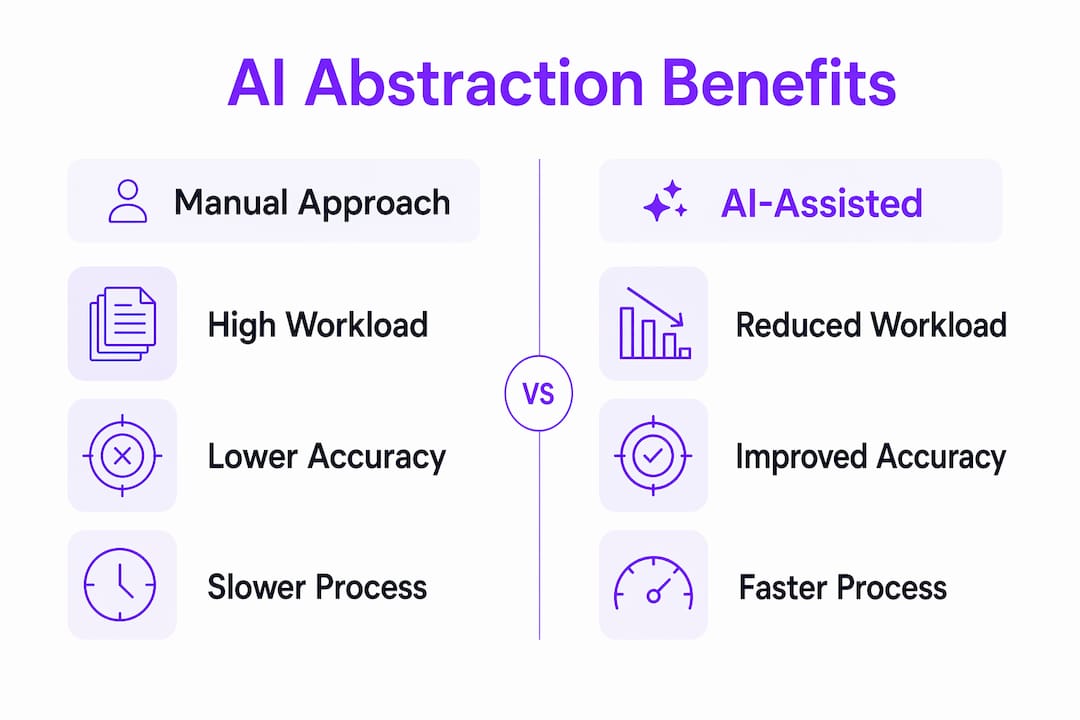
Accuracy is equally strong. A local schema-constrained language model pipeline achieved 83.6% accuracy in abstract screening with error-free metadata recovery and thematic evidence mapping. That level of accuracy is competitive with inter-rater agreement rates in manual dual-reviewer protocols.
| Task | Manual approach | AI-assisted approach |
|---|---|---|
| Title and abstract screening | Full manual review of every record | 57.3% reduction in records needing review |
| Metadata extraction | Researcher reads and transcribes | Automated schema-constrained extraction |
| Thematic mapping | Subjective categorization | Structured evidence mapping at 83.6% accuracy |
| Workload per reviewer | High, prone to fatigue errors | Reduced by approximately 77.8% |
| Fallback and audit | Ad hoc | Systematic human audit layer required |
The table above shows where AI abstraction creates the largest gains. Screening and metadata extraction benefit most because they are high-volume, low-ambiguity tasks. Thematic synthesis still requires researcher judgment, but AI abstraction reduces the cognitive load that precedes that judgment.
Human audits remain non-negotiable. The same pipeline that achieved 83.6% accuracy flagged that full-text synthesis remains essential for mechanistic precision. AI abstraction improves throughput. It does not replace the interpretive work that defines good research.
What are the challenges and nuances in applying AI abstraction in research?
AI abstraction carries real risks when researchers treat it as a black box rather than a tool with known limits. The most dangerous failure mode is hidden complexity. When abstraction layers bury how a decision was made, accountability disappears with it.
Clinical AI deployment offers a sharp example. Hiding AI complexity behind abstractions improved sepsis identification by 80% in one deployment, but the same system required formal governance structures to preserve accountability. Without those structures, clinicians could not audit why the model flagged certain patients. The same risk applies to systematic reviews: if a researcher cannot trace why a paper was excluded, the review loses reproducibility.
“AI is most effective when augmenting research judgment explicitly rather than replacing human interpretation, ensuring evidence is traceable and reliable. AI helps surface assumptions and gaps but cannot invent evidence or remove uncertainty.” — Shiza Ali, researcher and writer on responsible AI use
AI hallucination compounds this problem. A model operating behind an abstraction layer can generate plausible-sounding metadata that is factually wrong. Structured prompts and iterative refinement reduce hallucination rates, but they do not eliminate them. Human-led validation remains the only reliable check.
- Hidden complexity removes the audit trail researchers need for reproducibility
- Hallucination risk increases when outputs are accepted without spot-checking
- Over-abstraction can make pipelines brittle when underlying models change
- Loss of nuance occurs when thematic categories are set too broadly in the schema
- Governance gaps emerge when no one owns the validation layer
Pro Tip: Build a validation checklist into every AI-assisted extraction workflow. Spot-check at least 10% of AI outputs against the source text before accepting any batch as final.
How can academic researchers practically implement AI abstraction?
Practical implementation starts with workflow design, not tool selection. Researchers who pick a tool first and build around it often end up with pipelines that break when the tool changes. Researchers who design the abstraction interface first can swap tools without rebuilding.
The duplicate-first, abstract-later strategy works well for new pipelines. Let the AI generate concrete outputs for a small pilot batch. Review those outputs manually. Once stable patterns emerge, refactor the prompts and schemas into reusable abstractions. This approach, drawn from clean code economics with AI, prevents premature abstraction from locking in the wrong assumptions.
Prompt engineering is the most underrated skill in AI-assisted research. Structured output design, where the prompt specifies exact field names, data types, and acceptable values, dramatically reduces the cleanup work after extraction. Iterative refinement means testing each prompt change on a held-out sample before applying it to the full corpus.
- Map your workflow pain points first. Identify which tasks consume the most time and carry the highest error risk before designing any abstraction.
- Run a pilot batch manually. Extract data from 20–30 papers by hand to establish a ground truth before comparing AI outputs.
- Design structured output schemas. Specify field names, value types, and constraints in your prompts to get table-ready outputs.
- Implement iterative prompt refinement. Test prompt changes on a held-out sample. Never apply untested prompts to your full dataset.
- Schedule human audits at fixed intervals. Audit at least 10% of extracted records per batch. Document every correction as a training signal.
- Use AI as a critique partner. Ask the model to identify gaps or contradictions in your extracted data, not just to fill fields.
Peer-reviewed extraction adds another layer of reliability. Peer-reviewed extraction practices confirm that dual-reviewer validation, even when one reviewer is AI-assisted, produces more consistent results than single-reviewer manual extraction. The AI abstraction layer handles volume. The human reviewer handles judgment.
Pro Tip: Treat your prompt library as a living document. Version-control your prompts the same way you version-control your data. When a model update changes your outputs, you need to know exactly what changed and why.
What are the emerging trends shaping AI abstraction in academic research?
AI agent architectures represent the next major abstraction layer in research workflows. Rather than a single model processing a single task, agent systems chain multiple models together, each handling a specialized subtask. AI agents as abstraction layers allow researchers to delegate entire workflow segments, from database querying to citation formatting, without managing each step manually.
The economic logic behind this shift is clear. Interface abstraction shifts the researcher’s focus from syntactic detail to semantic comprehension. When AI handles the mechanical work of organizing references and filling extraction tables, researchers can spend more time on the interpretive questions that only domain expertise can answer.
- AI agent chains automate multi-step research tasks end to end
- Human oversight requirements are growing as delegation increases
- Expert validation is becoming a formal role in AI-augmented research teams
- Abstraction interfaces are replacing direct model interaction as the standard workflow design
- Audit trail standards are emerging as a best practice across disciplines
The growing emphasis on human oversight is not a reaction against AI abstraction. It is a recognition that abstraction works best when accountability is built into the design. Researchers who treat oversight as an add-on rather than a core component will face reproducibility problems as their pipelines scale.
Key Takeaways
AI abstraction in research delivers its largest gains when researchers design validation and accountability into the abstraction layer from the start, not as an afterthought.
| Point | Details |
|---|---|
| Workload reduction is substantial | ML screening tools reduce abstract review workload by approximately 77.8%, per the 2026 EULAR report. |
| Accuracy is high but not perfect | Schema-constrained pipelines reach 83.6% accuracy; human audits remain necessary for full reliability. |
| Abstraction design precedes tool selection | Define interfaces after identifying workflow pain points to avoid brittle, over-engineered pipelines. |
| Human judgment stays non-negotiable | AI surfaces assumptions and gaps but cannot replace interpretive research judgment or audit trails. |
| Agent architectures are the next frontier | AI agent chains will automate multi-step research workflows, making oversight design more critical than ever. |
Why I think most researchers are using AI abstraction backwards
Most researchers I have seen adopt AI tools start with the output they want and work backwards. They find a tool that produces something close to what they need, accept the defaults, and move on. That approach works until it doesn’t. When the model updates, when the schema breaks, when a batch of extractions turns out to be subtly wrong, there is no audit trail to diagnose the problem.
The researchers who get the most out of AI abstraction do the opposite. They start with the question: what decisions am I making, and which ones can I safely delegate? That framing keeps human judgment at the center of the workflow instead of treating it as a fallback for when the AI fails.
The 77.8% workload reduction from ML-assisted screening is real. But that number only holds if the 22.2% of work that remains is done with full attention and rigor. AI abstraction frees up cognitive capacity. What researchers do with that capacity determines whether the review is better or just faster.
The uncomfortable truth is that AI abstraction raises the bar for researchers, not lowers it. When the mechanical work is automated, the quality of your interpretive judgment becomes the differentiating factor. That is a good thing. But it requires researchers to stay engaged with the underlying evidence, not just the AI’s summary of it. Organizing references with AI is a genuine efficiency gain. Letting AI organize your thinking is a different matter entirely.
— Ubada
Papersynapse puts AI abstraction to work for your literature review
Systematic literature reviews are where AI abstraction delivers the clearest return. The volume of papers, the repetitive nature of screening, and the need for structured extraction all make reviews an ideal candidate for AI-assisted workflows.

Papersynapse is built specifically for this workflow. Researchers import references from Scopus or Web of Science, and the platform’s AI reads abstracts and fills structured extraction tables automatically. Papersynapse processes up to 200 papers in under two minutes, integrating extraction, normalization, and analysis in one place. The result is a systematic literature review process that is faster, more consistent, and easier to audit than manual extraction. If you are running a literature review and want to see what AI-assisted extraction looks like in practice, Papersynapse is worth a close look.
FAQ
What is AI abstraction in research?
AI abstraction in research is the process of hiding complex model operations behind clean, reusable interfaces so researchers interact with structured outputs rather than raw model logic. It reduces cognitive load and speeds up tasks like abstract screening and data extraction.
How much time can AI abstraction save in literature reviews?
Machine learning screening tools can reduce researcher workload by approximately 77.8%, cutting the number of abstracts requiring manual review by an average of 57.3%.
Is AI abstraction accurate enough for systematic reviews?
A schema-constrained language model pipeline achieved 83.6% accuracy in abstract screening, but manual audits and full-text synthesis remain necessary to reach the precision standards systematic reviews require.
What is the biggest risk of using AI abstraction in research?
The biggest risk is hidden accountability. When abstraction layers obscure how a decision was made, researchers lose the audit trail needed for reproducibility. Human-led validation at regular intervals is the standard mitigation.
How should graduate students start using AI abstraction in their research?
Start with a pilot batch of 20–30 papers extracted manually to establish ground truth, then compare AI outputs against that baseline. Use structured output design and iterative prompt refinement before scaling to your full corpus.