The Role of AI in Literature Synthesis: 2026 Guide
The Role of AI in Literature Synthesis: 2026 Guide
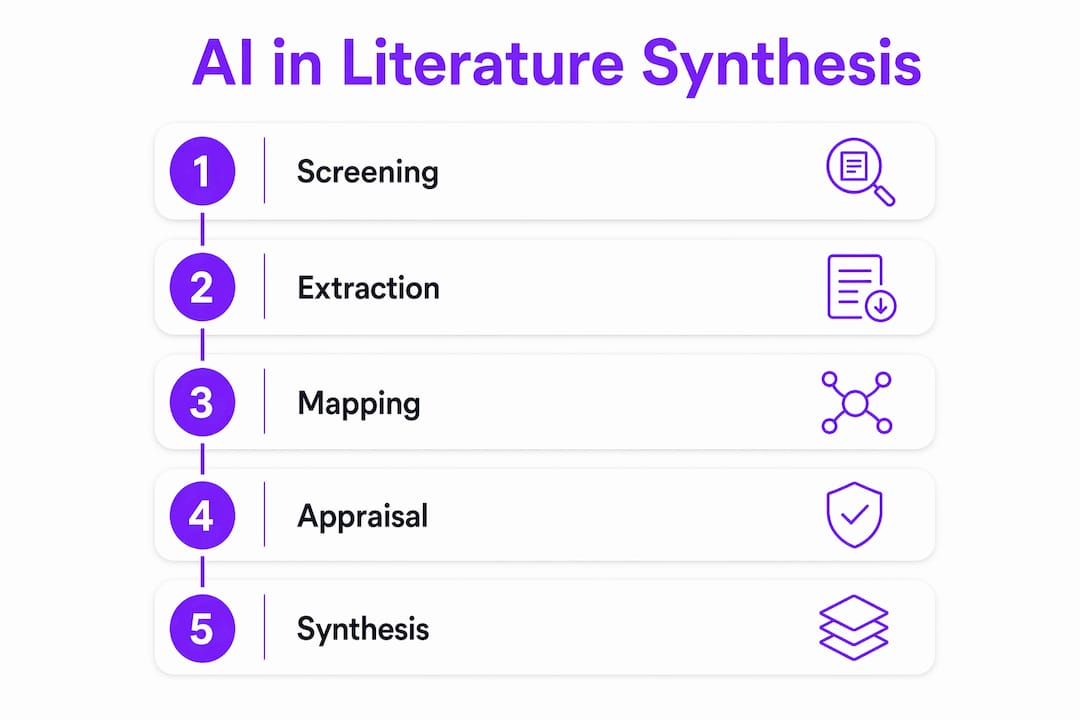
AI in literature synthesis is defined as the application of machine learning and natural language processing to automate document screening, data extraction, and thematic mapping within systematic review workflows. The role of AI in literature synthesis has shifted from experimental to expected: graduate students and academic researchers now use AI tools to process thousands of papers in the time it once took to read dozens. Institutional guidelines as of 2026 still mandate human oversight for all AI-generated outputs, because no system guarantees accuracy in summarizing complex academic findings. AI accelerates the process. Humans determine what the findings mean.
How does AI accelerate literature screening and data extraction?
AI shortens the most time-consuming phase of any systematic review: the initial screening of hundreds or thousands of abstracts. AI-driven platforms reduce cognitive load during this phase by filtering irrelevant studies before a researcher reads a single word. That shift lets you spend your attention on analysis rather than triage.
The core technology behind this speed is the transformer model, a type of neural network trained to understand context and meaning in text. Transformer models power natural language processing pipelines that read abstracts, detect thematic relevance, and flag studies for inclusion or exclusion. Some systems screen hundreds of abstracts for thematic relevance in under 120 seconds. That speed represents a reduction in manual labor that would otherwise take days.

Data extraction follows screening. AI tools read full-text papers and pull structured information: study design, sample size, outcome measures, and statistical results. They populate tables automatically, reducing the subjective judgment that creeps into manual extraction. The result is a more consistent dataset before human review begins.
Researchers working with large corpora benefit most from this automation. A meta-analysis covering 500 studies becomes manageable when AI handles the first pass. You still verify every extracted data point, but you start from a structured draft rather than a blank table.
Pro Tip: Always run a validation set of 20–30 papers you have already screened manually. Compare AI decisions against your own. If agreement falls below 85%, adjust your inclusion criteria prompts before scaling.
Key capabilities AI brings to screening and extraction:
- Abstract classification: Transformer models assign relevance scores based on your PICO criteria.
- Full-text parsing: AI reads PDFs and extracts structured fields into tables.
- Deduplication: Algorithms identify duplicate records across Scopus, Web of Science, and PubMed imports.
- Thematic clustering: AI groups papers by topic before you read them, surfacing patterns early.
Why human expertise still defines the quality of AI-assisted synthesis
Researchers often overestimate AI’s autonomy. Experts consistently frame AI as a tool requiring informed human guidance, not a replacement for critical appraisal. The distinction matters because the errors AI makes are not random. They are confident and plausible.
AI hallucination is the most serious risk in automated literature synthesis. A model may generate a citation that looks real, with a plausible author name, journal, and year, but the paper does not exist. AI often produces fabricated citations that pass a surface-level check. Every synthesized claim requires manual verification against the original source.
Conceptual synthesis is the second area where AI falls short. Qualified humans must perform the critical appraisal and conceptual synthesis that define academic rigor. AI can identify that two studies measured the same outcome. It cannot reliably judge whether their methodologies are comparable or whether one study’s design undermines its conclusions.
Pro Tip: Use the PICO framework (Population, Intervention, Comparison, Outcome) to structure your AI prompts. Tailored prompts using PICO yield significantly more relevant outputs than open-ended queries.
Four human review checkpoints that no AI tool replaces:
- Methodological appraisal: Assess study design, bias risk, and internal validity for each included paper.
- Citation verification: Confirm every AI-generated reference against the original database record.
- Conceptual interpretation: Determine what the pattern of findings means for your research question.
- Ethical compliance check: Verify that AI-assisted methods are disclosed per your institution’s authorship and transparency policies.
What AI tool capabilities matter most for literature synthesis?
AI tools vary significantly by the synthesis stage they support. Understanding where each capability applies helps you select the right approach for your workflow. The table below maps synthesis stages to AI support levels and their practical limits.
| Synthesis stage | AI support level | Key technology | Primary limitation |
|---|---|---|---|
| Discovery and search | Moderate | Semantic search, RAG | Coverage gaps vs. traditional databases |
| Abstract screening | High | Transformer models, NLP | Requires validation against manual review |
| Full-text extraction | High | Document parsing, table filling | Errors in complex tables and figures |
| Concept mapping | Moderate | Clustering algorithms | Misses nuanced argumentative relationships |
| Narrative synthesis | Low | Large language models | Lacks academic argumentative structure |
| Citation grounding | Moderate | RAG, MCP integration | Hallucination risk remains present |
Two technologies deserve specific attention: retrieval-augmented generation (RAG) and model context protocol (MCP). RAG retrieves relevant documents and feeds them into a model’s context window before generating a response. MCP standardizes how AI systems connect to external databases. Together, they improve citation grounding and reduce the chance of fabricated references.
AI tools are better at mapping relationships among studies than composing narrative syntheses. This is a critical distinction for researchers writing systematic reviews for publication. Use AI to build your concept map and identify clusters of evidence. Write the narrative yourself.
When selecting an AI approach for your review, prioritize tools that limit searches to verified academic databases rather than general web content. Academic database integration protects the integrity of your source pool and reduces the risk of including gray literature without disclosure.
How to integrate AI into systematic reviews responsibly
Responsible integration starts before you open any AI tool. Define your research question using a structured framework. PICO works well for clinical questions. SPIDER (Sample, Phenomenon of Interest, Design, Evaluation, Research type) suits qualitative reviews. A clear framework produces better prompts and better outputs.
The integration process follows a logical sequence:
- Export your reference pool from Scopus or Web of Science using your database search string. Import the file into your AI platform.
- Set inclusion and exclusion criteria as explicit prompt instructions. Be specific: “Include only randomized controlled trials published after 2015 in adult populations.”
- Run AI screening on the full abstract set. Review the AI’s decisions on a validation sample before accepting the full output.
- Extract structured data using AI-generated tables. Verify each row against the source paper before analysis.
- Use AI for concept mapping. Ask the model to identify thematic clusters across included studies. Use the map to organize your synthesis sections.
- Write the narrative synthesis yourself. Use AI outputs as a structured scaffold, not as final text.
Pro Tip: Rerun queries across multiple AI tools and compare results. AI search is less replicable than traditional database searches, so cross-referencing tools reduces coverage gaps.
Ethical considerations are non-negotiable. Disclose AI tool use in your methods section, specifying which tasks AI performed and how you verified outputs. Most journals and institutions now require this disclosure. Copyright questions around AI training data remain unresolved in many jurisdictions, so avoid submitting AI-generated text as your own prose without substantial revision.
AI also excels at identifying research gaps through literature mapping. After clustering your included studies, ask the model to identify topics that appear in your search results but lack sufficient primary research. That output gives you a starting point for your “future research directions” section.
Key Takeaways
AI in literature synthesis accelerates screening and extraction but requires human critical appraisal at every stage to maintain academic rigor.
| Point | Details |
|---|---|
| AI role is assistive, not autonomous | AI automates screening and extraction; humans perform appraisal and conceptual synthesis. |
| Speed gains are real and significant | Some platforms screen hundreds of abstracts in under 120 seconds, cutting days of manual work. |
| Hallucination risk is non-negotiable | Every AI-generated citation must be verified against the original database record. |
| PICO prompts improve output quality | Structured evidence frameworks produce more relevant AI synthesis results than open queries. |
| Concept mapping beats narrative generation | AI maps relationships among studies more reliably than it writes argumentative prose. |
AI in research is a skill, not a shortcut
I have watched graduate students treat AI tools as a finishing step rather than a starting point. That is the wrong mental model. The researchers who get the most out of AI-assisted synthesis are the ones who invest time upfront in defining their question precisely and structuring their prompts carefully. The tool reflects the quality of your thinking back at you.
What genuinely surprises me is how much AI improves the discovery phase rather than the synthesis phase. When you use semantic search to surface papers your keyword string missed, you find studies that change your conclusions. That is not a minor efficiency gain. That is a substantive improvement in research quality.
The caution I would offer every graduate student: AI confidence does not equal accuracy. A model that generates a fluent, well-formatted citation is not more likely to be correct than one that hedges. Treat every AI output as a draft from a very fast, occasionally unreliable research assistant. You are still the expert. The model is not.
The future of AI-assisted literature reviews will likely involve tighter integration between AI tools and institutional repositories, with better audit trails for reproducibility. Until that infrastructure matures, the researchers who combine AI speed with disciplined human verification will produce the most credible systematic reviews.
— Ubada
Papersynapse: built for systematic literature synthesis
Papersynapse is an AI platform designed specifically for the systematic review workflow that academic researchers and graduate students run every day.
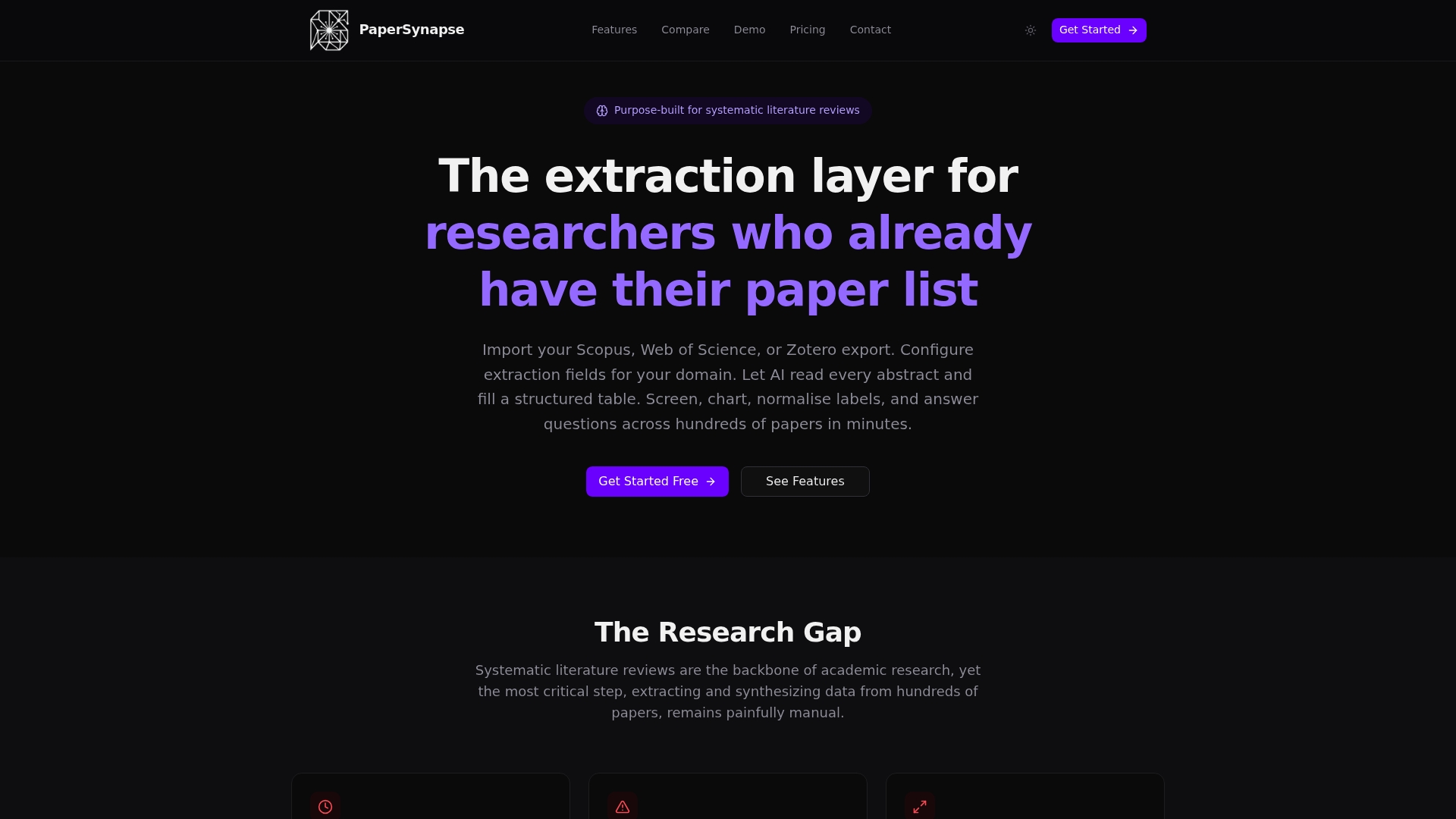
You import your reference list from Scopus or Web of Science, and Papersynapse reads each abstract, fills structured extraction tables, and normalizes data across papers. The platform processes up to 200 papers in under two minutes, which means your first structured dataset is ready before your first coffee. Extraction, normalization, and analysis live in one place, so you are not copying data between tools. If you want to see how AI handles the data extraction stage of your next review, Papersynapse is worth a close look.
FAQ
What is the role of AI in literature synthesis?
AI in literature synthesis automates document screening, data extraction, and thematic mapping to reduce manual workload. Human researchers must still perform critical appraisal and conceptual synthesis to maintain academic rigor.
Can AI replace human review in a systematic literature review?
No. Institutional guidelines as of 2026 require human evaluation of all AI-generated outputs because AI systems produce hallucinations and cannot perform methodological appraisal or conceptual interpretation.
What is retrieval-augmented generation in literature synthesis?
Retrieval-augmented generation (RAG) retrieves relevant academic documents and feeds them into an AI model’s context before generating a response. This improves citation grounding and reduces fabricated references compared to standard language model outputs.
How does prompt engineering improve AI literature synthesis?
Structured prompts using frameworks like PICO produce significantly more relevant AI outputs than open-ended queries. Specifying population, intervention, comparison, and outcome in your prompt focuses the model on your exact research question.
How should I disclose AI use in a systematic review?
Disclose which tasks AI performed, which tools you used, and how you verified outputs in your methods section. Most journals and institutions now require this transparency as a condition of publication.