The Role of AI in Organizing References for Researchers
The Role of AI in Organizing References for Researchers
AI reference management is defined as the use of machine learning and natural language processing to automate citation formatting, metadata extraction, and bibliographic organization across academic research workflows. The role of AI in organizing references has shifted from a convenience to a core research skill. Tools connected to databases like Crossref, PubMed, and OpenAlex now handle tasks that once consumed hours of a researcher’s week. Platforms like Papersynapse go further, processing up to 200 papers in under two minutes by reading abstracts and filling structured extraction tables automatically. The result is faster literature reviews with fewer formatting errors and more consistent source attribution.
What tasks in reference organization does AI automate and improve?
AI automates the most repetitive parts of reference management, starting with metadata extraction and citation formatting. Instead of manually typing author names, journal titles, and publication years, AI reads source documents and populates those fields automatically. Citation formatting across styles like APA 7 and IEEE happens in seconds rather than minutes per source. That speed compounds fast when you are managing a library of 300 or 400 papers.

Beyond formatting, AI summarizes large literature collections by extracting key findings from abstracts and full texts. A researcher reviewing 150 papers on climate adaptation no longer needs to read every abstract in full before deciding relevance. AI flags the most pertinent findings and groups papers by theme or methodology. That kind of semantic search and discovery also extends to citation network expansion, where AI suggests related papers you may have missed.
Duplicate detection is another area where AI outperforms manual review. The same paper can appear in a library under slightly different titles, DOI formats, or author name spellings. AI catches those inconsistencies before they create confusion in a final bibliography. Inconsistency in references is one of the most common reasons reviewers flag manuscripts for revision.
- Metadata extraction: AI reads PDFs and web sources to pull author, title, year, journal, and DOI fields without manual input.
- Citation formatting: AI applies APA 7, IEEE, Chicago, and other styles automatically after metadata is confirmed.
- Summarization: AI distills key findings from abstracts, reducing the time spent reading papers before screening decisions.
- Duplicate detection: AI identifies repeated entries across different naming conventions or DOI formats.
- Citation network expansion: AI recommends related papers based on semantic similarity to your existing library.
Pro Tip: Run duplicate detection before you begin any AI summarization. Cleaning your library first means AI works from accurate, non-redundant data, and your synthesis will be far more reliable.
How do AI tools integrate with traditional reference managers for verification?
The most reliable AI reference management workflow uses three distinct layers, each with a specific job. The first layer is a stable reference manager that serves as your source of record. The second layer is a metadata verification API. The third layer is AI, used only for synthesis and cleanup after the first two layers have confirmed source accuracy.
Multi-layer verification blocks citations that fail authenticity checks against databases holding 150 million or more records. Crossref, PubMed, and OpenAlex each serve different research domains. Crossref covers journal articles and conference papers broadly. PubMed specializes in biomedical and life sciences literature. OpenAlex offers open-access coverage across disciplines. Running a citation through at least one of these APIs before treating it as confirmed is the standard that Harvard Library advises for any tool-assisted workflow.
AI hallucination is the central risk in this layer. Large language models sometimes generate DOIs, author names, or journal titles that look real but do not exist. Those fabricated details pass a visual check but fail an API lookup. Connecting AI tools to live metadata lookups reduces hallucination risk by flagging unverifiable citations before they reach your bibliography.
| Workflow layer | Primary function | Key tools |
|---|---|---|
| Reference manager | Source of record and stable library | Desktop and cloud reference managers |
| Metadata verification API | Authenticity check against live databases | Crossref, PubMed, OpenAlex |
| AI synthesis layer | Summarization, tagging, and formatting | Papersynapse, AI writing assistants |
Citation formatting should always be the final step, applied only after metadata has been confirmed correct. Formatting an incorrect record just makes the error look polished.
Pro Tip: Verify DOIs by pasting them directly into doi.org before finalizing any citation. A working DOI resolves to the actual paper. A hallucinated one returns a 404 error.
What are the transparency and ethical considerations when using AI for references?
Transparency in AI-assisted research means labeling which outputs were generated or summarized by AI, not just which sources were cited. Transparency tagging using an “AI:” prefix on machine-generated notes is an emerging standard that gives reviewers and co-authors a clear audit trail. Without that label, it becomes impossible to distinguish a researcher’s own reading notes from an AI-generated summary.
Academic integrity policies at most universities now address AI use in some form, though standards for citing AI outputs in reference lists are still evolving. The core principle is consistent: disclose AI involvement wherever it shaped the content. That applies to summaries, paraphrases, and even organizational decisions like how papers were grouped by theme.
Transparency also protects against misattribution. If an AI-generated summary slightly misrepresents a source’s argument, and that summary is not labeled, the error gets attributed to the researcher. Labeling AI outputs creates a checkpoint where a human reviewer can catch and correct the mistake before it reaches publication.
Responsible AI use in reference organization follows a few clear principles:
- Label all AI-generated notes, summaries, and tags with a clear prefix like “AI:” so collaborators and auditors can identify them.
- Disclose AI tool use in your methods section when AI shaped how sources were selected, grouped, or summarized.
- Never cite an AI-generated summary as a substitute for reading the original source on a critical claim.
- Review AI-tagged categories before finalizing any thematic grouping in a literature review.
- Check your institution’s current AI use policy before submitting work that involved AI-assisted reference organization.
What challenges and pitfalls should researchers watch for with AI reference tools?
The most common mistake researchers make is treating AI as a primary source finder rather than a citation cleanup assistant. AI excels at organizing and summarizing what you have already collected. It is far less reliable at independently discovering the right sources from scratch. Researchers who rely on AI as a sole truth source risk building literature reviews on an incomplete or inaccurate foundation.
Hallucinated metadata is the most technically damaging pitfall. Fabricated DOIs and incorrect metadata are common issues with large language models, and they are easy to miss because the citation looks structurally correct. A paper titled “Climate Adaptation in Urban Systems” with a plausible-looking DOI may not exist at all. Only a live database lookup confirms the difference.
Orphaned notes create a slower but equally serious problem. When researchers jump straight into AI summaries without an organized library, notes accumulate without clear source attribution. Weeks later, it becomes impossible to trace which paper a specific finding came from. Building an organized library before AI synthesis prevents this entirely.
A practical approach to avoiding these pitfalls:
- Build your source library in a reference manager first, before running any AI analysis.
- Verify every DOI and metadata field against Crossref or PubMed before treating a citation as confirmed.
- Label all AI-generated notes at the moment of creation, not after the fact.
- Read the original source for any claim that will appear in your argument or conclusions.
- Treat AI outputs as drafts from a junior assistant, not as finished, authoritative content.
Pro Tip: Set a rule for yourself: any finding you plan to quote or cite directly must be verified against the original PDF, not just the AI summary. This single habit eliminates most hallucination-related errors.
How can researchers build an AI-assisted reference workflow that actually works?
A reliable AI-assisted workflow starts with structure, not speed. The goal is to build a stable, verified library first, then use AI to work through it faster. Skipping the foundation step is the reason most AI-assisted literature reviews run into accuracy problems later. Reference management tools play a central role in establishing that foundation before any AI layer is added.
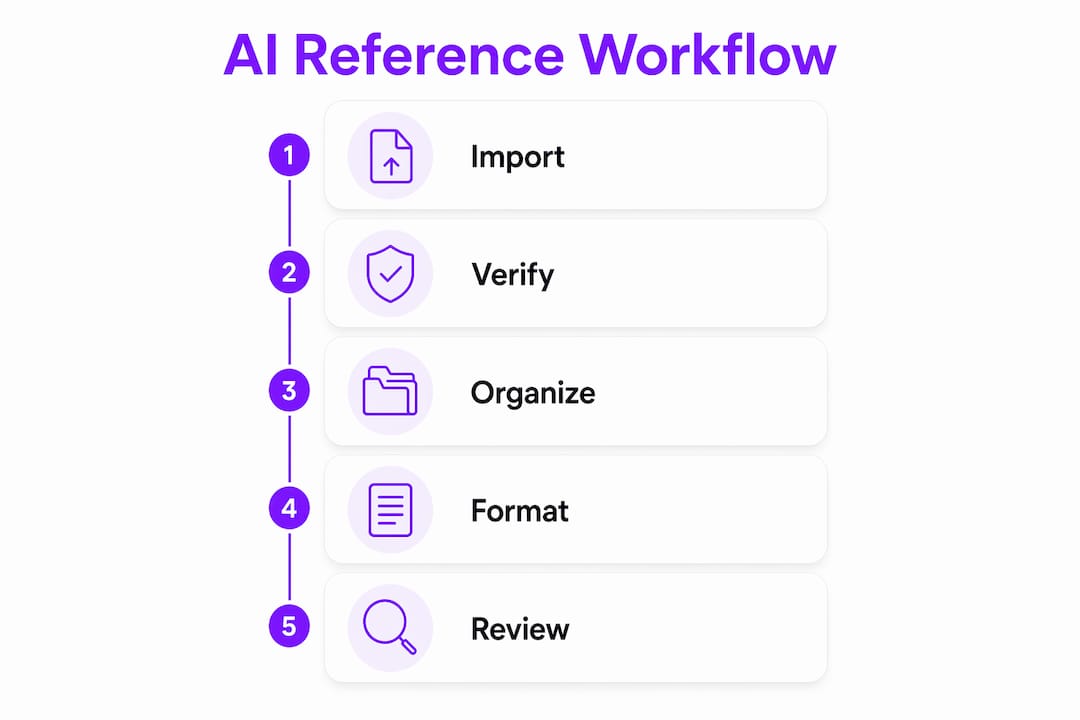
The recommended sequence works like this. First, import references from databases like Scopus or Web of Science into your reference manager. Second, verify metadata for each source using Crossref or PubMed. Third, use AI to summarize, tag, and group confirmed sources by theme or methodology. Fourth, review all AI-generated tags and summaries before treating them as final. Fifth, apply citation formatting only after metadata is confirmed correct.
Data consistency across your library is what makes AI synthesis reliable. When author names, journal titles, and publication years are standardized, AI grouping and tagging produces far more accurate results. Inconsistent metadata confuses AI categorization and creates errors that are hard to trace.
Practical features to use once your library is structured:
- Semantic tagging: Use AI to assign thematic tags to papers based on abstract content, then review and adjust the tags manually.
- Citation suggestions: Let AI recommend related papers based on your confirmed library, then verify each suggestion before adding it.
- Argument finding: Use AI to surface papers that support or contradict a specific claim, then read the relevant sections yourself.
- Batch formatting: Apply citation style formatting to your entire verified library in one step at the end of the process.
Papersynapse applies this workflow directly. Researchers import references from Scopus or Web of Science, and the platform uses AI to read abstracts and fill structured extraction tables. That process handles up to 200 papers in under two minutes, with results organized for immediate review and analysis.
Key Takeaways
AI reference management works best when it operates on a verified, well-structured library rather than as a first-pass source discovery tool.
| Point | Details |
|---|---|
| Build the library first | Import and verify sources in a reference manager before running any AI analysis. |
| Use three-layer verification | Combine a reference manager, a metadata API like Crossref, and AI synthesis in sequence. |
| Label AI outputs clearly | Add an “AI:” prefix to machine-generated notes to maintain audit trails and protect integrity. |
| Treat AI as a draft assistant | Review all AI-generated summaries and tags before using them in arguments or conclusions. |
| Format citations last | Apply citation style formatting only after metadata has been confirmed correct. |
Why I think most researchers are using AI reference tools backwards
Most researchers I have seen approach AI reference tools the same way: they open the tool, type a research question, and expect a ready-made bibliography. That approach almost always produces problems. The AI returns citations that look authoritative, the researcher accepts them, and the errors surface weeks later during peer review or a supervisor’s check.
The verification-first mindset flips that sequence entirely. You collect sources through established databases, confirm their metadata against live APIs, and only then bring AI into the process. At that point, AI is genuinely useful. It groups 200 confirmed papers by theme in minutes, surfaces patterns across abstracts, and flags gaps in your coverage. That is a powerful research tool. Used on unverified data, it is a liability.
The transparency piece is where I think the field is still catching up. Labeling AI-generated notes with an “AI:” prefix sounds like a small administrative step, but it changes how you relate to your own notes. You stop treating AI summaries as your own reading and start treating them as a starting point that needs your judgment. That shift in mindset is what separates researchers who use AI well from those who get burned by it.
AI will keep getting better at reference organization. The structured research database habits that make AI useful today will still matter when the tools are far more capable. The researchers who build those habits now will get the most out of every improvement that follows.
— Ubada
Papersynapse: AI-powered reference organization for systematic reviews
Researchers who want to put these workflows into practice without building them from scratch have a direct path forward.
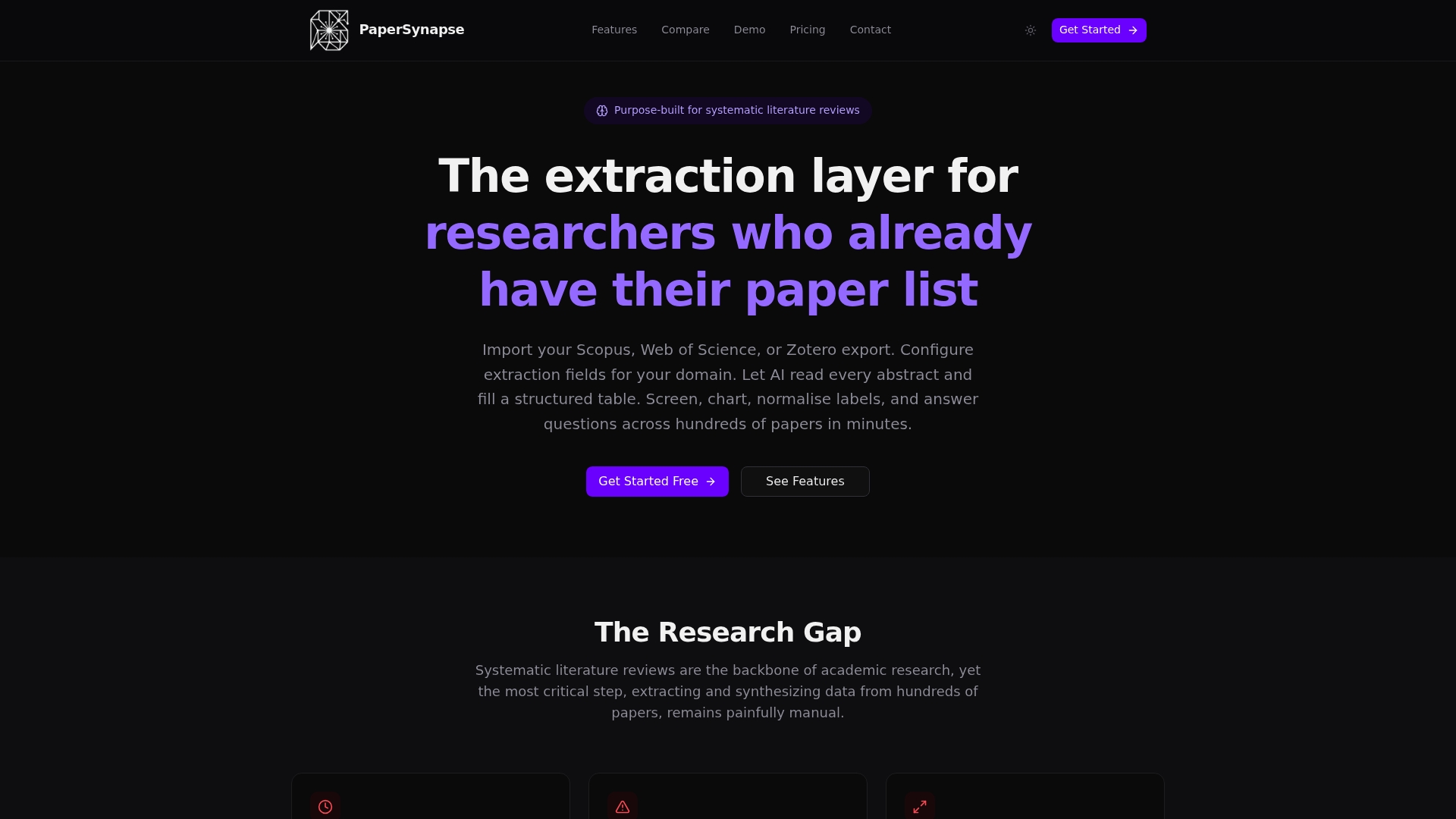
Papersynapse is built around the verification-first approach described throughout this article. Researchers import references directly from Scopus or Web of Science, and the platform uses AI to read abstracts and fill structured extraction tables automatically. Up to 200 papers are processed in under two minutes, with results organized for immediate categorization and analysis. The workflow integrates extraction, normalization, and analysis in one place, which removes the coordination overhead of stitching together separate tools. For researchers running systematic literature reviews who need both speed and accuracy, Papersynapse applies AI where it works best: on a structured, verified library.
FAQ
What is the role of AI in organizing references?
AI automates citation formatting, metadata extraction, duplicate detection, and thematic grouping across large reference libraries. Its primary role is to reduce manual effort after sources have been collected and verified.
Can AI tools generate accurate citations on their own?
AI tools frequently produce hallucinated DOIs and incorrect metadata when generating citations independently. Verifying every citation against databases like Crossref or PubMed before use is required to catch these errors.
How does AI integrate with traditional reference managers?
The most reliable workflow uses a reference manager as the source of record, a metadata API for verification, and AI only for synthesis and formatting after both earlier steps are complete.
What is transparency tagging in AI-assisted research?
Transparency tagging means labeling AI-generated notes and summaries with a prefix like “AI:” so collaborators and reviewers can distinguish machine-generated content from a researcher’s own analysis.
How do I avoid orphaned notes when using AI for references?
Build and organize your reference library in a reference manager before running any AI summarization. Jumping to AI synthesis without a structured library leads to notes with no traceable source attribution.