The Role of Normalization in Data Extraction
The Role of Normalization in Data Extraction

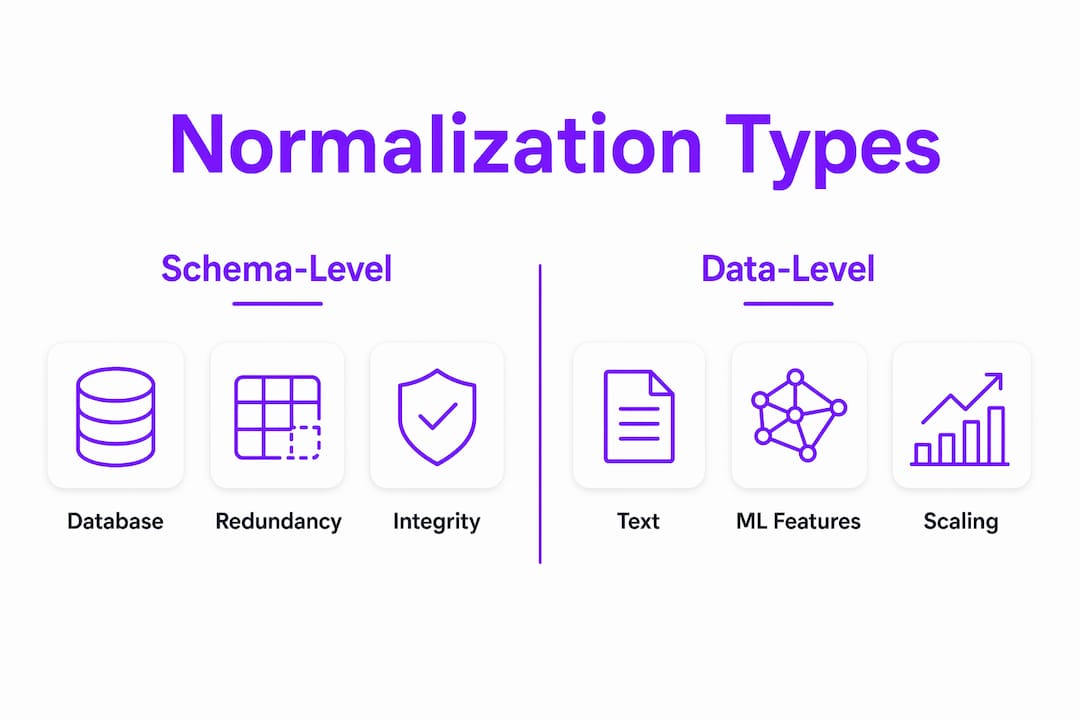
Normalization in data extraction is the process of converting raw, heterogeneous extracted data into a consistent, standardized format that downstream systems can actually use. Without it, dates arrive as “Jan 5, 2024,” “01/05/24,” and “2024-01-05” in the same dataset. That variability breaks analytics pipelines, corrupts AI training sets, and forces costly manual cleanup. The role of normalization in data extraction extends across three distinct domains: text normalization, database normalization governed by normal forms (1NF through 3NF), and machine learning feature scaling techniques like Min-Max Scaling and Z-Score Standardization. Each serves a different purpose, and conflating them causes real architectural damage.
What are the main types of normalization in data extraction?
Three distinct normalization types operate in data extraction workflows, and each targets a different layer of the data problem.
Text normalization converts unstructured extracted strings into canonical forms. A date field becomes ISO 8601 format (“2024-01-05”), a phone number becomes E.164 format (“+12025551234”), and a currency value becomes a decimal paired with a currency code (“USD 1,234.56”). As canonical format conversion shows, without this step, extracted text remains unusable strings rather than reliable, queryable data. Text normalization is the first line of defense in any extraction pipeline.

Database normalization operates at the schema level. It applies normal forms to relational tables to eliminate redundancy and prevent update, insert, and delete anomalies. Normal forms (1NF to 3NF) enforce the principle that each fact is stored exactly once. That constraint matters enormously when you are managing thousands of records: a single address stored in five places creates five opportunities for inconsistency.
ML feature normalization rescales numeric columns so that distance-based and gradient-based algorithms treat each feature equally. Without it, a feature measured in thousands (annual salary) dominates a feature measured in single digits (years of experience), skewing model outputs. Min-Max Scaling and Z-Score Standardization are the two standard techniques, and choosing between them depends on whether your data contains outliers that would distort a fixed range.
| Type | Goal | Common methods | When to apply |
|---|---|---|---|
| Text normalization | Canonical string formats | ISO 8601, E.164, currency codes | Immediately after extraction |
| Database normalization | Remove schema redundancy | 1NF, 2NF, 3NF | During schema design |
| ML feature scaling | Equal feature weighting | Min-Max, Z-Score | Before model training |
These three types are complementary, not interchangeable. A pipeline that applies only one and ignores the others will still produce unreliable outputs.
How does normalization improve data quality and extraction accuracy?
Raw extracted data is almost always inconsistent. A single document batch can contain the same entity spelled three different ways, dates in four formats, and phone numbers with or without country codes. That variability produces duplicate records, failed joins, and silent errors that propagate through every downstream system.
Normalization enforces a strict contract between the extraction layer and the analytics layer. Treating normalization as a contract prevents “poisoned” data from corrupting dashboards and AI models before anyone notices the problem. The cost of catching an error at the normalization stage is a fraction of the cost of tracing it back from a broken report six weeks later.
The concrete improvements normalization delivers include:
- Deduplication accuracy. Matching “Dr. Jane Smith” to “Jane Smith, MD” requires text normalization before any deduplication algorithm can work reliably.
- Join reliability. Database joins on date or ID fields fail silently when formats differ. ISO 8601 dates eliminate that class of error entirely.
- Model fairness. ML models trained on unnormalized features develop systematic bias toward high-magnitude variables, skewing predictions in ways that are hard to diagnose after the fact.
- Audit trail integrity. Normalized data produces consistent logs, making compliance reporting and exception handling far more tractable.
Pro Tip: Run a format-frequency audit on every extracted field before writing your normalization rules. If 95% of dates arrive in one format and 5% in another, you need a rule for both. Skipping the minority format guarantees silent failures.
The impact of normalization on data quality is measurable: thorough normalization and post-extraction validation can reduce manual exception handling by 30–50%. That is not a marginal efficiency gain. It is the difference between a pipeline your team trusts and one they constantly babysit.
What are best practices and common pitfalls when normalizing extracted data?
The single most important rule in normalization is timing. Normalize immediately after extraction, before any data touches a database or analytics layer. Failure to normalize at the point of extraction causes errors to propagate downstream, where they become exponentially harder to trace and fix.
A practical normalization workflow follows this sequence:
- Extract raw data from the source document, API, or web page.
- Apply text normalization rules to convert dates, phone numbers, currencies, and identifiers to canonical formats.
- Validate the normalized output against a schema or rule set before writing to storage.
- Log and quarantine any records that fail validation rather than silently dropping or passing them.
- Review quarantine logs on a regular cadence to catch systematic extraction failures early.
The most common pitfall is attempting to normalize inside SQL views during the loading phase. Normalizing in SQL views fails silently or produces cryptic errors that are difficult to diagnose. ETL-stage normalization, applied before data reaches the database, is the reliable alternative.
A second pitfall is underestimating the long-term cost of normalization decisions. Encoding decisions made early in a pipeline carry significant maintenance complexity as source formats evolve. A date format that works for English-language documents may break on multilingual sources. Build your normalization rules to be explicit, versioned, and testable.
Pro Tip: Use established normalization libraries rather than writing custom regex. Python’s dateutil, phonenumbers, and babel libraries handle edge cases that custom rules miss. Fewer edge cases in your rules mean fewer surprises in production.
Normalization also shapes how AI models interpret your data. Arbitrary normalization choices embed assumptions that influence model behavior, which means a careless decision at the pipeline design stage can introduce systemic bias into every model trained on that data. Treat normalization design as a first-class architectural decision, not an afterthought.
How do database normalization and ML normalization differ?
Database normalization and ML normalization share a name and nothing else. Conflating them leads to schema designs that solve the wrong problem. These two types serve distinct purposes and require separate architectural thinking.
Database normalization structures relational tables to eliminate redundancy. First Normal Form (1NF) requires atomic values in each cell. Second Normal Form (2NF) removes partial dependencies on composite keys. Third Normal Form (3NF) eliminates transitive dependencies between non-key columns. The goal is a schema where each fact exists in exactly one place, so updates, inserts, and deletes cannot create conflicting states.
ML normalization has no interest in schema structure. It rescales numeric feature columns so that gradient-based algorithms converge efficiently and distance-based algorithms weight features proportionally. A column with values ranging from 0 to 1,000,000 will dominate a column ranging from 0 to 1 unless both are rescaled to a common range or standardized to zero mean and unit variance.
| Dimension | Database normalization | ML normalization |
|---|---|---|
| Goal | Remove redundancy and anomalies | Rescale features for algorithm fairness |
| Methods | 1NF, 2NF, 3NF | Min-Max Scaling, Z-Score Standardization |
| Applied to | Relational schema design | Numeric feature columns |
| Output | Structured, non-redundant tables | Scaled feature matrices |
| Risk if skipped | Data anomalies, integrity failures | Biased models, slow convergence |
A research database that applies 3NF correctly but skips ML normalization will produce a clean schema and a biased model. Both steps are necessary. Neither substitutes for the other.
What are real-world applications of normalization in research workflows?
Normalization is the step that makes large-scale document extraction usable in practice. Without it, extracted fields from invoices, medical records, or research papers remain inconsistent strings that no downstream system can process reliably.
In systematic literature reviews, normalization is what allows data consistency in research to hold across hundreds or thousands of papers sourced from different journals, databases, and publication years. Author names, publication dates, sample sizes, and outcome measures all arrive in different formats. Normalizing them into a structured table is what makes cross-study comparison possible.
Specific applications where normalization delivers measurable value include:
- Invoice processing. Vendor names, amounts, and dates extracted from PDFs require text normalization before any matching or reconciliation can occur.
- Medical record extraction. Diagnosis codes, medication names, and dosage units must be mapped to standard vocabularies (ICD-10, RxNorm) before clinical analysis.
- Systematic literature reviews. Study characteristics, effect sizes, and population descriptors need canonical formats before meta-analysis tools can aggregate them.
- AI model training datasets. Feature normalization and label standardization directly affect model accuracy and generalizability across different source populations.
Platforms that integrate extraction, normalization, and validation in a single workflow eliminate the gaps where errors typically enter. Researchers using Papersynapse, for example, can import references from Scopus or Web of Science and have AI fill structured tables with normalized fields, processing up to 200 papers in under two minutes. The peer-reviewed extraction quality that results from integrated normalization is what separates a trustworthy literature review from one that requires constant manual correction.
Key Takeaways
Normalization is the foundational step that converts raw extracted data into consistent, structured formats that analytics, AI, and research workflows can trust.
| Point | Details |
|---|---|
| Normalize immediately after extraction | Applying normalization at the ETL stage prevents errors from propagating into storage and downstream systems. |
| Use canonical formats as the standard | ISO 8601 for dates, E.164 for phone numbers, and decimal plus currency code for amounts eliminate format-driven errors. |
| Distinguish database from ML normalization | Database normalization structures schemas; ML normalization rescales features. Conflating them causes architectural errors. |
| Treat normalization as a quality contract | Normalization acts as a strict boundary between extraction and analytics, blocking poisoned data from corrupting reports. |
| Normalization decisions shape AI outcomes | Arbitrary choices in normalization embed assumptions that influence model behavior and can introduce systemic bias. |
Why normalization deserves more respect than it gets
Normalization is the least celebrated step in any data pipeline, and that is exactly why it causes the most damage when it fails. I have seen research teams spend weeks debugging inconsistent meta-analysis results, only to trace the problem back to a date format that was never standardized at extraction. The fix took two hours. The debugging took three weeks.
The deeper issue is that normalization decisions are not purely technical. They are philosophical. When you choose how to represent a date, a name, or a currency, you are encoding an assumption about what that value means. Those assumptions shape how AI models interpret data, and arbitrary choices made under deadline pressure become permanent features of every model trained on that data.
My recommendation is to treat normalization as a “shift-left” quality control step, not a cleanup task. Design your normalization rules before you write your extraction logic. Version them. Test them. Review the types of normalization in research data that apply to your domain before you commit to a schema. The teams that do this spend their time on analysis. The teams that skip it spend their time on data repair.
— Ubada
Papersynapse: built for researchers who need clean data
Researchers who run systematic literature reviews know the real bottleneck is not finding papers. It is extracting, normalizing, and organizing data from hundreds of them without introducing errors.

Papersynapse addresses that bottleneck directly. The platform uses AI to read abstracts, fill structured extraction tables, and apply normalization across imported references from Scopus or Web of Science. Up to 200 papers can be processed in under two minutes, with fields normalized and ready for analysis. The result is a structured research database that holds up under scrutiny, not one that requires manual correction before every use. Researchers who want consistent, reliable extraction without the overhead of building a custom pipeline can start with Papersynapse and see the difference that integrated normalization makes.
FAQ
What is the role of normalization in data extraction?
Normalization converts raw extracted data into consistent, canonical formats that downstream systems can process reliably. Without it, format variation in dates, names, and identifiers produces duplicate records, failed joins, and corrupted analytics.
What are the main data normalization techniques used in extraction pipelines?
The three main techniques are text normalization (converting strings to canonical formats like ISO 8601), database normalization (applying normal forms to eliminate schema redundancy), and ML feature scaling (rescaling numeric columns with Min-Max or Z-Score methods).
Why does normalizing data immediately after extraction matter?
Errors that enter a pipeline before normalization propagate into every downstream system and become exponentially harder to debug. Normalizing at the ETL stage catches problems before they reach storage or analytics layers.
How does normalization affect AI model accuracy?
Normalization choices embed assumptions about data that directly influence how models interpret features. Inconsistent or arbitrary normalization introduces systemic bias and slows gradient-based algorithm convergence.
How does Papersynapse handle normalization in literature reviews?
Papersynapse integrates extraction and normalization in a single workflow, processing up to 200 papers in under two minutes and filling structured tables with consistently formatted fields drawn from Scopus or Web of Science imports.