How to Verify Extraction Accuracy in Research Data: 2026 Guide
How to Verify Extraction Accuracy in Research Data: 2026 Guide

That sequence covers the minimum. Everything else in this guide is about doing it well enough to defend in a methods section.
Minimum verification checklist:
- Pilot double-extraction: Two independent extractors cover the same sample; reconcile every disagreement before proceeding.
- Error rate per field: Count errors divided by total values inspected for each field separately, not across the whole form.
- Reconciliation rule: Define in advance whether disagreements go to a third reviewer or are resolved by consensus discussion.
- AI confidence threshold: Flag any output below your chosen confidence score for mandatory human re-check.
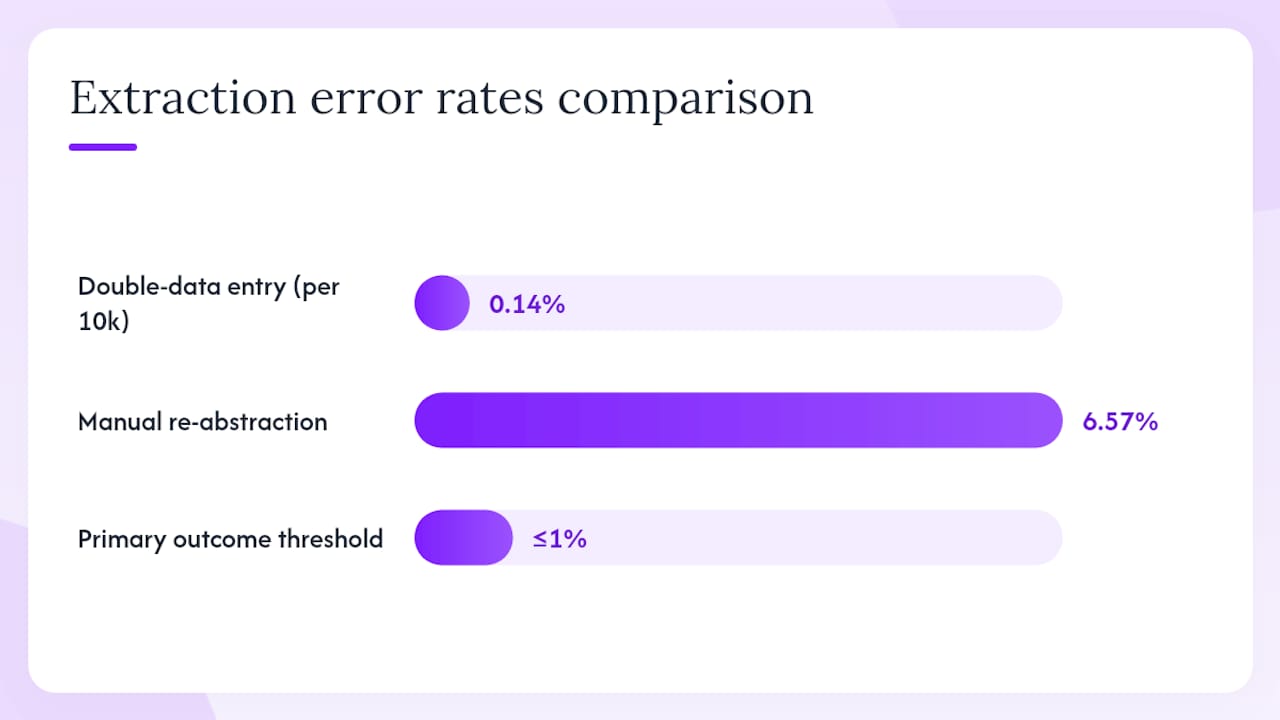
- Acceptable benchmark: Double-data entry pooled error rates run around 0.14% (normalized per 10,000 fields) in clinical research; single extraction without audit runs far higher.
Pro Tip: When selecting your pilot sample, stratify by study design (RCT, cohort, case-control) rather than pulling randomly. Errors cluster by design type, so a stratified sample surfaces the fields most likely to fail before you commit to full extraction.
Key Takeaways
Verifying extraction accuracy in research data requires a defined validation design, field-level error metrics, and transparent reporting — not just a general statement that extraction was checked.
| Point | Details |
|---|---|
| Use field-level error rates | Calculate errors ÷ values inspected per field; pooled double-entry error rates run around 0.14% per 10,000 fields. |
| Match design to stakes | Double independent extraction for primary outcomes; single extraction with 10% audit for descriptive fields. |
| Validate AI outputs explicitly | AI tools like ChatGPT-4o produce 5.2% false data when source information is absent; always apply confidence thresholds and sampled human re-checks. |
| Report the denominator | State your error-rate definition, sample fraction, reconciliation rules, and CI in the methods section. |
| Papersynapse for pilot verification | Schema templates, inline provenance, and reconciliation logs support field-level error-rate calculation and export for manuscript appendices. |
Table of Contents
- How to calculate and interpret extraction accuracy metrics
- Which study design should you use to verify extraction accuracy?
- How AI-assisted extraction workflows should handle verification
- What your methods section must report to make verification reproducible
- When automation is enough and when it is not
- Papersynapse puts the verification workflow in one place
- Sources
How to calculate and interpret extraction accuracy metrics
Getting the math right matters before you can report anything meaningful. Researchers often conflate percent agreement with a validated accuracy metric, and that conflation understates real error.
Error rate per field
The core formula: Error rate = errors ÷ total values inspected, calculated separately for each field. Normalized to errors per 10,000 fields, that becomes 300 errors per 10,000. The normalization matters because it lets you compare across studies that report different denominators.
A systematic review and meta-analysis of 84 manuscripts found error rates ranging from 2 to 2,784 errors per 10,000 fields depending on processing method, with manual re-abstraction (MRA) pooling at 6.57% and double-data entry pooling at just 0.14%. That spread is not a rounding difference. It reflects how dramatically verification design changes your data quality.
Agreement and reliability metrics
Percent agreement is the simplest check: agreements ÷ total comparisons × 100. Use it only as a quick sanity check.
Cohen’s kappa corrects for chance agreement and is the standard for categorical fields. Values above 0.80 indicate strong agreement; 0.61–0.80 is acceptable for most review contexts. Gwet’s AC1 is a more stable alternative when prevalence is very high or very low, since kappa can behave erratically in those conditions.
For continuous measurements, intraclass correlation coefficient (ICC) quantifies consistency between extractors on numeric values like means and standard deviations. An ICC above 0.90 is generally required for clinical data. Bland-Altman plots go further by showing the distribution of differences between paired measurements, which reveals systematic bias that ICC alone misses.
For classification tasks (e.g., “does this study report blinding?”), report sensitivity (true positives ÷ all actual positives) and specificity (true negatives ÷ all actual negatives). Precision and recall serve the same purpose when you are evaluating an AI extractor against a human reference standard.
| Metric | Best used for | Acceptable threshold |
|---|---|---|
| Error rate per field | Any extraction field | Below 1% per field for primary outcomes |
| Percent agreement | Quick pilot check | Typically 0.80 as a screening threshold |
| Cohen’s kappa | Categorical fields | ≥ 0.80 for publication |
| Gwet’s AC1 | Categorical with skewed prevalence | ≥ 0.80 |
| ICC | Continuous numeric fields | ≥ 0.90 for clinical data |
| Bland-Altman | Paired continuous differences | Limits of agreement within clinical tolerance |
| Sensitivity/Specificity | Binary classification items | Context-dependent; report both |
| Precision/Recall | AI vs. human reference | Report both; recall ≥ 0.90 for safety-critical fields |
Statistic callout: The pooled error rate for double-data entry (0.14% per 10,000 fields) versus manual re-abstraction (6.57%) represents a roughly 47-fold difference in error density. High error rates in primary outcomes can require sample-size increases to preserve statistical power, so measuring and reporting your error rate is not just a transparency exercise — it directly affects how you interpret null results.
Which study design should you use to verify extraction accuracy?
The design you choose determines how much error you will actually catch, and at what cost. There is no universally correct answer, but there is a clear hierarchy.
1. Double independent extraction with reconciliation
Two extractors work independently on every paper, then compare results field by field. Disagreements go to a third reviewer or are resolved by consensus. This is the gold standard for primary outcome data in systematic reviews and the approach recommended by the Cochrane Handbook and PRISMA guidance. The cost is roughly double the extraction time, but the error-detection power is the highest of any design. Use it for any field that feeds a meta-analysis or a safety conclusion.
2. Single extraction with audit/re-abstraction
If the sample error rate exceeds your threshold, you expand the audit or move to full double extraction. This design is appropriate for large-scale reviews where full double extraction is not feasible, and for lower-stakes descriptive fields like publication year or country of origin.
3. Double data entry
Both extractors enter data into the same structured form, and software flags any cell where the two entries differ. It is efficient for numeric and categorical fields but does not catch cases where both extractors made the same interpretive error.
4. Automated extraction with human reconciliation
An AI model performs initial extraction; a human reviewer checks flagged outputs and a random sample of unflagged ones. This is the fastest design and increasingly common in 2026 systematic review pipelines. Pair it with field-level validators and provenance linking.
For a form with 20 fields across 5 papers, that is 100 observations total — achievable in a small pilot. If your target margin is ±5 points, 35–40 observations per field suffice.
How AI-assisted extraction workflows should handle verification
The promise of AI extraction is speed. The risk is that errors are invisible until they are not. A well-designed human-in-the-loop workflow catches both.
End-to-end verification workflow:
- Schema-guided extraction: Define fields, data types, and allowed values before extraction begins. A schema forces the model to return structured output and makes downstream validation possible.
- Field validators: Immediately after extraction, run format and range checks. Numeric fields get min/max bounds and unit checks; categorical fields get allowed-value lists; date fields get format validators.
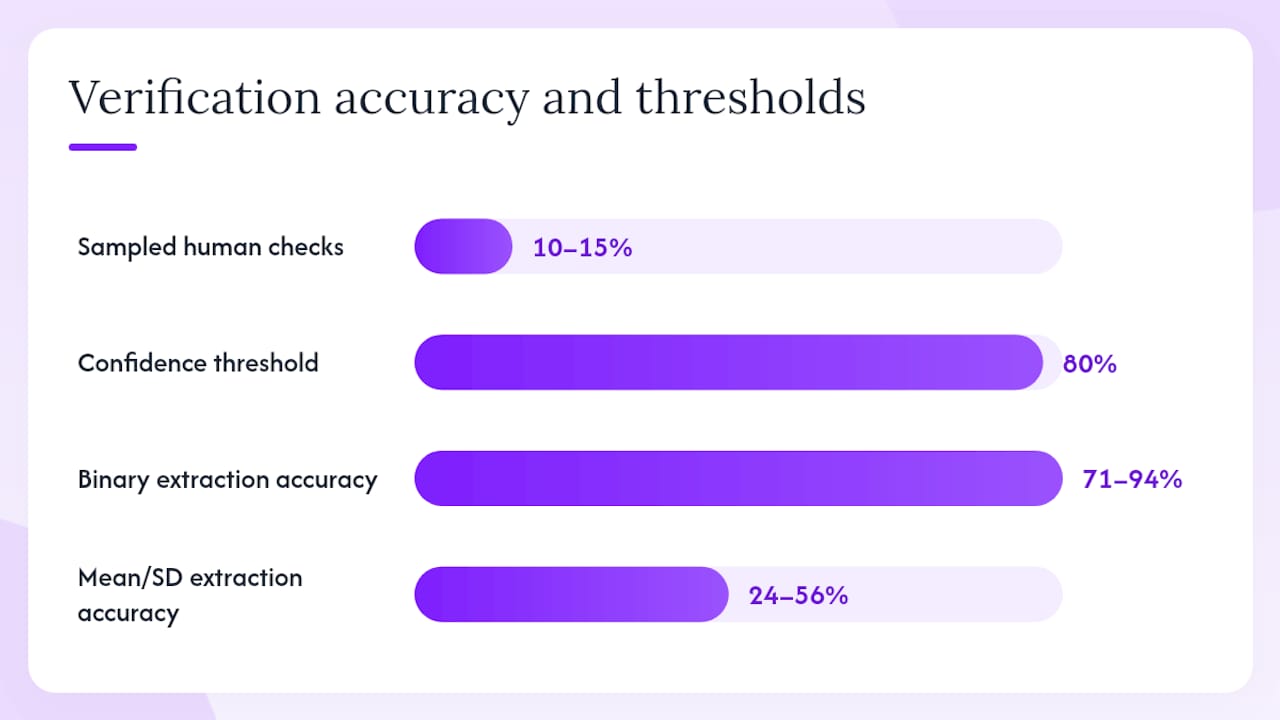
- Confidence thresholding: Flag any output where the model’s confidence score falls below your threshold (typically 0.80 for structured fields). Do not pass low-confidence outputs downstream without human review.
- Sampled human re-checks: Randomly sample 10–15% of all outputs, regardless of confidence score, for manual verification. This catches systematic errors the model makes confidently.
- Reconciliation and logging: Record every correction with the original value, the corrected value, the reason, and the reviewer’s ID. That log becomes your error-rate denominator.
AI-specific pitfalls to watch for:
- Image and table parsing: LLMs perform substantially worse on data embedded in figures and complex tables. One proof-of-concept evaluation found binary outcome extraction accuracy in the 71–94% range but mean/SD extraction accuracy dropping to 24–56%, with performance varying heavily by table layout.
- Hallucinated values: When a field is not reported in the source paper, some models fabricate plausible-sounding values rather than returning “not reported.” ChatGPT-4o produced some completely false data in one comparative study, with reproducibility dropping when information was absent from the source.
- Developer-reported accuracy versus independent validation: One systematic comparison found AI tools can extract more items than human reviewers for some structured fields but underperform on nuanced variables like intervention effects. Independent validation of developer-reported accuracy remains limited. Treat vendor benchmarks as starting points, not guarantees.
- Model variability: Running the same extraction twice on the same paper can produce different outputs. Log model version, temperature settings, and prompt text so you can reproduce your extraction.
Concrete verification checks to implement:
- Regex validators for numeric fields (e.g., sample size must be a positive integer)
- Cross-field consistency checks (e.g., events in arm A + events in arm B must not exceed total N)
- Provenance linking: store the exact source sentence or table cell alongside each extracted value so reviewers can verify without re-reading the full paper
- Automatic flags for any field where the extracted value differs from a cross-referenced field
Feasibility research consistently recommends using AI tools to complement human reviewers rather than replace them. AI can also surface errors in existing human datasets, which makes it useful as a cross-check even when humans did the primary extraction.
Pro Tip: Run your field validators before any human review begins. Most LLM formatting failures are systematic — the model consistently returns “mg/kg” when you need “mg/day” — and catching them automatically saves reviewers from correcting the same error dozens of times.
Papersynapse implements this workflow through schema templates that define field types and allowed values before extraction, inline source snippets that link each extracted value to its origin text, and reconciliation logs that track every correction. The AI-assisted literature synthesis guide covers how these features fit into a full review pipeline.
What your methods section must report to make verification reproducible
Transparency in reporting is what separates a defensible systematic review from one that reviewers send back. The PLOS Biology consensus on reproducibility explicitly calls for transparent reporting of error rates and validation procedures.
Mandatory reporting items:
- Extraction protocol and schema: Describe the fields extracted, data types, and any normalization rules (e.g., how units were standardized).
- Extractor roles and experience: State who extracted (number of extractors, their roles, and relevant experience), and whether extraction was blinded to study outcomes.
- Validation design: Name the design used (double extraction, audit sample, AI + human reconciliation) and the sample fraction for any audit.
- Error-rate definition and denominator: Define what counts as an error and what the denominator is (values per field, fields per paper, or total field-paper combinations).
- Uncertainty estimates: Report confidence intervals around your error rate, not just the point estimate.
- Reconciliation rules: State how disagreements were resolved and who had final authority.
- Software and tools: Name every tool used for extraction and validation, including version numbers.
Sample methods text researchers can adapt:
The SCDM Good Clinical Data Management Practices (GCDMP) and the Cochrane data-extraction forms provide templates and field-level guidance that align with these reporting requirements. PRISMA 2020 requires reporting of the extraction process in item 10, including whether it was done in duplicate. Present your error-rate data in a supplementary table organized by field, not just as a single aggregate number — readers need field-level detail to assess whether errors could affect your conclusions.
The systematic review quality checklist from Papersynapse maps these reporting items to a practical pre-submission checklist.
When automation is enough and when it is not
The honest answer most guides avoid: the acceptable level of automation depends entirely on what the extracted data will decide.
You are characterizing patterns, not computing effect sizes that will inform clinical guidelines.
For a review that feeds a meta-analysis of treatment effects, or one that a regulatory body will use to assess drug safety, double independent extraction is not optional. The pooled error rate data makes clear that single extraction without audit can reach error rates orders of magnitude higher than double-entry methods.
The fields that warrant mandatory double extraction regardless of review type: primary outcome event counts, intervention dose and duration, randomization and allocation concealment details, and any field that enters a subgroup or sensitivity analysis. Fields that can reasonably use single extraction with audit: publication metadata, study country, follow-up duration, and general design descriptors.
On AI specifically: the AHRQ white paper on machine-learning tools in evidence synthesis emphasizes cautious integration and validation requirements. That caution is warranted, but it should not translate into blanket rejection. AI is genuinely useful for initial extraction of structured fields and for flagging papers that likely contain a target variable. The accountability question is simpler than it sounds: document what the model did, what humans verified, and what the error rate was. If you can answer those three questions in your methods section, you have done the work.
The literature review automation benefits guide covers the efficiency side of this trade-off in more detail.
Papersynapse puts the verification workflow in one place
Running a rigorous verification workflow across hundreds of papers is where most review teams lose time — not because the methods are unclear, but because the tooling is fragmented. Spreadsheets for extraction, separate documents for reconciliation notes, manual error-rate calculations in Excel.

Papersynapse addresses that directly. Schema templates define your fields and allowed values before extraction begins, so validators run automatically on every output. Inline source snippets link each extracted value to the exact sentence or table cell it came from, which cuts reconciliation time substantially. Reconciliation logs track every correction with reviewer ID and reason, giving you the denominator you need to calculate and report field-level error rates. Exports to enriched CSV include those logs, so your Supplementary Appendix B is ready when the manuscript is.
For teams running a pilot double-extraction, Papersynapse’s systematic review platform supports collaborative extraction on the same paper set, with side-by-side comparison of extractor outputs.
Sources
- Error Rates of Data Processing Methods in Clinical Research: A Systematic Review and Meta-Analysis - PMC
- Validity and reproducibility of ChatGPT-4o for data extraction in systematic reviews — PLOS One
- Using Elicit (AI research assistant) for data extraction in systematic reviews: a feasibility study — Research Synthesis Methods