What Cross-Institutional Research Collaboration Really Means
What Cross-Institutional Research Collaboration Really Means

Cross-institutional research collaboration is a formal partnership between two or more independent universities, research centers, or organizations working toward a shared research goal that no single institution could reach alone. The payoff is real: broader expertise, shared equipment and data, and access to funding pools that require multi-partner teams, but it comes with governance overhead that catches most first-timers off guard, from mismatched IRB timelines to who gets first authorship.
Before diving into models and frameworks, it helps to know who actually shows up at the table. Most collaborations include some combination of:
- Individual research groups or labs contributing specific expertise
- University research centers or institutes that coordinate multiple projects
- Formal consortia or alliances spanning several institutions
- Industry partners providing funding, data, or applied testing grounds
- Federal or private funders setting eligibility rules and reporting requirements
- Administrative units (research offices, sponsored programs, IRBs) that manage compliance
Each of these groups pulls the project in a slightly different direction, and understanding that tension early saves months of friction later.
Key Takeaways
Cross-institutional research collaboration succeeds when teams pick a governance model that matches their scale and lock in MOU terms before any data changes hands.
| Point | Details |
|---|---|
| Definition | Two or more independent institutions formally partnering on research goals neither could reach alone. |
| Impact is measurable | Multi-institution papers show higher citation rates and more frequent placement in top-tier journals. |
| Match model to scale | Choose consortia, alliances, joint RFPs, or shared centers based on project size and duration, not habit. |
| Settle governance early | MOUs should cover leadership, budget, IP, data-sharing, and authorship before work begins. |
| Measure with mixed metrics | Track citations, follow-on funding, dataset reuse, and training outcomes together, not citations alone. |
| Pilot tools before scaling | Papersynapse speeds shared literature extraction across teams but complements, rather than replaces, formal governance. |
Table of Contents
- Why cross-institutional collaboration matters now
- What are the common models for research partnerships across institutions?
- What barriers and hidden costs should you expect?
- Which frameworks and governance practices actually prevent breakdowns?
- How do you set up and launch a cross-institutional collaboration?
- What do real cross-institutional collaborations look like?
- How do you measure whether a collaboration is actually working?
- How do collaboration and literature-review platforms support shared teams?
- What legal and administrative items need to be settled up front?
- Why sustained cross-institutional networks pay off for institutions
- A practical next step for teams managing shared literature reviews
- Sources
Why cross-institutional collaboration matters now
The case for partnering across institutions isn’t sentimental. It’s measurable. Papers co-authored across multiple institutions consistently earn higher citation rates and appear more often in top-tier journals than single-institution work. That pattern holds across disciplines, which is why funding agencies increasingly favor proposals that name multiple partner institutions over solo applications.
The practical benefits stack up quickly:
- Access to specialized equipment or facilities no single campus can afford alone
- Larger, more diverse datasets that strengthen statistical power and generalizability
- Eligibility for grant programs that explicitly require multi-institution teams
- Shared training pipelines that build capacity across smaller or under-resourced departments
- Faster problem-solving through combined disciplinary expertise
Statistic callout: Collaborative research has grown steadily in prevalence, and that growth tracks with rising citation counts across the papers studied. The same review found many researchers report needing formal training in collaboration and project-management skills, something graduate programs rarely teach directly.
Funders and institutions tend to prize two kinds of outcomes above all else: large multi-year grants that wouldn’t have cleared review as single-PI proposals, and shared datasets or infrastructure that outlive the original project and get reused by other teams for years afterward.
What are the common models for research partnerships across institutions?
Not every collaboration needs the same structure. Picking the wrong model, a heavyweight consortium for a two-lab pilot, or an informal handshake deal for a multi-year federal grant, is one of the fastest ways to stall a project before it starts.
- Consortia: formal, multi-year alliances with shared governance, often built around a specific research domain (climate data, rare disease registries). Best for long-term, resource-intensive work that needs sustained institutional buy-in.
- Research alliances: looser than consortia, often project-scoped, with fewer permanent staff. Best for medium-term efforts where full formalization isn’t worth the overhead.
- Shared centers or institutes: dedicated entities with their own staff, budget, and physical or virtual home. Cornell’s cross-institution initiatives, including the Einaudi Center for International Studies and the Atkinson Center for Sustainability, illustrate how a university anchors recurring cross-institutional work inside a permanent structure rather than reinventing governance for every new project.
- Joint RFP-funded projects: a funder issues a request for proposals that requires multiple named institutions to participate. Best for catalyzing new partnerships where funding is the forcing function.
- Industry-academic partnerships: companies contribute funding, data, or applied problems; universities contribute research capacity. Best for translational work with a clear commercial or policy application.
- Curriculum-sharing consortia: institutions pool teaching resources, shared degree pathways, or joint training grants. Best for capacity building rather than pure research output.
Scale changes the calculus too. A local, two-campus pilot can run on a lightweight MOU and a shared spreadsheet. A regional consortium usually needs a governance board. An international collaboration adds currency, export control, and data-residency questions that a same-state partnership never touches.
What barriers and hidden costs should you expect?
Most collaborations don’t fail because the science was bad. They fail because nobody planned for the friction of running a project across two or more bureaucracies.
- Governance misalignment: no clear decision-maker when partners disagree on direction or priorities.
- Intellectual property and data-sharing disputes: unclear ownership of jointly generated data or tools.
- Divergent IRB and ethics processes: each institution’s review board runs its own timeline, and approvals rarely align.
- Uneven credit and authorship norms: disciplines and institutions weigh authorship order differently, and nobody addressed it up front.
- Funding restrictions: subaward rules, indirect cost rates, and reporting requirements differ by institution and funder.
- Coordination costs: time spent scheduling, translating jargon across disciplines, and managing communication scales with the number of partners involved.
These barriers show up in predictable ways: a data-sharing agreement stuck in legal review for three months while the pilot’s timeline quietly slips, or a paper held from submission because two campuses can’t agree on author order. Coordination costs scale with geographic and organizational distance, and aligning IP, IRB, and data protocols almost always requires a formal governance body established early, not retrofitted after the first disagreement.
Pro Tip: Before you draft a single deliverable, ask each partner institution to list every internal approval step required to spend grant money or share data. Compare the lists side by side. The gaps between them are your hidden costs, and you’ll find them in week one instead of month six.
Which frameworks and governance practices actually prevent breakdowns?
A handful of named frameworks show up again and again in successful multi-institution work, and each solves a different structural problem.
| Framework | Purpose | Where it applies |
|---|---|---|
| TRAVE (League for Innovation) | Structures trust-building and role clarity across partner institutions | Early-stage alliances forming shared vision before formal agreements |
| Joint RFP model | Uses funder requirements to force multi-institution participation and shared accountability | Grant-driven projects, especially system-wide programs |
| Shared/multiple-PI leadership | Distributes decision authority instead of centralizing it in one institution | Consortia and alliances with roughly equal partner contributions |
| Standardized project management plans | Defines timelines, budget splits, and data workflows before work begins | Any multi-partner project, regardless of size |
| Formalized center/institute model | Creates a permanent entity with staff and recurring budget | Long-term, recurring collaboration across many projects |
Whatever framework you choose, your initial agreement should nail down these items before anyone touches a dataset:
- Named leadership roles and how disputes get escalated
- Budget rules, including subaward flow and indirect cost handling
- IP ownership and licensing terms for jointly created tools or data
- Data-sharing protocols, including who can access what and under what conditions
- Authorship and credit norms, agreed on paper, not assumed
- A conflict-resolution process for when partners disagree
- A review cadence for revisiting the agreement as the project evolves
Structured coordination mechanisms, formal joint RFPs, shared leadership, and standardized project plans, consistently outperform ad-hoc arrangements that leave these questions for later. The framework you pick should scale with the project: a two-lab pilot doesn’t need a formal center, but a five-year, multi-million-dollar consortium probably does.
How do you set up and launch a cross-institutional collaboration?
Getting from idea to funded program follows a fairly consistent sequence, even though the details vary by discipline and funder.
- Form the core team. Identify the lead investigators at each institution and confirm real interest, not just polite agreement, before drafting anything formal.
- Draft the MOU. Cover leadership, budget splits, IP, and authorship before a single dollar moves.
- Align IRB and data governance early. Submit to each institution’s review board in parallel, not sequentially, to avoid compounding delays.
- Build a joint budget. Account for indirect costs, subaward mechanics, and each institution’s specific reporting requirements.
- Run a small pilot. Test the collaboration’s workflow on a low-stakes task before committing to the full scope.
- Prepare the funding proposal or RFP response. Use the pilot’s results to strengthen the case for external funding.
A rough timeline: expect three to six months to form the team and draft agreements, a similar window to run a pilot, and twelve to eighteen months before a funded, multi-year program is fully operational. Ownership shifts as you go, PIs drive early team formation, research offices own the MOU and compliance steps, and a designated project manager typically owns the pilot and timeline once work begins.
Templates make this faster. Coordinating multiple researchers across institutions gets easier with a shared plan for multi-researcher literature review coordination, and a shared research database solves a lot of the data-access friction before it becomes a dispute. Store MOU and budget templates in your institution’s research office repository so future collaborations don’t start from a blank page.
What do real cross-institutional collaborations look like?
Cornell’s Einaudi and Atkinson centers. These operate as permanent institutional homes for cross-institution work rather than one-off project teams. The Einaudi Center coordinates international studies partnerships; the Atkinson Center does the same for sustainability research. Both illustrate how housing collaboration inside a standing center turns one-time projects into sustained networks with recurring funding cycles. Lesson: if your institution runs cross-institutional projects repeatedly in the same domain, a center structure pays off over rebuilding governance each time.

The TAMUS–UAAT joint RFP. The Texas A&M University System’s collaborative research program with UAAT specifies eligibility rules, PI limits, required letters of commitment, and weighted evaluation criteria that favor scientific merit and demonstrated collaboration strength. This is a funder-driven model: the RFP’s structure itself forces multi-institution participation rather than leaving it optional. Lesson: when you control the funding mechanism, you can engineer collaboration requirements directly into the proposal criteria.
An ERIC-documented conference delivery model. One case study describes institutions using a cross-institutional collaborative model to deliver a national roundtable conference, showing that these structures apply well beyond lab science, curriculum delivery, and large-scale events benefit from the same governance thinking. Lesson: don’t assume cross-institutional frameworks only apply to bench research; the same coordination principles transfer to programmatic and administrative work.
Across all three, the pattern repeats: sustained success came from structure decided up front, not improvised mid-project.
How do you measure whether a collaboration is actually working?
Publication counts alone tell an incomplete story. A useful evaluation plan tracks several metrics side by side:
- Publication output and citation patterns relative to single-institution comparisons
- Follow-on grant funding secured after the initial pilot or project
- Reuse of shared datasets by teams outside the original partnership
- Student and early-career researcher training outcomes
- Policy adoption or community impact where applicable
- Utilization rates of shared infrastructure or equipment
Statistic callout: Multi-institution and international collaborations tend to show higher citation impact than comparable single-institution work, but that number only tells you the paper traveled further, not whether the collaboration itself functioned well. Pair citation data with a follow-on funding rate and a dataset reuse count to get a fuller picture.
Set a review cadence from the start, quarterly check-ins for active projects, and an annual retrospective for sustained centers or consortia. A simple evaluation plan doesn’t need elaborate dashboards; a shared document tracking these five or six metrics, reviewed on a fixed schedule, catches problems long before a funder’s final report does.
How do collaboration and literature-review platforms support shared teams?
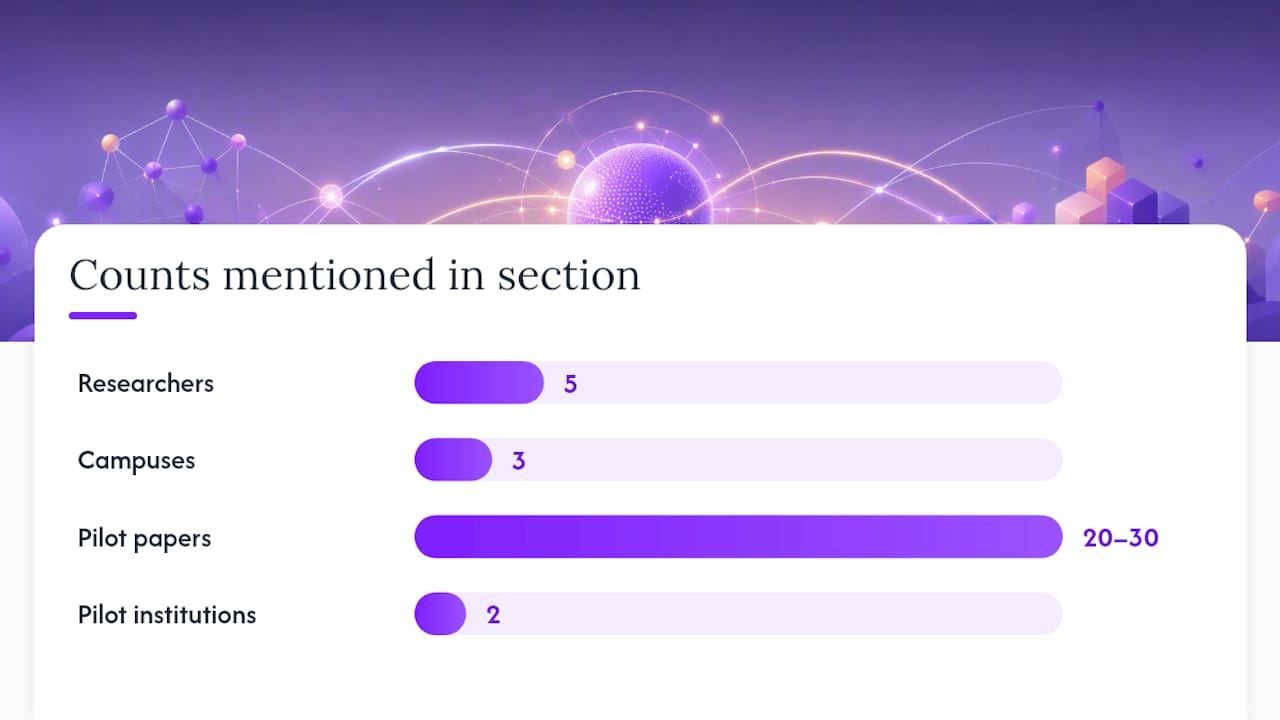
One of the most time-consuming parts of any multi-institution project is the shared literature review that precedes it, and it’s often where the coordination costs described earlier show up first. Getting five researchers across three campuses to extract data consistently from the same set of papers, using the same fields, the same categories, the same standards, is harder than it sounds. A platform built for this, like Papersynapse, speeds that specific task by importing references directly from Scopus or Web of Science, applying AI-assisted extraction to structured fields, and normalizing labels so one researcher’s “moderate effect” matches another’s “medium effect” instead of splitting into two categories during analysis.
Before adopting any tool across partner institutions, run it through a short checklist:
- Does it support import and export in formats your partner institutions already use?
- Are privacy and access controls granular enough for multi-institution data-sharing rules?
- Can multiple team members work in parallel without overwriting each other’s work?
- Does it keep a version history or audit log for funder reporting?
- Can exports meet the format requirements funders typically request?
- Does it integrate reasonably with existing institutional systems, or at least avoid creating new silos?
Pro Tip: Pilot any shared tool on a small, low-stakes batch of papers, twenty or thirty, split across two institutions before rolling it out to the full team. That surfaces workflow mismatches while the cost of fixing them is still small.
Tools reduce friction. They don’t replace governance. A well-designed extraction workflow won’t fix an authorship dispute or an unresolved IP question. Treat platforms as accelerators for the mechanical work, not substitutes for the agreements discussed earlier.
What legal and administrative items need to be settled up front?
A short list of documents and decisions determines whether a collaboration runs smoothly or stalls in year one:
- MOUs defining scope, leadership, and general terms of engagement
- MTAs (Material Transfer Agreements) if physical samples or materials move between institutions
- DSAs (Data-Sharing Agreements) specifying who can access data and under what restrictions
- IRB and ethics alignment across every participating institution, not just the lead
- IP and licensing terms for any tools, data, or discoveries generated jointly
- Budget flow and subaward mechanics, including indirect cost rates at each institution
- Reporting requirements tied to the funder, not just internal expectations
- Insurance and liability coverage for cross-institutional activities, especially with industry partners
Watch for red flags before signing anything: vague leadership with no named decision-maker, incentives that reward one institution more than others, mismatched timelines between partner IRBs or fiscal years, weak institutional commitment beyond the individual PI’s enthusiasm, and no written authorship policy. Any one of these, left unresolved, tends to resurface as a full-blown dispute later.
Most research offices maintain template libraries for MOUs and DSAs; sponsor portals for major funders often publish their own required formats as well. Ask your institution’s research office before drafting from scratch. A structured research database also helps once data-sharing terms are settled, giving partner teams one place to track what’s shared, by whom, and under what agreement.
Why sustained cross-institutional networks pay off for institutions
Institutional leaders who treat collaboration as a one-time grant strategy miss the larger return. The real value shows up over years, not within a single funding cycle: research offices that repeatedly enable smooth multi-institution partnerships become the ones faculty want to work through, and funders start recognizing which institutions execute joint projects without administrative drag.
Sustainable partnerships need more than good intentions between individual PIs. Programs that get embedded into core university research agendas are far more likely to become standing networks than projects that quietly wind down when the original grant ends. That’s an institutional commitment, not just a departmental one.
The return paths are concrete. New grants tend to follow institutions with a track record of delivering on multi-partner commitments. Talent flows toward research environments known for productive collaboration, both incoming faculty and the graduate students they bring. Shared infrastructure, once built, keeps generating value long after the project that funded it closes out. And reputational gains compound: an institution known as a reliable partner gets invited into the next consortium before it even applies.
A practical next step for teams managing shared literature reviews
Every model discussed here, consortia, alliances, joint RFPs, shared centers, hits the same early bottleneck: someone has to read, extract, and categorize a large batch of papers consistently across every partner institution involved. That’s manual work prone to inconsistency when five people apply five slightly different judgment calls to the same inclusion criteria.

Papersynapse handles that specific bottleneck. Import references directly from Scopus or Web of Science, and the platform’s AI reads abstracts and fills structured extraction tables automatically, cutting the time a team spends on manual categorization while keeping labels normalized across every contributor. Teams have processed up to 200 papers in under two minutes using the workflow, with PRISMA-compliant screening and export formats built for funder reporting. It’s a tool that speeds shared review tasks, not a replacement for the MOU or governance structure your collaboration still needs. If your team is planning a multi-institution literature review, start with Papersynapse’s free tier and pilot it on your next batch of papers before committing to a paid plan.
Sources
- Coordination costs and project outcomes (Kiesler et al.)
- Collaborative research impact (PubMed entry)
- TAMUS–UAAT collaborative research program (TAMUS)
- Collaboration in research (Nature summary PDF)