What Is Systematic Literature Review: A Scholar's Guide
What Is Systematic Literature Review: A Scholar’s Guide

A systematic literature review (SLR) is defined as a rigorous, replicable method for identifying, appraising, and synthesizing all empirical evidence that meets pre-specified criteria to answer a focused research question. Unlike a standard literature search, an SLR follows a transparent, reproducible process governed by explicit protocols, making it the gold standard for evidence synthesis in academic and clinical research. The PRISMA guidelines, PROSPERO registration, and the Cochrane Collaboration each represent foundational standards that define what separates a true SLR from a descriptive narrative review. Researchers who understand this distinction produce work that informs clinical guidelines, shapes public policy, and withstands peer scrutiny.
What is systematic literature review, and why does it matter?
A systematic literature review synthesizes all available empirical evidence on a specific question using pre-specified, reproducible methods. That reproducibility is the defining feature. Any researcher following the same protocol should arrive at the same pool of studies and the same conclusions, assuming the same data.
The importance of systematic reviews extends well beyond academic publishing. Health agencies use SLRs to update clinical guidelines. Policymakers rely on them to allocate resources. In education and social science, SLRs reveal what interventions actually work versus what merely sounds plausible. A single well-conducted SLR can redirect an entire field.

The term “systematic” is frequently misused in academic writing. Labeling a narrative review as systematic without meeting the methodological requirements undermines credibility and misleads readers who rely on the findings. Researchers must apply the label only when the full methodology is in place.
What are the essential steps in conducting a systematic review?
A full SLR follows a defined sequence. Skipping or shortcutting any phase compromises the entire review.
-
Formulate a focused research question. Use a structured framework such as PICO (Population, Intervention, Comparison, Outcome) or SPIDER for qualitative research. A poorly defined research question increases bias risk and reduces the usefulness of the final review. Every subsequent step depends on getting this right.
-
Write and register a protocol. Document your eligibility criteria, search strategy, and analysis plan before collecting data. Registering in PROSPERO locks in the plan and prevents outcome switching. Any deviation from the registered protocol must be transparently documented in the final report.
-
Design and execute a comprehensive search. Work with an expert librarian to build search strings across multiple databases, including PubMed, Embase, CINAHL, and discipline-specific sources. Grey literature, conference proceedings, and reference lists of included studies also belong in the search.
-
Screen studies independently. At least two reviewers screen titles, abstracts, and full texts against your eligibility criteria. Disagreements go to a third reviewer for resolution. Independent screening is not optional. It is the mechanism that removes selection bias.
-
Assess risk of bias. Apply validated tools such as AMSTAR2 for systematic reviews of interventions or ROBIS for reviews assessing bias at the review level. PRISMA guidelines require this step and specify how to report it using a 27-item checklist.
-
Extract and synthesize data. Use a pre-piloted extraction form to pull data consistently across studies. Synthesis takes the form of meta-analysis when studies are sufficiently homogeneous, or rigorous narrative synthesis when they are not.
-
Report following PRISMA. The PRISMA 27-item checklist covers everything from the abstract to the funding statement. Journals in medicine, psychology, and education increasingly require PRISMA compliance as a condition of submission.
Pro Tip: Pilot your data extraction form on five to ten studies before full extraction begins. Inconsistencies caught early save weeks of rework later. Use a shared data extraction table to keep all reviewers aligned.
How does a systematic review differ from other review types?
The differences between review types are methodological, not cosmetic. Choosing the wrong type for your research question produces misleading results.
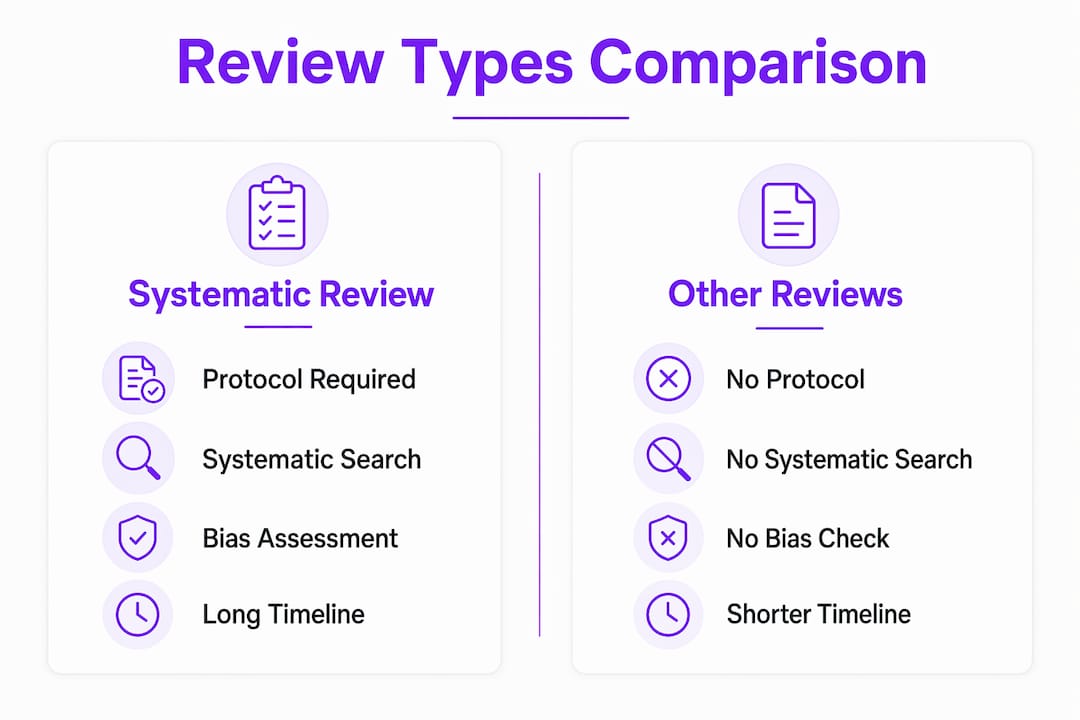
Narrative reviews summarize existing literature based on the author’s judgment. They have no pre-registered protocol, no systematic search, and no formal bias assessment. They are useful for broad overviews but cannot support causal claims.
Scoping reviews map the extent of a literature without synthesizing evidence to answer a specific question. They are appropriate when a field is new or when you need to identify research gaps before committing to a full SLR.
Rapid reviews apply a shortened methodology to deliver results faster, typically within 1–12 months. They relax some SLR requirements, such as dual screening or grey literature searches, to meet urgent policy or clinical needs.
A full SLR takes at least 12 months to complete properly. That timeline reflects the depth of the search, the rigor of screening, and the demands of bias assessment and synthesis. Researchers who underestimate this timeline produce incomplete reviews.
One persistent misconception deserves direct correction: not all SLRs include meta-analysis. Meta-analysis is appropriate only when primary studies are sufficiently homogeneous in population, intervention, and outcome measurement. When heterogeneity is high, rigorous narrative synthesis or vote counting is the correct approach. An SLR without meta-analysis is still a valid SLR.
| Review type | Protocol required | Systematic search | Bias assessment | Typical timeline |
|---|---|---|---|---|
| Systematic review | Yes | Yes | Yes | 12+ months |
| Scoping review | Yes | Yes | No | 6–12 months |
| Rapid review | Yes (abbreviated) | Partial | Partial | 1–12 months |
| Narrative review | No | No | No | Variable |
What are the best practices and common pitfalls in systematic reviews?
Quality in an SLR comes from discipline at every phase. The following practices separate credible reviews from ones that get rejected or retracted.
Pre-register your protocol. PROSPERO registration is the single most effective safeguard against outcome switching and post-hoc hypothesis generation. Reviewers and editors check PROSPERO registration as a credibility signal.
Formulate your question before touching the literature. Researchers who browse the literature before finalizing their question unconsciously shape their eligibility criteria around what they have already read. That is circular reasoning, and it introduces bias from the first step.
Build your search with a librarian. Search strategy design is a specialized skill. An expert librarian identifies synonyms, MeSH terms, database-specific syntax, and sources that researchers routinely miss. Inadequate search strategies are the most common reason SLRs fail peer review.
Pilot-test everything. Run your screening criteria and extraction form on a sample of studies before full-scale implementation. Disagreements during piloting reveal ambiguities in your criteria that will cause larger problems later.
Common pitfalls to avoid:
- Screening by a single reviewer without independent verification
- Ignoring grey literature, which introduces publication bias
- Skipping formal bias assessment with AMSTAR2, ROBIS, or GRADE
- Failing to document deviations from the registered protocol
- Conflating statistical heterogeneity with methodological heterogeneity
Pro Tip: Use a reference management tool like Zotero or EndNote from day one. Deduplication and citation tracking become unmanageable without one when your search returns thousands of records.
Practical considerations: time, team, and tools
A systematic literature review is a team project. First-time reviewers consistently underestimate the human resources required. A full SLR team requires at minimum two independent screeners, a third reviewer to resolve conflicts, an expert librarian, and a statistician for quantitative synthesis.
The time commitment is equally significant. A full SLR takes at least 12 months. Rapid reviews compress this to 1–12 months by relaxing specific methodological requirements. Neither timeline is casual. Both require dedicated calendar time from every team member.
When primary studies use different outcome measures, populations, or follow-up periods, meta-analysis is not appropriate. Narrative synthesis must then be conducted with the same rigor applied to statistical pooling. Document your synthesis decisions in the protocol and report them transparently.
Software tools reduce the manual burden at several stages. Reference managers handle deduplication and citation organization. Screening platforms support dual-reviewer workflows with conflict tracking. Data management tools maintain consistency across extraction when multiple reviewers work in parallel. AI-assisted platforms, including Papersynapse, now automate abstract screening and structured data extraction, cutting the time spent on manual categorization significantly.
| Task | Recommended tool type | Key benefit |
|---|---|---|
| Reference management | Dedicated reference manager | Deduplication and citation tracking |
| Dual screening | Screening platform | Conflict logging and audit trail |
| Data extraction | Structured extraction platform | Consistency across reviewers |
| Reporting | PRISMA checklist | Compliance with journal requirements |
Key Takeaways
A systematic literature review is only as credible as its protocol, and every phase from question formulation to PRISMA-compliant reporting must be executed with documented rigor.
| Point | Details |
|---|---|
| SLR definition | An SLR synthesizes empirical evidence using pre-specified, reproducible methods to answer a focused question. |
| Protocol registration | Register in PROSPERO before data collection to prevent outcome switching and document any deviations. |
| Team composition | A minimum team includes two screeners, a conflict resolver, a librarian, and a statistician. |
| Meta-analysis is optional | Use narrative synthesis when study heterogeneity makes statistical pooling inappropriate. |
| PRISMA compliance | Follow the 27-item PRISMA checklist to meet journal submission requirements and ensure transparent reporting. |
Why I think most researchers underestimate what an SLR actually demands
The greatest misconception I encounter is treating a systematic literature review as an upgraded Google Scholar search. Researchers collect papers, summarize them, and call the result systematic. It is not. A rigorous protocol and critical appraisal are what make results reliable enough to inform clinical guidelines or public policy. The literature search is the least demanding part.
What actually breaks SLRs is poor question formulation. A vague PICO question produces eligibility criteria that two reviewers interpret differently, which means your screening data is unreliable before synthesis even begins. I have seen PhD candidates spend six months screening papers only to realize their question was too broad to synthesize meaningfully.
The team requirement also surprises first-timers. Two independent screeners sounds straightforward until you are coordinating schedules across a 3,000-record title screen. Add a librarian, a statistician, and a third reviewer for conflicts, and you have a project management challenge on top of a research challenge.
My strongest advice: write your protocol first, register it in PROSPERO, and treat every deviation as a finding to report, not a mistake to hide. The transparency is the point. Readers and reviewers can evaluate a well-documented deviation. They cannot evaluate one that was quietly buried.
— Ubada
How Papersynapse supports your systematic review workflow
Systematic literature reviews demand precision at every stage, and the data extraction phase is where most teams lose the most time.

Papersynapse is an AI-powered platform built specifically for researchers conducting systematic reviews. It imports references directly from Scopus or Web of Science, reads abstracts with AI, and fills structured extraction tables automatically. The platform claims to process up to 200 papers in under two minutes, which addresses the manual bottleneck that slows most SLR teams. Extraction, normalization, and analysis all run within one workflow, keeping your data consistent across reviewers. For PhD candidates and research teams managing large reference sets, Papersynapse reduces the time between search completion and synthesis-ready data.
FAQ
What is the systematic review definition in simple terms?
A systematic review is a research method that collects and synthesizes all available evidence on a specific question using a pre-registered, reproducible protocol. It differs from a narrative review by requiring transparent search methods and formal bias assessment.
How long does a systematic literature review take?
A full systematic review takes at least 12 months to complete. Rapid reviews, which relax some methodological requirements, can be completed in 1–12 months depending on scope.
Do all systematic reviews require meta-analysis?
No. Meta-analysis is only appropriate when included studies are sufficiently homogeneous. When heterogeneity is high, rigorous narrative synthesis is the correct and valid alternative.
What is PRISMA and why does it matter for systematic reviews?
PRISMA is a 27-item reporting checklist that governs transparency in systematic review reporting. Most peer-reviewed journals in medicine, psychology, and education require PRISMA compliance as a condition of publication.
What is the difference between a systematic review and a scoping review?
A systematic review synthesizes evidence to answer a specific research question with formal bias assessment. A scoping review maps the breadth of a literature without synthesizing evidence or assessing bias, making it appropriate for emerging fields or gap identification.