Team-Based Systematic Review: A Researcher's Guide
Team-Based Systematic Review: A Researcher’s Guide
A team-based systematic review is a structured literature review conducted by multiple researchers, where critical tasks like screening, data extraction, and quality appraisal are completed independently by at least two people to minimize bias and improve reproducibility.
Three things to know before you go further:
- Cochrane will not publish a review completed by a single person. Teams are not optional under major standards.
- Title/abstract screening, full-text screening, data extraction, and critical appraisal must all be done in duplicate, with a third reviewer resolving conflicts.
- AI and collaboration tools can accelerate the process, but they do not replace independent human review. They reduce workload; they do not substitute for it.
Table of Contents
- What is a team-based systematic review, and why do standards require it?
- Who belongs on your team and what does each person do?
- Which tasks must be done in duplicate, and how do you handle disagreements?
- Step-by-step workflow from protocol to reporting
- How do you measure agreement and resolve conflicts efficiently?
- How AI and collaborative software change team-based reviews
- Papersynapse as a platform for team-based reviews
- Ready-to-use checklist for your team
- Key Takeaways
- The coordination problem nobody talks about enough
- Papersynapse cuts the extraction bottleneck for research teams
- Useful sources and further reading
What is a team-based systematic review, and why do standards require it?
Cochrane requires that study selection and data extraction be performed independently by at least two people. That is not a stylistic preference. It is a publication requirement. The rationale is straightforward: a single reviewer’s judgment is subject to selection bias, extraction errors, and interpretive drift. Two independent reviewers catch what one misses.
PRISMA (Preferred Reporting Items for Systematic Reviews and Meta-Analyses) reinforces this by requiring transparent reporting of methods, including who screened, who extracted, and how disagreements were resolved. A PRISMA flowchart documents every decision point, and a team structure is what makes that documentation credible.
Beyond bias reduction, teams address a practical scaling problem. A large database search can return thousands of records. Distributing that workload across screeners is the only realistic path to completion on an academic timeline.
- Cochrane mandates team-based work and will not publish single-author reviews.
- PRISMA requires transparent, reproducible methods that a team structure supports.
- Duplicate independent work catches errors that solo reviewers consistently miss.
- Multidisciplinary teams reduce the risk of narrow interpretive assumptions shaping conclusions.
Who belongs on your team and what does each person do?
Academic and library guidance recommends a minimum of three people: a project manager and at least two independent screeners. This three-person minimum is standard for rigorous reviews under university and Cochrane guidance.
Core roles:
- Project manager / team lead: Coordinates timelines, manages manuscript submission, tracks protocol amendments, and keeps the team on schedule. Designating this role explicitly is one of the strongest predictors of finishing on time.
- Screeners (minimum two, typically as part of a three-person team): Work independently through title/abstract and full-text screening rounds. They should not discuss decisions until after independent review is complete.
- Search specialist / informationist: Designs and runs the database search strategy across sources like PubMed, Scopus, and Web of Science. This role requires specialized expertise most content experts do not have.
- Statistician: Handles meta-analysis, heterogeneity assessment, and synthesis decisions. Not every review needs a statistician, but any review with quantitative pooling does.
- Content experts: Provide subject-matter judgment during appraisal and synthesis. Cochrane warns against teams with overly narrow topical expertise, which can bias interpretation.
- Stakeholders / advisory members: Patient representatives, clinicians, or policy experts who ensure the review question stays relevant to end users.
An odd number of reviewers simplifies arbitration. When two screeners disagree, a third reviewer breaks the tie without requiring a full reconciliation meeting.
Pro Tip: Draft a roles document at project kickoff that specifies authorship expectations, estimated time commitments per stage, and conflict-of-interest declarations. Revisit it before screening begins.

Which tasks must be done in duplicate, and how do you handle disagreements?
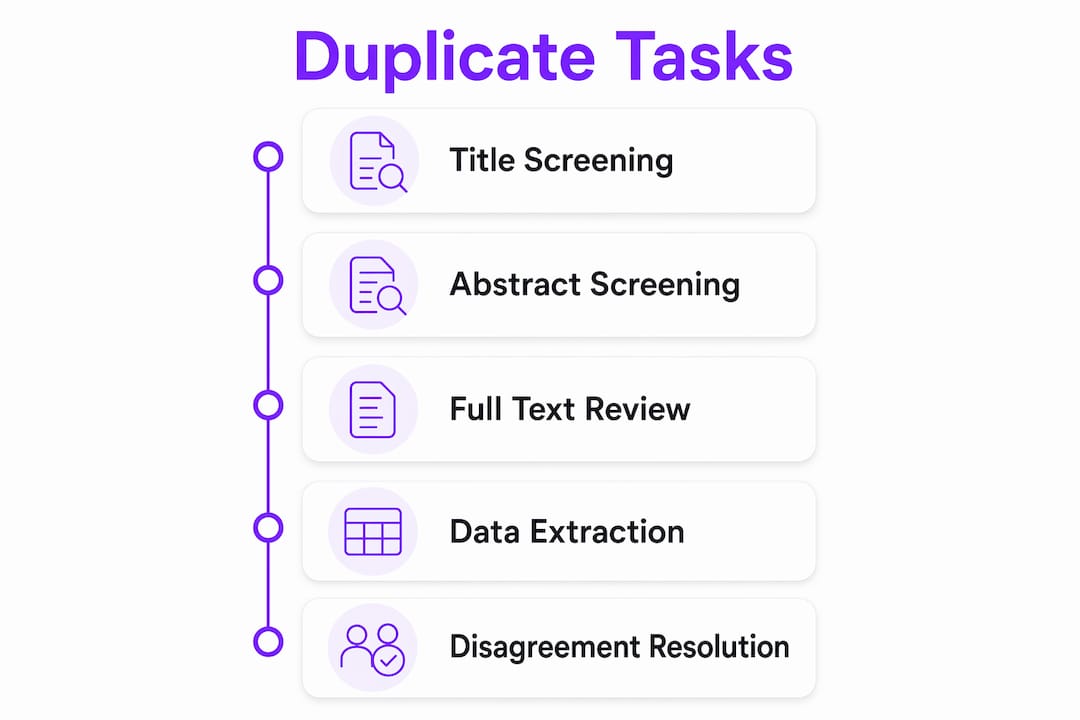
Four tasks require independent duplicate completion. No exceptions under Cochrane or CRD guidance.
| Task | Who duplicates it | Common disagreement source | Resolution step |
|---|---|---|---|
| Title/abstract screening | Two screeners | Ambiguous abstracts, borderline eligibility | Reconciliation meeting; third reviewer if unresolved |
| Full-text screening | Two screeners | Eligibility criteria interpretation | Reconciliation meeting; third reviewer arbitration |
| Data extraction | Two extractors | Numerical transcription, outcome labeling | Compare fields; third reviewer or consensus rule |
| Critical appraisal | Two appraisers | Risk-of-bias judgment calls | Structured discussion; third reviewer for persistent disagreement |
A practical adjudication protocol runs in three steps: independent work first, then a conflict-flagging pass where reviewers compare decisions without discussion, then a reconciliation meeting for flagged items. Anything unresolved after that goes to a third reviewer. Document every resolution in a shared log. That log becomes part of your audit trail for reporting.
For structured data extraction tables, pre-specifying every field before extraction begins dramatically reduces disagreement rates.
Step-by-step workflow from protocol to reporting
The systematic review process follows a defined sequence. Deviating from it without documentation introduces bias.
- Develop and register your protocol. Write your PICO question, inclusion/exclusion criteria, and planned analysis. Register in PROSPERO before searching begins. Any later amendments must be documented with a rationale.
- Build your search strategy. Work with a search specialist. Run pilot searches, refine terms, and document every database, filter, and date range.
- Run a calibration exercise. Before full screening, have all screeners independently screen a pilot set of 25–50 records. Compare decisions and resolve discrepancies to align interpretation of eligibility criteria.
- Title/abstract screening. Both screeners work independently. Anything one screener includes moves forward. Resolve conflicts per your adjudication protocol.
- Full-text retrieval and screening. Retrieve all records that passed title/abstract screening. Apply the same duplicate independent process.
- Data extraction. Both extractors complete pre-specified fields independently. Compare and reconcile.
- Critical appraisal. Apply a validated tool (e.g., Cochrane Risk of Bias, GRADE) independently, then reconcile.
- Synthesis. Narrative or quantitative, depending on heterogeneity. Document synthesis decisions.
- Reporting. Complete the PRISMA flowchart, which requires exact counts at every stage. A team structure is what makes those counts accurate.
Timeline reality: a well-resourced team typically needs 12–18 months for a full systematic review. Screening alone, for a search returning several thousand records, can take weeks even with two screeners working in parallel.
Pro Tip: Document protocol amendments in PROSPERO as they occur, not retrospectively. Reviewers and editors notice when amendments appear after results are known.
How do you measure agreement and resolve conflicts efficiently?
Cohen’s kappa is the standard statistic for inter-rater agreement in systematic review methodology. It corrects for chance agreement, which percent agreement alone does not. General interpretation benchmarks: kappa below 0.60 signals a calibration problem; 0.61–0.80 is acceptable; above 0.80 is strong.
Run kappa calculations after your pilot calibration set and again after the first 100 records of full screening. If kappa drops below your threshold, stop and retrain before continuing.
- Calibration procedure: Pilot set of 25–50 records, independent screening, kappa calculation, group discussion of every disagreement, revised eligibility guidance if needed.
- Re-calibration triggers: Kappa below threshold, a new screener joining mid-review, or a protocol amendment that changes eligibility criteria.
- Conflict-resolution options: Reconciliation meeting (preferred for complex disagreements), third-reviewer arbitration (faster for binary decisions), or majority rule when three reviewers are involved.
- Documentation: Log every conflict, the resolution method, and the final decision. This log supports transparent reporting and is often requested during peer review.
How AI and collaborative software change team-based reviews
AI tools change the workload distribution, not the methodological requirements. Duplicate independent review remains mandatory. What AI does is reduce the time each reviewer spends on low-signal tasks.
Practical benefits of AI-assisted workflows:
- Automated deduplication across database exports (Scopus, Web of Science, PubMed).
- Machine-assisted screening prioritization, which surfaces likely-relevant records earlier in the queue.
- AI-assisted extraction that pre-populates structured fields for human verification.
- Shared labeling environments with audit trails that show who made which decision and when.
- Version control on extraction tables, so no one overwrites a colleague’s work.
Risks worth managing: automation bias (accepting AI suggestions without independent judgment), opaque extraction logic that cannot be audited for reporting, and platforms that do not preserve individual reviewer decisions before reconciliation.
Feature checklist for collaboration software:
- Role-based user permissions (screener vs. adjudicator vs. administrator)
- Conflict-flagging that prevents reviewers from seeing each other’s decisions before independent review is complete
- Full audit logs exportable for reporting
- Direct import from Scopus and Web of Science
- Secure data handling, especially for sensitive health data
Pro Tip: Use AI-assisted screening as a prioritization tool, not a replacement for human screening. Every record a human excludes should still be logged, even if AI ranked it low.
Papersynapse as a platform for team-based reviews
Papersynapse integrates directly with the team workflow described above. References import from Scopus or Web of Science, and the platform’s AI reads abstracts and fills structured extraction tables, handling up to 200 papers in under two minutes for extraction tasks.
For teams, the relevant features map directly to compliance needs:
- Import from Scopus / Web of Science: Eliminates manual export-and-deduplication steps.
- AI-assisted abstract reading and structured extraction: Pre-populates fields that two human reviewers then verify independently.
- Structured extraction tables: Pre-specified fields reduce inter-rater disagreement at the extraction stage.
- Workflow integration: Extraction, normalization, and analysis within one platform, so teams are not reconciling data across multiple tools.
A typical team workflow in Papersynapse: import references, run parallel screening with role-based access, use AI-assisted extraction as a first pass, reconcile in the platform, then export for synthesis. The literature review automation benefits are most visible at the extraction stage, where manual work is slowest and most error-prone.
Ready-to-use checklist for your team
Copy and adapt these items for your project kickoff:
- [ ] Protocol written and registered in PROSPERO before searching begins
- [ ] Roles document completed (names, roles, time commitments, authorship criteria, COI declarations)
- [ ] Search strategy peer-reviewed by a search specialist
- [ ] Calibration set of 25–50 records screened independently; kappa calculated and documented
- [ ] Adjudication protocol written and shared with all team members
- [ ] Conflict-resolution log created (shared, version-controlled)
- [ ] Extraction table fields pre-specified before extraction begins
- [ ] PRISMA flowchart template set up with placeholders for counts at each stage
- [ ] Communications plan documented: meeting cadence, file-sharing platform, version-naming conventions
- [ ] Protocol amendment log created for tracking any changes post-registration
Pro Tip: For geographically dispersed teams, a documented communications plan with fixed weekly check-ins and a single shared file repository prevents the version-control failures that stall more reviews than methodology problems do.
Key Takeaways
A team-based systematic review requires duplicate independent work at every major stage, a defined adjudication protocol, and a project manager who owns the timeline.
| Point | Details |
|---|---|
| Teams are mandatory | Cochrane will not publish a single-author review; duplicate independent work is a publication requirement, not a preference. |
| Four tasks require duplication | Title/abstract screening, full-text screening, data extraction, and critical appraisal must all be done independently by at least two reviewers. |
| Measure agreement with kappa | Cohen’s kappa above 0.60 is the minimum acceptable threshold; recalibrate if it drops below that after your pilot set. |
| Communications plan prevents stalls | A documented schedule, single file repository, and version-naming convention are the practical difference between a review that finishes and one that doesn’t. |
| Papersynapse supports team workflows | AI-assisted extraction and direct Scopus/Web of Science import reduce the manual bottleneck while preserving the audit trail teams need for compliant reporting. |
The coordination problem nobody talks about enough
Most systematic review guides spend pages on methodology and a paragraph on team coordination. That ratio is backwards. The methodology is well-documented. The coordination is where reviews actually fail.
The most common stall point is not a disagreement about eligibility criteria. It is a screener who goes quiet for three weeks, a shared spreadsheet with conflicting versions, or a team lead who assumed someone else was tracking protocol amendments. These are administrative failures, and they are entirely preventable.
A single project manager with explicit authority over the timeline changes the dynamic. Not a rotating responsibility, not a shared assumption. One person who sends the weekly check-in, flags when a stage is behind, and owns the submission checklist. Pair that with a fixed meeting cadence and a single version-controlled repository, and most coordination failures disappear before they start.
On automation: the biggest practical gain from AI tools is not speed at the extraction stage. It is the reduction in transcription errors that cause disagreements in the first place. When AI pre-populates a structured field and two humans verify it independently, the disagreement rate drops because both reviewers are working from the same starting point. Human oversight remains essential, but the cognitive load per record goes down.
The teams that finish rigorous reviews on time are not necessarily the ones with the most methodological expertise. They are the ones with a project manager, a documented plan, and the discipline to follow it.
Papersynapse cuts the extraction bottleneck for research teams
Teams that have the methodology right often hit a wall at extraction: two reviewers, hundreds of papers, and a manual process that takes weeks. Papersynapse addresses that directly. Import your references from Scopus or Web of Science, let the AI read abstracts and fill structured extraction tables, and have your team verify and reconcile within the same platform. The audit trail is built in, so your reporting stays compliant with PRISMA requirements.
For teams ready to move faster without cutting methodological corners, start with Papersynapse and explore the coordination guides on the blog for practical setup advice.
Useful sources and further reading
- Cochrane Handbook, Chapter 1: Starting a Review — the authoritative source for team requirements, duplicate work standards, and conflict-of-interest guidance.
- Cochrane: Write Your Review — covers mandatory duplicate tasks and adjudication protocols.
- CRD Guidance for Undertaking Systematic Reviews — Centre for Reviews and Dissemination’s third-edition handbook; recommended by NIHR HTA and NICE.
- Duke University Medical Center: Assemble Your Team — practical role descriptions and minimum team-size guidance.
- University of Maryland Libraries: Build a Research Team — covers odd-number reviewer rationale and roles documents.
- University of Toronto: Assemble a Team — communications plan templates and diversity guidance for dispersed teams.
- Ohio State University: Steps of a Systematic Review — canonical step sequence for protocol through reporting.
- PubMed: Team-based integration in evidence synthesis — practitioner literature on keeping team involvement from protocol through mixed-methods analysis.
- PaperSynapse blog: What Is Systematic Literature Review — background on systematic review fundamentals for teams new to the methodology.