What Is Time-on-Task Research for Faculty?
What Is Time-on-Task Research for Faculty?
Time-on-task research for faculty measures how professors actually spend their professional hours across teaching, research, and service, using the same “engaged time” logic that governs student credit-hour rules. If you want a fast read on your own workload, run a one-week time diary or plug your course activities into LSU’s time-on-task calculator before you make any changes to your schedule.
- Start here: track hours in half-day blocks for five to seven days
- Reference point: the Carnegie Unit sets student learning time at 45 hours per credit
- Check your numbers against RIT’s guidance on what counts as engaged time
Key Takeaways
Faculty time-on-task research works because it replaces vague workload complaints with measurable data that can justify course releases, reshape tenure expectations, and reveal hidden labor like advising and mentoring.
| Point | Details |
|---|---|
| Two distinct definitions | Student time-on-task follows the Carnegie Unit (a standard amount of hours per credit); faculty time-on-task tracks actual professional hour allocation. |
| Diaries beat surveys | Web-based time diaries capture daily detail with less recall bias than annual “typical week” surveys. |
| Use existing calculators | LSU and Wake Forest both offer free tools that convert assignment design into estimated student hours. |
| Track before you advocate | A one to two week time diary gives faculty the data needed to request workload changes. |
| Automate research bottlenecks | Papersynapse speeds abstract screening and data extraction for systematic reviews, reclaiming hours for original research. |
Table of Contents
- Time-on-Task Definition: Student Learning vs. Faculty Work Hours
- How Do Researchers Measure Faculty Time Allocation?
- How Do You Calculate Time-on-Task? Worked Examples
- Why Faculty Time-on-Task Data Shapes Careers and Policy
- What Should Faculty Do to Track and Manage Their Time?
- Institutional Calculators and Resources Faculty Can Use Now
- Using Time Data to Support Faculty, Not Just Audit Them
- Cut Research Time Without Cutting Corners on Your Review
- Frequently Asked Questions
- Sources
Time-on-Task Definition: Student Learning vs. Faculty Work Hours
The term splits into two related but distinct meanings, and mixing them up causes most of the confusion faculty run into.
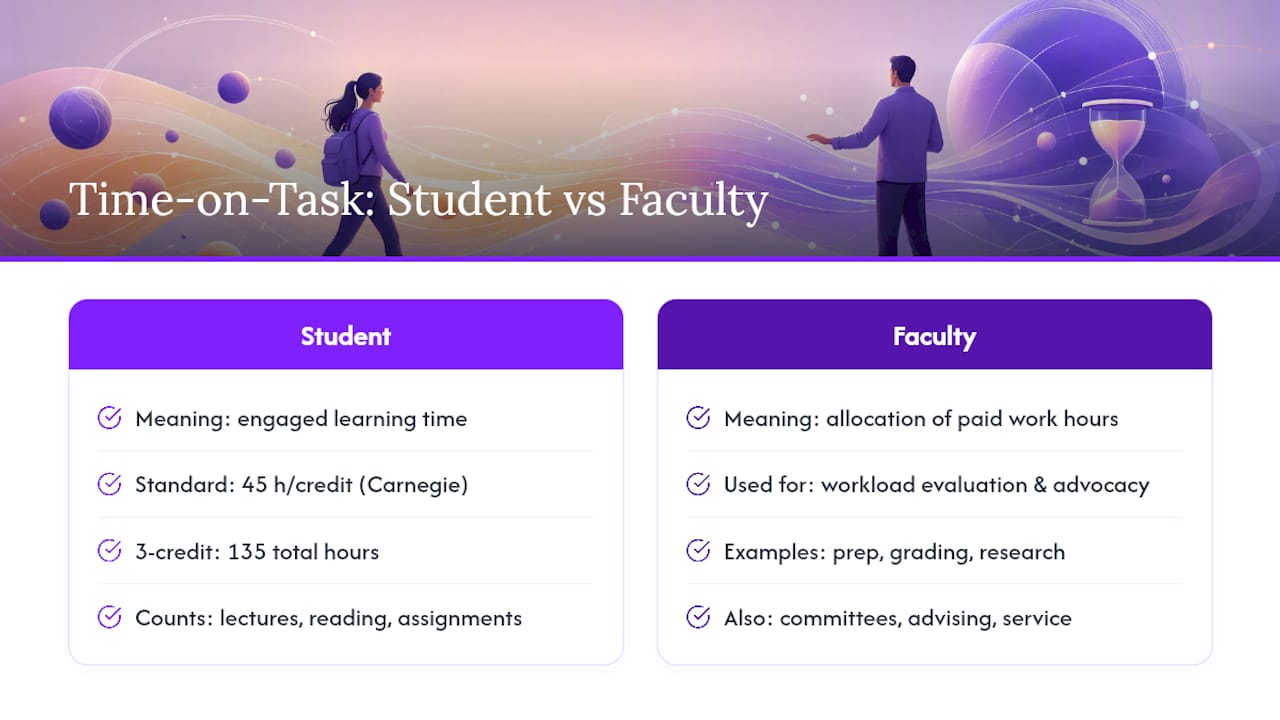
On the student side, time-on-task means total engaged learning time, and RIT’s Center for Teaching and Learning applies the Carnegie Unit standard: 45 hours of learning time per semester credit hour. A 3-credit course should demand a proportional total amount of engaged hours from a student across the term, counting lectures, reading, assignments, and exam prep, but excluding time spent finding a quiet place to study.
On the faculty side, time-on-task describes something else entirely: how you actually allocate your paid professional hours across teaching prep, grading, original research, committee work, advising, and service obligations. This is the definition that matters when you’re evaluating your own workload or advocating for a course release.
Where the two overlap: both rely on structured time accounting rather than guesswork. Where they diverge: student time-on-task is a compliance benchmark tied to credit hours, while faculty time-on-task is discretionary and highly variable by role, rank, and discipline. A biology professor running a wet lab logs time differently than a historian working from archives, and no single number captures both fairly.
How Do Researchers Measure Faculty Time Allocation?
Five methods dominate faculty time-use research, and each trades accuracy for convenience differently.
Web-based time diaries ask faculty to log activities in real time or shortly after, typically in short blocks across one or two weeks. Cross-sectional surveys ask faculty to estimate a “typical week” retrospectively, usually once a year. Activity logs sit somewhere between the two: structured categories, but filled in daily rather than annually. Direct observation involves a researcher or instrument tracking behavior in real time, mostly used for classroom engagement rather than full workload studies. Institutional administrative data pulls from course loads, grant records, and committee assignments already on file.
| Method | Strength | Weakness |
|---|---|---|
| Web-based time diary | Captures daily detail, low recall bias | Requires sustained participation |
| Annual survey | Fast to administer, low cost | Heavy recall bias, misses hidden work |
| Activity log | Structured, moderate accuracy | Faculty burden if kept too long |
| Direct observation | Objective, high resolution | Expensive, limited to classroom settings |
| Administrative data | No extra faculty effort | Misses informal work like mentoring |
A faculty time-use study brief from the University of Central Arkansas found that web-based diaries produce richer, less-biased pictures of daily work than the annual survey format most institutions default to. Annual surveys tend to underrepresent mentoring, informal advising, and course redesign because faculty simply forget these activities happened when asked to recall a “typical week” months later.

Discipline variation matters too. Lab scientists, clinical faculty, and humanities scholars distribute hours so differently that pooling them into one institutional average tends to obscure more than it reveals.
How Do You Calculate Time-on-Task? Worked Examples
The Carnegie Unit math is straightforward once you see it applied. A 3-credit course requires a standard amount of hours per credit, so total expected student learning time comes to a proportional total across a 15-week term, or about 9 hours per week split between class time, reading, and assignments.
Faculty time allocation does not follow a fixed formula, but two contrasting semesters show how the numbers shift:
- Teaching-heavy semester: A faculty member teaching three sections might log 20 hours weekly on prep and grading, 9 hours in class, 5 hours advising, and only 6 hours on research, a ratio that looks reasonable on paper but leaves almost no room for grant writing.
- Research-intensive semester: The same faculty member on course release might flip that ratio, logging 25 hours on data collection and writing, 8 hours teaching one section, and 7 hours on service commitments.
To model your own course load before the semester starts, check Wake Forest’s workload estimator or LSU’s calculator referenced above. Both tools convert assignment types into estimated student hours, which helps you sanity-check syllabus workload against the Carnegie standard.
Why Faculty Time-on-Task Data Shapes Careers and Policy
This isn’t an academic exercise. Time-on-task findings feed directly into decisions that affect your paycheck, your tenure file, and your department’s staffing.
- Workload models increasingly use time-use data to set teaching load equivalencies rather than relying on flat course counts
- Tenure and promotion committees reference typical time allocations when evaluating whether a candidate’s research output matches available research time
- Compensation structures at some institutions now factor in documented service and advising burden that used to go unrecognized
Case Western Reserve University’s teaching center treats structured time assessment as the foundational step for correcting excessive administrative burden, arguing that institutions can’t fix what they haven’t measured. That logic cuts both ways: faculty who track their own time gain leverage to request a committee reassignment or negotiate a course release, backed by data instead of a general sense of being overloaded.
The stakes go beyond individual careers. When aggregated across a department, time studies reveal whether certain roles, often held by junior faculty or women, absorb disproportionate service and advising loads relative to what tenure criteria actually reward.
What Should Faculty Do to Track and Manage Their Time?
Getting a reliable picture of your own time doesn’t require months of tracking. A short, well-designed diary beats a vague annual guess every time.
- Pick a tracking method you’ll actually sustain, a spreadsheet, a phone app, or a paper log, for one to two weeks
- Define four to six categories upfront: teaching prep, direct instruction, research, service, advising, and administrative tasks
- Log activities in real time or within a few hours, not at the end of the day, to avoid the recall bias annual surveys suffer from
- Review the results for low-value tasks: recurring email threads, redundant meetings, or manual data entry that could be delegated or automated
- Reallocate: block two or three uninterrupted hours for deep research work each week, and treat that block as non-negotiable
Integration matters more than most faculty assume. Research-led teaching, where a course assignment doubles as a literature review or a data-collection exercise, cuts the perceived time cost of running both duties separately.
Pro Tip: Batch your literature review screening into one sitting instead of spreading it across a week. Context-switching between reading papers and teaching prep costs more time than the reading itself.
Institutional Calculators and Resources Faculty Can Use Now
Several institutions have already built the tools, so there’s no reason to estimate workload from scratch.
- RIT’s Center for Teaching and Learning lays out which student activities count toward time-on-task and which don’t, useful for syllabus design
- LSU’s time-on-task calculator converts assignment types into estimated student hours
- Wake Forest’s workload estimator offers a similar model with slightly different assumptions about reading speed and assignment complexity
- ACPHS’s Center for Innovative Learning hosts webinars and slide decks specifically for faculty development around time-on-task concepts
For the research side of your workload, a structured research database built from the start saves the re-reading and re-categorizing that eats into research hours later.
Using Time Data to Support Faculty, Not Just Audit Them
I’ve seen time-use data misused as a surveillance tool, and that framing backfires immediately. Used well, it becomes a development conversation: showing a department chair that a junior faculty member’s research hours have collapsed under advising load justifies a real course release, not a lecture about time management. Present the numbers, not accusations. And always tell faculty upfront if their time data will be aggregated or shared, because trust evaporates fast once it feels like tracking without consent.
Cut Research Time Without Cutting Corners on Your Review
Systematic literature reviews eat more faculty hours than almost any other research task, and most of that time goes to manual abstract screening and copying data into spreadsheets. Papersynapse reduces that bottleneck directly: it imports your reference list from Scopus or Web of Science, uses AI to read abstracts and populate structured extraction tables, and can process up to 200 papers in under two minutes.
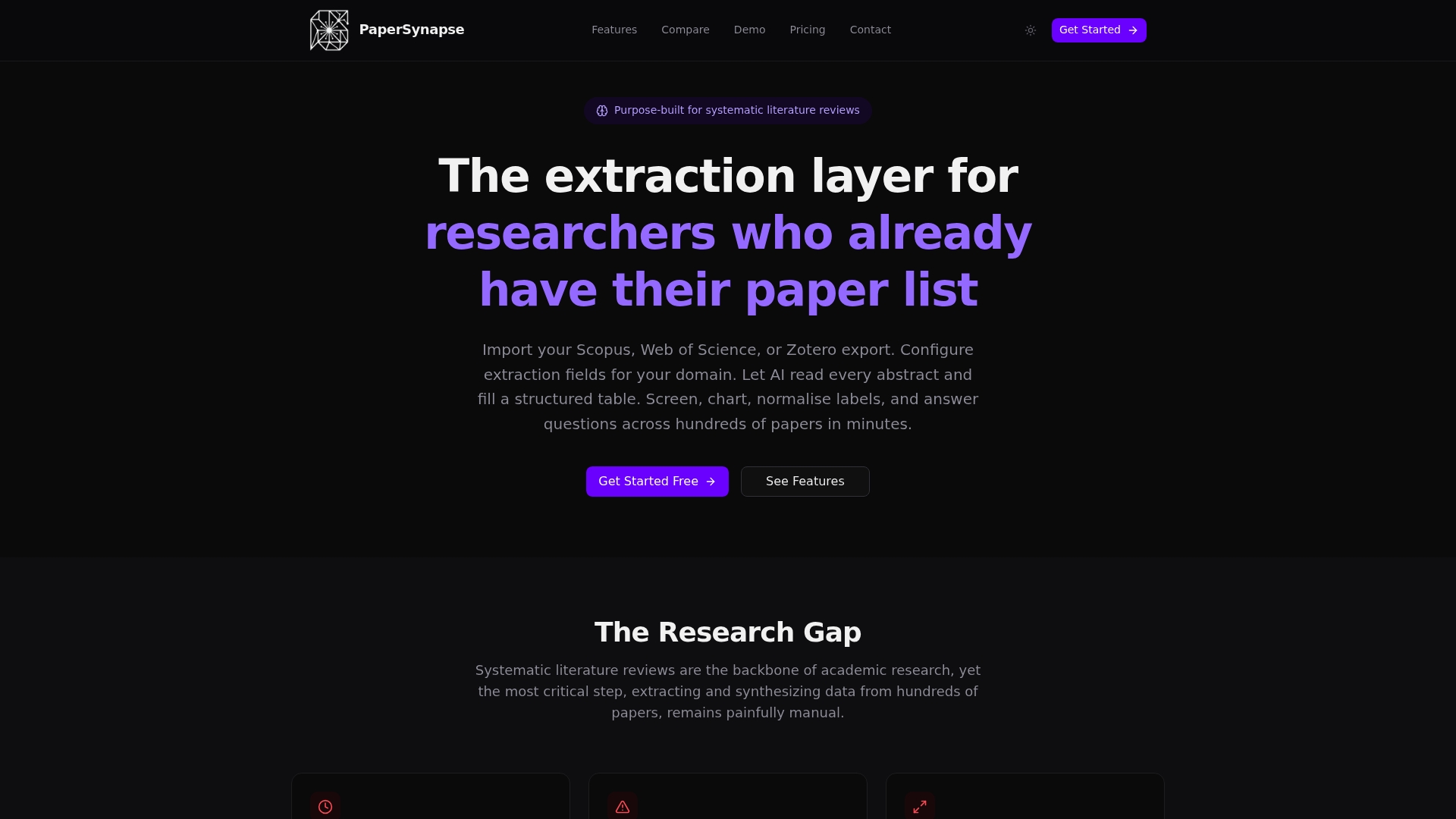
The workflow covers screening, extraction, and normalization in one platform, so you’re not juggling a spreadsheet, a citation manager, and a separate coding scheme. It also supports PRISMA-compliant screening steps, which matters if your review is headed toward publication. If literature review work is one of the low-value time drains your own diary just revealed, start a review on Papersynapse and see how many hours of screening it takes off your plate this month.
Frequently Asked Questions
What is time-on-task research faculty use to measure workload? It refers to studies and tools tracking how faculty allocate professional hours across teaching, research, and service, typically through time diaries, surveys, or institutional data rather than a single named method.
How is time-on-task different for students versus faculty? Student time-on-task follows the Carnegie Unit standard of 45 hours per credit hour, a compliance benchmark. Faculty time-on-task measures discretionary professional hours and varies widely by discipline and rank.
Which tool should I use to estimate course workload? LSU’s calculator and Wake Forest’s estimator both convert assignment types into estimated student hours, useful when designing a syllabus that respects credit-hour limits.
Does more time-on-task always mean better learning outcomes? No. A peer-reviewed review found the relationship between time-on-task and learning is positive but inconsistent, largely because studies measure engaged time differently.
How can faculty reduce research time-on-task without cutting corners? Automating repetitive tasks like abstract screening and data extraction, through tools like Papersynapse, reclaims hours otherwise spent on manual literature review work.
Sources
- Time on Task in Online Courses | Center for Teaching and Learning | RIT
- Faculty time-use study brief (UCA)
- Time-on-Task Calculator - Faculty Resources & Support - LSU