Why AI Reads Abstracts Faster: A Researcher's Guide
Why AI Reads Abstracts Faster: A Researcher’s Guide
AI reads academic abstracts faster because it processes standardized bibliographic data and machine learning models optimized for extraction, not comprehension. For PhD candidates and researchers running systematic literature reviews, this speed difference is not a minor convenience. AI assistants reduce screening time from 30–60 minutes per paper to about 2 minutes, compressing a week-long 30-paper search into a single workday. Understanding why AI reads abstracts faster, and where that speed breaks down, is the difference between a rigorous review and a fast but flawed one.
Why AI reads abstracts faster: the core mechanisms
AI processes abstracts faster than humans because it targets the bibliographic layer, not the full argument. Titles, abstracts, keywords, and citation metadata are all structured for machine parsing. AI does not need to understand a paper. It needs to classify it.
Three technical approaches drive AI abstract reading speed. Machine learning keyword re-ranking, citation-graph discovery, and large language model (LLM) summarization each serve a different function. Citation-graph tools identify influential papers faster than any manual search. LLM summarization is the fastest of the three but also the least reliable, carrying a real risk of plausible hallucinations.

Abstract structure also plays a direct role. AI-generated and well-formatted human abstracts follow rigid rhetorical patterns: background, objective, method, results, conclusion. That uniformity is exactly what AI parsing models are built to exploit. When every abstract follows the same template, the AI does not need to interpret. It matches patterns against a trained schema and extracts at scale.
Frameworks like IBM’s Watsonx.ai take this further by extracting and structuring data programmatically into standardized JSON outputs. That allows trend visualization across thousands of abstracts, a task that is simply beyond manual capacity.
Pro Tip: When setting up an AI-assisted triage, prioritize tools that output structured data (JSON or table format) rather than free-text summaries. Structured output is far easier to audit and cross-reference.
How does AI abstract processing differ from human reading?
Human reading is not just slower. It is a fundamentally different cognitive process. Researchers engage in contextual, critical reading. They notice when a method section contradicts the abstract’s claims. They catch when a sample size is too small to support the conclusion. AI does none of that by default.
The differences break down into four concrete areas:
- Processing mode. AI processes entire datasets simultaneously. A human reads one paper at a time, sequentially. For a 200-paper corpus, that sequential constraint is the single biggest time cost.
- Pattern recognition vs. interpretation. AI matches text against trained patterns. Humans interpret meaning, weigh evidence, and apply domain knowledge. These are not equivalent tasks.
- Metadata reliance. AI speed depends on structured bibliographic layers. When metadata is incomplete or inconsistent, AI accuracy drops sharply. Humans can compensate by reading context.
- Nuance detection. Abstract compression routinely omits study limitations, subgroup analyses, and effect size qualifications. AI reads what is there. Humans know to look for what is missing.
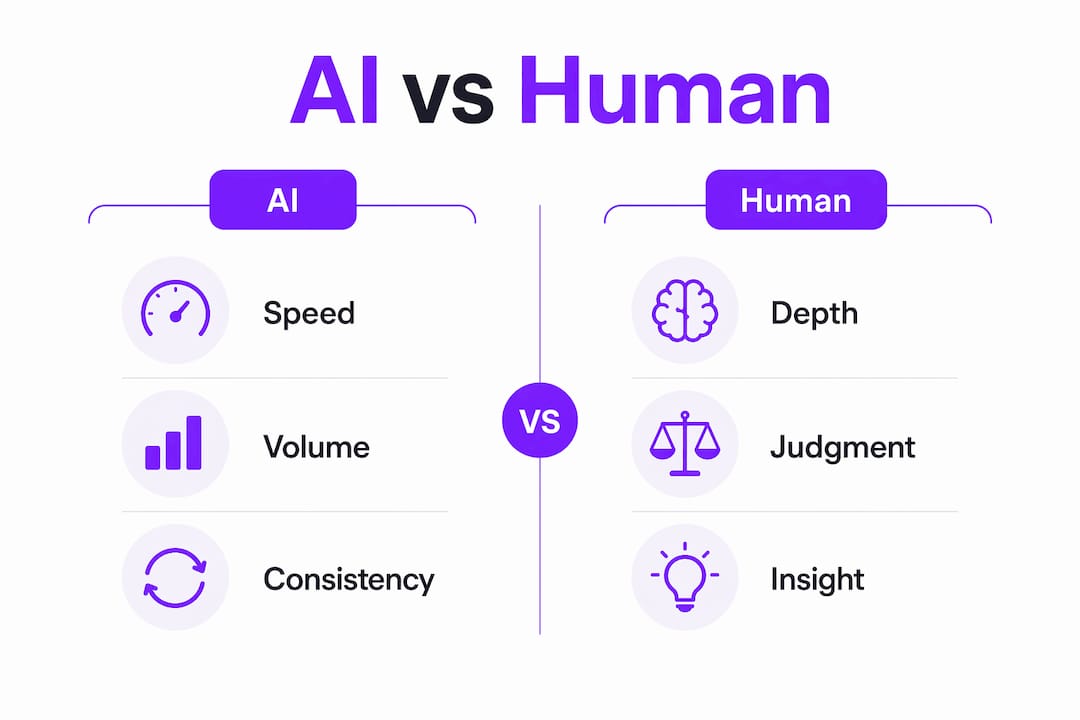
The practical implication is clear. AI wins on volume and speed. Humans win on depth and judgment. A literature review that relies on only one of these will be either too slow or too shallow.
What are the practical benefits and limitations of AI’s faster abstract reading?
The primary benefit of AI abstract reading speed is triage. Researchers can screen a large corpus quickly, identify the papers worth deep reading, and discard the rest with confidence. Using a three-pass workflow, only 1 in 4 papers typically advances past the triage stage. That ratio alone cuts reading time by 75% before a researcher opens a single PDF.
The benefits extend to consistency. Human screeners get tired, apply criteria inconsistently, and miss papers late in a long session. AI applies the same criteria to paper 1 and paper 200 with identical attention. For systematic reviews governed by PRISMA or Cochrane protocols, that consistency has real methodological value.
The limitations are equally real. The most documented risk is what practitioners call the authority trap. AI summaries are confident in tone, even when they are wrong. Researchers who treat AI outputs as final verdicts risk misinterpreting evidence without realizing it. An AI summary that says “the study found a significant positive effect” may omit that the effect disappeared after controlling for confounders.
A second limitation is coverage. AI reads what abstracts contain. Abstracts routinely omit limitations, adverse findings, and methodological caveats. A paper that looks promising at the abstract level may be fatally flawed at the methods level. AI cannot flag what it cannot see.
Pro Tip: Always spot-check AI-reported numbers against the original PDF. Test the AI by asking it to identify the weakest claim in the paper. If it cannot, treat its summary with extra skepticism.
The literature review automation benefits for researchers are real, but they require a structured workflow to capture without introducing new errors.
How to integrate AI abstract reading speed into your research workflow
The three-pass system is the most effective workflow for combining AI speed with scholarly rigor. Each pass serves a distinct purpose, and skipping any one of them creates risk.
- Pass 1: AI triage. Feed your full corpus into an AI tool. Use keyword re-ranking or LLM summarization to flag papers as include, exclude, or uncertain. This pass should take minutes, not hours. Set strict inclusion criteria before you start so the AI has clear rules to apply.
- Pass 2: Structured summary reading. For papers that pass triage, use AI to generate structured summaries covering objective, method, key finding, and limitation. Read these summaries critically. Flag any paper where the limitation field is empty or vague.
- Pass 3: Manual deep reading. Read the full text of every paper that survives pass 2. This is where human judgment is irreplaceable. Check methods sections, sample sizes, statistical approaches, and conflict-of-interest disclosures.
For verification, retrieval-augmented generation (RAG) tools offer a meaningful advantage. NotebookLM and similar RAG tools restrict AI responses to uploaded source documents and link every claim to an exact sentence in the PDF. That approach reduces hallucination risk significantly compared to general-purpose chatbots.
Researchers working on literature review protocols should document which AI tool handled which pass, what prompts were used, and how many papers were excluded at each stage. That documentation is now expected in methods sections for systematic reviews.
One more rule: never trust AI with numerical data without verification. Effect sizes, p-values, confidence intervals, and sample sizes are exactly the figures that AI most often misreports. Spot-check every number that appears in your final extraction table against the original source.
The role of AI in literature synthesis is to accelerate discovery, not to replace the critical evaluation that defines rigorous scholarship.
Key Takeaways
AI reads abstracts faster by exploiting structured metadata and standardized rhetorical patterns, but speed without verification introduces errors that undermine scholarly rigor.
| Point | Details |
|---|---|
| AI triage cuts screening time | AI reduces abstract screening from 30–60 minutes per paper to about 2 minutes. |
| Structured formats enable speed | Formulaic abstract structures let AI parse and classify without interpreting meaning. |
| Only 1 in 4 papers advances | A three-pass workflow filters most papers at triage, saving deep-read time for relevant studies. |
| Authority trap is a real risk | AI summaries sound confident even when incomplete; always verify key findings against full texts. |
| RAG tools reduce hallucination | Retrieval-augmented generation tools like NotebookLM link AI claims to exact source sentences. |
The speed advantage is real, but it is not the whole story
I have watched researchers treat AI abstract screening as a solved problem, and I understand the appeal. When a tool processes 200 papers in under two minutes, it feels like the hard work is done. It is not.
The speed gain is genuine and significant. What AI does well, it does consistently and at a scale no human team can match. For a PhD candidate managing a 500-paper corpus alone, AI triage is not a luxury. It is the only realistic path to a defensible systematic review.
But the researchers I respect most treat AI outputs as a first draft of their thinking, not a conclusion. They use AI to find the papers worth reading, then they actually read them. They check the methods. They look for what the abstract did not say. That combination, AI speed plus human judgment, produces better reviews than either approach alone.
The risk I see most often is not that researchers trust AI too much on obvious errors. It is that they trust it on subtle ones. An AI summary that misses a key confounder or misreports a confidence interval looks exactly like a correct summary. The only protection is the habit of verification, applied consistently, not just when something feels wrong.
AI will keep improving. The hallucination rates will drop. The coverage of nuanced methodological detail will expand. But the discipline of critical reading is not something AI will replace. It is something researchers need to protect, precisely because AI makes it so easy to skip.
— Ubada
How Papersynapse fits into a faster, more rigorous review
Researchers who want the speed benefits of AI abstract reading without building a custom workflow from scratch have a direct option.
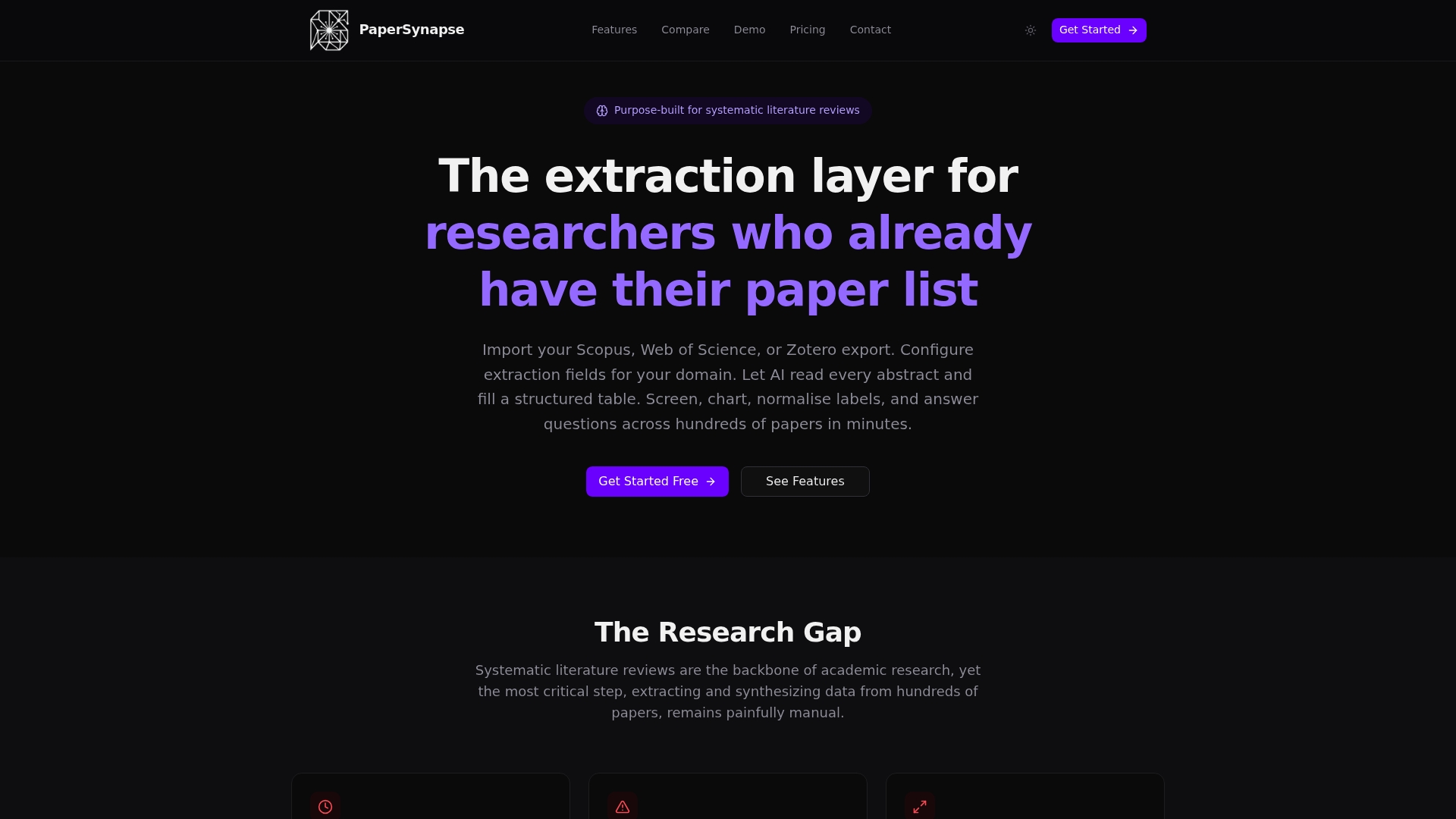
Papersynapse is built specifically for systematic literature reviews. Researchers import references directly from Scopus or Web of Science, and the platform uses AI to read abstracts and populate structured extraction tables automatically. That covers the triage and structured summary passes in one integrated step. Papersynapse processes up to 200 papers in under two minutes, and the output feeds directly into analysis and visualization tools within the same platform. For PhD candidates and research teams who need speed and consistency without sacrificing structure, Papersynapse is worth a close look.
FAQ
Why does AI read abstracts so much faster than humans?
AI processes structured bibliographic data, including titles, keywords, and abstracts, using pattern-matching models that do not require comprehension. That approach reduces screening time from 30–60 minutes per paper to about 2 minutes.
Can AI miss important details when reading abstracts?
Yes. Abstracts routinely omit study limitations, subgroup analyses, and methodological caveats. AI reads only what the abstract contains, so critical details buried in the methods section will not appear in an AI summary.
What is the authority trap in AI-assisted research?
The authority trap occurs when researchers accept confident AI summaries without verifying them against full texts. AI summaries can misreport findings or omit key qualifications while sounding entirely credible.
What is the three-pass method for AI-assisted literature review?
The three-pass method uses AI for initial triage, then structured summary reading, then manual deep reading of full texts. This workflow balances AI speed with the critical judgment that systematic reviews require.
Does AI abstract reading work for all research fields?
AI performs best in fields where abstracts follow strict, standardized formats, such as biomedical and clinical research. In humanities and social sciences, where abstract structure is more variable, AI parsing accuracy is lower and human review plays a larger role.