Why Peer-Reviewed Extraction Matters for Researchers
Why Peer-Reviewed Extraction Matters for Researchers

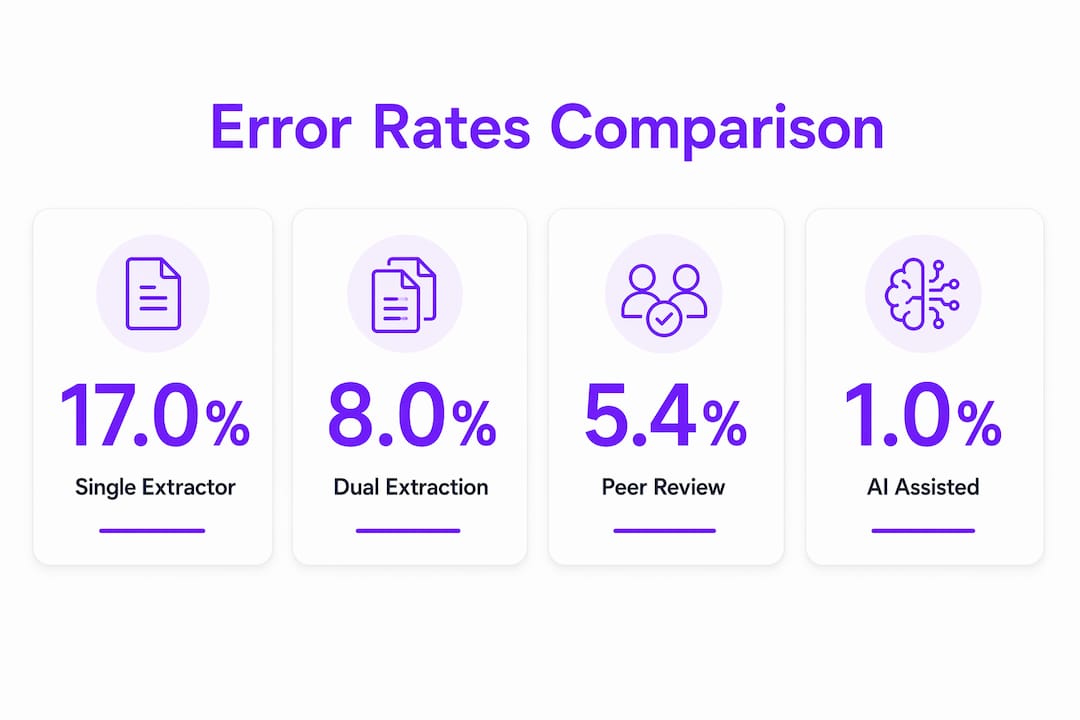
Peer-reviewed extraction is defined as the process of having independent experts verify and validate data pulled from academic studies to confirm accuracy, reduce errors, and uphold research integrity. Understanding why peer-reviewed extraction matters is not optional for researchers conducting systematic reviews. Manual extraction error rates reach 17.0% at the study level, 66.8% at the meta-analysis level, and 85.1% at the systematic review level. Those numbers mean that without peer verification, the conclusions of most large-scale evidence syntheses rest on shaky ground. Springer Nature identifies peer review as the mechanism that sustains academic integrity in 2026, especially as generative AI floods research pipelines with unverified output.
Why peer-reviewed extraction matters: error rates and what they cost you
Manual data extraction fails at a predictable and measurable rate. Study-level error rates average 17.0% for single-investigator workflows, and that figure compounds dramatically as reviews scale. At the systematic review level, errors appear in more than 8 out of 10 reviews. That is not a rounding problem. It is a structural flaw in how single-investigator extraction works.
The most common error sources are missing data, misinterpretation of outcome definitions, and inconsistent table structures. A reviewer might record a mean difference where a median was reported, or omit a subgroup entirely because the original table was formatted ambiguously. These are not careless mistakes. They reflect the genuine difficulty of translating complex study designs into standardized extraction fields.

Dual-independent extraction addresses this directly. Two reviewers extract data separately, then compare and adjudicate disagreements. Dual extraction takes approximately 172 minutes per study versus 107 minutes for single-investigator extraction with verification. The extra time is the cost of catching errors before they propagate into pooled estimates and policy recommendations.
Pro Tip: Build a disagreement log into your extraction protocol. Recording every adjudicated conflict, and the reasoning behind the final decision, creates an audit trail that strengthens reproducibility and helps train future reviewers.
The table below shows how error rates shift across extraction approaches and review stages.
| Extraction approach | Study-level error rate | Meta-analysis error rate | Systematic review error rate |
|---|---|---|---|
| Single investigator | High (17.0% avg.) | Very high (66.8% avg.) | Critical (85.1% avg.) |
| Dual independent | Substantially reduced | Substantially reduced | Substantially reduced |
| Hybrid AI + human review | Reduced with oversight | Reduced with oversight | Reduced with oversight |
How does AI change extraction accuracy, and what are its limits?
Large language models have entered systematic review workflows faster than the research community has validated them. The appeal is obvious: AI can process hundreds of abstracts in minutes. The risk is equally obvious once you look at the error data.
High-performing LLMs still err in 1 in 5 outcome cells during extraction tasks. That error rate is lower than single-investigator manual extraction in some scenarios, but it is not low enough for clinical-grade or policy-relevant systematic reviews. The errors cluster around complex tables and semi-structured data, exactly the places where precision matters most.
The “black box” problem compounds this. Unverified automated extraction creates a situation where extracted data cannot be traced back to the original source material. Without that direct linkage, auditing errors after the fact becomes nearly impossible. Hallucination, where an AI generates plausible but fabricated data points, is a real and documented risk in this context.
AI tools also require far more maintenance than researchers expect. Prompt engineering for AI extraction is not a one-time setup. It demands iterative refinement and metadata schema customization to approach human accuracy. Some AI configurations achieve a 0% reasoning match against human benchmarks on their first deployment.
The practical implication is clear:
- AI performs well on high-volume, low-ambiguity extraction tasks such as pulling publication years, sample sizes, and study designs.
- AI struggles with outcome definitions, subgroup data, and any field requiring contextual judgment.
- Human reviewers must adjudicate every ambiguous or critical data point that AI flags or misses.
- Replicability across AI algorithm versions is a major unsolved challenge without human oversight built into the workflow.
Pro Tip: Treat AI extraction output as a first draft, not a final product. Assign a human reviewer to audit every field where the AI confidence score is below your pre-specified threshold before the data enters your synthesis.
What ethical responsibilities do peer reviewers carry?
Peer review is not just a quality control mechanism. It is a professional obligation with documented ethical dimensions. Peer reviewers bear obligations of impartiality, confidentiality, conflict of interest disclosure, and constructive feedback free from personal or institutional bias. These are not aspirational standards. They are the conditions under which peer review actually works.
The stakes are high. Reviewers’ decisions influence academic careers, clinical guidelines, and public health policy. A biased or careless review of an extraction protocol can allow flawed data to enter a meta-analysis that shapes treatment recommendations for thousands of patients.
Ethical responsibilities in peer-reviewed extraction include:
- Disclosing any financial, professional, or personal relationship with the authors or the research topic before accepting a review assignment.
- Maintaining strict confidentiality about unpublished data encountered during the review process.
- Resisting “publish-or-perish” pressures that might push reviewers toward approving work that does not meet extraction quality standards.
- Providing specific, constructive feedback rather than vague criticism that authors cannot act on.
Reviewer burnout is a real structural problem. Institutional recognition and formal training are the two most effective interventions for sustaining peer review quality as submission volumes grow. Journals and research institutions that treat reviewing as invisible service work accelerate burnout and degrade the quality of the reviews they receive.
Transparency models also matter. Open peer review, where reviewer identities are disclosed, reduces the risk of retaliatory or biased feedback. Anonymous review protects junior reviewers from professional pressure but can reduce accountability. Neither model is universally superior. The choice should match the norms and power dynamics of the specific research community.
Best practices for building peer-reviewed extraction into your workflow
A reliable peer-reviewed extraction workflow has four non-negotiable components: structured protocols, dual extraction, adjudication procedures, and auditability. Skipping any one of these creates a gap that errors will fill.
Structured protocols and dual extraction
Every extraction field must be defined before data collection begins. Ambiguous fields produce inconsistent data even when two reviewers are working from the same study. Write operational definitions for every variable, including how to handle missing data, and pilot the form on a sample of studies before full deployment. Data consistency in research depends on this upfront investment in protocol clarity.
Dual independent extraction means each reviewer completes the form without seeing the other’s responses. Comparing responses after the fact, rather than collaborating in real time, is what makes disagreements visible and meaningful. Disagreement rates above 10% on any single field signal a protocol definition problem, not just reviewer error.
Adjudication and auditability
Every disagreement needs a resolution process. The standard approach is a third reviewer who adjudicates without knowing which response came from which reviewer. Document every adjudicated decision in a conflict log. Linking extracted data directly to the original source passage is the only way to make that log auditable after the fact.
Structured tables are the backbone of auditability. Well-structured research tables make it possible to trace any extracted value back to its source, compare extraction decisions across reviewers, and identify systematic patterns in disagreements. Unstructured or free-text extraction fields make all of this much harder.
Pro Tip: Use a pre-registered extraction protocol on a platform like OSF (Open Science Framework) before you begin. Pre-registration timestamps your methods and prevents post-hoc changes that could introduce bias.
Integrating AI without losing oversight
AI works best as a first-pass tool that flags studies, pre-populates low-ambiguity fields, and identifies potential gaps for human reviewers to investigate. The most reliable systematic reviews use a hybrid human-in-the-loop approach: AI handles preliminary extraction, and humans adjudicate critical or ambiguous data. This combination captures the speed benefit of automation without sacrificing the accuracy that peer review provides.
Train every reviewer on the specific extraction form, the operational definitions, and the adjudication process before data collection begins. Reviewer training is not a one-time event. It should include calibration exercises on sample studies and periodic recalibration checks during long reviews.
Key Takeaways
Peer-reviewed extraction is the single most effective method for catching and correcting data errors before they compromise systematic review conclusions.
| Point | Details |
|---|---|
| Error rates are severe without peer review | Manual single-investigator extraction produces errors in up to 85.1% of systematic reviews. |
| AI is a tool, not a replacement | LLMs err in 1 in 5 outcome cells and require human adjudication for critical data fields. |
| Ethical obligations are binding | Reviewers must disclose conflicts, maintain confidentiality, and resist publication pressure. |
| Dual extraction is the minimum standard | Two independent reviewers plus a formal adjudication process substantially reduce error rates. |
| Auditability requires direct source linkage | Every extracted value must trace back to its original source passage to support reproducibility. |
The uncomfortable truth about automation and peer review
I have watched the research community treat AI extraction tools as a shortcut to the same rigor that peer review provides. It is not. The error data makes this clear, and I think researchers underestimate how much the “black box” problem will matter when their work faces scrutiny.
The volume of published research is growing faster than the reviewer pool can absorb. That pressure is real, and I understand why teams reach for automation. But the answer to reviewer scarcity is not to remove human oversight. It is to use AI to reduce the volume of low-stakes decisions that humans need to make, so that human attention concentrates where it counts most: ambiguous data, complex tables, and high-stakes outcome fields.
The ethical dimension is also underappreciated. Peer review is not just a technical process. It is a community commitment. When institutions treat reviewing as invisible labor, they erode the foundation that makes published research trustworthy. Formal recognition, training, and workload management are not nice-to-haves. They are the conditions under which peer review remains functional at scale.
My honest recommendation: adopt a hybrid workflow now, before the pressure to publish forces you into a fully automated process that your field’s standards cannot yet support. The benefits of literature review automation are real, but they only hold when human peer verification stays in the loop.
— Ubada
Papersynapse and peer-reviewed extraction workflows
Researchers who need to manage large-scale extraction without sacrificing verification quality have a practical option in Papersynapse.

Papersynapse imports references directly from Scopus or Web of Science, uses AI to read abstracts and pre-populate structured extraction tables, and processes up to 200 papers in under two minutes. That speed handles the volume problem. The platform’s structured table format keeps every extracted value traceable, which is the foundation of any auditable peer-reviewed workflow. Human reviewers work from pre-populated fields rather than blank forms, which reduces low-stakes cognitive load and lets them focus on adjudication and verification. For teams building or refining a systematic review workflow, Papersynapse integrates extraction, normalization, and analysis in one place without removing the human oversight that peer-reviewed extraction requires.
FAQ
What is peer-reviewed extraction in systematic reviews?
Peer-reviewed extraction is the process of having two or more independent reviewers extract data from studies separately, then compare and adjudicate disagreements. It is the standard method for reducing errors and bias in systematic reviews and meta-analyses.
How common are errors in manual data extraction?
Manual extraction errors reach 17.0% at the study level and 85.1% at the systematic review level. Dual independent extraction substantially reduces these rates by making disagreements visible before data enters synthesis.
Can AI replace human peer reviewers in data extraction?
AI cannot replace human peer reviewers. High-performing LLMs err in 1 in 5 outcome cells and struggle with complex tables, making human adjudication of critical fields non-negotiable for research-grade extraction.
What are the ethical obligations of a peer reviewer?
Peer reviewers must maintain impartiality, disclose conflicts of interest, protect the confidentiality of unpublished data, and provide constructive feedback. These ethical obligations exist because reviewer decisions directly influence academic careers, clinical guidelines, and public policy.
What is the best workflow for peer-reviewed extraction?
The most reliable approach combines AI for preliminary extraction with dual independent human review and a formal adjudication process. Hybrid human-in-the-loop workflows balance speed and accuracy better than either fully manual or fully automated extraction alone.